
If you are planning to buy a solar or inverter battery in Nigeria, you may come across two popular lead-acid options:
GEL battery
and
Tubular battery
Both can be used for solar and inverter backup, but they work differently and have different advantages.
So which one is better?
For most buyers, the choice depends on how you use the battery.
If you want a sealed, low-maintenance battery and your system is designed correctly, GEL can be a good choice.
If you want a traditional deep-cycle battery that can handle regular cycling and you don’t mind maintenance, a good tubular battery can also be a strong option.
Let’s compare them properly.
GEL vs Tubular Battery at a Glance
| Feature | GEL Battery | Tubular Battery |
|---|---|---|
| Battery type | Sealed lead-acid | Flooded lead-acid |
| Electrolyte | Gel | Liquid electrolyte |
| Water topping | No | Yes |
| Maintenance | Very low | Requires maintenance |
| Ventilation | Still needs proper installation | Important |
| Deep-cycle use | Good | Very good |
| Charging speed | Usually slower | Generally faster |
| Overcharging tolerance | Lower | Generally more forgiving |
| Heat | Can be affected by high heat | Can handle demanding conditions but heat still shortens life |
| Installation | Easier in some locations | Needs suitable ventilated location |
| Initial price | Varies | Varies |
| Best for | Low-maintenance backup | Regular deep-cycle use |
| Main weakness | Sensitive to incorrect charging | Needs maintenance and ventilation |
The exact performance depends on the battery brand, model, capacity, charging settings, temperature and how deeply the battery is discharged.
What Is a GEL Battery?
A GEL battery is a type of sealed lead-acid battery.
Instead of using a free-flowing liquid electrolyte like a traditional flooded battery, the electrolyte is held in a gel-like form.
This makes the battery sealed and reduces the need for regular water topping.
GEL batteries are commonly used for:
- Solar systems
- Inverter backup
- CCTV systems
- Telecom equipment
- Emergency backup
- Small and medium power systems
One of their biggest advantages is convenience.
You don’t normally need to open the battery and add distilled water as you would with a traditional flooded tubular battery.
You can see the GEL battery options currently listed in our Solar Battery Prices in Nigeria database.
What Is a Tubular Battery?
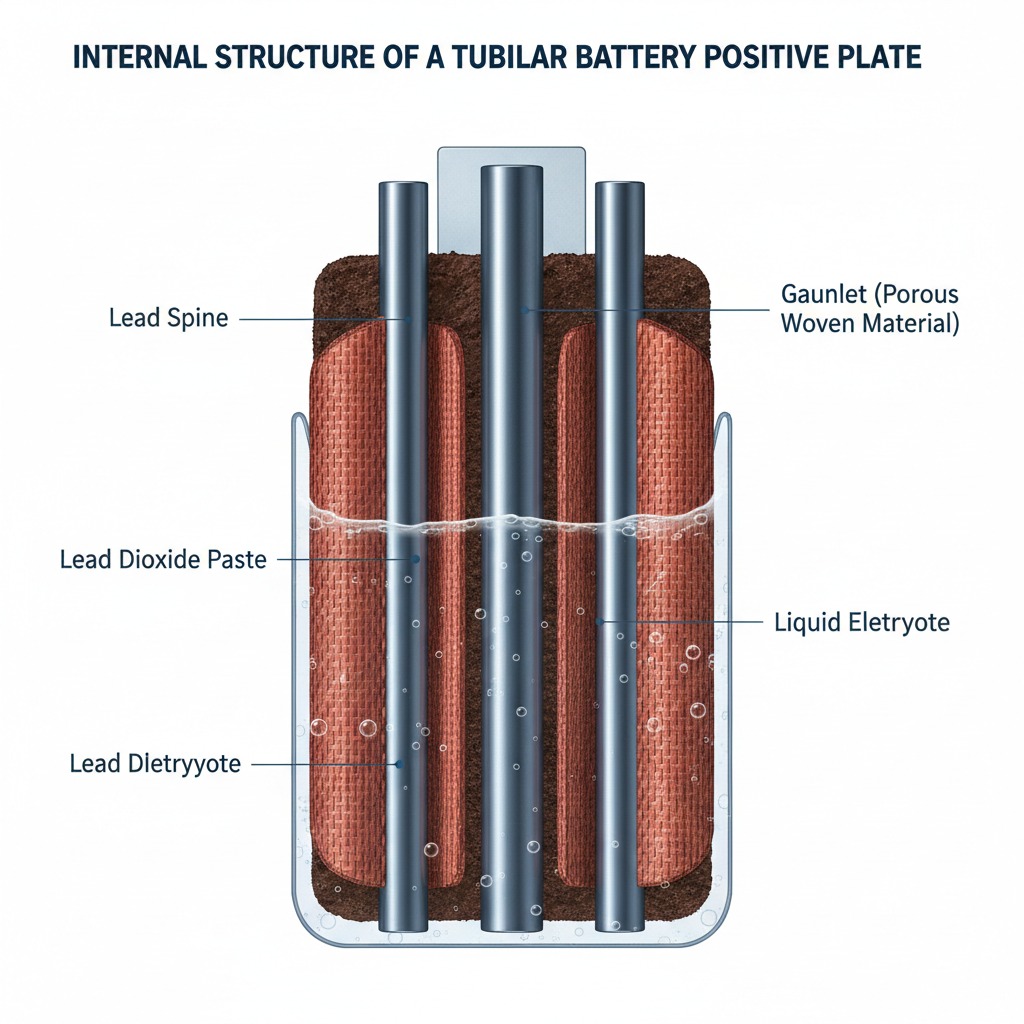
A tubular battery is a type of lead-acid battery that uses tubular positive plates.
Unlike a sealed GEL battery, traditional tubular batteries normally contain liquid electrolyte.
They are popular for inverter and solar applications because they are designed for repeated charging and discharging.
Tubular batteries are available in sizes such as:
- 100Ah
- 150Ah
- 180Ah
- 200Ah
- 220Ah
- 250Ah
- 300Ah and more
The exact sizes available depend on the manufacturer.
Our Solar Battery Prices in Nigeria page currently includes many tubular battery models and capacities.
What Is the Biggest Difference Between GEL and Tubular?
The biggest difference is their construction.
GEL
The electrolyte is held in a gel.
Tubular
The battery uses liquid electrolyte around tubular plates.
This difference affects:
- Maintenance
- Charging
- Installation
- Deep cycling
- Heat behaviour
- Overcharging
- Expected lifespan
So you should not choose between them simply because one has a higher Ah rating.
Which One Lasts Longer?
There is no single number that applies to every battery.
A quality tubular battery can last for several years when properly maintained.
A quality GEL battery can also last for several years when used and charged correctly.
The actual lifespan depends heavily on:
- Depth of discharge
- Number of cycles
- Charging voltage
- Charging current
- Temperature
- Battery quality
- Maintenance
- How often the battery is used
For example, repeatedly draining a lead-acid battery very deeply can shorten its life significantly.
This is why battery capacity alone is not enough.
Which One Handles Deep Discharge Better?
Tubular batteries generally have an advantage for repeated deep-cycle use.
They are designed for applications where the battery is repeatedly charged and discharged.
However, this does not mean you should regularly drain a tubular battery completely.
Deep discharge still puts stress on lead-acid batteries.
A battery that is only partially discharged and properly recharged will generally have a better chance of lasting longer than one that is repeatedly taken very low.
Can GEL Batteries Handle Deep Cycling?
Yes.
GEL batteries are also designed for deep-cycle applications.
They can be a good option for solar and inverter systems where the battery is regularly cycled.
The important issue is proper charging.
GEL batteries are sensitive to charging conditions.
If the charging voltage is too high, the battery can suffer permanent damage.
This is why the inverter or charge controller must have the correct charging settings for the battery.
Which One Needs More Maintenance?
Tubular battery.
Traditional tubular batteries require regular maintenance.
The electrolyte level needs to be checked and topped up with the correct distilled or deionized water when necessary.
You also need to keep the battery terminals clean and make sure the battery is installed in a suitable location.
GEL batteries normally do not require this type of water topping.
This makes GEL attractive to people who want a more convenient battery.
Which One Is Better If I Don’t Want Maintenance?
GEL.
If your priority is:
“I don’t want to keep checking water levels.”
GEL is the more convenient choice.
It is sealed and designed to operate without regular electrolyte topping.
However, “maintenance-free” does not mean you can install the battery and forget about everything.
You still need to:
- Use the correct charging settings
- Keep the battery within its recommended temperature range
- Check connections
- Avoid excessive discharge
- Follow the manufacturer’s instructions
Which One Charges Faster?
Tubular batteries generally have an advantage.
GEL batteries normally need more careful charging because excessive charging voltage can damage the gel structure.
This can make them less suitable when you need to recharge the battery very quickly.
However, charging time depends on:
- Battery capacity
- State of charge
- Charger size
- Solar panel capacity
- Inverter/charger
- Battery manufacturer’s specifications
So don’t assume every tubular battery will charge faster than every GEL battery.
Which One Is Better When NEPA Gives Light for Only a Short Time?
If your available charging window is short, charging speed becomes important.
For example, suppose electricity is available for only a few hours and you need to recharge your battery before the next outage.
A battery that can accept the available charging current efficiently can be useful.
Tubular batteries can be a practical choice in this situation.
However, the charging system must still be properly sized.
You should not force a battery to accept more charging current than the manufacturer allows.
Which One Is Better in Hot Nigerian Weather?
Neither battery should be exposed to excessive heat.
This is important.
People sometimes ask:
“Which battery can survive Nigerian heat?”
The better question is:
“How can I keep the battery within a suitable temperature range?”
High temperatures can shorten the life of lead-acid batteries.
Whether you choose GEL or tubular:
- Keep the battery away from direct sunlight
- Provide suitable ventilation
- Avoid placing it in an extremely hot room
- Follow the manufacturer’s temperature recommendations
- Keep the battery away from unnecessary heat sources
A good battery installed in a very hot location can still have a short life.
Which One Is Safer for Indoor Installation?
GEL has an advantage.
Because GEL batteries are sealed, they are generally more convenient for indoor or enclosed installations when installed according to the manufacturer’s instructions.
Traditional flooded tubular batteries can release gases during charging.
That means ventilation is important.
Never place a flooded battery in a poorly ventilated room simply because you don’t have another space.
Battery installation should be treated as an electrical and safety matter.
Does a Tubular Battery Need Ventilation?
Yes, proper ventilation is important.
Traditional flooded lead-acid batteries can release hydrogen gas during charging.
Hydrogen is highly flammable.
This is one reason battery installations should have proper ventilation and should be kept away from flames, sparks and smoking.
Always follow the battery manufacturer’s installation instructions.
Which One Is Cheaper?
There is no permanent winner.
Prices change based on:
- Brand
- Capacity
- Battery quality
- Seller
- Location
- Exchange rate
- Availability
For example, a 200Ah GEL battery from one brand can cost more or less than a 200Ah tubular battery from another brand.
So comparing only the battery type can be misleading.
You should compare batteries with similar:
- Voltage
- Ah capacity
- Intended use
- Quality
- Warranty
You can check the current estimated prices in our Solar Batteries Prices in Nigeria database.
GEL vs Tubular: Don’t Compare Only Ah
This is one of the biggest mistakes people make.
Someone may say:
“This battery is 200Ah, so it must be better.”
Not necessarily.
Ah tells you the battery’s rated amp-hour capacity under specified conditions.
It does not tell you everything about:
- Usable energy
- Cycle life
- Discharge limits
- Battery quality
- Charging requirements
- Efficiency
- Temperature performance
For example, two 12V 200Ah batteries can have very different real-world performance.
How Much Energy Is in a 12V 200Ah Battery?
A simple calculation is:
Voltage × Ah = nominal watt-hours
So:
12V × 200Ah = 2,400Wh
or:
2.4kWh
But this does not mean you should expect to use the entire 2.4kWh.
Lead-acid batteries are normally not designed to be fully discharged repeatedly.
Usable energy depends on the battery chemistry, discharge rate, recommended depth of discharge and the manufacturer’s specifications.
This is why a battery’s advertised capacity should not be treated as the same thing as usable backup energy.
How Many 200Ah Batteries Do I Need?
It depends on your:
- Appliance load
- Backup time
- Battery voltage
- Battery type
- Usable battery capacity
- Inverter efficiency
For example, a 24V inverter may require two 12V batteries connected in series.
A 48V system may require four 12V batteries in series, depending on the inverter.
Don’t buy batteries simply because somebody tells you:
“A 5kVA inverter needs four batteries.”
The correct number depends on the inverter’s battery voltage and your energy requirement.
Use our Battery Calculator to get a starting estimate.
Which Battery Is Better for a 3kVA Inverter?
Both can work with a properly designed 3kVA system.
The important question is not just:
GEL or tubular?
You also need to know:
- Inverter battery voltage
- Required backup time
- Appliance load
- Battery capacity
- Battery charging capability
For example, if your 3kVA inverter uses a 24V battery bank, you may need two 12V batteries in series.
But the required Ah capacity depends on how much energy you want to store.
Use our Battery Calculator rather than choosing batteries based only on the inverter’s kVA rating.
Which Battery Is Better for a 5kVA Inverter?
Again, both can work.
A 5kVA inverter does not automatically require one particular battery type.
You should first calculate the actual loads.
For example, a 5kVA inverter might power:
- Lights
- Fans
- TV
- Refrigerator
- Freezer
- Router
- Computers
Or it might be used for much heavier loads.
The battery requirement can therefore be completely different.
Start with your appliances and desired backup time.
Then calculate the battery bank.
Which One Is Better for Frequent Power Outages?
If your battery is being charged and discharged frequently, battery cycle life becomes very important.
Both GEL and tubular batteries can be used for cycling.
But your usage pattern matters.
If you regularly discharge the battery very deeply, you should pay close attention to the manufacturer’s recommended depth of discharge and cycle-life information.
Don’t choose a battery simply because the seller says:
“It is deep cycle.”
Ask for the actual specifications.
Which One Is Better for a Small Home?
For a small home with moderate backup requirements, GEL can be attractive because it requires less maintenance.
Tubular can also be a good choice if you are comfortable with regular maintenance and have a suitable ventilated battery location.
The better choice depends on your budget and how much attention you are willing to give the battery.
Which One Is Better for a Shop or Business?
For a business, reliability and total operating cost are important.
If the battery is going to cycle frequently, you should look closely at:
- Cycle life
- Depth of discharge
- Charging time
- Warranty
- Replacement cost
- Maintenance
A cheap battery that needs frequent replacement may cost more over time than a better battery with a higher purchase price.
Which One Is Better for Someone Who Travels Often?
GEL can be more convenient.
If you are away from home frequently, a sealed battery can reduce the amount of routine maintenance you need to worry about.
However, the system still needs to be properly configured and monitored.
If you leave a solar system unattended for long periods, make sure the charging system is correctly configured before you leave.
GEL vs Tubular Battery Lifespan
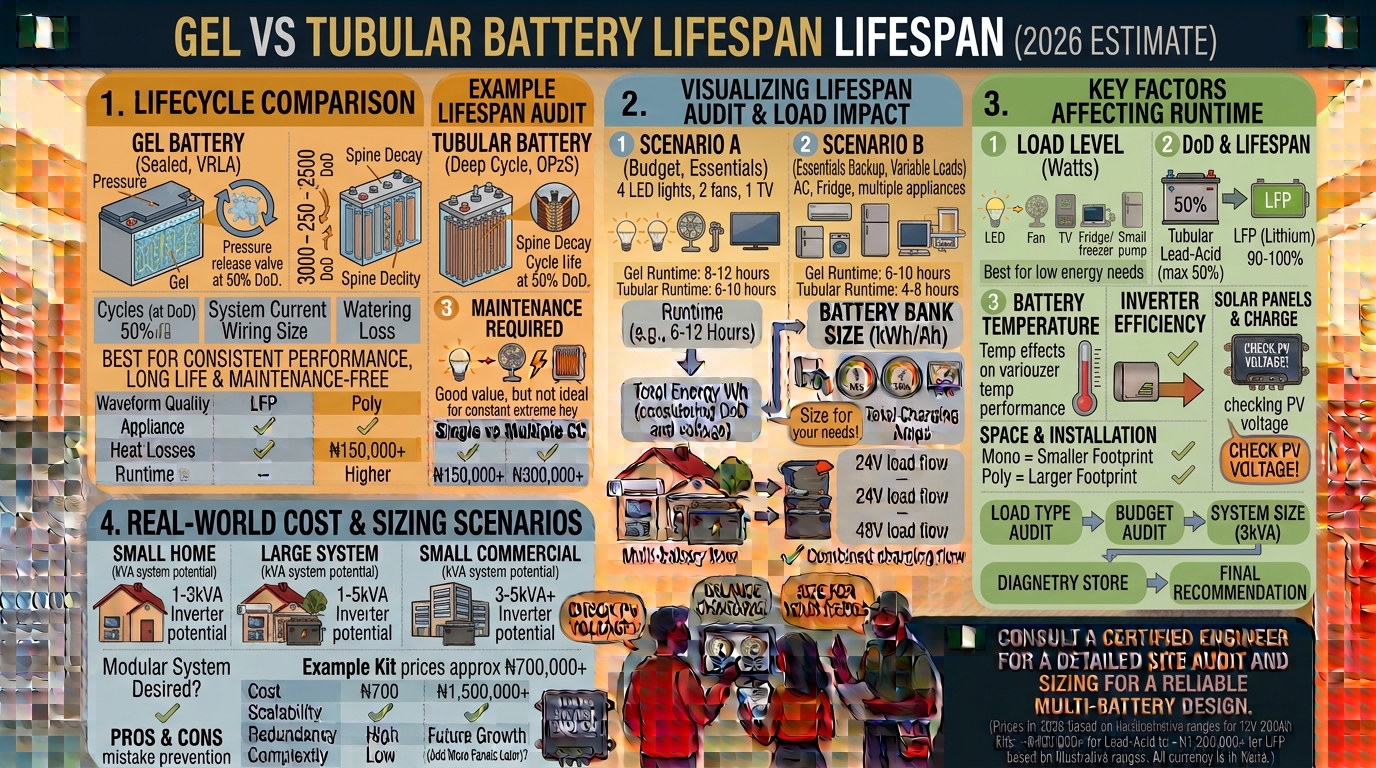
It is difficult to give one exact lifespan because battery life depends heavily on use.
A battery that is gently cycled and properly charged can last much longer than one that is deeply discharged every day.
Factors that affect lifespan include:
1. Depth of discharge
The deeper you discharge a lead-acid battery, the more stress you put on it.
2. Charging
Incorrect charging can shorten battery life.
3. Temperature
High temperatures can accelerate battery aging.
4. Battery quality
Two batteries with the same Ah rating can have very different quality.
5. Maintenance
For flooded tubular batteries, poor maintenance can shorten their useful life.
6. Usage frequency
A battery used every day experiences much more cycling than one used occasionally.
Which One Is Better for Solar?
Both can be used for solar.
But solar systems can cycle batteries regularly, so you should pay attention to:
- Cycle life
- Recommended DoD
- Charging voltage
- Maximum charging current
- Temperature range
- Warranty
If the solar system is going to cycle the battery every day, don’t buy based only on the cheapest price.
Can I Use a GEL Battery With a Solar Panel?
Yes.
The solar panel itself does not charge the battery directly in a typical system.
The normal setup is:
Solar panels → charge controller/inverter charger → battery → inverter → appliances
The charging equipment must have the correct settings for the GEL battery.
Use our Solar Panel Calculator to estimate your panel requirement and our Battery Calculator to estimate battery storage.
Can I Use a Tubular Battery With Solar Panels?
Yes.
Tubular batteries are widely used in solar and inverter systems.
The important thing is to match:
- Battery voltage
- Battery capacity
- Charging voltage
- Charging current
- Solar array
- Charge controller or inverter charger
Your complete system must be designed as one system.
Can I Mix GEL and Tubular Batteries?
I would not recommend mixing them casually.
Even if they have the same voltage and Ah rating, they can have different:
- Charging requirements
- Internal resistance
- Discharge behaviour
- Age
- Capacity
When batteries are connected together, differences between them can cause poor performance and uneven charging.
If you need a larger battery bank, use batteries that are properly matched and follow the inverter and battery manufacturer’s instructions.
Can I Mix Old and New Batteries?
It is generally better to avoid mixing old and new batteries in the same bank.
The older battery may have lost part of its original capacity.
This can cause the batteries to behave differently during charging and discharging.
If you are expanding an existing battery bank, ask a qualified installer to assess the existing batteries before adding new ones.
Which Battery Has Better Backup Time?
Neither GEL nor tubular automatically gives more backup time simply because of its type.
Backup time depends mainly on:
Battery energy × usable capacity ÷ appliance load
For example, if your appliances consume 500W, they will use energy much faster than if they consume 200W.
This is why the same 200Ah battery can provide very different backup times for different homes.
Use our Battery Calculator to estimate your backup requirement.
GEL vs Tubular: Pros and Cons
GEL Battery
Advantages
- Sealed design
- Very little maintenance
- No regular water topping
- Good for deep-cycle applications
- Convenient for suitable indoor installations
- Low self-discharge
- No need to handle liquid electrolyte during normal use
Disadvantages
- Sensitive to incorrect charging
- Can be slower to recharge
- High heat can shorten life
- Not ideal for every charging system
- Quality varies greatly between brands
Tubular Battery
Advantages
- Designed for repeated cycling
- Commonly used for inverter and solar systems
- Good capacity options
- Can be a practical choice for larger battery banks
- Often easier to find in the Nigerian market
- Can be suitable for frequent power backup
Disadvantages
- Requires maintenance
- Water level must be monitored
- Needs proper ventilation
- Can release gas during charging
- High temperatures still reduce battery life
- Incorrect maintenance can shorten lifespan
Which One Should You Buy?
Here is the simple answer.
Choose GEL if:
- You want low maintenance
- You prefer a sealed battery
- You have limited space for battery maintenance
- Your charging system supports GEL correctly
- You don’t want to top up water
- Your expected loads are suitable for a GEL battery
Choose tubular if:
- You don’t mind regular maintenance
- You have a properly ventilated battery location
- You expect regular cycling
- You want a traditional deep-cycle battery
- You can maintain the electrolyte correctly
- The price and specifications are better for your system
My Recommendation for Most Nigerian Buyers
If you are choosing between a good-quality GEL battery and a good-quality tubular battery, I would not automatically say one is better for everybody.
Instead, I would ask:
How often will you use the battery?
How much backup do you need?
Where will the battery be installed?
Are you willing to maintain it?
How quickly do you need it to recharge?
What does your budget allow?
For someone who wants convenience and minimal maintenance, GEL is attractive.
For someone who wants a traditional deep-cycle battery and doesn’t mind maintenance, tubular can be a very practical option.
But whichever you choose, battery quality and correct system design are more important than simply choosing GEL or tubular.
A Simple Example
Imagine two homes.
Home A
The owner wants:
- Lights
- TV
- Router
- Two fans
The battery is installed indoors and the owner does not want to check water levels.
A quality GEL battery may be a good fit.
Home B
The owner has:
- Larger backup needs
- A suitable ventilated battery room
- Regular power outages
- Someone available to maintain the battery
A good tubular battery may make more sense.
The lesson is simple:
The best battery is the one that matches the way you use your system.
Common Mistakes to Avoid
1. Buying based only on Ah
A 200Ah label does not automatically mean better battery performance.
2. Ignoring charging settings
GEL and tubular batteries have different charging requirements.
3. Putting a tubular battery in a closed room
Flooded lead-acid batteries need proper ventilation.
4. Allowing the battery to get too hot
Heat can shorten battery life.
5. Deeply discharging the battery every day
Repeated deep discharge can reduce the life of lead-acid batteries.
6. Mixing different batteries
Avoid mixing different battery types, brands, ages or capacities without proper system design.
7. Buying only because the seller says “deep cycle”
Ask for the actual datasheet and warranty.
8. Choosing a battery before calculating your load
First determine how much energy you need.
Then choose the battery.
Final Verdict
GEL and tubular batteries can both work well for solar and inverter systems in Nigeria.
But they have different strengths.
GEL is better when you value low maintenance, sealed construction and convenience.
Tubular is better when you want a traditional deep-cycle battery, have proper ventilation and don’t mind regular maintenance.
If both options are suitable for your system, compare their:
- Price
- Capacity
- Warranty
- Cycle life
- Recommended depth of discharge
- Charging requirements
- Brand
- Actual specifications
Don’t choose simply because one battery is called GEL or tubular.
And don’t buy a battery before calculating how much energy your home actually needs.
Start with your appliances, determine your backup time, choose the correct battery voltage and capacity, then compare available batteries.
Frequently Asked Questions
Is GEL better than tubular battery?
Not in every situation. GEL is better for people who want low maintenance, while tubular can be a strong choice for regular deep-cycle use when proper maintenance is possible.
Which battery lasts longer, GEL or tubular?
There is no fixed answer. Lifespan depends on battery quality, depth of discharge, charging, temperature, maintenance and how frequently the battery is cycled.
Which battery is better for solar in Nigeria?
Both can be used. A good GEL battery may suit someone who wants low maintenance, while a good tubular battery may suit someone who wants regular deep-cycle use and can maintain it properly.
Does a GEL battery need water?
No. A properly used GEL battery is sealed and does not require regular water topping.
Does a tubular battery need water?
Traditional flooded tubular batteries require electrolyte level checks and topping up with the correct water when necessary. Follow the manufacturer’s instructions.
Which battery charges faster, GEL or tubular?
Tubular batteries generally have an advantage, but charging speed depends on the battery model, charger, capacity, state of charge and charging current.
Which battery is better for frequent power outages?
Both can work, but frequent outages mean frequent battery cycling. Pay close attention to cycle life, recommended depth of discharge and charging requirements.
Can I use GEL and tubular batteries together?
It is generally better not to mix them in the same battery bank because they can have different charging and discharge characteristics.
Can GEL batteries be used with solar panels?
Yes. They can be used in solar systems when the charging equipment is configured correctly for GEL batteries.
Can tubular batteries be used with solar panels?
Yes. Tubular batteries are commonly used for solar and inverter backup systems.
Is a 200Ah GEL battery better than a 200Ah tubular battery?
Not automatically. Both may have the same rated Ah capacity, but their construction, charging requirements, usable capacity, cycle life and real-world performance can differ.
How do I know how many batteries I need?
Your battery requirement depends on your appliance load, backup time, battery voltage, capacity and usable energy.
Use our Battery Calculator to get a starting estimate.
Check Battery Prices in Nigeria
Once you know the type and capacity you need, you can compare available batteries on our:
Solar Batteries Prices in Nigeria
You can find different:
- GEL batteries
- Tubular batteries
- Lithium batteries
- Battery capacities
- Brands and models
Prices are estimates and can change based on the seller, location, exchange rate, stock and exact model.
You can also read our broader guide:
Inverter Battery Price in Nigeria: Lithium vs Tubular vs GEL
That article gives a wider look at the three major battery types and their price ranges.
Plan Your Battery System
Before buying a battery, use our free tools:
Battery Calculator — Estimate the battery capacity and number of batteries you may need.
Inverter Calculator — Estimate the inverter capacity required for your appliances.
Solar Panel Calculator — Estimate your solar panel requirement.
Solar Installation Cost Calculator — Estimate the likely cost of your complete solar installation.
Prices and specifications can change. Always confirm the exact battery specifications, charging requirements, warranty and final price with the manufacturer, seller or qualified installer before purchasing.