Last reviewed: September 27, 2026
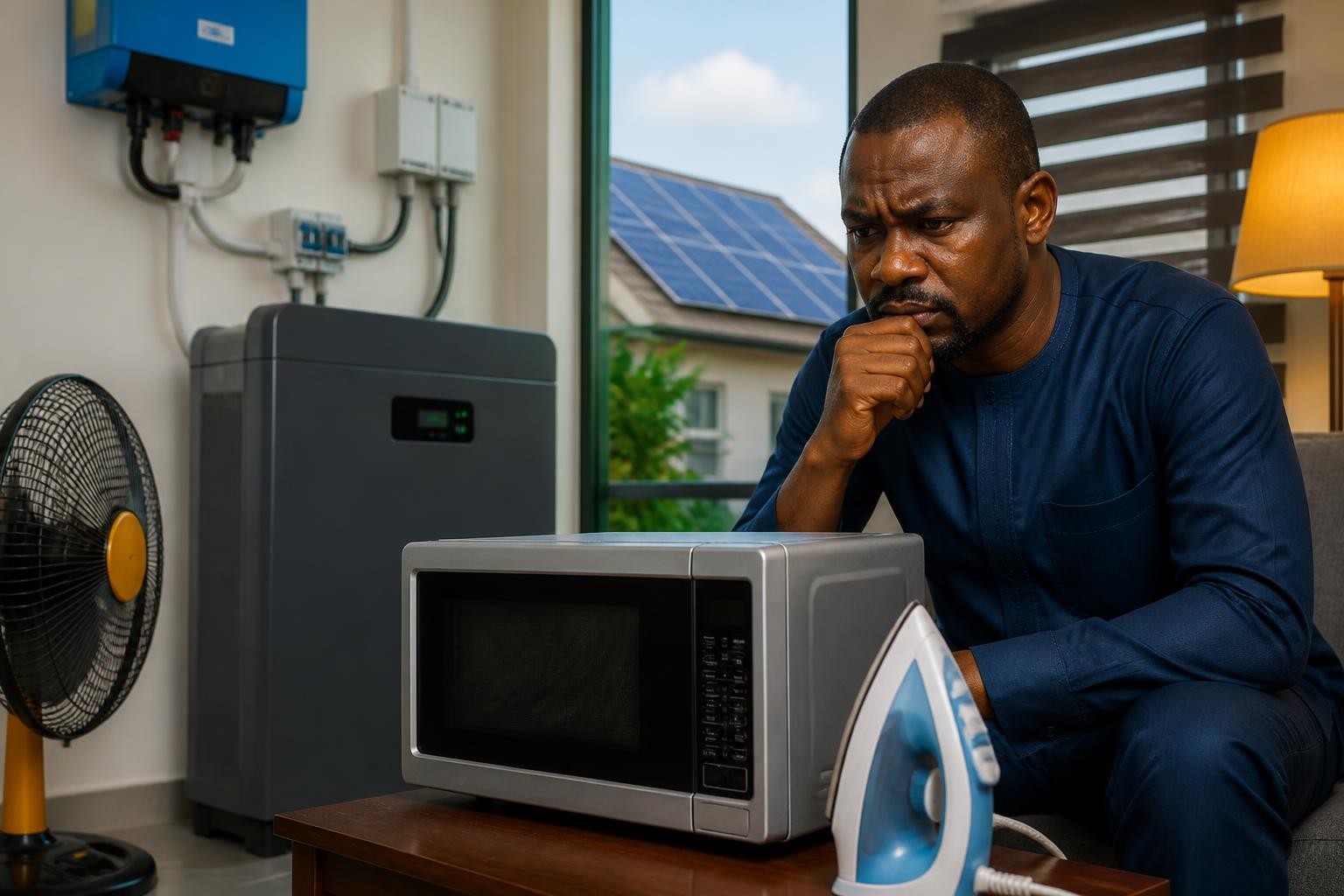
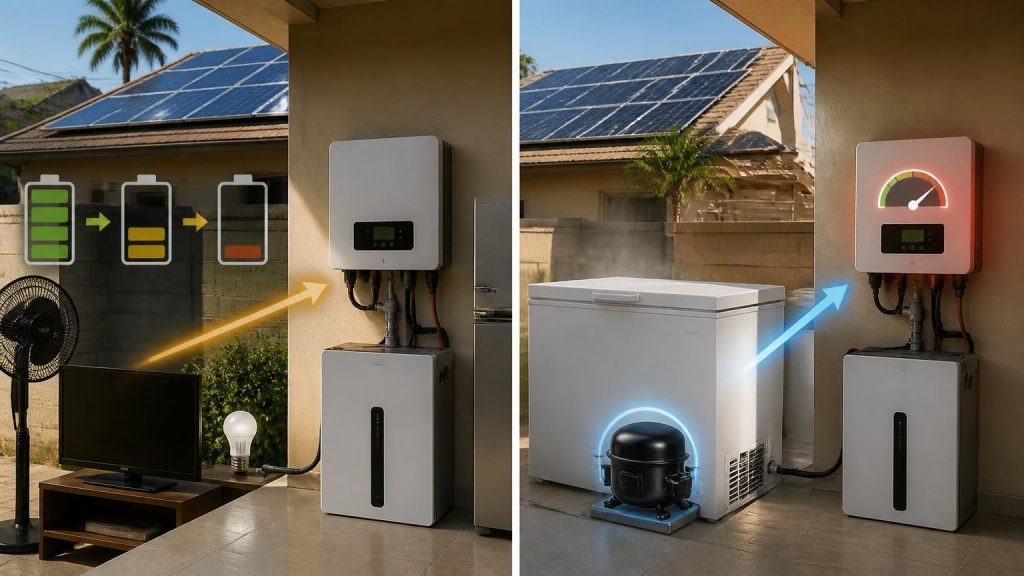
If your solar system used to last through the evening but now runs out earlier after you added a fan, freezer, television, pump, router or another appliance, the new appliance is probably using part of the battery energy that was previously available for the older loads.
There are two different problems to separate:
- Backup time becomes shorter: the appliances are using more energy than before.
- The inverter trips or shuts down immediately: the new appliance may have pushed the system beyond its continuous output or starting-surge limit.
Before buying a bigger battery, measure the new appliance’s actual power use, check whether the battery is fully charging during the day, and confirm that the inverter can handle the appliance when it starts. A new appliance can expose a battery, wiring or charging problem, but it can also simply make a previously tight system carry more load.
Why one new appliance can reduce your backup time
Your battery stores energy, while your appliances consume energy over time. The more energy the household uses, the sooner the battery reaches the inverter’s low-voltage or minimum-state-of-charge limit.
A simple planning relationship is:
Energy used = power in watts × time in hours
For example, adding a 100W appliance for five hours adds about:
100W × 5 hours = 500Wh, or 0.5kWh
That is only a simple estimate. Real battery energy available at the AC sockets is lower than the battery’s nominal rating because of usable-depth limits, inverter losses, battery condition, temperature and the discharge behaviour of the battery chemistry.
First check whether the problem is runtime or inverter capacity
| What happens after adding the appliance? | What it usually points to | What to check first |
|---|---|---|
| The system stays on but the battery runs out earlier | Higher energy consumption | Actual watts, operating hours and battery usable energy |
| The inverter trips when the appliance starts | Starting surge, overload or voltage drop | Appliance starting demand and inverter surge rating |
| The system works in the day but fails soon after sunset | Solar power was masking an undersized or undercharged battery | Battery state of charge before sunset and evening load |
| The battery reaches “full” unusually quickly and empties quickly | Lost battery capacity, incorrect settings or incomplete charging | Battery health, charging profile and a controlled capacity test |
| The battery does not recover fully by the next evening | More daily energy is being used than the solar array replaces | Daily consumption, solar production and daytime loads |
This distinction matters. A larger battery may help with a runtime problem, but it will not safely solve an inverter overload or an undersized battery cable. Likewise, adding more solar panels may improve daily recharging but may not stop an inverter from tripping when a motor starts.
Calculate the extra energy from the new appliance
Start with the appliance label, but do not treat the label as a perfect measurement of actual energy use. A fan or television may operate near a fairly steady wattage. A refrigerator, freezer, water pump or air conditioner cycles on and off and may use a high starting current.
Use this basic process:
- Write down the appliance’s rated running power in watts.
- Estimate how many hours it operates from the battery each day.
- Multiply watts by hours to get watt-hours.
- Convert watt-hours to kilowatt-hours by dividing by 1,000.
- Allow for cycling, standby consumption, inverter losses and battery limits.
If the new appliance is rated at 150W and runs for four hours, the simple estimate is 600Wh, or 0.6kWh. If it is a freezer that cycles rather than running continuously, its average daily energy may be lower than 150W multiplied by every hour. The most reliable approach is to measure it with a suitable energy meter or use monitoring data over a normal day.
For a personalised estimate, use the SolarPriceNG Battery Calculator, then compare the result with the appliance’s measured behaviour and the manufacturer’s limits.
Use usable battery energy, not just the battery label
A battery label does not mean that all of its nominal energy should be delivered to your appliances. The usable amount depends on chemistry, battery settings, discharge limits, age, temperature, load size and inverter efficiency.
- Lithium batteries: use verified kWh as the main capacity unit, then allow for the manufacturer’s recommended usable state-of-charge range and inverter losses.
- Tubular, GEL and AGM batteries: use Ah together with the battery voltage, and do not assume the full nominal capacity is available for repeated deep discharge.
- Battery banks: check the complete bank voltage, configuration and the condition of each battery. One weak battery can reduce the usable performance of the bank.
Do not compare a lithium battery and a lead-acid battery by Ah alone. The chemistry, voltage, discharge limit and usable energy are different. A battery with a larger label may still provide less practical backup if it is old, poorly charged or restricted by the inverter settings.
A Nigerian home example
Imagine a home in Lagos, Enugu or Abuja that normally uses lights, fans, a television and a router in the evening. The system used to last until morning, but the household later added a freezer.
The freezer may affect the system in two ways:
- Its compressor adds energy use whenever it cycles on.
- Its motor may briefly demand much more power when starting.
If the battery previously had only a small energy margin, the extra freezer consumption can shorten the night-time backup. If the inverter is close to its limit, the compressor’s starting surge can also make the inverter trip even when the freezer’s normal running watts look acceptable.
The correct response is not automatically “buy a bigger battery”. First record the inverter warning, measure the evening load, check the freezer’s starting behaviour and confirm how much energy the solar panels put back into the battery during the day.
Why the system may appear fine during the day
Solar power can hide a sizing problem. During good sunlight, the panels may supply the new appliance directly while also charging part of the battery. After sunset, the battery must supply the entire evening load by itself.
This creates a common pattern:
- The inverter looks healthy during the afternoon.
- The battery display reaches full or nearly full, but the charge may not represent the energy expected because the battery is ageing or the settings are wrong.
- The new appliance continues using energy after sunset.
- The battery reaches its low-voltage or minimum state-of-charge limit earlier than before.
If the battery is not fully recharged each day, the lost backup time can become worse over several days of cloudy weather, rain, Harmattan dust, shading or heavy daytime use. Check whether the battery actually reaches its normal charging stage instead of relying only on a “full” icon.
Check whether the new appliance is causing a starting-surge problem
Runtime and starting power are separate checks. The inverter must be able to supply the appliance’s normal running power and tolerate its short starting demand.
Appliances that may have a significant starting demand include refrigerators, freezers, water pumps, borehole pumps, air conditioners and some workshop equipment. A system can have enough stored energy for the appliance over several hours but still shut down when the motor starts.
Check:
- the inverter’s continuous output rating;
- the inverter’s surge or peak rating and its duration;
- the appliance’s starting or locked-rotor demand where available;
- battery voltage during the start-up event;
- voltage drop in the battery cables and protection devices.
Use the SolarPriceNG Inverter Calculator as a planning aid, but confirm the final choice against the exact appliance and inverter specifications.
Check whether the solar panels can replace the extra daily energy
Adding an appliance increases not only night-time consumption but also the amount of energy that must be replaced during the day. If the solar array was already just large enough for the old loads, the battery may begin each evening with less energy than before.
Look at:
- solar power and daily solar energy recorded by the inverter;
- the time the battery reaches its normal charging stage;
- daytime appliances that consume solar power before the battery can charge;
- panel shading, dust, Harmattan conditions, rain and high temperatures;
- the inverter or charge controller’s maximum PV input;
- whether the new appliance runs mainly during the day, at night or both.
More panels may be the better upgrade when the battery is not being replenished fully. A bigger battery may be the better upgrade when the panels already provide enough daily energy but the stored energy is not enough for the required night-time load. Reducing or rescheduling a non-essential load may be cheaper and safer than changing equipment.
See Which Is Cheaper: Adding a Battery, Adding Solar Panels, or Reducing Your Load in Nigeria? before choosing an upgrade.
A practical troubleshooting sequence
- Record the change. Note the appliance added, when it operates, the old backup time and the new backup time.
- Read the inverter display. Save any low-battery, overload, over-temperature or battery-communication warning before resetting the system.
- Test with the new appliance disconnected. If the old backup time returns, the added load is strongly involved, although the battery may still have a separate weakness.
- Measure the actual load. Use monitoring data or a suitable energy meter rather than relying only on the appliance’s marketing label.
- Check the battery before sunset. Confirm whether it reaches the correct charging stage and state of charge.
- Check the inverter limit. Compare both running power and starting demand.
- Check the battery and cables under load. A qualified technician should compare voltage at the battery and inverter, especially if the system reports low battery when a motor starts.
- Choose the smallest effective change. This may be load reduction, scheduling, more panels, a larger battery, better cables, or a correctly sized inverter.
When the new appliance is not the only problem
If backup time dropped much more than the new appliance’s estimated energy use would explain, investigate the rest of the system. Possible causes include:
- a battery that has lost capacity;
- incomplete charging from weak solar input or a charging fault;
- an incorrect battery type or charging setting;
- hidden loads such as routers, CCTV, chargers, pumps or standby equipment;
- loose, undersized or damaged battery cables;
- high inverter self-consumption or a cooling problem;
- another appliance that has recently changed its operating pattern.
If the inverter shows a low-battery warning, a short backup time alone does not prove that the battery is bad. Compare the system with a controlled, known load and have a qualified technician perform a suitable battery and cable test. Our guide on how to tell whether the battery or inverter is the problem can help you organise the evidence.
What should you upgrade first?
| Evidence | Upgrade or action to consider first |
|---|---|
| The battery is full before sunset, but the night load needs more energy | More usable battery capacity or reduced night-time load |
| The battery is not fully charged before sunset | Check charging faults, then consider more panels if the inverter and roof can accept them |
| The inverter trips when the appliance starts | Check surge capacity, cable voltage drop and appliance starting demand |
| The battery is old or fails a proper capacity test | Replace the battery with a compatible, correctly sized unit |
| The new appliance is non-essential or can run in sunlight | Schedule it for daytime or keep it off during battery backup |
Do not increase battery capacity without checking the inverter’s battery voltage, maximum charging current, battery chemistry settings, cable size, protection and installation space. A larger battery must be compatible with the complete system.
Safety checks
Stop and call a qualified installer or electrician if you notice hot cables, melted insulation, a burning smell, smoke, arcing, swollen or leaking batteries, repeated breaker trips or a lithium battery protection warning that does not clear through the manufacturer’s normal procedure.
Do not bypass a fuse, breaker, battery-management system or low-voltage cut-off. Do not connect an extra battery, change series or parallel wiring, or open an inverter cabinet just to make the new appliance work. High-current DC systems can cause severe injury, fire or equipment damage.
Bottom line
Your solar backup time usually drops after adding an appliance because the total energy used by the home has increased. The new appliance can also cause an inverter overload if it has a large starting surge.
Measure the appliance, check the battery’s usable energy and charging status, confirm the inverter’s running and surge limits, and inspect the battery-cable path safely. The best next step may be a bigger battery, more solar panels, a correctly sized inverter, load scheduling or simply removing a non-essential load. Choose from the evidence rather than replacing equipment by guesswork.