
Last reviewed: September 23, 2026
If you have received a solar quotation in Nigeria, do not judge it by the final naira amount alone. A quote can look cheap because it leaves out batteries, protection devices, mounting, cabling or installation work. Another quote can look expensive because it includes better equipment, a larger battery, difficult roof work or a more complete scope.
The safest way to check a quote is to make every installer price the same job, identify the exact equipment models, compare each item with current Nigerian price information, and ask what is included or excluded. If the quote does not show enough detail to do that, it is not ready for you to approve.
Quick answer: A solar quote is a warning sign when it hides the equipment model, battery voltage or usable capacity, panel quantity, protection, installation scope, warranty or exclusions. It may be overpriced when its normalised cost is much higher than comparable current equipment and site-work costs without a clear technical reason.
Use this guide before paying a deposit or signing an installation agreement.
Do not compare the total price first
Two quotations may both say “5kVA solar system” but describe very different systems. One may include a small battery and basic installation. The other may include a larger lithium battery, more panels, a roof structure, protection equipment, monitoring and a longer workmanship warranty.
Before comparing prices, put both quotes into the same structure:
- What appliances or circuits should the system run?
- What is the inverter’s exact brand, model, battery voltage and output rating?
- What battery chemistry and capacity are included?
- How many panels, and what wattage and model, are included?
- Which cables, breakers, isolators, surge protection and earthing work are included?
- Does the price include transport, mounting, labour, testing, commissioning and handover?
- What is excluded, and what might be added later?
Only after this “same job” check should you ask which quote is better value.
What a Complete Solar Quote Should Show
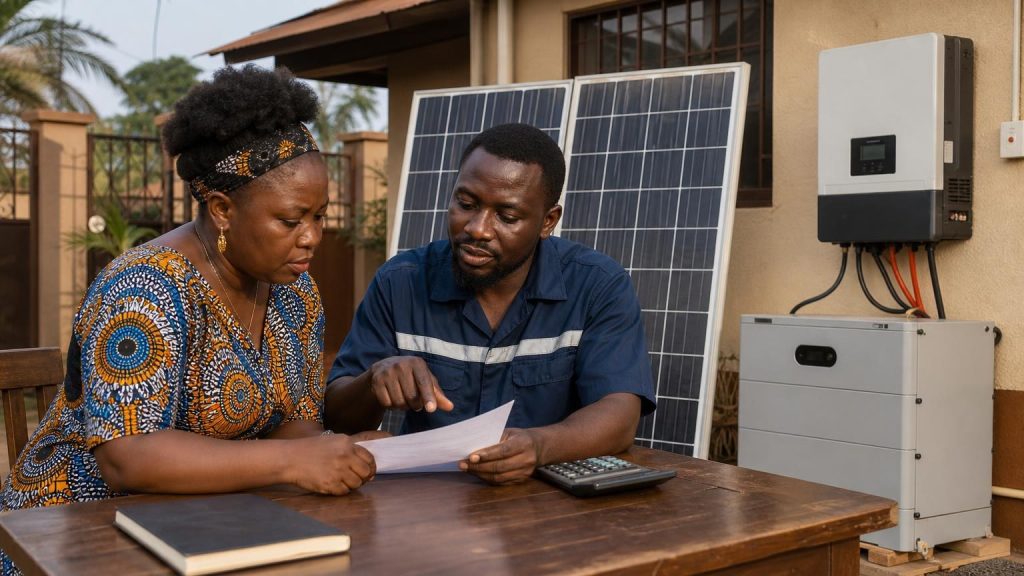
A professional quote does not need to be complicated, but it should be specific enough for another knowledgeable person to understand what will be supplied and installed.
| Quote section | What to look for | Warning sign |
|---|---|---|
| System purpose | Critical loads, backup hours, grid/generator use and expansion plan | “Powers the whole house” with no load list |
| Inverter | Brand, exact model, battery voltage, continuous output, surge rating and PV input limits | Only “5kVA inverter” or a stock photo |
| Battery | Brand, model, chemistry, voltage, Ah or kWh, usable capacity and quantity | “Big battery” or Ah shown without voltage |
| Solar panels | Brand/model, wattage, quantity, total DC size and string arrangement | Only “Tier 1 panels” with no model |
| Electrical protection | DC/AC breakers or isolators, fuses, surge protection, earthing and distribution changes | Protection described as “accessories” or omitted |
| Physical installation | Mounting structure, roof or ground work, cable routes and distances | One unexplained installation lump sum |
| Commercial terms | Warranty, delivery date, payment stages, exclusions and after-sales support | Large deposit requested before a final scope |
If several important rows are missing, do not try to guess what the installer meant. Ask for a revised, itemised quotation.
Check the inverter properly
“5kVA” is not a complete inverter specification. It is a size label, not a full system design. The quote should identify the exact model so you can verify its battery-voltage requirement, continuous output, surge capability, maximum solar input, MPPT voltage range, maximum PV current, charging limits and operating conditions.
Ask these questions:
- Is the stated rating continuous output or only a short-term rating?
- Can it start the refrigerator, freezer, pump or air-conditioner you want to connect?
- What battery voltage does this model require: 12V, 24V or 48V?
- How much solar power can it accept, and at what voltage and current?
- Is the proposed panel arrangement within the manufacturer’s voltage and current limits?
- Is the inverter compatible with the proposed lithium battery and its BMS communication, if applicable?
Do not accept “the inverter can carry it” as the only explanation. A system can fit the running wattage and still fail when a motor or compressor starts. You can use SolarPriceNG’s Inverter Calculator to prepare a load list before asking installers to quote.
Check the battery using the correct unit
The battery is often where an apparently cheap quote hides a major difference. Do not compare batteries by Ah alone.
- For lithium batteries, use kWh as the main energy-capacity figure when that is the verified specification.
- For tubular, GEL and AGM batteries, check Ah together with voltage, battery quantity and the expected usable portion.
- Confirm the battery chemistry, model, warranty, maximum continuous discharge current and charging requirements.
- Check whether batteries connected in series or parallel are identical, compatible and properly protected.
For example, 12V 200Ah is about 2.4kWh of nominal energy before usable-capacity and system-loss assumptions. A 48V 100Ah battery is about 4.8kWh nominal. The Ah number by itself does not tell you which battery stores more energy.
A quote should also explain the expected backup load. If the critical load is 1,200W for four hours, the simple energy requirement is:
1,200W × 4 hours = 4,800Wh, or 4.8kWh
An illustrative 10kWh battery assumption of 80% usable energy and 90% inverter efficiency would provide about 7.2kWh of AC energy, which is roughly six hours at a steady 1,200W load. This is only a calculation example, not a promise about every 10kWh battery. Real backup time changes with battery condition, temperature, inverter behaviour and the appliances’ actual cycling.
Use the Battery Calculator to check whether the quoted storage matches the backup time you actually want.
Check the panel array and its layout
A panel line in a quotation should show the model, wattage and quantity. “3kW solar panels” is useful, but it is not enough to confirm compatibility or value.
Ask the installer to show:
- Total panel wattage and the number of panels
- Voc, Vmp, Isc and Imp from the panel datasheet
- How the panels will be connected in series and parallel
- Whether shade, roof direction, roof condition and cable distance were considered
- Whether the inverter’s MPPT voltage and current limits are respected
As an illustration, six 550W panels make a 3.3kW DC array. If someone assumes four peak-sun hours and a 75% overall delivery factor, the rough daily energy estimate would be 3.3 × 4 × 0.75 = 9.9kWh. That is a planning example, not a guaranteed daily output for every Nigerian location or season. Harmattan dust, rain, heat, shading, roof orientation and system losses can change the result.
Check the proposed array with SolarPriceNG’s Solar Panel Calculator, then ask the installer to explain any difference.
Do not allow protection and installation work to disappear
Some quotations list the inverter, batteries and panels clearly but hide all the smaller electrical items inside “installation accessories”. That makes it difficult to know whether the system is safe and whether you will be asked to pay extra later.
Ask the installer to state what is included for:
- DC and AC cables, including sizes and approximate routes
- Battery fuses or breakers and isolators
- DC and AC surge protection where required by the design
- Earthing and bonding work
- Distribution-board changes, changeover equipment and circuit separation
- Panel mounting rails, brackets, clamps, waterproofing and roof repairs
- Transport, lifting, scaffolding, testing, commissioning and labels
The correct cable and protection ratings depend on the actual equipment, current, distance, installation method and local requirements. Do not choose a cable or breaker from an internet guess. A qualified installer should produce the design and test the completed work.
How to tell whether the quote is overpriced
There is no honest universal rule such as “add 10% and that is the fair price”. Nigerian solar prices vary by brand, model, exchange rate, stock, location, transport, roof work, system complexity and installer responsibility.
Instead, use this five-step comparison:
- Split the quote into line items. Separate inverter, battery, panels, structure, protection, cabling, labour, transport, design and taxes or fees where applicable.
- Verify the identity. Search the exact model and compare its datasheet, not just the brand name or a similar-looking product.
- Check current Nigerian price evidence. Use the Solar Prices in Nigeria database to compare the same or a genuinely equivalent product. Do not compare a verified lithium model with an unspecified battery or compare a panel price without considering wattage and model.
- Normalise installation scope. Add back items missing from the cheaper quote before deciding it is cheaper.
- Ask for an explanation of the difference. A higher quote may be justified by a larger battery, longer cable runs, roof work, better protection, difficult access or stronger warranty. An unexplained difference is the problem.
SolarPriceNG’s price data is an estimate of market information, not a promise that every installer must charge the same amount. The useful comparison is “same model, same quantity, same scope and same date”, not simply “lowest total wins”.
Red flags that are more serious than a high price
- The installer refuses to provide exact model numbers or datasheets.
- The quote promises to power every appliance without a load assessment.
- The battery capacity is shown only as Ah with no voltage, chemistry or quantity.
- The quote says “all accessories” but does not list protection, cables or earthing.
- The installer cannot explain the panel string design or inverter PV limits.
- The price is suspiciously low because major components or labour are excluded.
- You are pressured to make a large payment before a site assessment and final scope.
- There is no written warranty, handover plan, serial-number record or after-sales contact.
- You are told to bypass breakers, remove protection or connect incompatible batteries.
Check the installer, not only the equipment
A good product can still be part of a poor installation. Ask who will design the system, who will do the electrical work, who will test it and who will honour the workmanship warranty.
NEMSA’s renewable-energy certification guidance covers solar PV, inverter and battery-storage installation work, as well as electrical protection such as earthing and grounding. You can also use NEMSA’s official channels to learn about certified electrical contractors and inspection services. For roof work, battery work and electrical connections, use competent professionals and do not work on live circuits yourself.
If the project will export power to the grid, serve multiple customers or operate as a mini-grid, ask the installer to explain the relevant utility, inspection and regulatory responsibilities. Those projects are not the same as a normal home backup installation.
What to ask for before you pay
- A final itemised quotation with a validity date
- Exact equipment models and datasheets
- A load list and a clear statement of the circuits being backed up
- Battery voltage, chemistry, capacity and expected usable energy
- Panel quantity, wattage, model and proposed string arrangement
- Protection, cabling, earthing, mounting and distribution-board scope
- Installation timeline, payment stages and exclusions
- Product warranties, workmanship warranty and after-sales process
- Commissioning tests, labels, operating instructions and handover documents
A simple decision rule
Reject or pause the quote if you cannot identify what you are buying. Ask for the missing details first.
Do not automatically reject the highest quote. First check whether it includes a larger battery, better protection, more complete installation, difficult site work or stronger support.
Do not automatically accept the lowest quote. A low number may exclude the panels, battery, mounting, protection, transport, labour or future work needed to make the system safe and usable.
If you want a broader cost estimate before speaking with installers, use SolarPriceNG’s Solar Installation Cost Calculator. It is a planning tool, not a replacement for a site assessment or professional design.
Final checklist
Before signing, you should be able to answer “yes” to these questions:
- Do I know the exact inverter, battery and panel models?
- Does the battery capacity match my required backup time?
- Does the panel array match the inverter’s input limits?
- Are protection, cables, earthing, mounting and labour itemised?
- Are the backed-up appliances, assumptions and exclusions written down?
- Have I compared the same equipment and scope with current Nigerian price information?
- Do I have written warranty and handover terms?
- Will competent professionals carry out and test the electrical installation?
A quote is not good because it is cheap or expensive. It is good when the system is correctly sized, the equipment is identifiable, the safety work is included, and the price can be explained line by line.