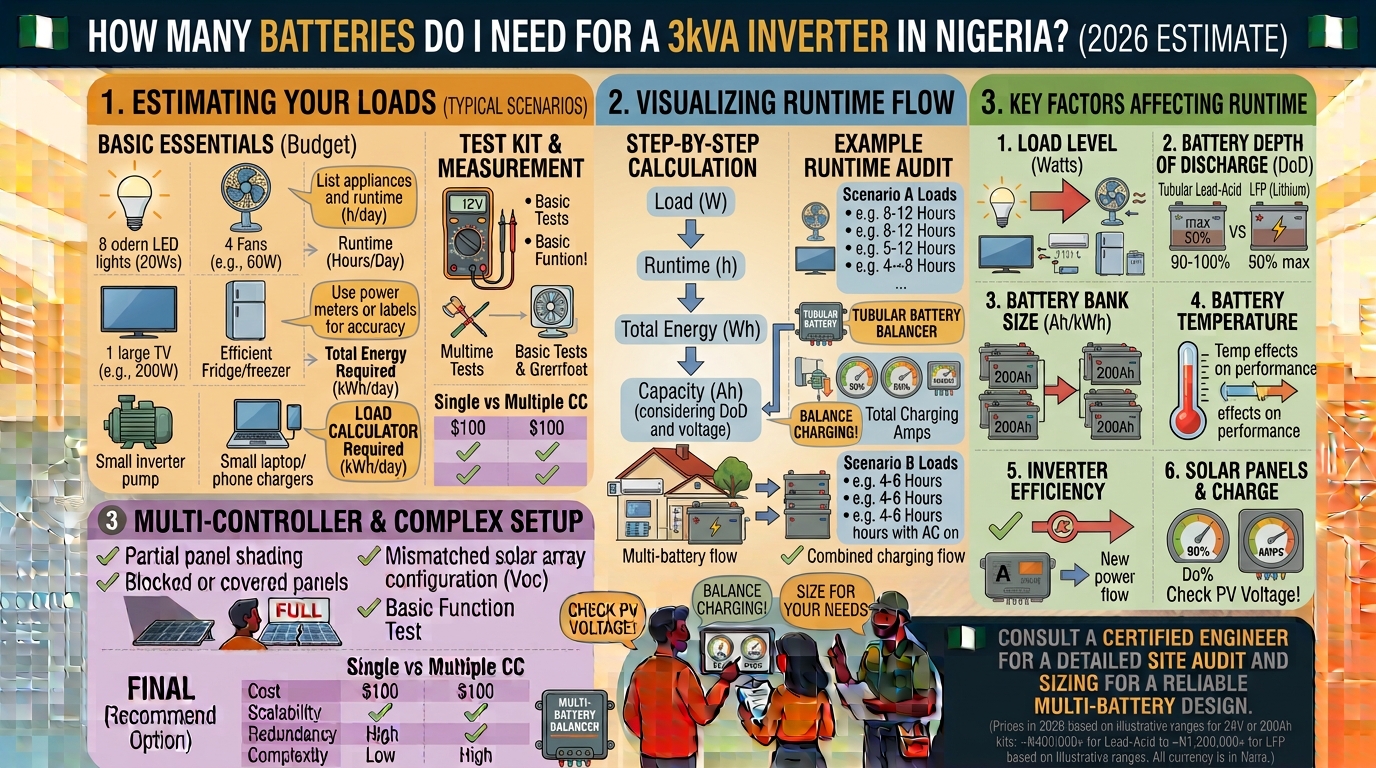
If you are buying a 3kVA inverter, one of the next questions you will probably ask is: How many batteries do I need?
There is no single answer.
A 3kVA inverter does not automatically require two batteries, four batteries or a particular Ah rating.
The correct number depends on the inverter’s battery voltage, the battery capacity, your appliances, how long you want them to run and the type of battery you are using.
For example, a 3kVA inverter designed for a 24V battery bank may require a completely different battery arrangement from a 3kVA inverter designed for 48V.
This guide explains how to work it out.
First, Check the Battery Voltage of the Inverter
Before buying any battery, check the inverter specifications.
A 3kVA inverter may be designed for:
- 12V
- 24V
- 48V
The exact requirement depends on the model.
You cannot simply choose any battery because the inverter is rated 3kVA.
For example, if your inverter requires 24V, you cannot connect one 12V battery and expect the system to work correctly.
You would normally need two compatible 12V batteries connected in series to create:
12V + 12V = 24V
Always check the manufacturer’s specification before connecting batteries.
How Many 12V Batteries Do I Need for a 24V 3kVA Inverter?
If your 3kVA inverter requires a 24V battery bank, two 12V batteries can create the required voltage:
2 × 12V = 24V
For example:
2 × 12V 200Ah batteries
gives:
24V 200Ah
The nominal stored energy is:
24V × 200Ah = 4,800Wh
or:
4.8kWh
This does not mean you will get the full 4.8kWh as usable AC energy because battery and inverter losses must be considered.
What If I Use 12V 100Ah Batteries?
Two 12V 100Ah batteries connected in series give:
24V 100Ah
The nominal energy is:
24V × 100Ah = 2,400Wh
or:
2.4kWh
Notice something important.
Adding batteries in series increases voltage, but the Ah rating remains approximately the same.
So:
2 × 12V 100Ah = 24V 100Ah
not 24V 200Ah.
What If I Use 12V 200Ah Batteries?
Two 12V 200Ah batteries in series give:
24V 200Ah
Nominal energy:
24V × 200Ah = 4.8kWh
This gives you twice the nominal energy of a 24V 100Ah battery bank.
How Many Batteries Do I Need for a 48V 3kVA Inverter?
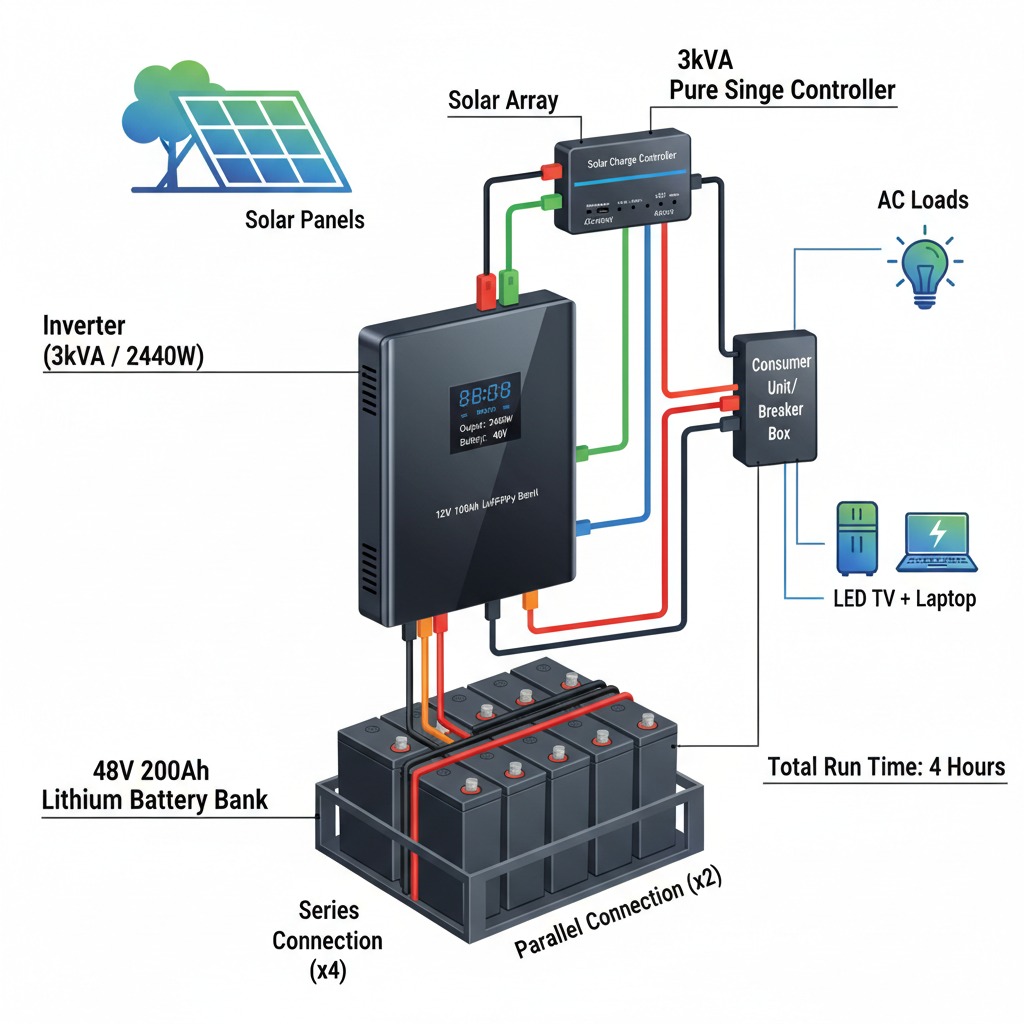
If your 3kVA inverter requires a 48V battery bank and you are using 12V batteries, you would normally need:
4 × 12V batteries
because:
12V × 4 = 48V
For example:
4 × 12V 200Ah
creates:
48V 200Ah
Nominal energy:
48V × 200Ah = 9.6kWh
Again, the usable energy will be lower after accounting for the battery’s usable capacity and inverter losses.
How Many Lithium Batteries Do I Need for a 3kVA Inverter?
Lithium batteries make this question slightly different because they come in many configurations.
You may find:
- 12V 100Ah
- 12V 200Ah
- 24V 100Ah
- 24V 200Ah
- 48V 50Ah
- 48V 100Ah
- 48V 200Ah
- 2.5kWh
- 5kWh
- 10kWh
Therefore, you should not count lithium batteries without checking their voltage and capacity.
For example, if your 3kVA inverter requires 24V, a single 48V battery would not be the correct match simply because it has enough energy.
Voltage compatibility comes first.
How Much Battery Capacity Do I Need?
This is where many people make a mistake.
The number of batteries needed for the voltage is different from the amount of batteries needed for backup time.
For example:
You might need:
2 batteries
to create the required 24V.
But that does not automatically mean those two batteries will provide the backup time you want.
If your appliances consume a lot of energy, you may need a larger battery bank.
Example: 3kVA Inverter With 500W Load
Suppose your appliances are using:
500W
and you want:
5 hours
of backup.
Your basic energy requirement is:
500W × 5 hours = 2,500Wh
or:
2.5kWh
You then need to account for battery usable capacity and inverter losses.
So you would not simply buy a 2.5kWh battery and assume it will provide exactly five hours.
This is why battery sizing should be based on your actual load and backup requirement.
Example: 3kVA Inverter With 1,000W Load
Suppose your total load is:
1,000W
and you want:
5 hours
of backup.
Your basic energy requirement is:
1,000W × 5 = 5,000Wh
or:
5kWh
That is twice the energy requirement of the previous example.
The inverter is still:
3kVA
but the required battery capacity is much larger.
This shows why:
Inverter size ≠ battery size.
The inverter determines how much power you can draw at once.
The battery determines how much energy you can store.
Can I Use Two 200Ah Batteries With a 3kVA Inverter?
You can if the inverter is designed for the resulting battery voltage and the batteries are suitable for the system.
For example:
2 × 12V 200Ah
connected in series gives:
24V 200Ah
with approximately:
4.8kWh nominal energy.
But you should still check:
- Inverter battery voltage
- Battery chemistry
- Maximum charging current
- Maximum discharge current
- Battery age
- Battery compatibility
- Manufacturer recommendations
Do not mix batteries of different ages, capacities or types in the same battery bank unless the manufacturer specifically allows it.
Can I Use Four 12V Batteries With a 3kVA Inverter?
It depends on the inverter.
If the inverter requires 48V, four 12V batteries may be appropriate for the voltage.
If the inverter requires 24V, simply connecting four batteries in series would create:
48V
which could be too high for that inverter.
This is why you should never determine battery quantity from inverter kVA alone.
How Long Will the Batteries Last?
This depends on your actual load.
For example, a battery bank supplying:
300W
will normally last much longer than the same battery bank supplying:
1,500W
Other factors also matter:
- Battery chemistry
- Depth of discharge
- Battery age
- Temperature
- Inverter efficiency
- Battery discharge rating
- Wiring losses
Our Battery Calculator takes these types of factors into account when estimating the battery bank needed for your appliances and backup time.
3kVA Inverter Does Not Mean 3kW of Battery
This is another common misunderstanding.
A 3kVA inverter is describing the inverter’s power rating.
The battery is measured differently.
Battery capacity is normally described using:
- Ah
- Wh
- kWh
For example:
24V 200Ah
has approximately:
4.8kWh
of nominal stored energy.
The battery can therefore store energy for the inverter to use.
What Appliances Can a 3kVA Inverter Run?
That depends on the actual wattage of your appliances and their starting power.
A 3kVA inverter may be suitable for a combination of loads such as:
- LED bulbs
- TV
- Decoder
- Fans
- Wi-Fi router
- Refrigerator
- Small freezer
- Laptop
- Some pumps
But you should calculate the total load rather than choosing appliances based only on their names.
Some appliances, especially those with motors and compressors, can have higher starting power.
Use our Inverter Calculator to estimate the inverter capacity required for your appliances.
What Size Solar Panels Do I Need for a 3kVA System?
The battery is only one part of the system.
You also need enough solar generation to recharge the battery and supply daytime loads.
The required solar panel capacity depends on:
- Battery size
- Daily energy use
- Battery recharge requirement
- Peak sun hours
- Panel efficiency
- System losses
- Controller type
So don’t assume that a 3kVA inverter automatically needs a fixed number of solar panels.
Use our Solar Panel Calculator to estimate your panel requirement.
What Charge Controller Do I Need?
If your system uses a separate charge controller, its size must also match the solar array and battery system.
The controller depends on:
- Solar panel wattage
- Solar panel voltage
- Battery voltage
- Controller type
- Maximum charging current
Our Charge Controller Calculator can help estimate the required controller size.
How Much Does a 3kVA Solar System Cost in Nigeria?
There is no single price for a 3kVA system.
The final cost depends on what you include.
For example:
- Inverter
- Batteries
- Solar panels
- Charge controller if required
- Mounting
- Cables
- Protection
- Distribution
- Installation labour
A 3kVA system using lithium batteries can therefore have a very different price from one using tubular batteries.
You can check our Solar Prices in Nigeria page for current estimated market ranges.
How Much Does Installation Cost?
Equipment is only part of the total cost.
Installation can include:
- Labour
- Wiring
- Mounting
- Protection
- Earthing
- Distribution
- Changeover equipment
- Testing
- Other site-specific work
Use our Solar Installation Cost Calculator to get an estimate based on your planned system.
What Is the Best Battery for a 3kVA Inverter?
There is no single battery that is best for everyone.
Lithium
Good when you want:
- Higher usable capacity
- Faster charging
- Low maintenance
- Frequent cycling
- Longer service life
Tubular
Can be attractive when:
- Initial budget is more important
- You want a traditional lead-acid option
- The system is properly maintained
GEL
Can be useful when you want:
- A sealed battery
- Low routine maintenance
- A lead-acid option for backup applications
The best choice depends on your budget, usage pattern and inverter compatibility.
You can compare the current Nigerian market ranges on our Solar Prices in Nigeria page.
So, How Many Batteries Do You Actually Need?
For a 3kVA inverter, start with these three questions:
1. What battery voltage does the inverter require?
Is it:
12V, 24V or 48V?
2. How much backup do you need?
Do you need:
2 hours, 5 hours, 8 hours or more?
3. What appliances are you powering?
A system running only lights and fans will need much less stored energy than one running a refrigerator, freezer, pump and air conditioner.
Once you answer those questions, you can calculate the required battery bank.
Use the SolarPriceNG Battery Calculator
Instead of guessing how many batteries you need, enter the appliances you want to run and the number of hours you want them to operate.
Our Battery Calculator estimates the battery capacity required for your backup period.
You can then use the other SolarPriceNG tools to continue planning your system:
- Inverter Calculator
- Solar Panel Calculator
- Charge Controller Calculator
- Solar Installation Cost Calculator
And when you know what equipment you need, check the estimated Nigerian market prices on:
Final Advice
Don’t buy batteries simply because someone tells you:
“A 3kVA inverter needs two batteries.”
That may be correct for one inverter but completely wrong for another.
First check the inverter’s battery voltage.
Then calculate the energy you need during backup.
Finally, choose a battery bank that can provide that energy while staying within the battery manufacturer’s recommended operating limits.
For example, two 12V 200Ah batteries can create a 24V 200Ah battery bank, giving approximately 4.8kWh of nominal energy.
But whether that is enough for your home depends on how much power your appliances use and how long you want them to run.
Calculate your battery requirement with the SolarPriceNG Battery Calculator before buying.