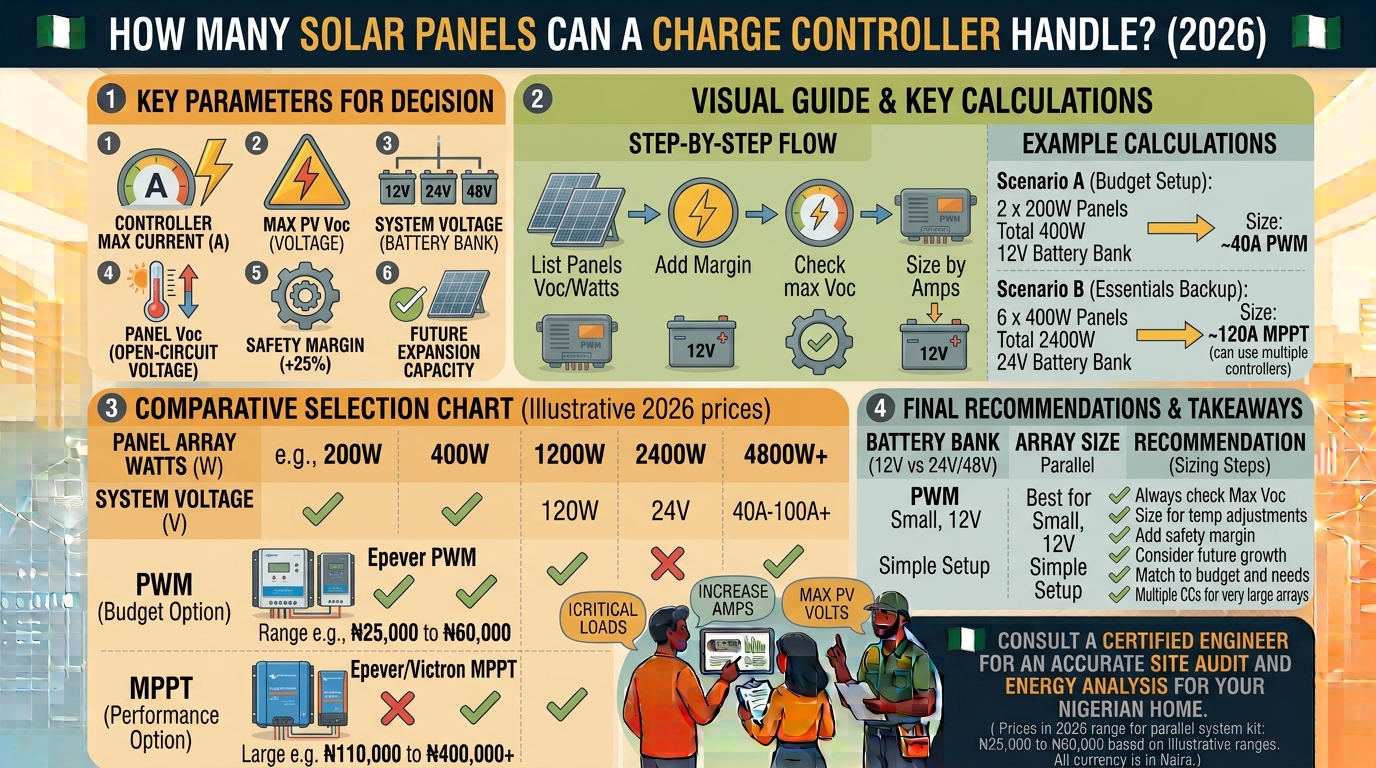
If you already have solar panels or you are planning to buy them, you may be wondering:
How many solar panels can one charge controller handle?
The answer is not simply based on the number of panels.
A charge controller can handle a certain amount of solar power, voltage and current. The number of panels depends on the wattage and electrical specifications of each panel, as well as your battery voltage.
For example, a 60A MPPT charge controller could handle a different number of panels in a 24V system compared with a 48V system.
In this guide, we will explain how to work it out using simple examples.
If you want to calculate your own system quickly, use our Solar Charge Controller Calculator.
Quick Answer
The number of solar panels a charge controller can handle depends mainly on:
- The controller’s maximum PV power
- Maximum PV voltage
- Maximum charging current
- Solar panel wattage
- Solar panel Voc and Vmp
- Solar panel Isc and Imp
- Battery voltage
- Whether the panels are connected in series or parallel
So, there is no single answer such as:
“A 60A controller can handle 6 panels.”
It depends on the panels and the rest of the system.
Example: How Many 250W Panels Can a Charge Controller Handle?
Let’s say you have 250W solar panels.
If you connect:
2 × 250W = 500W
4 × 250W = 1,000W
6 × 250W = 1,500W
8 × 250W = 2,000W
But whether a particular controller can handle those panels depends on its specifications.
For example, a 60A MPPT controller might be suitable for around 1,000W of solar on a 24V system, while the same controller may handle more solar power on a 48V system if the manufacturer allows it.
You therefore need to check the controller’s maximum PV power.
How Many 100W Solar Panels Can I Use?
If you have 100W panels:
| Number of Panels | Total Solar Power |
|---|---|
| 1 | 100W |
| 2 | 200W |
| 3 | 300W |
| 4 | 400W |
| 5 | 500W |
| 6 | 600W |
| 8 | 800W |
| 10 | 1,000W |
A small PWM controller may be suitable for a small number of these panels, depending on the battery voltage and panel specifications.
For larger arrays, an MPPT controller may be more suitable for it than PWM.
How Many 200W Panels Can a Charge Controller Handle?
With 200W panels:
| Panels | Total Solar Power |
|---|---|
| 1 | 200W |
| 2 | 400W |
| 3 | 600W |
| 4 | 800W |
| 5 | 1,000W |
| 6 | 1,200W |
| 8 | 1,600W |
| 10 | 2,000W |
Again, the number alone does not tell you whether the controller can handle the array.
You need to compare the total power with the controller’s maximum PV rating.
How Many 250W Panels Can a 30A Charge Controller Handle?
There isn’t one answer because the battery voltage matters.
For example, with a 24V battery system:
250W × 2 = 500W
500W ÷ 24V = approximately 20.8A
So two 250W panels could potentially work with a 30A MPPT controller, provided the controller’s PV voltage and power limits are also suitable.
But adding another 250W panel gives:
750W ÷ 24V = 31.25A
That is already above 30A before considering any safety margin.
So three 250W panels would generally not be the right match for a 30A controller in this example.
How Many 250W Panels Can a 60A Charge Controller Handle?
Let’s use a 24V system.
4 panels
4 × 250W = 1,000W
1,000 ÷ 24 = 41.7A
This is within 60A from the basic current calculation.
6 panels
6 × 250W = 1,500W
1,500 ÷ 24 = 62.5A
This is already above 60A from the basic calculation.
Therefore, 4 × 250W panels is a much more reasonable starting point for a 60A controller on a 24V system, while 6 panels would require a different design or controller arrangement.
But you must still check the controller’s maximum PV power and voltage.
How Many Solar Panels Can a 60A Charge Controller Handle?
A 60A charge controller does not automatically mean you can connect a fixed number of solar panels. The number depends on the battery-system voltage, panel wattage and the controller’s maximum PV input specifications.
As a simple example, a 60A controller could theoretically provide about 720W at 12V, 1,440W at 24V and 2,880W at 48V. These figures are only basic estimates based on controller output current and system voltage. Always check the manufacturer’s maximum PV power, voltage and current limits before connecting panels.
For example, two 550W panels produce about 1,100W of PV power. Whether a 60A controller can safely use that array depends on the controller model, battery voltage and its stated PV input limits.
What Size Solar Controller Do I Need for a 500W Solar Panel?
A 500W solar panel does not have one universal controller size. The correct controller depends on the battery voltage, panel specifications and whether the controller is PWM or MPPT.
A 500W panel can require a very different controller setup on a 12V system compared with a 24V or 48V system. This is why you should not choose a charge controller from the panel wattage alone.
You should check the panel’s voltage and current ratings and compare them with the controller’s maximum PV input limits.
You can also use our Solar Charge Controller Calculator to estimate the controller size for your solar setup.
What About a 48V Battery System?
The situation changes significantly.
Suppose you have:
1,500W of solar panels
and a:
48V battery system
The basic current calculation is:
1,500 ÷ 48 = 31.25A
That is considerably lower than the current required from a 24V system.
This is one reason larger solar systems commonly use higher battery voltages.
Can I Put Too Many Solar Panels on a Charge Controller?
Yes.
Every charge controller has limits.
You should not simply keep adding panels because the controller is charging the battery successfully.
You need to stay within the manufacturer’s limits for:
Maximum PV power
This tells you how much solar power the controller is designed to accept.
Maximum PV voltage
This tells you the highest solar-array voltage the controller can safely accept.
Maximum charging current
This tells you the maximum current the controller can send toward the battery.
Exceeding the voltage limit is particularly important because it can damage the controller.
What Happens If I Add Too Many Panels?
Depending on the controller design, adding more solar power than the controller can use may result in the controller limiting the available power.
However, you should never assume that over-paneling is safe.
The manufacturer’s specified limits must be followed.
In particular, exceeding the controller’s maximum PV voltage can cause serious problems.
So don’t look only at the wattage.
Solar Panel Wattage Is Not Enough
This is one of the biggest mistakes people make when designing a solar system.
Someone may say:
“I have a 60A controller, so I can connect 60A worth of panels.”
But the controller’s PV input is not determined by its amp rating alone.
You also need the solar panel’s:
- Voc
- Vmp
- Isc
- Imp
Voc
Open Circuit Voltage
Vmp
Voltage at Maximum Power
Isc
Short Circuit Current
Imp
Current at Maximum Power
These figures are normally printed on the solar panel label or listed on the manufacturer’s datasheet.
Series vs Parallel: Why It Matters
The way you connect your panels changes the electrical characteristics of the solar array.
Panels in series
Voltage increases.
Panels in parallel
Current increases.
For example, suppose one panel has:
Vmp = 40V
Two panels in series would have approximately:
80V Vmp
Three panels:
120V Vmp
But if the panel has a Voc of 48V:
Two panels would have approximately:
96V Voc
Three would have:
144V Voc
You must make sure the resulting voltage remains below the controller’s maximum PV voltage.
How Many 600W Solar Panels Can a Charge Controller Handle?
The answer depends on the controller and system voltage. A 600W panel should not be treated as simply “one panel equals one controller.”
For example, adding two 600W panels gives a 1,200W solar array. Before connecting them, check the charge controller’s maximum PV power, maximum PV voltage and maximum PV current.
The way the panels are connected also matters. Series connections increase voltage, while parallel connections increase current. The final configuration must remain within the controller’s specified limits.
Can I Connect 4 Solar Panels to One Charge Controller?
Yes, but whether you should depends on the panels and controller.
For example:
4 × 250W = 1,000W
That could be suitable for some MPPT controllers.
But you need to check:
- Battery voltage
- Controller PV power limit
- Panel Voc
- Panel Vmp
- Controller maximum PV voltage
- Panel current
- Series/parallel arrangement
Four panels could be perfectly suitable for one controller in one system and unsuitable in another.
Can I Connect 6 Solar Panels to One Charge Controller?
Again, it depends.
For example:
6 × 250W = 1,500W
That is a 1.5kW solar array.
Whether one controller can handle it depends on the controller’s maximum PV power and the battery voltage.
A 1,500W array on a 48V system has a much lower charging current requirement than the same array on a 24V system.
Can I Connect 8 Solar Panels to One Charge Controller?
You can only do so if the controller is designed to handle the complete array.
For example:
8 × 250W = 2,000W
A 2kW solar array is already a fairly substantial system.
At this point, you need to pay close attention to:
- Battery voltage
- Controller current rating
- Maximum PV power
- Maximum PV voltage
- Panel string configuration
A 48V system may be much easier to design around this amount of solar power than a 12V system.
How Many Panels Can a 100A Charge Controller Handle?
A 100A controller can potentially handle a large solar array, but again, the battery voltage matters.
For example:
24V system
100A × 24V = approximately 2,400W
48V system
100A × 48V = approximately 4,800W
These are only simple power calculations and should not be treated as the controller’s official PV rating.
The manufacturer may specify a different maximum PV power.
Always follow the actual controller specification.
Can I Use More Solar Panels Than the Controller’s Charging Current?
Some MPPT controllers allow a certain amount of PV over-sizing, meaning the solar array’s rated power can be higher than the controller’s nominal charging output.
But this is model-specific.
For example, a controller may be designed to accept a certain amount of extra PV power and simply limit its output when the panels can produce more than the controller can process.
Another controller may have stricter limits.
Therefore:
Never assume that every 60A controller can safely accept the same amount of solar power.
Check the manufacturer’s specifications.
What Size Charge Controller Do I Need for 1,000W Solar?
This depends on the battery voltage.
For a basic MPPT calculation:
1,000W ÷ battery voltage
12V
1,000 ÷ 12 = 83.3A
24V
1,000 ÷ 24 = 41.7A
48V
1,000 ÷ 48 = 20.8A
Adding a 25% planning margin gives approximately:
| Battery Voltage | Basic Current | With 25% Margin |
|---|---|---|
| 12V | 83.3A | 104A |
| 24V | 41.7A | 52A |
| 48V | 20.8A | 26A |
So, as a simple example:
1,000W + 24V battery → around 60A controller
1,000W + 48V battery → around 30A controller
But the actual controller must also meet the PV voltage and power requirements.
What Size Charge Controller Do I Need for 2,000W Solar?
Using the same basic approach:
| Battery Voltage | Basic Current | With 25% Margin |
|---|---|---|
| 12V | 166.7A | 208A |
| 24V | 83.3A | 104A |
| 48V | 41.7A | 52A |
This demonstrates why a 2,000W solar system is generally much easier to manage with a higher-voltage battery system.
For example, a 48V system could potentially use a controller around 60A, provided the specific controller supports the required PV power and voltage.
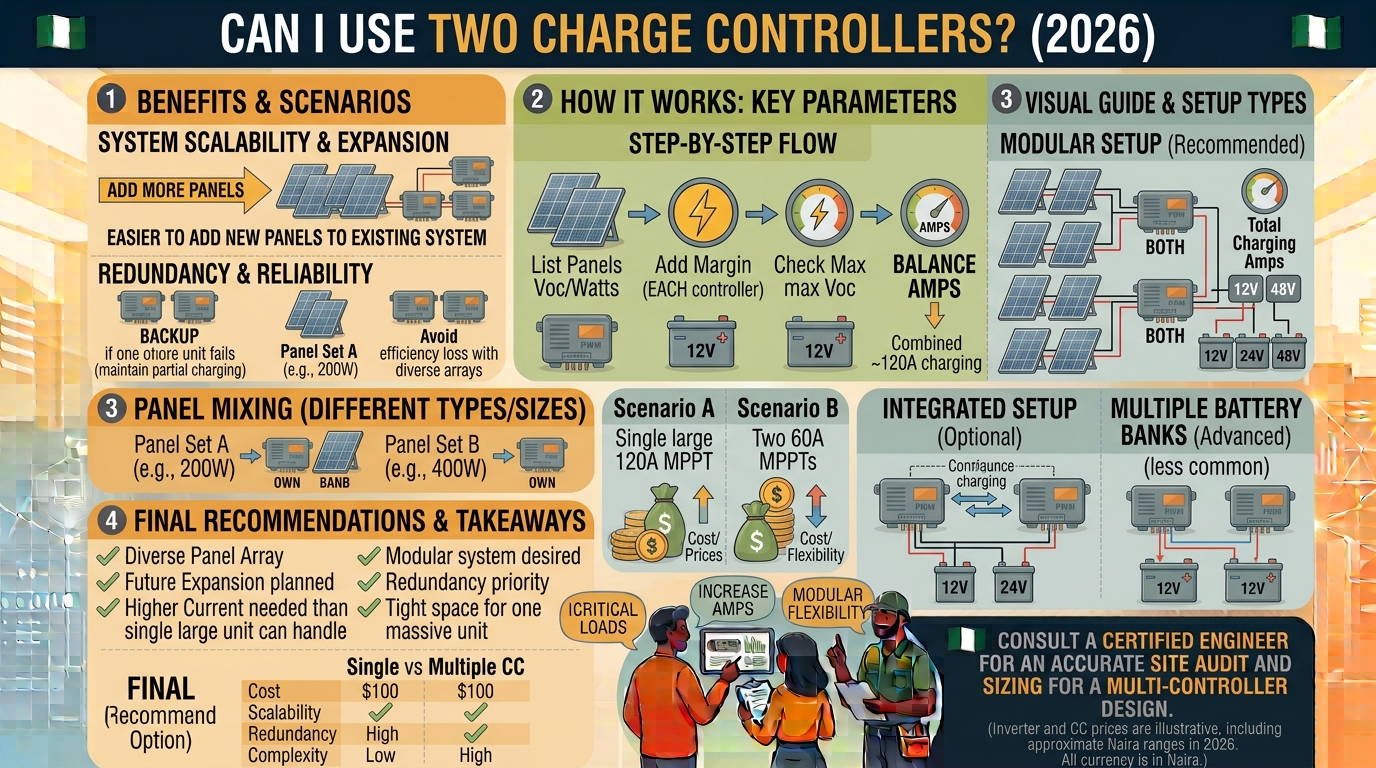
Can I Use Two Charge Controllers?
Yes.
Using two controllers can be useful when the solar array becomes too large for one controller.
For example, instead of trying to put a large array through one controller, you could divide the panels between two appropriately sized controllers.
This can also make system expansion easier.
However, the controllers and batteries must be configured correctly.
If you are planning a large installation, it is better to have the complete system designed properly rather than simply adding controllers.
Can I Add More Panels Later?
Yes, but you should plan for expansion from the beginning.
For example, if you currently have:
4 × 250W = 1,000W
and you think you may later add another four panels:
8 × 250W = 2,000W
you should consider whether your current charge controller, inverter and battery bank can handle the future system.
Buying a slightly larger controller now may sometimes make sense if it allows reasonable expansion.
But don’t overspend on a very large controller if you have no plans to expand.
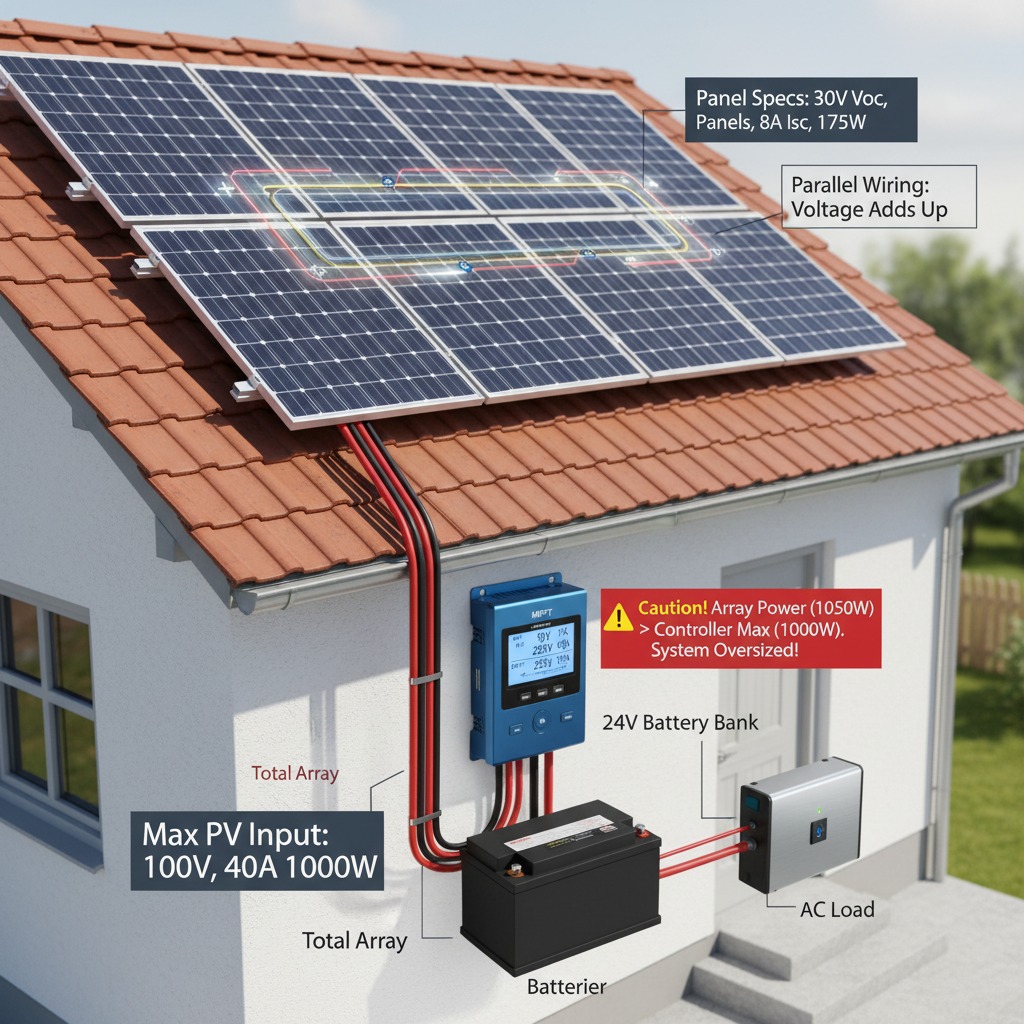
How Do I Know How Many Panels My Controller Can Handle?
Check these five things:
1. Controller maximum PV power
Example:
1,500W max PV
Your solar array should be designed around that limit.
2. Maximum PV voltage
Example:
100V max PV
Your panel string must stay below this limit.
3. Maximum charging current
Example:
60A
The controller cannot deliver unlimited charging current.
4. Battery voltage
12V, 24V and 48V systems require different current levels for the same solar power.
5. Panel specifications
Check:
- Voc
- Vmp
- Isc
- Imp
- Wattage
Use Our Solar Charge Controller Calculator
If you are not sure how many panels your controller can handle, our Solar Charge Controller Calculator can help you estimate the required controller size.
You can use the result as a starting point before checking the specifications of the actual controller you want to buy.
After calculating the required size, you can also check our Solar Prices in Nigeria page to see estimated prices for different charge controller sizes.
Check Your Solar Panel Requirements Too
The charge controller is only one part of the system.
You also need to know how many solar panels you need.
Our Solar Panel Calculator can help you estimate the number and wattage of panels required for your system.
For example, you can use it to compare different panel sizes such as:
- 100W
- 150W
- 200W
- 250W
- 300W
- 400W
- 450W
- 500W
- and larger panels.
You can then check the Nigerian market prices for those panels on our Solar Prices in Nigeria page.
Don’t Forget the Battery and Inverter
Your solar panels and charge controller must also work with your battery and inverter.
If you need help choosing your battery size, use our Battery Calculator.
For inverter sizing, use our Inverter Calculator.
And if you want to estimate the cost of the complete installation, use our Solar Installation Cost Calculator.
Simple Example: 4 × 250W Solar Panels
Let’s put everything together.
Suppose you have:
4 × 250W panels
Total:
1,000W
Battery:
24V
Controller:
MPPT
Basic charging current:
1,000 ÷ 24 = 41.7A
With a 25% planning margin:
41.7 × 1.25 = 52.1A
You would therefore look at a controller around 60A, provided the controller supports the array’s maximum PV power and voltage.
The next step is checking how you will connect the four panels.
You must compare their Voc and Vmp with the controller’s PV voltage range.
Don’t Size a Charge Controller by Amps Alone
The controller’s amp rating is only one part of the calculation. Before choosing a solar charge controller, check:
- Battery-system voltage
- Total solar panel wattage
- Panel voltage
- Panel current
- Maximum PV input voltage
- Maximum PV input current
- Maximum PV array power
- Whether the controller is PWM or MPPT
This is why a 60A controller does not always mean the same number of solar panels on every solar system.
Frequently Asked Questions
How many solar panels can I put on a 60A charge controller?
It depends on the system voltage, panel wattage and the controller’s maximum PV input limits. A 60A controller on a 12V system has a very different practical capacity from one used on a 48V system.
What size solar controller do I need for a 500W solar panel?
It depends on the battery voltage, panel specifications and controller type. Check the controller’s maximum PV input voltage, current and power rather than choosing a controller from the 500W figure alone.
Can I connect 600W solar panels to a 60A charge controller?
Possibly, but the answer depends on the number of panels, battery voltage and the controller’s maximum PV input specifications. Check the manufacturer’s limits before connecting the array.
Final Advice
The number of solar panels a charge controller can handle is not determined by the number of panels alone.
For example, four 250W panels give you:
1,000W
But whether one controller can handle that 1,000W depends on:
Panel wattage + panel voltage + panel current + battery voltage + controller specifications.
So don’t buy a charge controller based only on its amp rating.
First calculate your system.
Use our Solar Charge Controller Calculator
Then check the available equipment and estimated Nigerian prices on:
Solar Prices in Nigeria
You can also use: