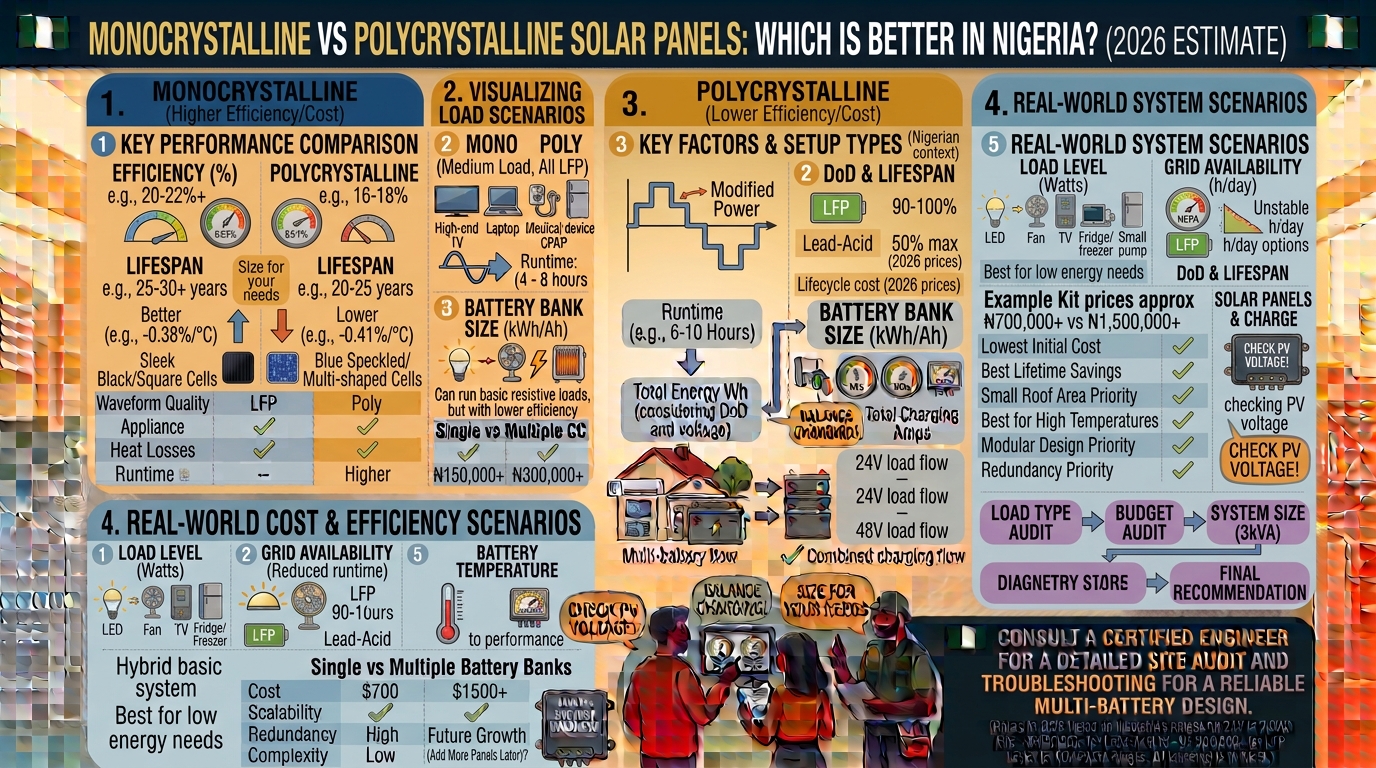
If you are planning to buy solar panels in Nigeria, you will probably come across two names:
Monocrystalline
and
Polycrystalline
Both are solar panel technologies that use silicon to convert sunlight into electricity.
But they are not exactly the same.
So which one should you buy?
For most new solar installations in Nigeria, monocrystalline panels are usually the better choice.
They generally offer higher efficiency and make better use of limited roof space.
However, polycrystalline panels can still work, especially if you find a good deal and have enough installation space.
Let’s compare them properly.
Monocrystalline vs Polycrystalline at a Glance
| Feature | Monocrystalline | Polycrystalline |
|---|---|---|
| Efficiency | Generally higher | Generally lower |
| Space required | Less | More |
| Appearance | Usually black/dark | Usually blue |
| Cost per watt | Often competitive | Historically cheaper |
| Performance in heat | Generally better | Generally lower |
| Low-light performance | Generally good | Generally good |
| Technology | Newer/common in modern panels | Older technology |
| Best for limited roof space | Yes | Less suitable |
| Best for modern systems | Yes | Can still work |
| Availability in new installations | Very common | Less common |
| Long-term choice | Generally preferred | Can be suitable on a budget |
Actual performance depends on the exact panel model, manufacturer, cell technology, temperature, installation and operating conditions.
What Is a Monocrystalline Solar Panel?
A monocrystalline solar panel is made using solar cells produced from a single crystal structure of silicon.
You will usually recognize these panels by their dark or black appearance.
Monocrystalline panels are now very common in residential and commercial solar installations.
One of their biggest advantages is efficiency.
Because they can produce more power from a given amount of panel area, they are useful when roof space is limited.
For example, if you need a large solar array but your roof is small, using higher-efficiency panels can help you achieve the required capacity without covering as much space.
What Is a Polycrystalline Solar Panel?
Polycrystalline solar panels are also made from silicon, but the manufacturing process uses multiple silicon crystal fragments.
They are commonly recognized by their blue or blue-speckled appearance.
Polycrystalline panels were very popular when solar panels were more expensive.
They offered a cheaper way to produce solar power.
However, solar panel technology has improved significantly, and monocrystalline panels have become much more common.
This does not mean polycrystalline panels cannot work.
They can still produce electricity and can be useful in the right situation.

What Is the Main Difference Between Mono and Poly Panels?
The biggest practical difference is efficiency.
A higher-efficiency panel can produce more electricity from the same amount of surface area.
For example, imagine two panels:
Panel A: 400W monocrystalline
Panel B: 400W polycrystalline
Both are rated at 400W.
But the physical size and efficiency may be different.
The important point is that the wattage rating alone does not tell you everything about a panel.
You should also look at:
- Panel efficiency
- Dimensions
- Operating voltage
- Operating current
- Temperature coefficient
- Warranty
- Degradation rate
- Manufacturer
Which Is More Efficient?
Monocrystalline is generally more efficient.
Modern monocrystalline panels commonly achieve higher efficiency than traditional polycrystalline panels.
This means you can produce more watts from a smaller area.
This becomes important in Nigeria because many homes have limited roof space.
If your solar system requires 5kW, for example, the number and physical size of panels matter.
A higher-efficiency panel can make it easier to fit the required solar array on your roof.
Which Is Better for Nigerian Weather?
Modern monocrystalline panels are generally the better choice.
Nigeria has strong sunlight, but we also have high temperatures.
Solar panel output changes with temperature.
As the panel gets hotter, its power output normally falls.
This means you should not look only at the panel’s advertised wattage.
You should also check its temperature coefficient.
A panel with a better temperature coefficient can lose less power as temperatures rise.
Modern monocrystalline technologies can offer strong performance in these conditions.
However, you should still compare the actual datasheet of the panels you are considering.
Does Polycrystalline Perform Badly in Nigeria?
No.
This is important.
Polycrystalline panels can still produce electricity in Nigeria.
They are not useless.
The issue is that modern monocrystalline panels can often provide better efficiency and value for the space used.
So the question is not:
“Can polycrystalline work in Nigeria?”
Yes, it can.
The better question is:
“Does polycrystalline still give me the best value compared with the monocrystalline panels available today?”
In many new installations, the answer will be monocrystalline.
Which One Produces More Electricity?
If you compare panels with the same wattage rating, both are designed to produce that rated power under standard test conditions.
For example:
400W mono ≈ 400W poly
on the nameplate.
But you need to look beyond the nameplate.
If you compare panels based on:
- Available roof space
- Panel efficiency
- Temperature behaviour
- Actual operating conditions
- Number of panels
- Long-term degradation
the more modern monocrystalline panel may provide better overall value.
This is why simply asking which panel has more watts is not enough.
Which One Needs Less Roof Space?
Monocrystalline.
This is one of its biggest advantages.
Suppose you need a 5kW solar array.
You could use:
10 × 500W panels = 5,000W
The actual roof area depends on the dimensions of those particular panels.
If you have limited roof space, the physical size and efficiency of the panel become important.
This is especially useful for homes in cities where roof space may be limited.
Use our Solar Panel Calculator to estimate the solar panel capacity and number of panels you may need.
Which One Is Cheaper?
Historically, polycrystalline panels were usually cheaper.
But the difference is not always large today.
The price depends on:
- Brand
- Wattage
- Cell technology
- Panel efficiency
- Availability
- Import costs
- Exchange rate
- Seller
- Warranty
You should therefore compare the price per watt, not just the price of one panel.
For example:
Panel A costs ₦150,000 and produces 500W.
Panel B costs ₦180,000 and produces 600W.
Panel B costs more per panel, but it may offer better value per watt.
You can check current panel price ranges on our Solar Panel Prices in Nigeria page.
How Do You Calculate Price Per Watt?
A simple calculation is:
Panel price ÷ panel wattage = price per watt
For example:
₦150,000 ÷ 500W = ₦300 per watt
Another panel:
₦180,000 ÷ 600W = ₦300 per watt
In this example, both have the same price per watt.
But you should still compare the complete specifications before deciding.
Which One Is Better for a Small Roof?
Monocrystalline.
If roof space is limited, higher-efficiency panels can be very useful.
You may be able to install the required solar capacity using fewer or smaller panels.
This can also simplify the installation.
However, don’t choose panels based on efficiency alone.
Check their physical dimensions and actual wattage.
Which One Is Better for a Large Roof?
If you have plenty of space, the difference becomes less important.
You could potentially use polycrystalline panels if they are significantly cheaper and available in good condition.
But if the price difference is small, modern monocrystalline panels are usually the more attractive choice.
Which One Lasts Longer?
Both types can last for many years when properly manufactured and installed.
Solar panels are normally designed for long-term operation.
However, the exact expected performance depends on the panel model and manufacturer.
When comparing panels, look at the performance warranty.
For example, some modern panels are backed by performance warranties extending to 25 or 30 years.
Don’t judge a panel’s lifespan simply by whether it is mono or poly.
The manufacturer and specific technology matter.
Which One Degrades Faster?
All solar panels gradually lose some of their ability to produce power over time.
This is called degradation.
The degradation rate depends on the panel technology and manufacturer.
Modern panels can have relatively low annual degradation rates.
So when buying a panel, check the manufacturer’s stated:
- First-year degradation
- Annual degradation
- End-of-warranty power output
This gives you a better idea of how much power the panel is expected to produce later in its life.
Mono vs Poly in Hot Weather
Temperature is an important consideration in Nigeria.
A panel’s power output normally falls as its cell temperature increases.
This is why two panels with the same 500W rating may not behave exactly the same way in real conditions.
Look at the Pmax temperature coefficient on the datasheet.
For example, a specification might show something like:
-0.30%/°C
The more negative the number, the more output the panel loses as temperature rises, all else being equal.
So don’t choose a panel simply because it says “500W.”
Read the datasheet.
What About Cloudy Weather and Harmattan?
Both monocrystalline and polycrystalline panels can generate electricity during cloudy conditions because sunlight still reaches the panels.
However, their output will be lower than during strong sunlight.
Modern panel technologies can perform well under lower-light conditions, but you should not expect a panel to produce its full rated wattage when sunlight is weak.
During Harmattan, dust can also reduce the amount of sunlight reaching the panel.
This makes regular cleaning important.
Does Cleaning Affect Solar Panel Performance?
Yes.
Dust, dirt and other materials on the panel surface can reduce the sunlight reaching the cells.
This is particularly relevant in dusty areas and during Harmattan.
Regardless of whether you buy mono or poly panels, keeping them reasonably clean can help maintain their output.
However, cleaning should be done safely and according to the manufacturer’s recommendations.
Which One Is Better for a 3kW Solar System?
Both can be used.
For example, you could build a 3kW array using:
6 × 500W panels = 3,000W
The exact number depends on the panel wattage.
A modern monocrystalline panel would generally be my preferred choice if the price and specifications are reasonable.
But don’t forget that the inverter’s solar input must support the array.
You should check:
- Maximum PV voltage
- MPPT voltage range
- Maximum PV current
- Maximum PV power
before connecting the panels.
Which One Is Better for a 5kW Solar System?
Monocrystalline is generally the better choice.
A 5kW array could use:
10 × 500W panels
or:
9 × 550W panels = 4,950W
or another suitable combination.
The final arrangement depends on the inverter and panel specifications.
Our Solar Panel Calculator can help you estimate the number of panels.
Which One Is Better for a 10kW Solar System?
For a larger system, monocrystalline becomes even more attractive when roof space matters.
For example:
20 × 500W = 10kW
or:
17 × 600W = 10.2kW
The exact design must consider the inverter’s PV input limits.
Large systems should be designed carefully rather than simply connecting as many panels as possible.
What About Modern TOPCon Panels?
This is where solar panel technology has moved beyond the simple mono vs poly discussion.
You may now see technologies such as:
- PERC
- TOPCon
- HJT
- N-type
- Bifacial
Many modern TOPCon and HJT panels are based on monocrystalline silicon.
So when a seller says:
“This is a monocrystalline panel.”
you should still ask:
“What cell technology?”
A modern N-type TOPCon panel is not the same as an older monocrystalline panel.
Technology has continued to improve.
Should You Still Buy Polycrystalline in 2026?
You can, but be careful.
If you find a good-quality polycrystalline panel at a significantly lower price, it may still make sense for a particular project.
But if the price difference between a suitable poly panel and a modern mono panel is small, I would normally choose monocrystalline.
There is little reason to choose an older technology simply because it has a different colour.
Check the actual specifications and price.
Which Is Better for a Nigerian Home?
Monocrystalline.
For most homeowners, I would choose a good-quality monocrystalline panel.
It offers:
- Higher efficiency
- Better use of roof space
- Strong availability
- Modern technology
- Good long-term value
But don’t buy the cheapest mono panel you can find.
The brand, warranty, specifications and seller still matter.
Which Is Better for a Business?
Usually monocrystalline.
Businesses often have larger energy requirements.
Roof space may also be limited.
Higher-efficiency panels can help you install more solar capacity without requiring as much physical space.
For commercial systems, however, the best choice should be based on the complete project cost rather than panel type alone.
Which Is Better for Rural or Small Solar Systems?
This depends on the system.
A small rural system may use:
- 100W panel
- 200W panel
- 250W panel
- 300W panel
or other smaller sizes.
You don’t always need the latest high-efficiency panel for a very small system.
Our Solar Panel Prices in Nigeria database includes smaller panel options as well as larger panels.
This is useful because not every Nigerian solar buyer needs a 500W or 600W panel.
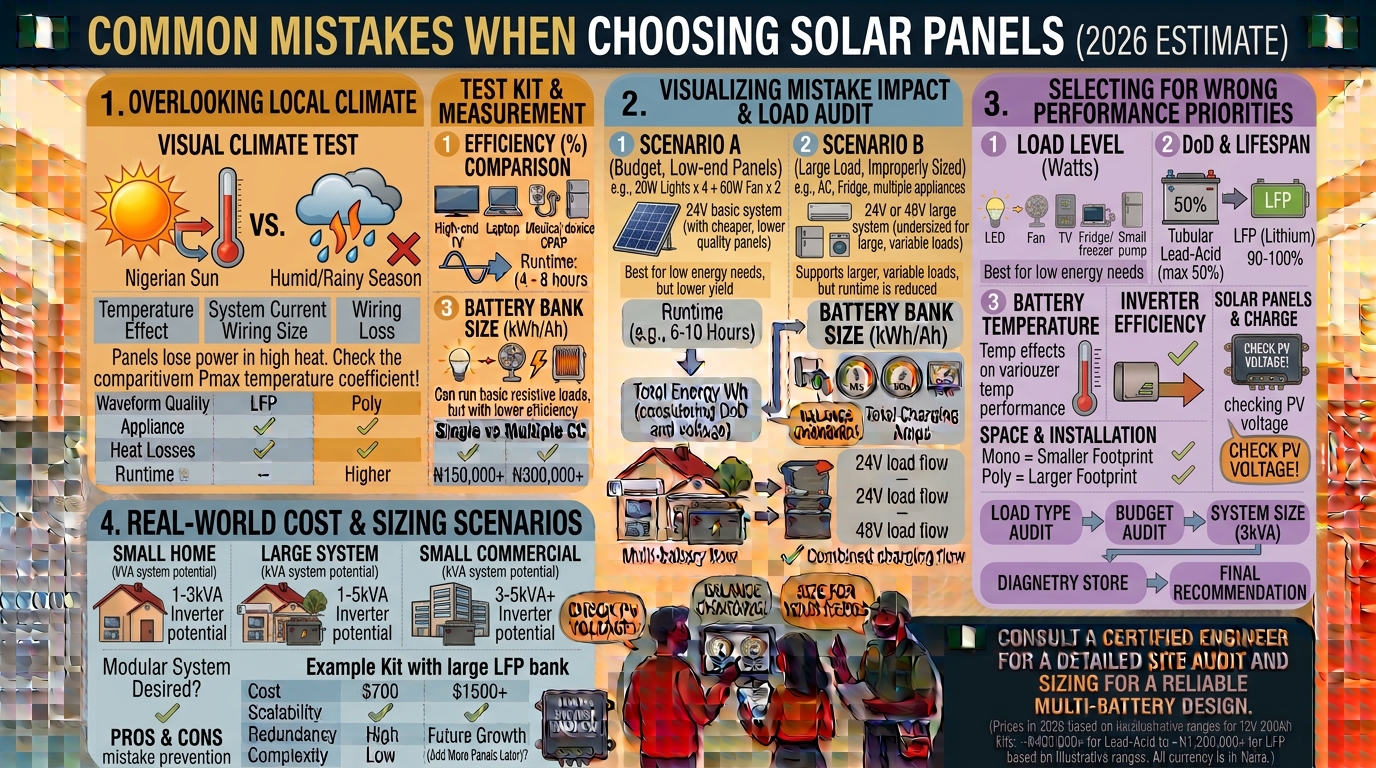
Common Mistakes When Choosing Solar Panels
1. Choosing only by wattage
A 500W label does not tell you everything.
Check the complete datasheet.
2. Choosing only by price
The cheapest panel may not offer the best long-term value.
3. Ignoring physical size
Two panels with similar wattage can have different dimensions.
Make sure they will fit your roof.
4. Ignoring temperature coefficient
Nigeria can be very hot.
Temperature affects panel output.
5. Ignoring warranty
A good warranty can be important when buying equipment expected to work for many years.
6. Buying without checking the brand
Ask who manufactured the panel and whether the seller can provide proper product information.
7. Ignoring the inverter
Your solar panels must be compatible with your inverter’s PV input.
Don’t buy panels first and only later discover that their voltage is outside the inverter’s MPPT range.
How Many Solar Panels Do You Need?
The answer depends on your required solar power.
For example:
2kW system
4 × 500W panels = 2,000W
3kW system
6 × 500W panels = 3,000W
5kW system
10 × 500W panels = 5,000W
These are simple examples.
Your actual panel requirement may be higher depending on:
- Daily energy consumption
- Peak sun hours
- System losses
- Battery charging requirements
- Inverter limitations
- Panel orientation
- Temperature
- Shading
That is why it is better to calculate your system instead of simply copying someone else’s panel count.
Use our Solar Panel Calculator to get a starting estimate.
Monocrystalline vs Polycrystalline: Simple Decision Guide
| Your situation | Better choice |
|---|---|
| Limited roof space | Monocrystalline |
| New home solar installation | Monocrystalline |
| Want higher efficiency | Monocrystalline |
| Want modern technology | Monocrystalline |
| Large roof with very low budget | Poly may work |
| Found significantly cheaper quality poly panels | Poly may be considered |
| Long-term residential system | Monocrystalline |
| Commercial solar system | Usually monocrystalline |
| Small basic solar system | Either, depending on price |
| Choosing in 2026 | Monocrystalline is generally preferred |
Final Verdict
Monocrystalline is generally the better choice for most solar buyers in Nigeria.
It offers higher efficiency, uses roof space more effectively and is widely used in modern solar installations.
Polycrystalline panels can still work.
If you already have a good-quality polycrystalline panel at a very good price, you do not automatically need to reject it.
But if you are buying new panels today and the price difference is reasonable, I would normally choose monocrystalline.
More importantly, don’t choose a solar panel based only on:
“Mono is better.”
Check the actual panel.
Look at:
- Wattage
- Efficiency
- Voltage
- Current
- Temperature coefficient
- Warranty
- Degradation rate
- Dimensions
- Manufacturer
- Price per watt
That is how you make a better solar buying decision.
Frequently Asked Questions
Is monocrystalline better than polycrystalline?
For most new solar installations, yes. Monocrystalline panels generally offer higher efficiency and better use of available space.
Is polycrystalline still good?
Yes. Polycrystalline panels can still produce electricity and may make sense when the price is significantly lower and enough installation space is available.
Which solar panel is best for Nigeria?
A good-quality modern monocrystalline panel is generally a strong choice for Nigerian homes and businesses. The exact panel should still be selected based on its datasheet, price, warranty and system requirements.
Does monocrystalline produce more power?
A higher-efficiency monocrystalline panel can produce more power from the same amount of surface area. But a 500W mono panel and 500W poly panel are both rated at 500W under their test conditions.
Are monocrystalline panels more expensive?
They can be, but the price difference varies by brand, wattage and market conditions. Compare the price per watt rather than only the price of one panel.
Which solar panel is better in hot weather?
The answer depends on the panel’s temperature coefficient and design. Modern monocrystalline panels can offer strong temperature performance, but always compare the actual datasheets.
Can polycrystalline panels work with lithium batteries?
Yes. The panel type and battery chemistry are separate issues. The important thing is that the solar array, charge controller or inverter and battery are correctly matched.
Can I mix mono and poly solar panels?
It is possible in some situations, but it is not something you should do randomly.
Panels connected together need to be compatible in terms of voltage, current and electrical configuration.
If panels have significantly different specifications, they may not operate efficiently together.
Ask a qualified installer to check the design before mixing different panels.
How long do monocrystalline solar panels last?
Good-quality solar panels are designed to operate for many years. The exact expected performance depends on the manufacturer, model and warranty.
Should I buy 500W or 550W solar panels?
Don’t choose only by wattage.
Compare:
- Price
- Physical size
- Efficiency
- Voltage
- Current
- Warranty
- Temperature coefficient
A 550W panel is not automatically the better deal.
Check our Solar Panel Prices in Nigeria page to compare available panel options.
Plan Your Solar System
Before buying your panels, use our free tools:
Solar Panel Calculator — Estimate your solar panel requirement.
Battery Calculator — Estimate your battery storage requirement.
Inverter Calculator — Estimate the inverter size based on your appliances.
Solar Installation Cost Calculator — Estimate the likely installation cost.
You can also check Solar Panel Prices in Nigeria to compare current estimated prices and available panel sizes.
Prices and specifications can change. Always confirm the exact specifications, compatibility, warranty and final price with the manufacturer, seller or qualified installer before purchasing.