
If you are looking for an inverter in Nigeria, you may have seen two common types:
Pure sine wave inverter
and
Modified sine wave inverter
The price difference can be noticeable, so it is normal to ask:
Do I really need pure sine wave, or can I save money with modified sine wave?
The simple answer is:
For most Nigerian homes, a pure sine wave inverter is the better choice.
A modified sine wave inverter can still work for some simple appliances, especially when the budget is very limited.
But if you want to power appliances such as refrigerators, freezers, pumps, computers, TVs, chargers and other modern electronics, pure sine wave is generally the safer choice.
Let’s look at the difference.
Pure Sine Wave vs Modified Sine Wave at a Glance
| Feature | Pure Sine Wave | Modified Sine Wave |
|---|---|---|
| Output quality | Smooth and clean | Stepped waveform |
| Similar to grid electricity | Yes | No |
| Price | Usually higher | Usually cheaper |
| Motors | Better suited | Can cause noise or poor performance |
| Refrigerators | Recommended | Not ideal |
| Freezers | Recommended | Not ideal |
| Fans | Generally better | May buzz or run differently |
| TVs | Generally suitable | Some may work, others may have issues |
| Computers | Better choice | Not recommended for sensitive systems |
| Phone/laptop chargers | Better choice | Some may work, but can run hotter |
| Pumps | Better choice | Usually not recommended |
| Sensitive electronics | Better | Less suitable |
| Efficiency | Generally better for suitable loads | Can be less efficient with some loads |
| Best for | Modern homes and mixed loads | Basic, simple loads |
The exact behaviour depends on the inverter and the appliance. Not every appliance will react the same way to modified sine wave power.
What Is a Pure Sine Wave Inverter?
A pure sine wave inverter produces an AC output that is very similar to the electricity supplied by the public power grid.
This makes it suitable for a wide range of appliances.
A pure sine wave inverter can be used with appliances such as:
- TVs
- Refrigerators
- Freezers
- Fans
- Computers
- Laptops
- Routers
- Chargers
- Washing machines
- Pumps
- Air conditioners
- Other electronic equipment
This is why most modern solar inverters sold for homes use pure sine wave output.
For example, many of the inverters currently listed in the SolarPriceNG database are pure sine wave models. You can see the available options on our Solar Prices in Nigeria page.
What Is a Modified Sine Wave Inverter?
A modified sine wave inverter produces an AC waveform that is simpler and more stepped than pure sine wave.
It can still power many basic electrical loads.
For example, it may work with:
- Simple lights
- Some fans
- Some TVs
- Basic electronics
- Some phone chargers
- Other simple resistive loads
The problem is that some appliances do not work well with this type of power.
You may experience:
- Buzzing
- Extra heat
- Reduced performance
- Electrical noise
- Charger problems
- Motor problems
- Shorter equipment life in some situations
This does not mean every appliance will fail when connected to modified sine wave.
It means compatibility is less predictable.
Why Does the Waveform Matter?
Electricity supplied by the grid is approximately a smooth sine wave.
A pure sine wave inverter tries to reproduce this type of output.
A modified sine wave inverter produces a stepped approximation.
You don’t necessarily see the difference with your eyes.
But electrical appliances can react differently to the two types of power.
Simple appliances may not care much.
Motors, compressors, transformers, chargers and sensitive electronics can care much more.
This is why the waveform becomes important when choosing an inverter.
Which One Is Better for a Nigerian Home?
Pure sine wave is generally better.
A typical Nigerian home may have many different types of appliances.
For example:
- Refrigerator
- TV
- Decoder
- Fans
- Router
- Laptop
- Phone chargers
- Freezer
- Water pump
- Washing machine
Some of these contain motors, compressors or electronic power supplies.
Instead of trying to determine whether every appliance will work properly with modified sine wave, choosing pure sine wave gives you much wider compatibility.
This is one reason pure sine wave is the better choice for a modern home.
Can a Modified Sine Wave Inverter Power a TV?
Sometimes, yes.
Some TVs can work with modified sine wave power.
However, the result can depend on the TV’s power supply design.
You may notice:
- Buzzing
- Flickering
- Extra heat
- Poor performance
Some TVs may work normally.
Others may not.
So if you are buying an inverter specifically to power modern electronics, pure sine wave is the safer choice.
Can a Modified Sine Wave Inverter Power a Refrigerator?
It is generally not recommended.
A refrigerator has a compressor motor.
Motors can behave differently when supplied with a stepped waveform.
A modified sine wave inverter may cause the compressor to:
- Make unusual noise
- Run less efficiently
- Produce more heat
- Have difficulty starting
The starting power of the refrigerator is also important.
This means you need to consider both the inverter waveform and the inverter’s surge capacity.
For a refrigerator, a good pure sine wave inverter is generally the better option.
What About a Freezer?
The same concern applies to freezers.
A freezer normally uses a compressor, and compressor loads can have a high starting demand.
For this reason, I would recommend a pure sine wave inverter for a freezer rather than taking a chance with a modified sine wave inverter.
You also need to make sure the inverter is large enough to handle the freezer’s running and starting power.
Our Inverter Calculator can help you estimate the inverter capacity you may need based on your appliances.
Can Modified Sine Wave Run a Fan?
It can, but it may not run as smoothly.
Some fans work with modified sine wave inverters.
However, you may notice:
- Buzzing
- Humming
- Extra heat
- Different speed
- Higher power consumption
The exact result depends on the fan and inverter.
If you are powering several fans every day, pure sine wave is usually the better choice.
Can Modified Sine Wave Charge a Phone?
Some phone chargers can work.
But chargers contain electronic components that may not behave the same way on a modified waveform.
A charger may:
- Work normally
- Become warmer
- Make noise
- Charge differently
- Fail to work properly
Because phone chargers are relatively cheap compared with the inverter and other equipment, there is little reason to take unnecessary risks if you are building a complete home backup system.
Pure sine wave is the safer choice.
What About Laptop Chargers?
Laptop chargers can work with some modified sine wave inverters, but compatibility depends on the charger.
Some power supplies may become hotter or make noise.
If you are using a laptop for work or business, I would choose pure sine wave.
The cost difference between inverter types is usually small compared with the cost of replacing important electronics.
Can Modified Sine Wave Power a Water Pump?
It is generally not the best choice.
Water pumps use motors.
Motor loads are one of the areas where pure sine wave inverters have a clear advantage.
A modified sine wave inverter may have difficulty starting some pumps or may cause the motor to run less efficiently.
If you want to run a water pump from solar or battery backup, use a suitable pure sine wave inverter with enough surge capacity.
What About an Air Conditioner?
Use pure sine wave.
Air conditioners normally have compressors and motors, and their starting and running requirements can be significant.
You also need an inverter with enough capacity to handle the load.
For inverter air conditioners, the power requirement can change depending on the operating condition.
For a system that will power an air conditioner, don’t choose an inverter based only on the running wattage.
You need to consider the complete system and the inverter manufacturer’s specifications.
Our Inverter Calculator can help you start the sizing process.
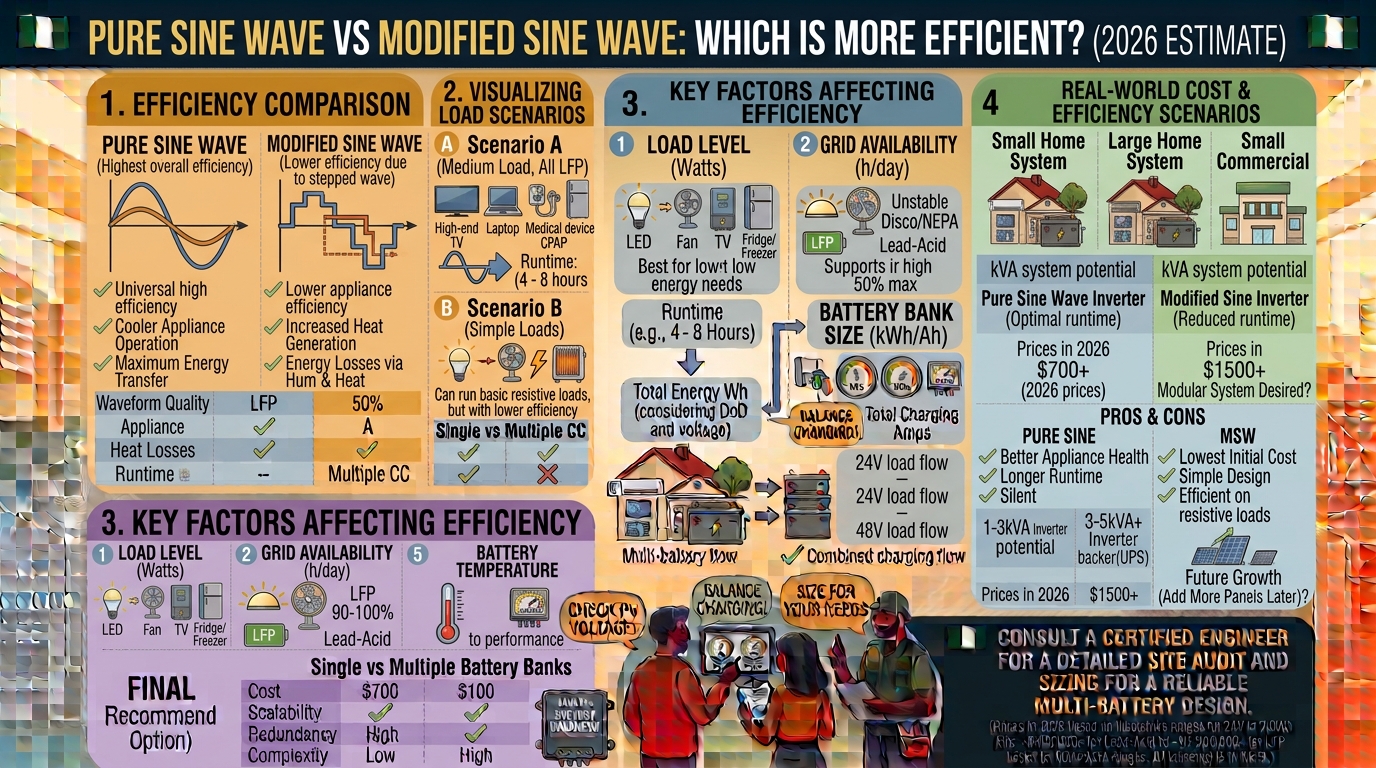
Pure Sine Wave vs Modified Sine Wave: Which Is More Efficient?
Pure sine wave is generally the better choice for mixed household loads.
The actual efficiency depends on the inverter design and the load.
A modified sine wave inverter may appear attractive because it is cheaper, but some appliances can consume more power or operate less efficiently when supplied with a stepped waveform.
For example, motors may run less smoothly.
So don’t judge an inverter only by its purchase price.
You should also consider how efficiently it powers the appliances you actually use.
Which One Is More Expensive?
Modified sine wave is usually cheaper.
This is its biggest advantage.
If someone only wants to power a few simple loads, a modified sine wave inverter can provide a lower-cost entry point.
However, pure sine wave inverters are now available in many different sizes and price ranges.
Our Solar Inverter Prices in Nigeria guide explains the different inverter sizes and what affects their prices.
You can also check our live Inverter Prices in Nigeria database for current estimated prices.
Is Pure Sine Wave Worth the Extra Money?
For most homes, yes.
If your inverter will only power a light bulb or a very simple load, modified sine wave may be enough.
But a home normally has several types of appliances.
You may start with:
- Lights
- Fans
- TV
Then later add:
- Refrigerator
- Freezer
- Router
- Laptop
- Pump
- Washing machine
- Air conditioner
If you already know that you will expand your system, buying pure sine wave from the beginning can save you from having to replace the inverter later.
Pure Sine Wave vs Modified Sine Wave for Solar Systems
There is another important point.
The waveform is only one part of choosing a solar inverter.
You also need to consider:
- Inverter capacity
- Battery voltage
- Battery capacity
- Solar input
- MPPT capacity
- Surge capacity
- Battery compatibility
- Grid input
- Generator support
- Warranty
For example, a 5kVA pure sine wave inverter may still be a poor choice if it cannot handle your solar panel capacity or battery requirements.
The complete system must work together.
Our Solar System Calculator tools can help you start planning the different parts of the system.
Does Pure Sine Wave Mean the Inverter Is Better Quality?
Not automatically.
This is very important.
An inverter being pure sine wave does not automatically mean it is a high-quality inverter.
You still need to check:
- Brand
- Model
- Build quality
- Warranty
- Surge capacity
- Efficiency
- Battery compatibility
- Solar input
- Protection features
- After-sales support
A poor-quality pure sine wave inverter can still be a bad purchase.
Likewise, a modified sine wave inverter may be perfectly adequate for a very simple application.
Can I Use a Modified Sine Wave Inverter for Lights and Fans?
It may work.
If your system is only powering simple loads such as:
- LED bulbs
- Some fans
- Some basic electronics
a modified sine wave inverter may be sufficient.
But if you are building a complete home backup system, I would still recommend pure sine wave.
This is because you are less likely to run into compatibility problems when you add more appliances later.
Which One Should I Buy for a Small Home?
If your small home only needs:
- Lights
- Fans
- TV
- Decoder
- Router
a small pure sine wave inverter is still my preferred choice.
You do not necessarily need a large inverter.
You just need a properly sized one.
Use our Inverter Calculator to estimate your required capacity.
Which One Should I Buy for a Large Home?
Pure sine wave.
For a larger home with:
- Refrigerator
- Freezer
- Multiple fans
- TVs
- Computers
- Pumps
- Washing machine
- Air conditioners
I would not recommend choosing modified sine wave simply because it is cheaper.
A properly sized pure sine wave inverter is the better choice.
You can also read our guide:
How Many kVA Inverters Do I Need for My Home in Nigeria?
That guide explains why inverter size should be based on your actual appliance load.
What About Sachet Inverters in Nigeria?
In Nigeria, you may hear people call some small modified sine wave inverters “sachet inverters.”
These are usually low-cost inverter products designed for basic backup needs.
They can be attractive because they are cheap and easy to get.
For example, someone may want a small backup system for:
- Lights
- Fan
- TV
- Decoder
- Phone charging
A sachet-type inverter may be enough for such basic use.
But you should not expect the same performance or appliance compatibility as a good pure sine wave solar inverter.
If you plan to power refrigerators, freezers, pumps, computers or other sensitive loads, pure sine wave is generally the better option.
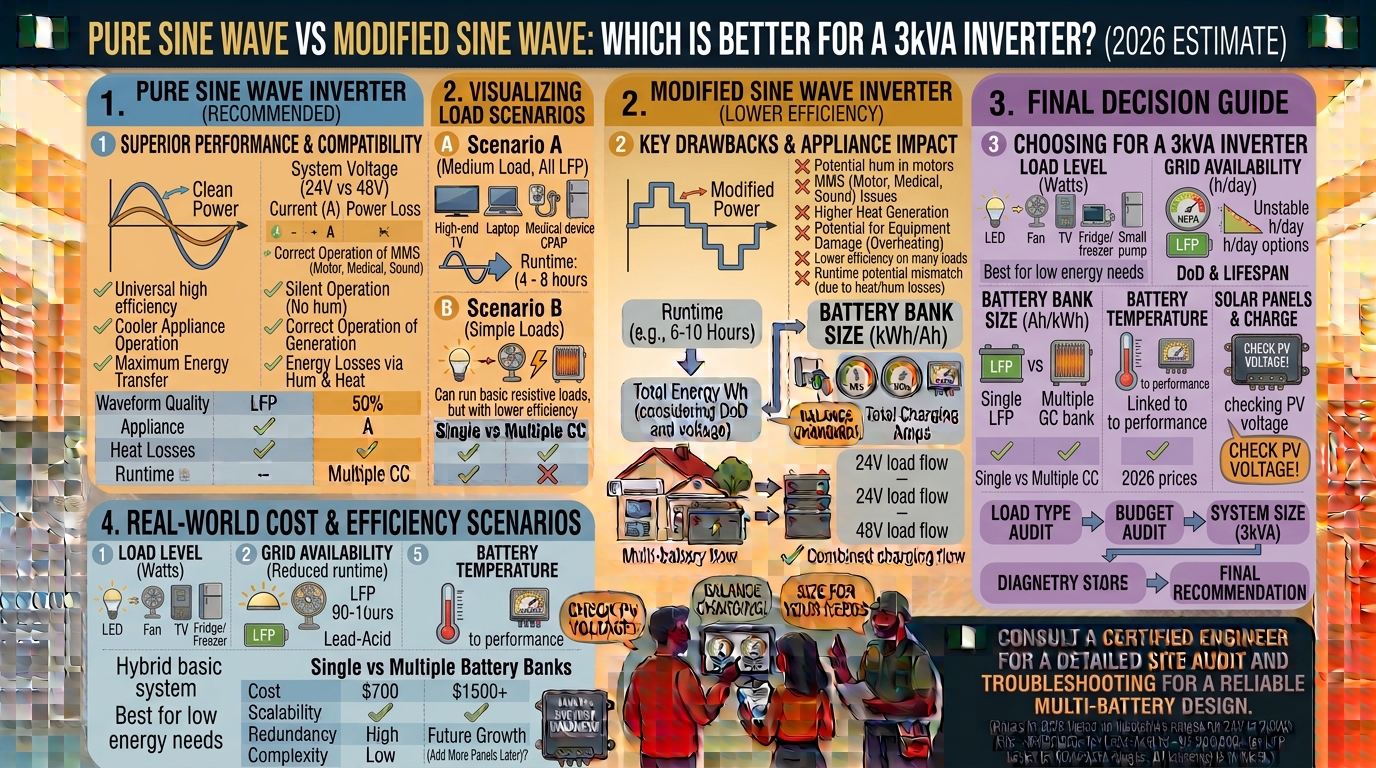
Pure Sine Wave vs Modified Sine Wave: Which Is Better for a 3kVA Inverter?
If you are choosing between a 3kVA pure sine wave and 3kVA modified sine wave inverter, I would choose pure sine wave for a home.
The 3kVA rating tells you about the inverter’s power capacity.
The waveform tells you about the type of AC power it produces.
So these are two different things.
A 3kVA modified sine wave inverter is not automatically better than a 2kVA pure sine wave inverter just because the first number is larger.
You need to consider both:
Power capacity + waveform
Our 3kVA inverter prices and options can help you compare available models.
Pure Sine Wave vs Modified Sine Wave: Which Is Better for a 5kVA System?
For a 5kVA home solar system, I would strongly recommend pure sine wave.
A 5kVA system is normally intended for more than a few lights and fans.
You may want to run:
- Refrigerator
- Freezer
- TV
- Fans
- Router
- Pump
- Washing machine
- Other household appliances
Pure sine wave gives you better compatibility with this type of mixed load.
You can also compare available 5kVA inverters in Nigeria before buying.
How Do I Know If My Inverter Is Pure Sine Wave?
Don’t assume it is pure sine wave because the seller says it is a “solar inverter.”
Check the product specification.
Look for:
Output waveform: Pure Sine Wave
or:
Pure Sine Wave Output
If the specification says:
Modified Sine Wave
then it is not a pure sine wave inverter.
If the seller cannot clearly tell you the waveform, ask for the manufacturer’s datasheet before paying.
Should I Buy a Modified Sine Wave Inverter to Save Money?
Only if your loads are very simple.
If you are on a tight budget and only need basic backup, modified sine wave can make sense.
But if the difference in price is manageable, I would rather buy a smaller pure sine wave inverter than a larger modified sine wave inverter for a home.
For example, instead of buying a cheap 3kVA modified sine wave inverter because it looks powerful, you may be better off buying a properly sized pure sine wave inverter that can safely run the appliances you actually need.
Pure Sine Wave vs Modified Sine Wave: Simple Decision Guide
| Your situation | Better choice |
|---|---|
| Only basic lights | Either |
| Simple fan and lights | Either, but pure sine preferred |
| TV and decoder | Pure sine preferred |
| Refrigerator | Pure sine |
| Freezer | Pure sine |
| Water pump | Pure sine |
| Computer | Pure sine |
| Laptop | Pure sine preferred |
| Air conditioner | Pure sine |
| Mixed household appliances | Pure sine |
| Long-term home solar system | Pure sine |
| Very limited budget and simple loads | Modified sine can work |
Common Mistakes to Avoid
1. Choosing only by price
The cheapest inverter is not always the cheapest solution over time.
If the inverter cannot properly power your appliances, you may eventually have to replace it.
2. Looking only at kVA
A 3kVA or 5kVA rating does not tell you everything.
You also need to know the waveform, surge capacity, battery voltage and other specifications.
3. Ignoring starting power
Refrigerators, freezers, pumps and some motors can require more power when starting.
Your inverter must be able to handle that demand.
4. Assuming every appliance works the same
Some appliances work fine with modified sine wave.
Others do not.
Never assume that because your friend’s TV works on one inverter, your refrigerator or pump will behave the same way.
5. Buying without checking the datasheet
Always check the manufacturer’s specifications before buying.
Final Verdict
If you are buying an inverter for a modern Nigerian home:
Choose pure sine wave.
It is generally more suitable for household appliances and gives you better compatibility with motors, compressors, chargers and electronics.
Modified sine wave can still be useful when:
- Your budget is very limited
- Your loads are simple
- You understand its limitations
- You don’t need to run sensitive or motor-based appliances
But for a proper home solar system, the extra money spent on a good pure sine wave inverter is usually worth it.
The important thing is to choose the right size as well.
A pure sine wave inverter that is too small can still overload.
So before buying, calculate your actual appliance load and choose an inverter that can handle both the running power and starting requirements.
Frequently Asked Questions
Is pure sine wave better than modified sine wave?
Yes, for most home and solar applications. Pure sine wave produces cleaner AC power and is generally more compatible with modern electronics, motors and compressors.
Is modified sine wave bad?
Not necessarily. It can work well with some simple loads. The problem is that some appliances do not perform well with it.
Can modified sine wave damage appliances?
It can cause some appliances to run poorly, become hotter, make noise or operate less efficiently. Compatibility depends on the appliance.
Can I use a modified sine wave inverter for a refrigerator?
It is generally not recommended. Refrigerators use compressors, and pure sine wave is a safer choice.
Can I use modified sine wave for a TV?
Some TVs can work with it, but others may have problems. Pure sine wave is generally the safer choice.
Can modified sine wave run a fan?
Some fans can run on modified sine wave, but they may buzz, run differently or become hotter.
Is pure sine wave more expensive?
Usually, yes. But the price difference depends on the inverter size, brand and features.
Is pure sine wave worth the extra money?
For most homes, yes. The wider appliance compatibility makes it a better long-term choice.
What is a sachet inverter?
In Nigeria, “sachet inverter” is commonly used to describe some small, low-cost inverter products, often using modified sine wave output. They can be useful for basic backup but are not normally the best choice for a complete home solar system.
Does pure sine wave use more battery?
Not necessarily. A good pure sine wave inverter can be very efficient. Battery usage depends mainly on the load, inverter efficiency, battery capacity and how long the appliances run.
Does pure sine wave mean my inverter is solar?
No. Pure sine wave describes the AC output waveform. An inverter can be pure sine wave without having solar charging capability.
Can a hybrid inverter be pure sine wave?
Yes. Many modern hybrid inverters use pure sine wave output. For example, several hybrid models currently listed in the SolarPriceNG database are described as pure sine wave.
What should I check before buying an inverter?
Check:
- Inverter capacity
- Output waveform
- Battery voltage
- Surge capacity
- Solar input
- MPPT specifications
- Battery compatibility
- Grid/generator input
- Warranty
- Manufacturer support
Plan Your Solar System
Before buying your inverter and other equipment, use our free tools:
Inverter Calculator — Estimate the inverter capacity based on your appliances.
Battery Calculator — Estimate the battery storage you may need.
Solar Panel Calculator — Estimate your solar panel capacity and number of panels.
Solar Installation Cost Calculator — Estimate the likely installation cost.
You can also check Solar Prices in Nigeria to compare current estimated prices for pure sine wave inverters, hybrid inverters, batteries, solar panels and other equipment.
Prices and specifications can change. Always confirm the exact specifications, compatibility, warranty and final price with the manufacturer, seller or qualified installer before purchasing.