If you are thinking about buying a 1.5kVA inverter, the most important question is probably not “What is a 1.5kVA inverter?”
You are more likely asking:
Can a 1.5kVA inverter actually power the appliances I use at home?
The answer is yes, for many small and medium household loads, but it depends on the actual watt rating of the inverter, the appliances you want to run together, and the starting power of appliances such as refrigerators and pumps.
A 1.5kVA inverter gives you more room than a 1kVA inverter, but that does not mean you can simply connect every appliance in your house.
This guide will show you what a 1.5kVA inverter can realistically handle, what you should avoid, how much battery you may need, and when it makes more sense to move to a 2kVA or 3kVA system.
Quick Answer
A 1.5kVA inverter can be suitable for a small Nigerian home or apartment running appliances such as:
- LED lights
- TV
- Decoder
- Wi-Fi router
- Fans
- Laptops
- Phone chargers
- Some small electronics
- A refrigerator or freezer in some setups, if its starting demand is compatible
But the exact limit depends on the inverter.
A 1.5kVA label does not automatically mean you have 1,500W of continuous usable power.
For example, a particular 1.5kVA inverter may have a continuous output around 1,200W, while another model may have a different power rating.
That is why you should check the manufacturer’s continuous watt rating and surge rating before deciding what you can run.
Our current SolarPriceNG inverter listings also show why you should look beyond the headline kVA rating. For example, SolarPriceNG currently lists an SRNE 1.5kVA hybrid inverter as a 12V model, with its own product specifications and market price range.
The First Thing to Understand: 1.5kVA Is Not Always 1,500W
This is one of the most common mistakes people make when choosing an inverter.
kVA and kW are related, but they are not always the same thing.
The actual usable power depends partly on the inverter’s power factor.
So if an inverter is rated:
1.5kVA / 1,200W
you should use the 1,200W continuous output when planning your household load.
Do not simply add appliances until they reach 1,500W.
The exact specification on your inverter should always win over a general rule.
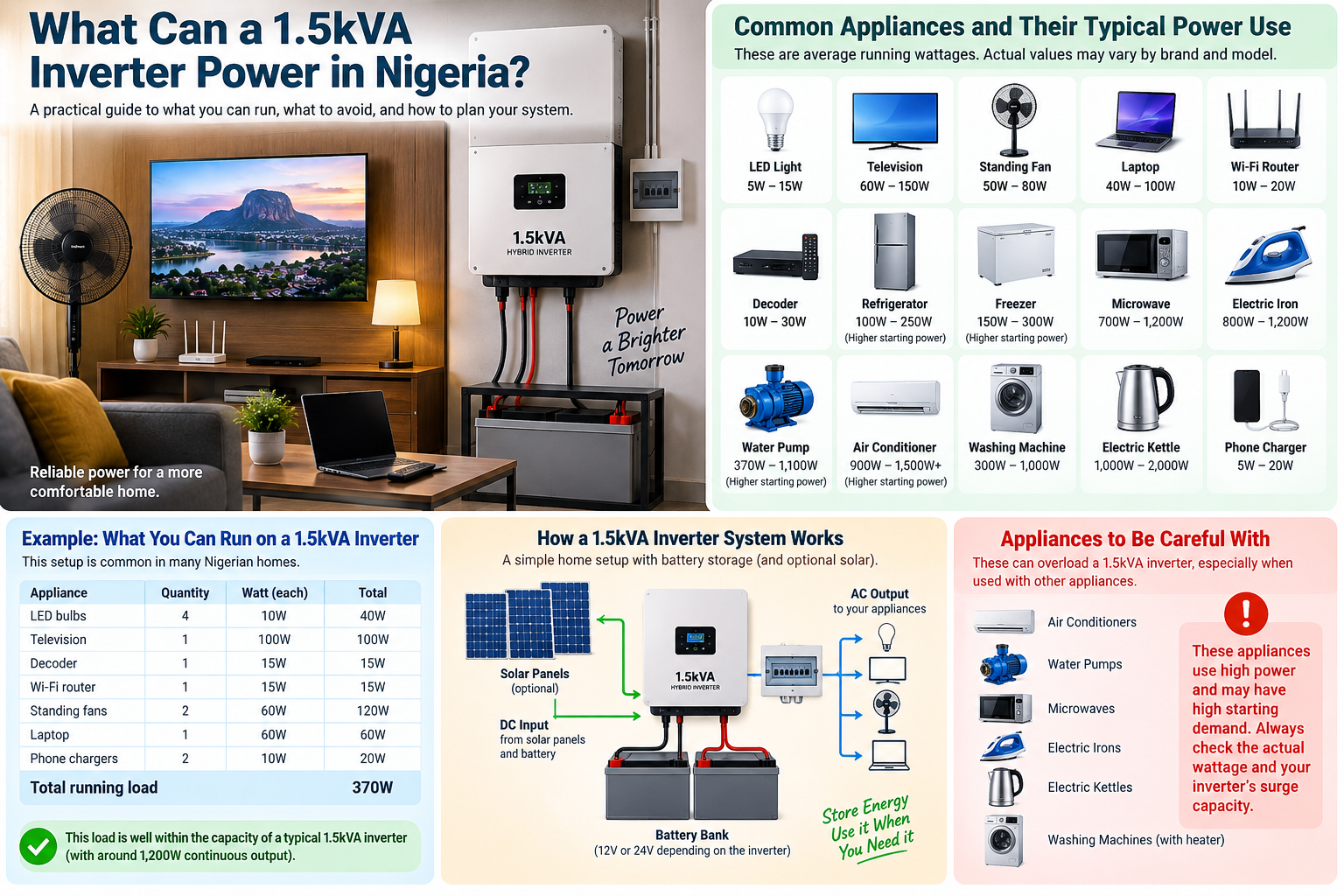
What Can a 1.5kVA Inverter Power?
Let’s start with an ordinary small-home backup setup.
For example:
| Appliance | Example power |
|---|---|
| 4 LED bulbs | 40W |
| TV | 80W |
| Decoder | 15W |
| Wi-Fi router | 15W |
| 2 standing fans | 120W |
| Laptop | 60W |
| Phone chargers | 20W |
| Total | 350W |
A 350W running load is well below a typical 1.5kVA inverter’s continuous capacity.
This means there is still room for normal changes in appliance consumption.
You could also have other small electronics running without immediately pushing the inverter close to its limit.
But remember that these are example figures.
Your own TV, fan, laptop or decoder may use more or less power.
If you want an accurate answer for your appliances, use the SolarPriceNG Inverter Calculator and enter the appliances you actually want to use.
Can a 1.5kVA Inverter Power a TV and Fans?
Yes.
This is one of the situations where a 1.5kVA inverter makes a lot of sense.
For example:
- TV: 100W
- 2 fans: 140W
- Lights: 40W
- Router: 15W
- Decoder: 15W
Total:
310W
That is a relatively small load for a suitable 1.5kVA inverter.
This type of setup can be useful when your main goal is to keep the house comfortable during power outages without trying to run heavy appliances.
Can a 1.5kVA Inverter Power a Refrigerator?
It can, but you need to check the refrigerator’s starting power.
This is important because a refrigerator does not always consume the same amount of power.
The compressor may need a higher amount of power when it starts.
For example, a refrigerator might have a relatively modest running load, but its starting demand can be considerably higher.
So you need to check:
- Running watts
- Starting or surge watts
- Inverter continuous output
- Inverter surge capability
A 1.5kVA inverter with good surge capability may start a refrigerator successfully, while another inverter with a weaker surge rating may struggle.
So don’t decide based only on the refrigerator’s running wattage.
Can a 1.5kVA Inverter Power a Freezer?
The same rule applies to freezers.
A freezer may look like a small load when you check its normal running power, but the compressor can require additional power when starting.
If you want to run a freezer from a 1.5kVA inverter, check the freezer’s specifications and compare them with the inverter’s continuous and surge ratings.
If you are buying the inverter specifically because you want to power a freezer, check this before buying the inverter, not after.
Can a 1.5kVA Inverter Power a Fridge and TV Together?
This can be possible.
For example:
- TV: 100W
- Decoder: 15W
- Refrigerator running load: 150W
- Router: 15W
- Lights: 40W
- Fan: 60W
Running load:
380W
That is not a large continuous load for many 1.5kVA systems.
The problem is the refrigerator’s compressor starting.
So the correct question is not only:
“How many watts does my fridge use?”
It is:
“Can my inverter handle the fridge’s starting demand while the other appliances are already running?”
That is a much better way to size an inverter.
Can a 1.5kVA Inverter Power an Electric Iron?
This is where you need to be careful.
Electric irons can use a large amount of power.
Suppose your inverter has a continuous output of 1,200W.
Now imagine:
- TV: 100W
- Fan: 60W
- Lights: 40W
- Router: 15W
- Iron: 1,000W
Total:
1,215W
You are already above the 1,200W example continuous rating.
And this is why an appliance that looks like “just one more appliance” can cause an inverter to overload.
If you regularly want to use an electric iron together with other household appliances, calculate the complete load first.
Can a 1.5kVA Inverter Power a Microwave?
It depends on the microwave’s actual electrical input.
Do not use only the number advertised as its cooking power.
Check the input power on the appliance label.
If your microwave draws close to the inverter’s maximum continuous output, there may not be enough capacity left for your TV, fans, lights or other appliances.
A microwave can therefore be a poor match for a small inverter if you want to use it together with several other loads.
Can a 1.5kVA Inverter Power a Water Pump?
This is another appliance that needs special attention.
Water pumps use motors.
Motors can require a large amount of power when starting.
So a pump that appears to use a reasonable amount of power while running can still cause an inverter to trip when the motor starts.
If you want to run a water pump from a 1.5kVA inverter, check:
- Pump running power
- Pump starting power
- Inverter continuous output
- Inverter surge rating
- Battery voltage
- Battery’s ability to supply the required current
If the pump has a high starting requirement, a larger inverter may be the safer choice.
Can a 1.5kVA Inverter Power an Air Conditioner?
For a normal household air conditioner, I would not choose a 1.5kVA inverter without first checking the exact AC specification.
An AC can have a significant electrical load, and compressor starting behaviour also matters.
Some inverter-type air conditioners can have different power characteristics from conventional fixed-speed units, but that does not mean every 1.5kVA inverter can run one safely.
If running an AC is one of your main requirements, calculate the actual AC load and check the inverter’s continuous and surge ratings.
If the result is close to the inverter’s limit, move to a larger system rather than hoping it will work.
Can a 1.5kVA Inverter Power a Washing Machine?
It depends on the washing machine.
A simple washing machine may have a relatively manageable load, but models with powerful motors or heating elements can require much more power.
The motor’s starting demand is also important.
So before connecting one to a 1.5kVA inverter, check the machine’s:
- Input power
- Motor rating
- Starting requirement
- Heating element, if present
If it has a high-power heating function, the electrical demand can be much higher than you expect.
Example: A Practical 1.5kVA Home Setup
Let’s imagine a small Nigerian apartment.
The owner wants backup power for:
| Appliance | Quantity | Example watts | Total |
|---|---|---|---|
| LED lights | 5 | 10W | 50W |
| TV | 1 | 100W | 100W |
| Decoder | 1 | 15W | 15W |
| Fans | 2 | 60W | 120W |
| Router | 1 | 15W | 15W |
| Laptop | 1 | 70W | 70W |
| Phone chargers | 2 | 10W | 20W |
| Total | 390W |
The running load is approximately:
390W
This is a comfortable-looking load for a suitable 1.5kVA inverter.
Now imagine the owner adds a refrigerator with a 150W running load.
The running total becomes:
540W
That can still look reasonable.
But the inverter must also be able to handle the refrigerator’s compressor starting demand.
This example shows why running watts alone are not enough.
How Much Battery Do I Need for a 1.5kVA Inverter?
The inverter size and battery size answer two different questions.
The inverter answers:
How much power can I use at one time?
The battery answers:
How much energy can I store and how long can I run the appliances?
For example, suppose your appliances use:
500W
and you want to run them for:
4 hours
The basic energy requirement is:
500W × 4 hours = 2,000Wh
or:
2kWh
But you cannot simply say:
“I need exactly a 2kWh battery.”
You need to allow for battery chemistry, usable capacity, inverter losses and other system losses.
SolarPriceNG’s Battery Calculator currently accounts for these planning factors and uses different assumptions for lithium, GEL and tubular batteries.
Use the SolarPriceNG Battery Calculator to estimate the battery requirement for your actual appliances and desired backup time.
Lithium vs Tubular vs GEL for a 1.5kVA Inverter
The battery chemistry matters.
Lithium
Lithium batteries can offer a high amount of usable energy from a relatively compact battery.
They are often a good choice when you want longer useful backup from a smaller physical battery bank.
But you must check the battery’s voltage, usable capacity, discharge capability and compatibility with the inverter.
Tubular
Tubular batteries are still common in Nigerian inverter systems.
They are normally described using Ah, such as:
- 12V 100Ah
- 12V 150Ah
- 12V 200Ah
- 12V 220Ah
Their usable energy is not the same as simply multiplying the label capacity and expecting the entire amount to be available.
GEL
GEL batteries are another option.
Again, you should look at:
- Voltage
- Ah capacity
- Usable energy
- Maximum discharge
- Battery age
- Inverter compatibility
Do not choose a battery just because its Ah number is larger.
The current SolarPriceNG battery data includes both Ah-based batteries and kWh-based lithium products, so the correct comparison depends on the battery chemistry and how the product is specified.
What Battery Voltage Does a 1.5kVA Inverter Need?
There is no universal answer.
A 1.5kVA inverter can be designed for different battery voltages.
For example, SolarPriceNG currently has a 1.5kVA hybrid inverter listing using a 12V battery system.
But another 1.5kVA model may use a different battery arrangement.
Therefore:
Never buy the battery first based only on the inverter’s kVA rating.
Check the exact inverter model.
The battery voltage must match the inverter’s requirements.
How Much Does a 1.5kVA Inverter Cost in Nigeria?
Prices change with brand, model, battery voltage, features, seller, exchange rate and availability.
SolarPriceNG’s current general inverter guide gives a broad market range for 1.5kVA inverters, while the individual Price Manager listings provide product-specific ranges.
For example, one current SolarPriceNG listing for an SRNE 1.5kVA hybrid inverter is around:
₦295,000–₦310,000
with the price last reviewed in September 2026.
That is not a universal price for every 1.5kVA inverter.
A cheaper model may have different specifications, while a more expensive model may include features such as a built-in MPPT solar charge controller, different battery voltage or greater charging capability.
Check the current Solar Inverter Prices in Nigeria before buying.
1.5kVA vs 1kVA: Is the Upgrade Worth It?
If you are choosing between a 1kVA and 1.5kVA inverter, the 1.5kVA option gives you more headroom.
That can be useful when your load is slightly above what a 1kVA system can comfortably handle.
For example, a home running:
- TV
- 2 fans
- lights
- router
- decoder
- laptop
- small refrigerator
may benefit from the additional capacity.
But don’t upgrade just because a larger inverter sounds better.
If your actual load is only 250W, a 1.5kVA inverter may provide capacity you don’t really need.
The better question is:
What appliances do I need to run at the same time?
1.5kVA vs 2kVA: When Should You Move Up?
Consider a 2kVA inverter when:
- Your normal load is getting close to the 1.5kVA inverter’s continuous limit.
- You regularly use high-power appliances.
- Your refrigerator, freezer or pump has a large starting demand.
- You want more room for future appliances.
- Your calculated load requires more capacity.
But do not use inverter size alone to decide.
A larger inverter may also require a different battery configuration, larger cables, different protection equipment and a larger solar array depending on the system design.
What Can a 1.5kVA Inverter NOT Safely Power?
There is no universal “never” list because inverter models differ.
However, you should be very careful with:
- Large air conditioners
- Electric water heaters
- Electric cookers
- High-power kettles
- Electric irons combined with other loads
- Large water pumps
- High-power microwaves
- Multiple refrigerators/freezers
- Welding machines
- Other heavy motor or heating loads
The problem is not just the running watts.
It can also be:
Starting power + continuous load + battery limitations.
A Better Way to Decide
Instead of asking:
“Is 1.5kVA enough?”
Ask these four questions:
1. What appliances do I want to run?
Write them down.
2. What is the wattage of each appliance?
Use the appliance nameplate whenever possible.
3. Which appliances have starting surges?
Look carefully at:
- Refrigerators
- Freezers
- Pumps
- Washing machines
- Air conditioners
- Other motor-driven appliances
4. How long do I need them to run?
This determines your battery requirement.
Once you know these four things, choosing the inverter becomes much easier.
Use the SolarPriceNG Calculators Before Buying
If you are not sure whether a 1.5kVA inverter is enough, don’t guess.
Start with the SolarPriceNG Inverter Calculator.
Use your actual appliances and estimate the maximum load you expect to run together.
Then use the Battery Calculator to estimate the battery storage required for your desired backup time.
If you plan to recharge the battery with solar panels, use the Solar Panel Calculator to estimate the solar array.
Then check current equipment costs in SolarPriceNG’s solar prices database.
This gives you a better path:
Appliances → inverter size → battery → solar panels → current prices
rather than buying an inverter first and trying to make everything fit afterward.
Final Answer
A 1.5kVA inverter can be a good middle ground for a small Nigerian home, especially if your main backup loads are lights, fans, TV, router, decoder, laptop and other small appliances.
It may also handle a refrigerator or freezer, but you must check the appliance’s starting demand against the inverter’s surge capability.
It is not automatically suitable for heavy appliances such as air conditioners, water pumps, electric irons, microwaves or heating appliances.
The biggest mistake is to look only at the words:
1.5kVA
Instead, check:
Continuous watts + surge watts + appliance load + battery capacity + battery voltage.
If your total load comfortably fits within the inverter’s real continuous output and your appliances’ starting demands are within its surge capability, a 1.5kVA inverter can be a practical choice.
If the numbers are close to the limit, don’t force the system to work. Move to the next suitable size.
Frequently Asked Questions
Can a 1.5kVA inverter power a fridge?
It can, depending on the refrigerator and inverter. The refrigerator’s starting power must be within the inverter’s surge capability.
Can a 1.5kVA inverter power two fans and a TV?
Yes, this is generally a light load for a suitable 1.5kVA inverter.
Can a 1.5kVA inverter power an electric iron?
It depends on the iron’s wattage and what else is running. A high-power iron can consume most of the inverter’s available output.
Can a 1.5kVA inverter power a freezer?
It may, but check the freezer’s running and starting requirements first.
Can a 1.5kVA inverter power an AC?
Do not assume it can. Check the exact AC’s running and starting requirements and compare them with the inverter’s specifications.
How many batteries do I need for a 1.5kVA inverter?
The number depends on the inverter’s battery voltage, the battery capacity and how long you want the system to run. Inverter size alone does not determine the number of batteries.
Is 1.5kVA better than 1kVA?
It provides more capacity, but “better” depends on your actual load. If your appliances only need 300W, you may not need the additional capacity.
Is 1.5kVA enough for a 2-bedroom house?
House size does not determine inverter size. A small two-bedroom home may need less power than a larger home with heavy appliances. Calculate the appliances you want to run instead of sizing by number of rooms.
What is the most important thing to check before buying?
Check the inverter’s actual continuous watt output, surge capacity, battery voltage and solar-input specifications, then compare those with your appliances and expected usage.