
If you are planning to buy a 1kVA inverter, you may be wondering:
What can a 1kVA inverter actually power in my house?
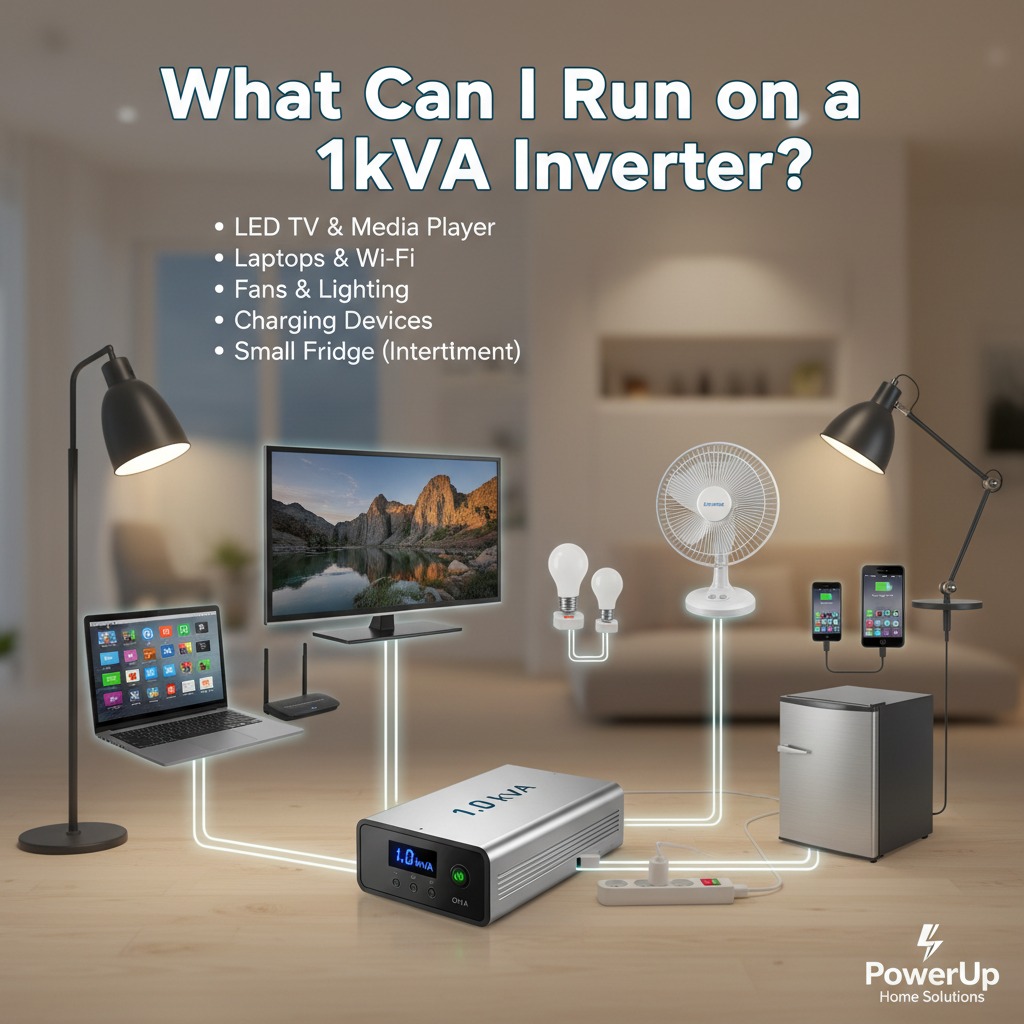
A 1kVA inverter can handle several small appliances, but it is not designed to run every appliance in a normal Nigerian home at the same time.
For example, a 1kVA inverter may be suitable for a combination of lights, a TV, a Wi-Fi router, fans and other small electronics. But adding a refrigerator, freezer, water pump, electric iron or other heavy appliance can change the situation quickly.
The important thing is not just the 1kVA written on the inverter.
You also need to look at:
- The inverter’s actual watt rating
- The appliances you want to use together
- Starting or surge power
- Your battery size
- How long you want the appliances to run
- The inverter’s battery voltage and specifications
This guide will help you work out what a 1kVA inverter can realistically power in Nigeria and when you should move to a larger inverter.
Quick Answer: What Can a 1kVA Inverter Power?
A 1kVA inverter is commonly around the 800W range in real power output, but the exact figure depends on the inverter’s power factor and manufacturer specifications.
So you should not assume that every 1kVA inverter can continuously supply 1,000W.
A small 1kVA inverter may comfortably handle a load such as:
| Appliance | Example running power |
|---|---|
| LED lights | 40W |
| TV | 80W |
| Wi-Fi router | 15W |
| Decoder | 15W |
| 2 standing fans | 120W |
| Laptop | 60W |
| Total | 330W |
A 330W load is far below the typical continuous output of many 1kVA inverters.
That leaves some room for normal variations in appliance power.
However, the exact limit depends on your inverter model.
Always check the inverter’s rated continuous output before connecting appliances.
The First Problem: 1kVA Does Not Always Mean 1,000W
This is one of the easiest mistakes to make when buying an inverter.
An inverter may be labelled:
1kVA
but its actual usable power may be something like:
800W
The reason is that kVA and kW are not always the same thing.
For simple household planning, you should pay attention to the inverter’s stated continuous watt output, not just the kVA number.
For example, if your inverter is rated:
1kVA / 800W
then you should plan your normal load around the 800W figure.
You should not deliberately run it at 1,000W simply because the front of the inverter says 1kVA.
If you are unsure about the difference between kVA and kW, see our guide on how many kVA inverters you need for a home in Nigeria.
What Can I Run on a 1kVA Inverter?
For a small home or room, a 1kVA inverter can be useful for basic backup power.
Here is an example.
Example 1: Basic Home Backup
Suppose you want to run:
- 4 LED bulbs — 40W
- TV — 80W
- Decoder — 15W
- Wi-Fi router — 15W
- One standing fan — 60W
- Laptop — 60W
Total:
40W + 80W + 15W + 15W + 60W + 60W = 270W
A 1kVA/800W inverter would have plenty of continuous capacity for this example.
You would still need to check the actual wattage of your appliances because appliances vary.
This is why the best way to size your inverter is to calculate the actual load rather than copying somebody else’s setup.
You can use the SolarPriceNG Inverter Calculator to estimate the inverter size for your own appliances.
Can a 1kVA Inverter Power a TV and Fan?
Yes, in many cases.
A TV and fan are relatively small loads compared with the output of a typical 1kVA inverter.
For example:
- TV: 80W
- Fan: 60W
Total:
140W
Even if the actual appliances use more than these example figures, the combined load would normally still be well below the capacity of many 1kVA inverters.
You can also add small loads such as:
- LED lights
- Wi-Fi router
- Decoder
- Laptop
- Phone chargers
The important thing is to keep checking the total running load.
Can a 1kVA Inverter Power a Fridge?
Possibly, but you need to be more careful.
A refrigerator does not simply use the same amount of power from the moment you switch it on.
The compressor can require a higher amount of power when starting.
This is called starting or surge power.
For example, imagine your refrigerator normally uses around 150W while running.
It does not automatically mean that a 1kVA inverter will have no problem starting it.
The inverter must be able to handle the refrigerator’s starting demand.
This is why the manufacturer’s surge rating matters.
If you want to run a refrigerator from a 1kVA inverter, check:
- Refrigerator running power
- Refrigerator starting power
- Inverter continuous output
- Inverter surge capacity
- Battery voltage
- Battery capacity
A refrigerator that works perfectly on one 1kVA inverter may cause another 1kVA inverter to overload because the two inverter models may have different specifications.
Can a 1kVA Inverter Power a Freezer?
A freezer has the same basic issue as a refrigerator.
The compressor needs extra power when starting.
So the answer is:
It may, but you must check the freezer and inverter specifications.
Don’t make the decision based only on the freezer’s normal running watts.
For example, if the freezer normally uses 150W, you should still find out what its starting requirement is.
If you are buying a new inverter specifically to run a freezer, it is safer to calculate the load and check the inverter’s surge capability before buying.
Can a 1kVA Inverter Power a Water Pump?
This is where a 1kVA inverter can become unsuitable.
Water pumps use motors, and motors can require a high starting current.
A pump that appears to be a relatively small load while running can demand much more power when starting.
So I would not recommend choosing a 1kVA inverter for a water pump based only on the pump’s running wattage.
You need to check the pump’s starting requirement and the inverter’s surge capability.
For many motor-driven appliances, this starting demand is one of the reasons people end up needing a larger inverter than they expected.
Can a 1kVA Inverter Power an Electric Iron?
This is usually not a good match.
Electric irons commonly use a lot of power compared with TVs, fans and lights.
For example, an iron could use several hundred watts or more depending on its rating.
If your inverter is rated around 800W continuous output, adding a high-power iron to other household appliances can push the system close to or above its limit.
For example:
- TV: 80W
- Fan: 60W
- Lights: 40W
- Router: 15W
- Iron: 800W
Total:
995W
That would already be too high for an inverter rated at 800W.
Even if your particular iron uses less power, you should check its nameplate.
If you need to run high-power heating appliances regularly, a larger inverter and battery system may be more appropriate.
Can a 1kVA Inverter Power a Microwave?
A microwave is another appliance that needs careful attention.
Many microwaves use a high amount of electrical power.
A microwave labelled with a certain cooking output does not necessarily draw that same amount of electrical power from the wall.
Always check the appliance’s actual input power.
If the microwave’s input power is close to the inverter’s maximum output, there may be little or no room left for other appliances.
For this reason, a 1kVA inverter is generally better suited to lighter loads than to running a microwave together with several other appliances.
Can a 1kVA Inverter Power an Air Conditioner?
For most normal household air conditioners, a 1kVA inverter is generally not the size I would choose.
An air conditioner can have a significant running load and may also have a high starting demand depending on its compressor and design.
Even an inverter-type air conditioner still needs to be matched carefully to the inverter.
If your main goal is to run an AC, you should calculate the actual AC load and compare it with the inverter’s continuous and surge ratings.
In many cases, this pushes the system into a larger inverter class.
Do not buy a 1kVA inverter first and then assume you can add an AC later.
Example: A 1kVA Inverter Load That Makes Sense
Let’s look at a more realistic small-home backup.
Suppose you want to run:
| Appliance | Quantity | Example watts | Total |
|---|---|---|---|
| LED bulbs | 4 | 10W | 40W |
| TV | 1 | 80W | 80W |
| Standing fan | 2 | 60W | 120W |
| Router | 1 | 15W | 15W |
| Decoder | 1 | 15W | 15W |
| Laptop | 1 | 60W | 60W |
| Total | 330W |
This is a comfortable-looking load for an inverter with an 800W continuous rating.
But remember that the figures above are examples, not the exact power consumption of every appliance.
Your TV could use 120W.
Your fan could use 80W.
Your laptop could use 100W.
The correct approach is to check the actual appliance labels whenever possible.
What Happens When You Add a Refrigerator?
Now let’s add a refrigerator.
Suppose its running load is approximately 150W.
The simple running-load calculation becomes:
330W + 150W = 480W
That still looks reasonable for an 800W inverter.
But the refrigerator can require additional starting power.
This is why we don’t stop at the simple running-watt calculation.
The inverter needs enough surge capacity to start the compressor.
This is also why some 1kVA systems work well with refrigerators while others struggle or trip.
How Much Battery Do I Need for a 1kVA Inverter?
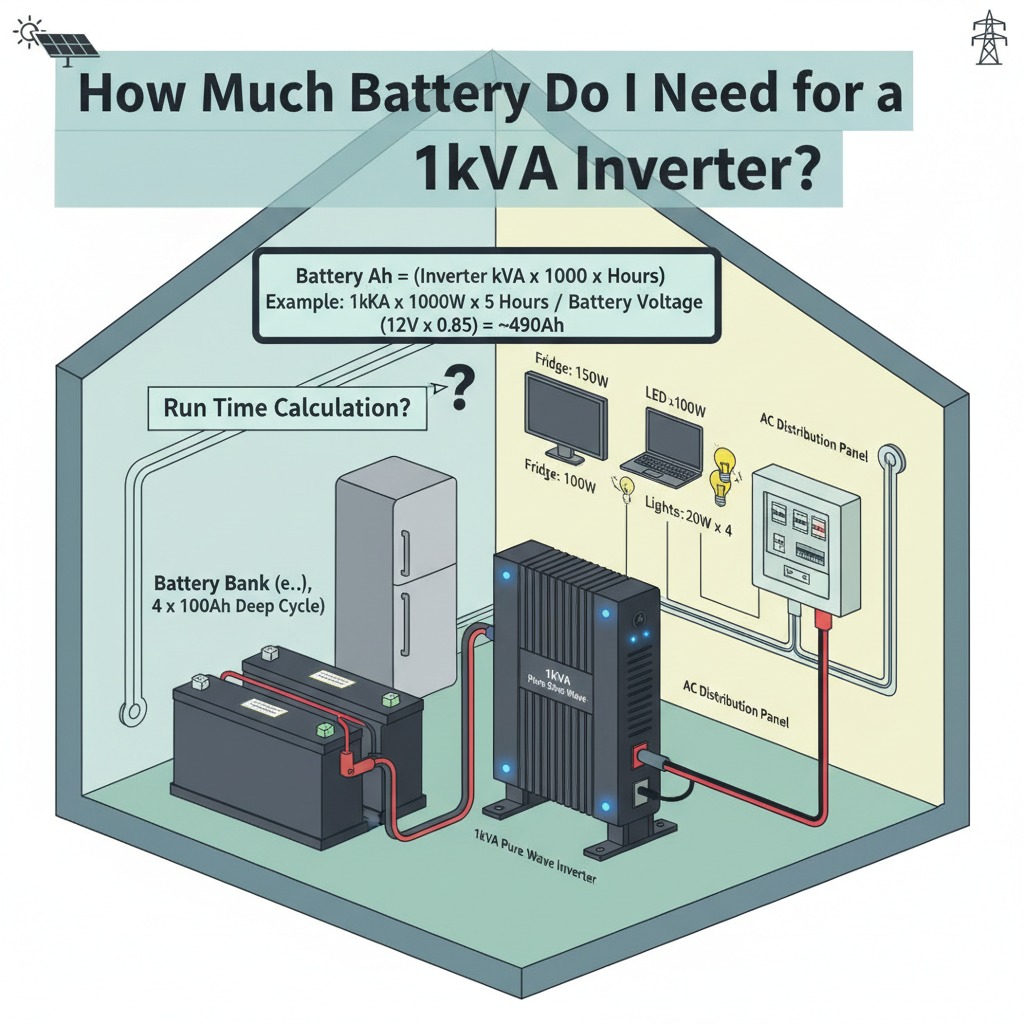
The inverter tells you how much power you can use at once.
The battery determines how long you can keep using it.
These are two different questions.
For example:
A 1kVA inverter with a small battery may run your appliances successfully but shut down after a short period.
A larger battery can provide longer backup, assuming the inverter and battery are correctly matched.
Example
Suppose your load is:
300W
and you want approximately:
4 hours
of backup.
Your basic energy requirement is:
300W × 4 hours = 1,200Wh
That does not mean you should simply buy a 1,200Wh battery and expect exactly four hours.
You also have to account for:
- Battery usable capacity
- Inverter efficiency
- Battery chemistry
- Recommended depth of discharge
- Battery age
- Wiring losses
For a real calculation, use the SolarPriceNG Battery Calculator.
The calculator also lets you estimate backup time from an existing battery and load.
A 1kVA Inverter Does Not Mean 1kVA of Backup Time
This is another common misunderstanding.
The inverter size answers:
How much power can I use at once?
The battery size answers:
How much energy do I have available?
Think of it like this:
Inverter = size of the tap
Battery = size of the water tank
A large inverter does not automatically give you long backup.
A large battery does not automatically mean you can run high-power appliances.
You need both parts to match.
What Battery Voltage Does a 1kVA Inverter Use?
This depends on the inverter model.
Many small inverters use 12V or 24V battery systems, but you should never guess.
Check the manufacturer’s specification before buying a battery.
For example, if your inverter requires a 24V battery bank, connecting only one 12V battery may not be the correct configuration.
You may need two compatible 12V batteries in series, or a suitable 24V battery depending on the system design.
The battery must also be able to supply the required current.
Should I Buy a 1kVA, 2kVA or 3kVA Inverter?
This depends on your actual load.
Here is a simple way to think about it:
| Inverter size | General use |
|---|---|
| 1kVA | Lights, TV, fans, router, laptop and other small loads |
| 1.5–2kVA | More small appliances and some moderate loads |
| 3kVA | Larger household load and more appliance combinations |
| 5kVA | Much larger home loads and higher-power appliances |
These are only general planning categories.
A 2kVA inverter is not automatically better for your particular home.
If your normal load is only 300W, buying a much larger inverter may simply add cost.
On the other hand, if your expected load is close to the limit of a 1kVA inverter, moving up to a larger size may make more sense.
Check the Actual Inverter Before Buying
Two products can both be sold as 1kVA inverters but have different specifications.
Check:
- Continuous output watts
- Surge output
- Battery voltage
- Battery charging current
- Solar input, if it is a solar/hybrid inverter
- Maximum PV voltage
- Maximum PV power
- Waveform
- Manufacturer recommendations
For example, our current SolarPriceNG inverter database contains products in different sizes and configurations, so you should compare the exact model specifications rather than choosing only by the kVA label.
You can also check the current estimated solar inverter prices in Nigeria before deciding what size to buy.
A Simple 1kVA Inverter Checklist
Before buying, answer these questions:
1. What appliances do I want to run?
Write them down.
2. What is the wattage of each appliance?
Use the actual nameplate where possible.
3. Which appliances start with a motor or compressor?
Pay special attention to refrigerators, freezers, pumps and some AC units.
4. What is my total running load?
Add the appliances you expect to use at the same time.
5. What is the inverter’s continuous watt rating?
Don’t use the kVA number alone.
6. What is its surge rating?
This matters when starting motor-driven appliances.
7. How many hours of backup do I need?
This determines the battery energy requirement.
8. What battery voltage does the inverter require?
Make sure the battery bank matches it.
When Should You Move Above 1kVA?
A 1kVA inverter may not be the right choice if you regularly want to run several high-power appliances together.
Consider a larger inverter when:
- Your normal load is already close to the inverter’s maximum output.
- You regularly use an electric iron with other appliances.
- You need to run a water pump.
- You want to run an AC.
- You need to run several refrigerators or freezers.
- Your appliance starting loads are too high.
- You expect your electricity needs to increase soon.
But don’t jump straight to a 5kVA system just because it sounds better.
Calculate the load first.
The Easiest Way to Know Your Correct Size
If you are trying to decide whether a 1kVA inverter is enough for your home, start with your appliances.
List:
Appliance → watts → quantity → hours of use
Then calculate your total running load.
After that, check the starting loads of appliances with compressors or motors.
You can use the SolarPriceNG Inverter Calculator to estimate the inverter size you need.
Then use the Battery Calculator to estimate the battery capacity required for your desired backup time.
Finally, check the Solar Prices in Nigeria database to see current estimated market ranges before buying.
Final Answer
So, what can a 1kVA inverter power in Nigeria?
A suitable 1kVA inverter can be useful for a small backup system running things such as:
- LED lights
- TV
- Decoder
- Wi-Fi router
- Fans
- Laptop
- Phone chargers
- Other small electronics
It may also run a refrigerator or freezer, but only if the inverter’s continuous and surge ratings are suitable for that particular appliance.
It is generally not the size I would choose if your main goal is to run heavy appliances such as air conditioners, water pumps, electric irons and microwaves together with several other loads.
The most important lesson is this:
Do not buy a 1kVA inverter simply because you think 1kVA means 1,000W. Check the actual watt rating, your total appliance load and the starting power of motor-driven appliances.
If you calculate those three things before buying, you are much less likely to spend money on an inverter that cannot do what you need.
Frequently Asked Questions
Can a 1kVA inverter power a TV and fan?
Yes. A TV and one or more fans are generally a light load for a suitable 1kVA inverter, although you should check the actual wattage.
Can a 1kVA inverter power a fridge?
It can in some cases, but the refrigerator’s starting power must be compatible with the inverter’s surge capability.
Can a 1kVA inverter power a freezer?
Possibly. Check both the freezer’s running and starting power and compare them with the inverter’s continuous and surge ratings.
Can a 1kVA inverter power an electric iron?
It depends on the iron’s wattage and what else is running. A high-wattage iron can consume most or all of the usable output of a small inverter.
Can a 1kVA inverter power an AC?
A 1kVA inverter is generally not the size to choose for a normal household AC. Check the AC’s actual running and starting requirements before choosing an inverter.
How long can a 1kVA inverter run?
The inverter itself does not determine the backup time. Backup time mainly depends on the battery’s usable energy and the load being powered.
How many batteries do I need for a 1kVA inverter?
It depends on the inverter’s required battery voltage, battery capacity and how long you want the system to run. Use the Battery Calculator to estimate the required battery bank.
Is a 1kVA inverter enough for a 2-bedroom house?
House size alone does not determine inverter size. A 2-bedroom home with lights, fans, TV and a router may need much less power than a similar home running a freezer, pump, iron and air conditioner.
What is better, a 1kVA or 2kVA inverter?
Neither is automatically better. The correct choice is the one that safely handles your actual load with reasonable room for starting loads and future needs.