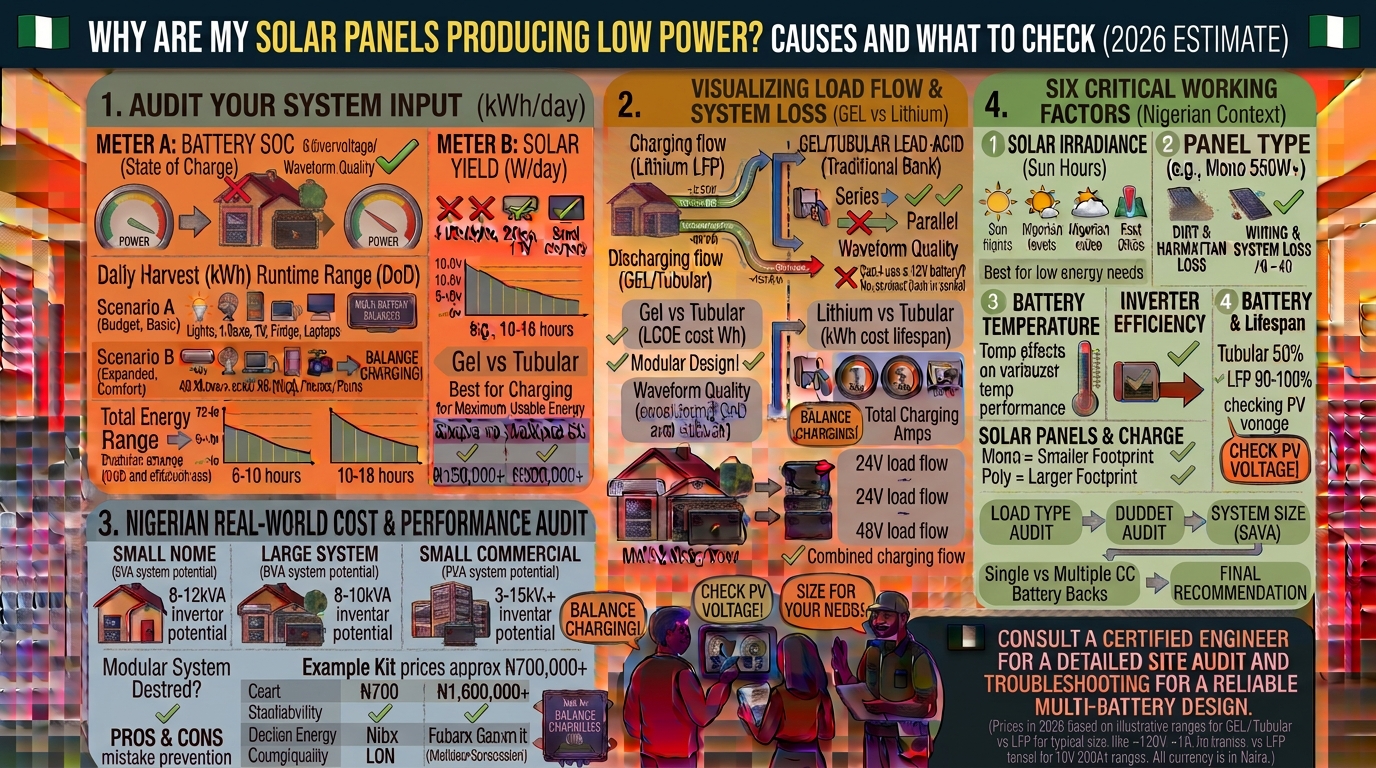
If your solar panels are supposed to produce a certain amount of power but your inverter or charge controller is showing much less, you may be wondering what is wrong.
For example, you may have:
- 4 × 550W solar panels = 2,200W rated capacity
- 6 × 550W solar panels = 3,300W rated capacity
- 8 × 550W solar panels = 4,400W rated capacity
But you may look at your inverter during the day and see a much lower number.
This does not always mean the panels are faulty.
Solar panel output changes throughout the day. Sunlight intensity, clouds, panel temperature, shading, dust, panel angle, wiring, connectors, the charge controller and the inverter can all affect how much power reaches your battery or loads.
In this guide, we will look at the common reasons solar panels produce low power and what you should check.
First: A 550W Solar Panel Does Not Produce 550W All Day
This is one of the most important things to understand.
A solar panel’s rated wattage is measured under standard test conditions. Real outdoor conditions are usually different.
So a 550W panel does not mean:
550W from morning until evening.
You may see much lower output:
- early in the morning
- late in the afternoon
- when clouds are covering the sun
- when the panels are heavily shaded
- when the panels are very hot
- when the panels are dirty
- when the system is limiting the available solar power
The important question is therefore not simply:
“Why am I not seeing the full panel wattage?”
The better question is:
“Is my solar system producing a reasonable amount of power for the conditions at that time?”
1. Clouds and Weak Sunlight
The first thing to check is the weather.
Solar panels need sunlight to produce electricity. When thick clouds cover the sun, solar production can fall significantly.
You may notice:
Clear midday sun: High solar production.
Light cloud: Lower production.
Heavy cloud/rain: Much lower production.
This is normal.
Do not immediately assume that your panels are damaged because the power drops during cloudy weather.
2. You Are Checking at the Wrong Time of Day
Solar production is not constant from morning to evening.
A panel may produce little power early in the morning, increase as the sun gets higher, and then reduce again later in the afternoon.
Therefore, checking your inverter at 7:00 AM and comparing the number with the panel’s 550W rating is not a useful test.
If you want to investigate low production, check the system during a period of strong, unobstructed sunlight, rather than judging it from early morning or late afternoon readings.
3. Shade Is Covering Some of the Panels
Shading is one of the most common causes of low solar production.
Look around the panels for:
- trees
- buildings
- walls
- water tanks
- satellite dishes
- roof structures
- poles
- other panels
- nearby objects
A shadow that reaches only part of a panel can still affect its output.
This becomes even more important when panels are connected in series.
A problem affecting one panel or part of a string can reduce the performance of that string.
Check the roof at different times
Do not only inspect the panels at noon.
A tree may not shade the panels at noon but could cast a shadow across them in the morning or afternoon.
4. The Panels Are Dirty
Dust and dirt can reduce the amount of sunlight reaching the solar cells.
This can be particularly important in areas where dust, dirt and other particles regularly settle on the panels.
The dirtier the surface becomes, the less sunlight can reach the cells.
If your panels are visibly dirty, cleaning may help restore some of the lost production.
But clean them properly and safely. Avoid damaging the panel surface, and do not climb onto a roof simply to clean them if doing so is unsafe.
5. The Panels Are Very Hot
It may sound strange, but very strong sunshine can also make solar panels hot enough to reduce their electrical performance.
Solar panels need sunlight, but higher temperatures can reduce their voltage and therefore reduce power output.
This means you can sometimes have:
Very strong sunlight + very hot panels = less power than you expected.
That is another reason why the number printed on a panel should not be treated as a guaranteed real-world output.
6. The Panel Angle or Position Is Not Good
The amount of sunlight reaching a panel depends partly on how the panel is positioned.
If the panels are poorly positioned, they may receive less useful sunlight during important parts of the day.
Things to consider include:
- panel orientation
- panel tilt
- nearby shade
- roof direction
- surrounding buildings
- seasonal sun position
Your installer should design the array so the panels receive good sunlight throughout the useful solar period.
7. A Solar Panel May Be Damaged
Sometimes the problem really is the panel itself.
A panel may develop a fault because of:
- physical damage
- cracked cells
- damaged wiring
- water intrusion
- hot spots
- connector problems
- manufacturing defects
- long-term degradation
Look for visible signs such as:
- cracked glass
- burn marks
- damaged cables
- damaged junction boxes
- loose connectors
- unusual discoloration
However, a panel can also have an electrical problem without an obvious visible sign.
If one panel consistently performs much worse than the others under similar conditions, it deserves further testing.
8. One Weak Panel Can Affect a Solar String
This is especially important when several panels are connected in series.
In a series connection, the panels work together as a string.
If one panel has a problem, the performance of the string can be affected.
For example, suppose you have:
4 × 550W panels
connected as one string.
If one panel has a fault, you should not assume the other three panels will simply continue producing their full expected output independently.
This is why comparing individual panels or strings can help a technician identify where the problem is.
9. Loose or Corroded Connectors
The panels may be producing power, but that power may not be reaching the inverter or charge controller properly.
Check for problems around:
- MC4 connectors
- junction boxes
- cable connections
- isolators
- terminals
- combiner boxes
A loose, damaged or poorly connected cable can create resistance and cause voltage drop or unreliable operation.
If you notice:
- burnt connectors
- melted plastic
- loose connections
- corrosion
- damaged insulation
stop and have a qualified solar technician inspect the system.
Do not work on live PV wiring if you are not trained to do so.
10. The Solar Cables May Be Causing Voltage Drop
Long cable runs, undersized cables, damaged cables or poor connections can cause losses between the panels and the equipment.
For example, the panels may be producing reasonable voltage and current at the roof, but the voltage arriving at the controller may be lower than expected.
This is one reason why solar system design should consider:
- cable size
- cable length
- current
- voltage
- connection quality
If you suspect cable losses, this is something a qualified installer can test properly.
Solar Panel Voltage Too Low: What Should You Check?
If your solar panels are producing less power because the PV voltage is lower than expected, check the system step by step.
First, check whether the solar string is receiving good sunlight. Then compare its voltage with a similar string under the same conditions.
Possible causes of unusually low PV voltage include:
- Too few panels connected in series
- A loose or damaged connection
- Cable problems or voltage drop
- A faulty panel
- A problem with the string configuration
- The solar array operating outside the inverter or MPPT’s expected range
- Incorrect measurement
Check the panel’s Voc and Vmp and compare the expected string voltage with the inverter or charge controller specifications.
A low-voltage reading does not automatically mean that the solar panels are bad. The complete string and its connections should be checked before replacing equipment.
Low Solar Voltage vs Low Solar Current
Low voltage and low current are not the same problem.
Low voltage means the PV voltage is below what you would normally expect from the string.
Low current means the string is producing less current than expected.
Low power can result from either problem because:
Power = Voltage × Current
For example, a solar string can have reasonable voltage but unusually low current, or reasonable current but unusually low voltage.
This is why checking both PV voltage and PV current gives you more useful information than looking at solar watts alone. For a more specific low-current diagnosis, see low current in a solar string.
11. The Panels May Be Connected in the Wrong Configuration
Solar panels can be connected in:
- series
- parallel
- a combination of both
The configuration changes the voltage and current of the solar array.
For example, putting panels in series increases voltage, while putting them in parallel increases current.
But the final configuration must stay within the inverter or charge controller’s specifications.
Your equipment may have limits for:
- maximum PV voltage
- MPPT voltage range
- maximum PV current
- maximum PV power
- number of MPPT inputs
Read our How Many Solar Panels Can a Charge Controller Handle? article for more information.
12. The Solar Array Is Outside the MPPT Voltage Range
This is a more technical problem, but it is important.
An MPPT charge controller or hybrid inverter normally has a specific voltage range in which its MPPT can operate.
For example, a device may have:
- minimum MPPT voltage
- maximum MPPT voltage
- maximum PV voltage
Your solar panel string needs to be designed to operate correctly within those limits.
If the voltage is too low or the string configuration is unsuitable, the equipment may not be able to extract the expected power from the panels.
This is why you should not choose panels only by looking at their wattage.
Check the panel’s:
- Voc
- Vmp
- Isc
- Imp
and compare them with the inverter or charge controller specifications.
If the PV voltage is consistently too low, compare the measured string voltage with the expected voltage based on the number and type of panels connected in series. Also check the inverter or charge controller’s minimum MPPT operating voltage.
13. The Charge Controller Is Limiting the Solar Power
Sometimes the panels are capable of producing more power, but the charge controller cannot use all of it.
For example, suppose you have a large solar array but a controller with a lower maximum charging or PV capacity.
The controller may limit the amount of power being processed.
Our Solar Charge Controller Calculator can help you estimate the controller size required for an array.
But the calculator is only a starting point. You should always check the actual manufacturer’s specifications.
You can also read What Size Solar Charge Controller Do I Need in Nigeria? for more detail.
14. The Inverter May Be Limiting the Solar Input
If your solar panels connect directly to a hybrid inverter, the inverter itself may have limits.
Check the inverter’s:
- maximum PV power
- maximum PV voltage
- MPPT voltage range
- maximum PV current
- number of MPPT inputs
For example, two 5kVA hybrid inverters can have different maximum solar input specifications.
So you cannot assume:
“I have a 5kVA inverter, therefore I can connect any size solar array.”
The inverter’s actual specification is what matters.
Read How Many Solar Panels Do I Need for a 5kVA Inverter in Nigeria? for more information.
15. Your Battery Is Already Nearly Full
This is another situation that can confuse people.
Suppose your solar panels are producing plenty of energy, but your battery is already close to full.
The charge controller may reduce charging power because the battery does not need the same amount of charging current.
You might therefore see solar input fall even though nothing is wrong with the panels.
For example:
Panels → inverter/controller → battery
If the battery is nearly full, the system may reduce the amount of energy going into the battery.
That does not automatically mean the panels have suddenly become weak.
16. Your Daytime Appliances Are Using the Solar Power
Sometimes the panels are actually producing good power, but you do not see much of it going into the battery because your appliances are using it.
For example:
Solar panels produce:
2,000W
Your house is currently using:
1,500W
Only part of the solar energy may be available for battery charging, depending on the system.
So if you look only at battery charging power, you may think:
“My solar panels are producing low power.”
But the solar energy may simply be going directly to the loads.
This is why it is important to know where you are reading the solar power.
17. You Are Looking at Battery Charging Current Instead of Solar Production
Solar power and battery charging power are not always the same thing.
Your inverter may show:
- PV voltage
- PV current
- PV watts
- battery voltage
- battery charging current
- battery charging watts
- load watts
These numbers represent different parts of the system.
For example, the panels could be producing solar power while your appliances are using most of it.
So before deciding that your panels are producing low power, identify exactly what number you are looking at.
18. The Panels Are Old or Have Degraded
Solar panels can lose some performance as they age.
The rate depends on the panel technology, quality, environment and operating conditions.
If an old system is producing considerably less than it used to under similar conditions, the panels and other system components should be inspected.
19. The Problem May Be the Whole System, Not the Panels
Low solar power can come from many parts of the system.
For example:
Panels → cables → connectors → isolator → inverter/controller → battery
A problem anywhere along this path can affect what you eventually see at the battery.
That is why replacing the panels immediately is not always the right solution.
A proper diagnosis should identify where the power is being lost.
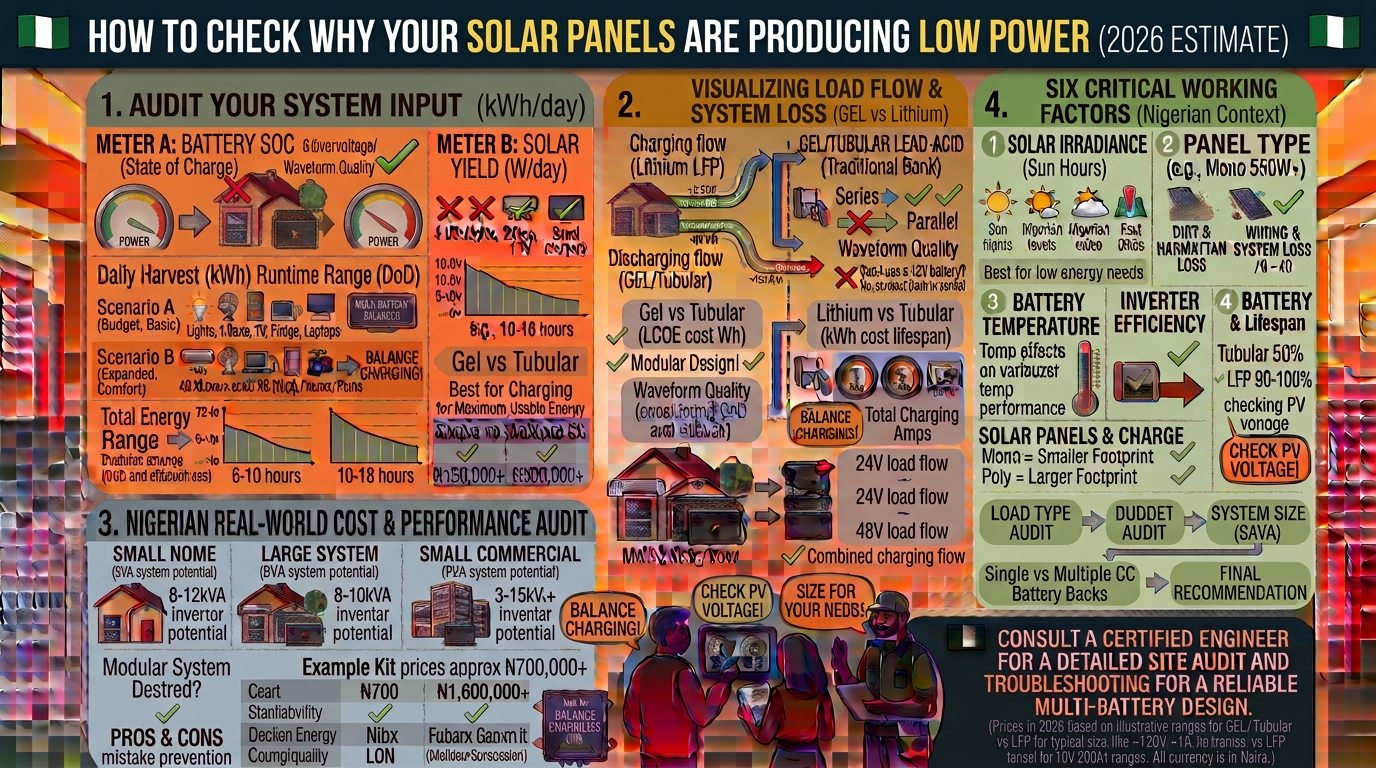
How to Check Why Your Solar Panels Are Producing Low Power
If you notice unusually low output, go through this simple checklist.
Step 1: Check the weather
Is it cloudy, rainy or hazy?
If yes, lower production may be normal.
Step 2: Check the time
Are you checking early morning or late afternoon?
Compare production during a period of strong sunlight.
Step 3: Check for shade
Look for trees, buildings, tanks, walls and other objects casting shadows.
Step 4: Check the panels
Are they covered with dust or dirt?
Look for visible damage as well.
Step 5: Check the inverter/controller display
Look for:
- PV voltage
- PV current
- PV watts
- battery voltage
- battery charging current
- load power
Compare the PV voltage and current with a similar string if you have more than one string.
Do not judge the system from PV watts alone.
Step 6: Check whether the battery is nearly full
If it is nearly full, the system may reduce battery charging power.
Step 7: Check your daytime load
Your appliances may be using much of the solar power directly.
Step 8: Check the solar configuration
Confirm that the panels are connected according to the inverter or charge controller specifications.
Step 9: Check the equipment limits
Compare the solar array with:
- maximum PV voltage
- MPPT voltage range
- maximum PV current
- maximum PV power
Step 10: Check cables and connectors
Look for damaged, loose, corroded or overheated connections.
Step 11: Compare production over several clear days
Do not diagnose a solar system based on one cloudy afternoon.
If the output remains unusually low during strong sunlight over several days, investigate further.
Should I Test the Solar Panels With a Multimeter?
Electrical testing can help identify whether the problem is coming from the panels, wiring or controller.
A technician may measure things such as:
- open-circuit voltage (Voc)
- operating voltage
- current
- string voltage
- string current
But solar panels can produce dangerous DC voltage, especially when several panels are connected in series.
If you are not trained to work on solar DC systems, do not disconnect or test live solar wiring yourself.
A qualified solar technician can measure the array safely and compare the readings with the panel and inverter specifications.
What If One Solar Panel Is Producing Much Less Than the Others?
If the panels are under similar sunlight conditions and one panel consistently performs much worse, it could indicate:
- shading
- dirt
- damaged cells
- connector problems
- cable problems
- a faulty panel
- a string configuration problem
The technician should compare the panel or string readings rather than replacing equipment immediately.
How Much Solar Power Should My Panels Produce?
There is no single number that applies to every solar system.
For example:
4 × 550W = 2,200W rated solar capacity
But 2,200W is the rated capacity of the array, not a guarantee that the inverter will show exactly 2,200W every moment.
Actual output depends on sunlight, temperature, shading, dirt, panel condition, wiring, system configuration and equipment limits.
This is also why the Solar Panel Calculator uses useful sunlight hours and system performance assumptions instead of assuming that panels produce their full rated wattage all day.
When Should I Be Concerned?
Lower output is not automatically a fault.
You should investigate more seriously when:
- the weather is clear
- the panels are receiving strong sunlight
- there is no obvious shading
- the panels are reasonably clean
- the system used to produce more power under similar conditions
- the battery is not already full
- your daytime load is not consuming most of the solar
- the inverter/controller is not limiting the PV input
- the output remains unusually low over several clear days
That is when a proper electrical inspection becomes useful.
Do Not Replace Your Solar Panels Too Quickly
If your solar system is producing less power than expected, replacing the panels should not be your first step.
First find out where the problem is.
The cause could be:
Weather → shade → dirt → heat → wiring → connectors → panel configuration → controller → inverter → battery charging conditions.
A proper diagnosis can save you from spending money on new panels when the real problem is a connector, cable, configuration or controller setting.
Check Your Solar System Size Too
If your panels are working normally but your solar system still cannot produce enough energy for your needs, the problem may be that the solar array is simply too small.
You can use our Solar Panel Calculator to estimate the panel capacity you may need.
You can also use our Solar Calculator to look at your appliances, battery backup and overall system requirements.
For panel prices, see our Solar Prices in Nigeria page and Solar Panels Price Category.
Final Advice
If your solar panels are producing low power, don’t immediately assume that the panels are bad.
Start with the simple things:
- Check the weather.
- Check the time of day.
- Look for shade.
- Clean dirty panels.
- Check for visible damage.
- Check the inverter or controller PV reading.
- Check whether the battery is already full.
- Check your daytime load.
- Check the panel and string configuration.
- Check the inverter and charge controller limits.
- Check cables and connectors.
- Compare production over several clear days.
Remember that a solar panel’s rated wattage is a laboratory rating, not a promise of constant output. Real-world production changes with sunlight, temperature, shading, dirt, system design and other conditions.
If your system consistently produces much less power than expected under good sunlight, get a qualified solar technician to test the panels, strings, cables and controller/inverter before replacing expensive equipment.
Related Articles
- How Many Solar Panels Do I Need for My House in Nigeria?
- How Many Solar Panels Do I Need for a 5kVA Inverter in Nigeria?
- How Many Solar Panels Can a Charge Controller Handle?
- What Size Solar Charge Controller Do I Need in Nigeria?
- Why Is My Solar Battery Not Charging?
- How to Connect a Solar Panel to a Charge Controller and Battery
- How Much Solar Power Do I Need to Run My House in Nigeria?