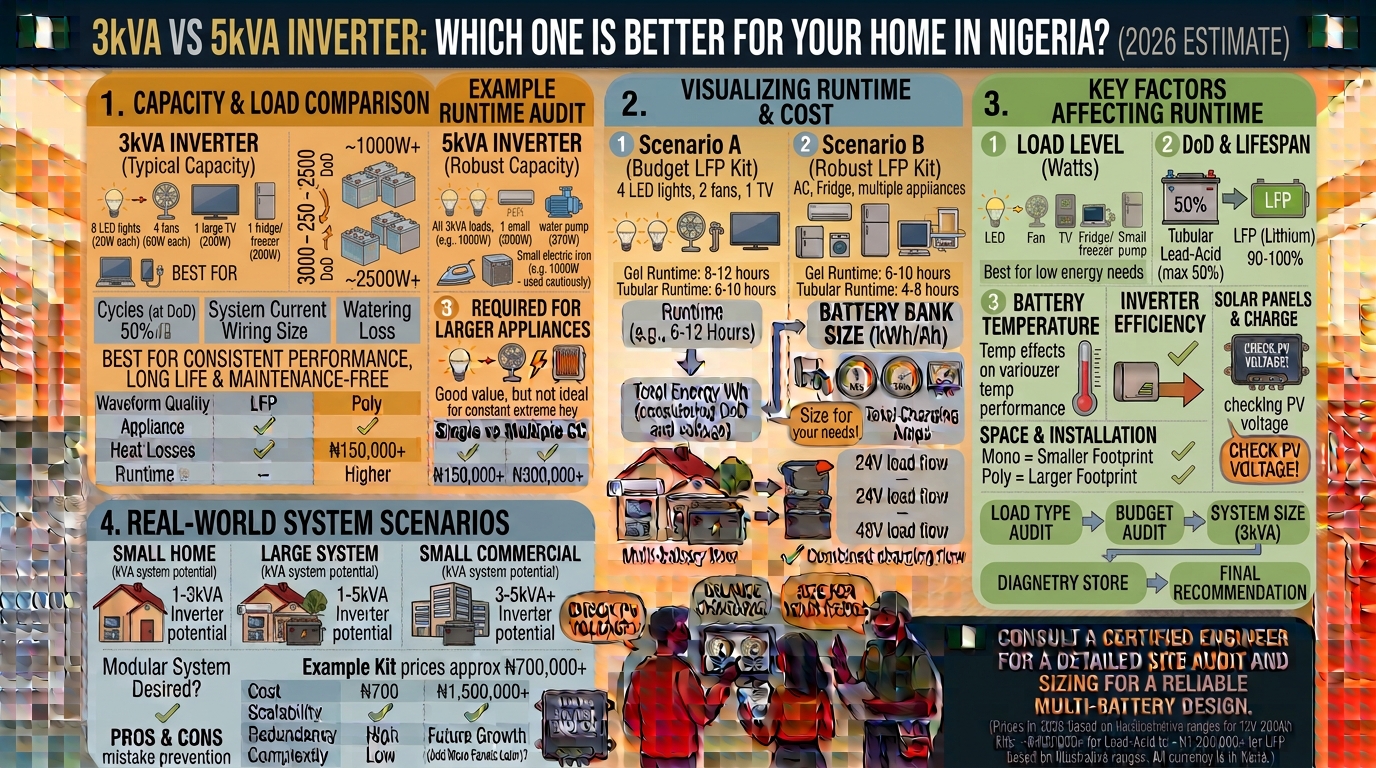
If you are planning to buy an inverter for your home, you may find yourself choosing between a 3kVA inverter and a 5kVA inverter.
Both are popular sizes for homes in Nigeria.
But they are not designed for exactly the same level of load.
A 5kVA inverter is not automatically better simply because it is bigger.
If your home only needs a 3kVA system, spending extra money on a 5kVA inverter may not be necessary.
On the other hand, if your appliances are already close to the limit of a 3kVA inverter, buying a 3kVA system may leave you with very little room to add more appliances later.
So which should you choose?
Choose 3kVA if your home has a small to moderate load and you mainly want to power essential appliances.
Choose 5kVA if you have a larger load, want more capacity for appliances, or expect your electricity needs to grow.
Let’s compare them properly.
3kVA vs 5kVA Inverter at a Glance
| Feature | 3kVA Inverter | 5kVA Inverter |
|---|---|---|
| Capacity | Smaller | Larger |
| Best for | Small/moderate loads | Moderate/larger loads |
| Typical home use | Essential appliances | More appliances at once |
| Battery requirement | Usually lower | Usually higher |
| Solar panel requirement | Usually lower | Usually higher |
| Initial system cost | Lower | Higher |
| Space required | Usually less | Usually more |
| Future expansion | More limited | Better |
| Heavy appliances | Limited | Better suited |
| Best for large homes | Usually not enough | More suitable |
Important: kVA is not the same as the amount of power your appliances will always be able to use. The actual usable output depends on the inverter’s power factor, model and specifications.
What Is a 3kVA Inverter?
A 3kVA inverter is a common size for smaller homes and apartments.
It can be suitable for essential loads such as:
- LED bulbs
- Fans
- TV
- Wi-Fi router
- Laptop
- Refrigerator
- Decoder
- Small electronics
The exact appliances it can run depend on their wattage and the inverter’s actual output rating.
For example, a 3kVA inverter may be able to run several normal household appliances at the same time.
But that does not mean you can connect every appliance in the house and turn everything on together.
The total running load and startup surge must stay within the inverter’s limits.
What Is a 5kVA Inverter?
A 5kVA inverter provides more capacity than a 3kVA unit.
It can therefore handle a larger combination of appliances.
Depending on the particular model and system design, it may be suitable for homes running:
- Multiple fans
- Refrigerator
- Freezer
- TV
- Lights
- Router
- Computers
- Washing machine
- Water pump
- Some air-conditioning loads
However, you should never assume that every 5kVA inverter can run every appliance listed above at the same time.
The actual load must be calculated.
Some air conditioners, pumps, refrigerators and other motor-driven appliances can have high startup power.
What Is the Main Difference Between 3kVA and 5kVA?
The main difference is how much electrical load the inverter can handle.
A 5kVA inverter has a higher capacity than a 3kVA inverter.
This gives you more room to run appliances at the same time.
For example, imagine your home’s maximum running load is around 2,000W.
A suitable 3kVA inverter may be enough.
But if your load can reach 3,500W or more, a 3kVA inverter may no longer be the right choice.
A 5kVA inverter may provide the extra capacity you need.
The important thing is to calculate your actual load rather than choosing based on the size of your house.
3kVA Does Not Mean 3,000W in Every Situation
This is an important point.
People often see:
3kVA
and assume:
3,000W
But kVA and kW are not always exactly the same.
The relationship depends on the inverter’s power factor.
For example:
kW = kVA × power factor
So a 3kVA inverter with a power factor of 0.8 would have a rated real power of:
3 × 0.8 = 2.4kW
A 5kVA inverter with the same 0.8 power factor would be:
5 × 0.8 = 4kW
But inverter manufacturers can specify different power factors and output ratings.
Always check the actual datasheet of the model you want to buy.
Which One Can Power More Appliances?
5kVA.
This is the simple answer.
A 5kVA inverter has more capacity, so it can normally handle a larger total load than a 3kVA inverter.
But don’t make the mistake of thinking:
“5kVA means I can switch on everything in my house.”
You still have to consider the total running power and startup surge.
For example, a water pump may consume much more power for a short period when starting.
The same can happen with some refrigerators, freezers and air conditioners.
What Can a 3kVA Inverter Power?
A typical example could include:
- 6 LED bulbs
- 2 standing fans
- 1 TV
- 1 refrigerator
- Wi-Fi router
- Decoder
- Laptop
Let’s use simple example figures:
| Appliance | Example Power |
|---|---|
| 6 LED bulbs | 60W |
| 2 fans | 160W |
| TV | 100W |
| Refrigerator | 150W |
| Router | 15W |
| Decoder | 20W |
| Laptop | 65W |
| Total | 570W |
This is only an example.
Actual appliance consumption varies by model.
A 3kVA inverter could have plenty of capacity for this type of load.
But if you add several heavy appliances, the situation changes quickly.
What Can a 5kVA Inverter Power?
A 5kVA system gives you more room.
For example, you might have:
- Several lights
- Multiple fans
- TV
- Refrigerator
- Freezer
- Router
- Computers
- Washing machine
- Water pump
Again, this does not mean everything can necessarily run together.
You need to add the actual wattage of your appliances and check the inverter’s continuous and surge ratings.
Can a 3kVA Inverter Run a Refrigerator?
Yes.
A refrigerator is not necessarily a problem for a 3kVA inverter.
The important thing is the refrigerator’s power requirement and startup surge.
Modern inverter refrigerators can have lower running power than some older refrigerators.
This is why you should use the actual appliance specification whenever possible.
Can a 3kVA Inverter Run an Air Conditioner?
It depends.
This is one of the areas where people make mistakes.
An air conditioner can have a significant running load and may also have a startup surge.
An inverter air conditioner may behave differently from an older non-inverter model.
A small, efficient AC may work with a suitable 3kVA system in some setups, but that does not mean every 3kVA inverter can handle every AC.
If your system needs to run an AC regularly, calculate the complete load first.
For larger AC loads, a 5kVA or larger system may be more appropriate.
Can a 5kVA Inverter Run an Air Conditioner?
It can, depending on the AC and the rest of the load.
A 5kVA inverter gives you more capacity than a 3kVA inverter.
But you still need to consider:
- AC running power
- Startup requirements
- Other appliances running at the same time
- Inverter output rating
- Battery capacity
- Solar capacity
A 5kVA inverter is not automatically enough for every home with an AC.
Can a 3kVA Inverter Run a Water Pump?
It depends on the pump.
A water pump has a motor.
Motors can require extra power when starting.
A small pump may work with a suitable 3kVA inverter.
A larger pump may require a bigger inverter or a system designed to handle its startup surge.
Always check the pump’s running and starting requirements.
Can a 5kVA Inverter Run a Water Pump?
It has a better chance because it has more capacity.
But the same rule applies.
Check the pump.
Don’t simply look at:
“5kVA”
and assume the pump will work.
The inverter must be able to handle the pump’s startup surge.
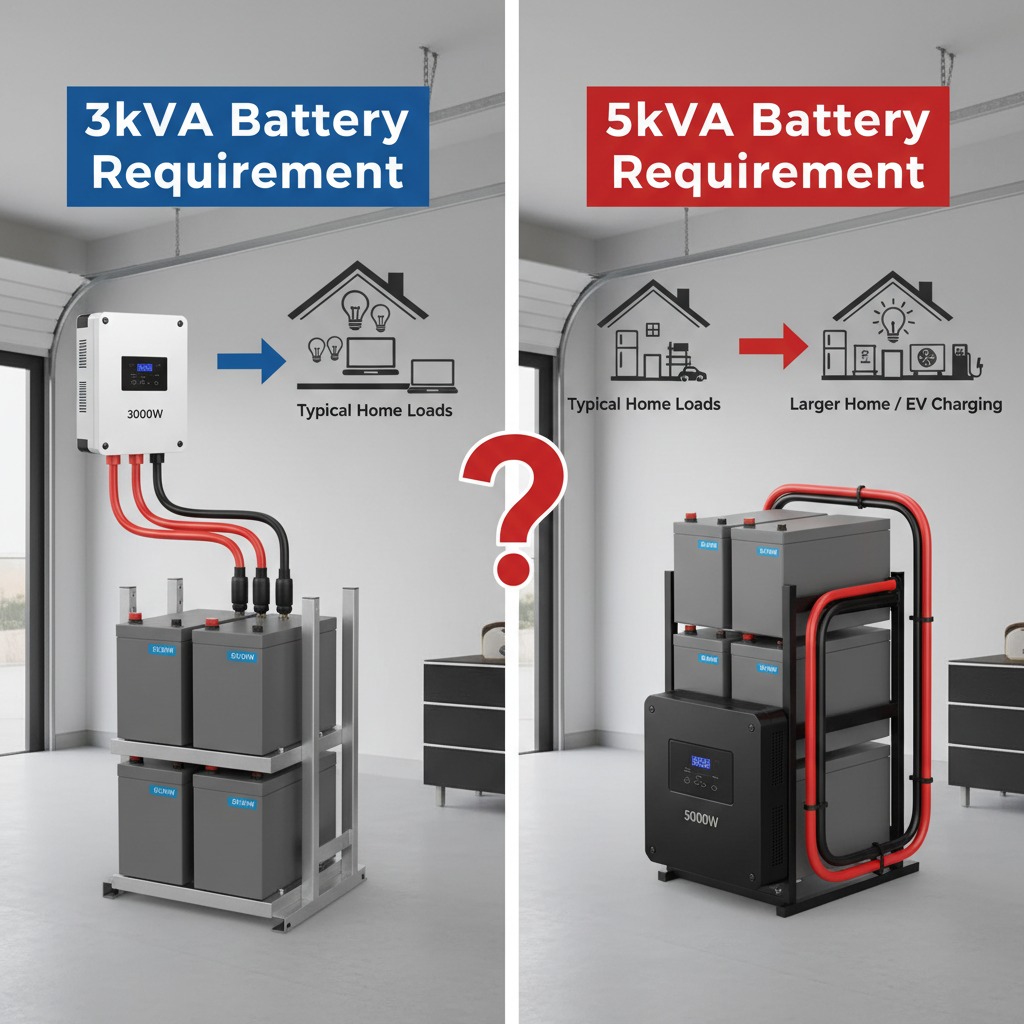
3kVA vs 5kVA Battery Requirement
This is where many buyers forget that the inverter is only one part of the system.
A bigger inverter can support a larger load, but you also need enough battery capacity to run that load for the required amount of time.
For example, if you want to run a 3kVA inverter near its full capacity for several hours, you need a much larger battery bank than if you only run a few hundred watts.
The same applies to a 5kVA inverter.
A 5kVA inverter with a very small battery will not magically give you long backup.
Use our Battery Calculator to estimate your battery requirement.
You can also read our guide on Inverter Battery Prices in Nigeria: Lithium vs Tubular vs GEL.
How Many Batteries Does a 3kVA Inverter Need?
There is no single answer.
It depends on the inverter’s battery voltage.
For example, some 3kVA inverters use a 24V battery system.
If you are using 12V batteries, a 24V system normally requires two 12V batteries connected in series.
But the Ah capacity depends on how much backup you need.
For example:
2 × 12V 200Ah batteries
would create a 24V 200Ah battery bank when connected in series.
The nominal stored energy would be:
24V × 200Ah = 4.8kWh
But the usable energy is lower and depends on the battery chemistry, depth of discharge, inverter efficiency and other factors.
How Many Batteries Does a 5kVA Inverter Need?
Again, there is no universal number.
Many modern 5kVA systems use 48V battery banks.
If using 12V batteries, a 48V battery bank would normally require four 12V batteries in series.
But lithium systems are often available as 48V or 51.2V battery units, which can simplify the installation.
The exact battery setup must match the inverter.
Do not buy four batteries simply because someone says:
“5kVA needs four batteries.”
The inverter’s battery voltage and your required storage capacity must be checked first.
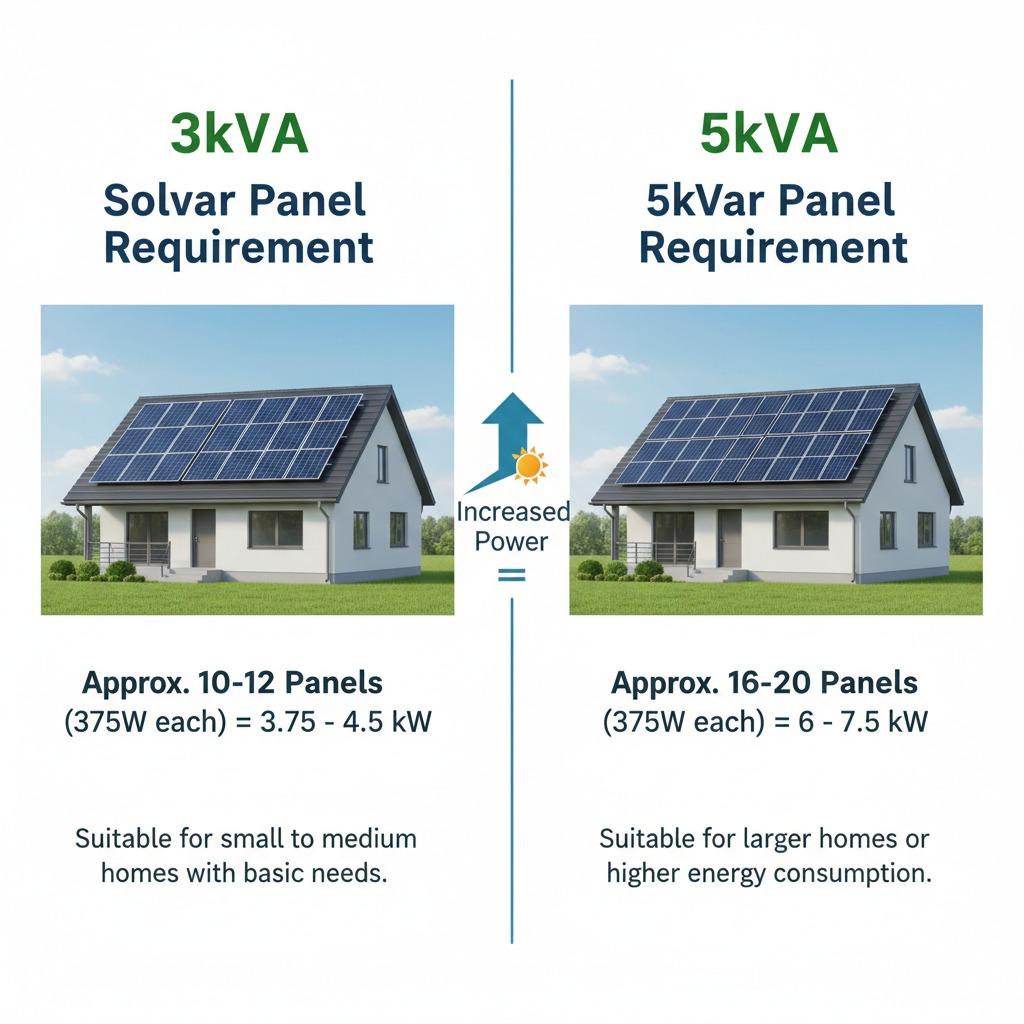
3kVA vs 5kVA Solar Panel Requirement
A bigger inverter does not automatically tell you how many solar panels you need.
The solar array depends on:
- Your daily energy use
- Battery capacity
- Charging requirements
- Peak sun hours
- Inverter’s maximum PV input
- Panel wattage
- System losses
For example, a 5kVA inverter may be able to accept a larger solar array than a 3kVA model.
But you must check the inverter’s maximum PV power and MPPT voltage range.
Use our Solar Panel Calculator to estimate the panel capacity you may need.
You can also check Solar Panel Prices in Nigeria before buying.
Is a 5kVA Inverter Better for a Large House?
Usually, but the number of rooms is not what determines the inverter size.
A large house with only:
- Lights
- Fans
- TV
- Router
- Refrigerator
may not need a 5kVA inverter.
A smaller house with:
- Two ACs
- Water pump
- Freezer
- Washing machine
- Electric cooker
- Multiple other loads
could need much more than 5kVA.
So don’t choose an inverter based on:
“I have a 4-bedroom house, so I need 5kVA.”
Calculate the actual load.
Is 3kVA Enough for a 2-Bedroom House?
It can be.
For example, if the home mainly uses:
- Lights
- Fans
- TV
- Refrigerator
- Router
- Small electronics
a 3kVA inverter may be enough.
But if the same 2-bedroom house has multiple AC units, a large water pump and other heavy appliances, 3kVA may not be enough.
The number of bedrooms does not determine inverter size.
Your appliances do.
Is 5kVA Enough for a 3-Bedroom House?
It can be suitable for many 3-bedroom homes, but again, it depends on the appliances.
A 3-bedroom house with moderate loads may work well with 5kVA.
A 3-bedroom house with several air conditioners, electric cooking equipment and large pumps may need more.
Calculate before buying.
Which One Uses More Electricity?
The inverter itself does not decide how much electricity your home uses.
Your appliances determine your energy consumption.
A 5kVA inverter does not automatically consume more electricity simply because it is rated higher.
If you connect the same 1,000W load to a suitable 3kVA inverter and a suitable 5kVA inverter, the appliances are still using roughly the same amount of power.
The difference is that the 5kVA inverter has more capacity available if you need it.
Which One Has Better Backup Time?
Neither automatically gives longer backup.
Backup time mainly depends on:
Battery capacity ÷ load
For example, if two homes have identical batteries but one home uses 500W while the other uses 1,500W, the first home will normally get much longer backup.
This is why buying a larger inverter does not automatically mean longer battery backup.
If you want longer backup, you may need a larger battery bank.
Which One Is Cheaper?
3kVA is normally cheaper.
The inverter itself is usually cheaper because it has a smaller capacity.
It can also reduce the cost of other parts of the system if your energy needs are small.
For example, you may need:
- Smaller battery capacity
- Smaller solar array
- Smaller cables in some designs
- Smaller protection equipment
However, the complete system cost depends on the design.
A 3kVA system with a large lithium battery can still cost more than a basic 5kVA system using cheaper batteries.
So compare the complete system, not only the inverter.
When Should You Buy a 3kVA Inverter?
A 3kVA inverter may be suitable if:
- Your total load is relatively small
- You mainly want essential backup
- You have a limited budget
- You don’t plan to run many heavy appliances
- Your calculated load fits comfortably within the inverter’s rating
- You don’t expect a large increase in your electricity needs soon
If this describes your home, there may be no reason to spend extra money on a 5kVA inverter.
When Should You Buy a 5kVA Inverter?
A 5kVA inverter may be the better choice if:
- Your load is already close to 3kVA
- You want to run more appliances together
- You have larger appliances
- You plan to add appliances later
- You want more room for expansion
- Your budget can support the larger system
If you are already close to the limit of a 3kVA inverter, moving to 5kVA can be a better long-term decision.
Should You Buy 5kVA Just for Future Expansion?
Sometimes.
If you know you will soon add:
- An AC
- Freezer
- Water pump
- More fans
- More computers
- Other appliances
it may make sense to buy a larger inverter now.
But don’t oversize the system unnecessarily.
If you currently need only a small system and have no plans to expand, spending significantly more on unused capacity may not give you good value.
A reasonable amount of future allowance is useful.
Buying twice the capacity “just in case” is not always necessary.
3kVA vs 5kVA for Lithium Batteries
Both can work very well with lithium batteries.
Lithium batteries are attractive because they can generally provide a larger usable portion of their rated capacity and can have a long cycle life when properly managed.
But the inverter must support the battery correctly.
Some lithium batteries also support communication with compatible inverters.
This can help the inverter and battery exchange information about:
- State of charge
- Charging
- Discharging
- Battery protection
Always check compatibility before purchasing.
3kVA vs 5kVA for Tubular Batteries
Both inverter sizes can also work with tubular batteries.
However, a 5kVA system may require a larger battery bank if you intend to use its higher output for longer periods.
For a tubular battery system, remember that:
- Deep discharge can shorten battery life
- Water levels need monitoring
- Proper ventilation is important
- Charging settings must be correct
Read our GEL vs Tubular Battery comparison if you are deciding between these battery types.
3kVA vs 5kVA for Solar Panels
The bigger inverter can often accept a larger solar array, but this varies by model.
For example, one 5kVA inverter might accept a larger PV array than another 5kVA inverter.
So don’t assume:
5kVA = X number of panels
Always check the inverter datasheet.
Look for:
- Maximum PV power
- Maximum PV voltage
- MPPT voltage range
- Maximum PV current
- Number of MPPTs
Then select the panel arrangement.
What About a 3kVA Hybrid Inverter?
A hybrid inverter can combine multiple power sources depending on the model.
For example:
Solar + Battery + Grid
Some models may also work with a generator.
A 3kVA hybrid inverter can be useful when you want solar charging and grid charging in the same system.
Our Hybrid vs Off-Grid Inverter comparison explains the difference between these inverter types.
What About a 5kVA Hybrid Inverter?
A 5kVA hybrid inverter provides the same type of flexibility but with more output capacity, depending on the model.
This can make it attractive for larger homes.
However, don’t buy a 5kVA hybrid inverter simply because it has more features.
Check:
- Battery voltage
- Maximum PV input
- MPPT range
- Maximum output
- Surge rating
- Battery compatibility
- Warranty
- Monitoring
- Number of MPPT inputs
Common Mistakes When Choosing Between 3kVA and 5kVA
1. Choosing based on house size
A 4-bedroom house does not automatically need 5kVA.
Calculate your load.
2. Choosing based only on price
The cheaper inverter may not have the features or capacity you need.
3. Forgetting startup surge
Motors can require extra power when starting.
4. Ignoring battery size
A larger inverter needs an appropriately designed battery bank if you want to use its full capacity.
5. Ignoring solar input limits
Your inverter may not accept as many solar panels as you expect.
6. Buying too much capacity
A larger inverter is not automatically better if you will never use the extra capacity.
7. Buying too little capacity
A system that is constantly near its limit may not be a good long-term choice.
Simple Example: Choosing Between 3kVA and 5kVA
Imagine your home has the following estimated running load:
- Lights: 100W
- Fans: 200W
- TV: 100W
- Refrigerator: 150W
- Router: 15W
- Laptop: 65W
- Decoder: 20W
Total:
650W
A 3kVA inverter may have plenty of capacity for this load.
Now imagine you add:
- Air conditioner: 800W
- Water pump: 500W
- Freezer: 150W
Your running load could now be around:
2,100W
And that does not fully account for startup surges.
A 3kVA inverter might still be possible depending on the actual equipment and inverter rating, but the system has much less spare capacity.
A 5kVA inverter gives you more room.
This is why the correct answer depends on your actual appliances.
3kVA vs 5kVA: Which One Should You Choose?
Use this simple guide.
Choose 3kVA if:
Your load is small or moderate
You mainly want:
- Lights
- Fans
- TV
- Refrigerator
- Router
- Small electronics
and you do not plan to add many heavy appliances.
Choose 5kVA if:
Your load is larger
You want to run more appliances together or you expect your electricity needs to increase.
Final Verdict
3kVA is better for a smaller, carefully managed system.
5kVA is better when you need more capacity and room for expansion.
Neither is automatically the best.
The right choice depends on:
- Your total appliance load
- Startup surge
- Desired backup time
- Battery capacity
- Solar panel capacity
- Future appliances
- Budget
If your calculated load comfortably fits within 3kVA, you don’t need to buy 5kVA simply because it is bigger.
But if your load is already approaching the practical limit of 3kVA, a 5kVA inverter may be the safer long-term choice.
The best approach is simple:
Calculate first. Buy second.
Frequently Asked Questions
Is 5kVA better than 3kVA?
It has more capacity, but that does not mean it is better for every home. If your load is small, a 3kVA inverter may be enough.
Can a 3kVA inverter power a whole house?
It can power many household appliances, but whether it can power your whole house depends on the total load and which appliances you use at the same time.
Can a 5kVA inverter power a whole house?
It can power a larger load than a 3kVA inverter, but it still may not be enough for a home with several heavy appliances running simultaneously.
Can 3kVA run a fridge and TV?
Yes, provided the total load and startup requirements remain within the inverter’s limits.
Can 3kVA run an AC?
It depends on the AC’s running and startup power and what other appliances are operating at the same time.
Can 5kVA run an AC?
It can be suitable for some AC setups, but the actual AC specification and the rest of the home’s load must be checked.
Does 5kVA give longer battery backup?
Not by itself. Backup time depends mainly on battery capacity and the load being powered.
Does a 5kVA inverter need more batteries?
It may, especially if you want to use the higher output for longer periods. The actual number depends on the inverter’s battery voltage and required storage capacity.
Is 3kVA cheaper than 5kVA?
The 3kVA inverter itself is normally cheaper, but the total system price depends on the batteries, solar panels, accessories and installation.
Should I buy 3kVA or 5kVA?
Calculate your maximum expected load first. Choose 3kVA if your load comfortably fits. Choose 5kVA if you need more capacity or expect your load to grow.
Calculate Your Solar System Before Buying
Don’t guess your inverter size.
Use our tools to estimate your system:
Inverter Calculator — Estimate the inverter size based on your appliances.
Battery Calculator — Estimate the battery capacity you may need for your desired backup.
Solar Panel Calculator — Estimate your solar panel requirement.
Solar Installation Cost Calculator — Estimate the likely cost of your solar installation.
You can also check our Solar Inverter Prices in Nigeria page to compare available inverter sizes and models.
Prices and specifications can change. Always confirm the exact inverter specifications, battery requirements, solar input limits, warranty and final price with the manufacturer, seller or qualified installer before purchasing.