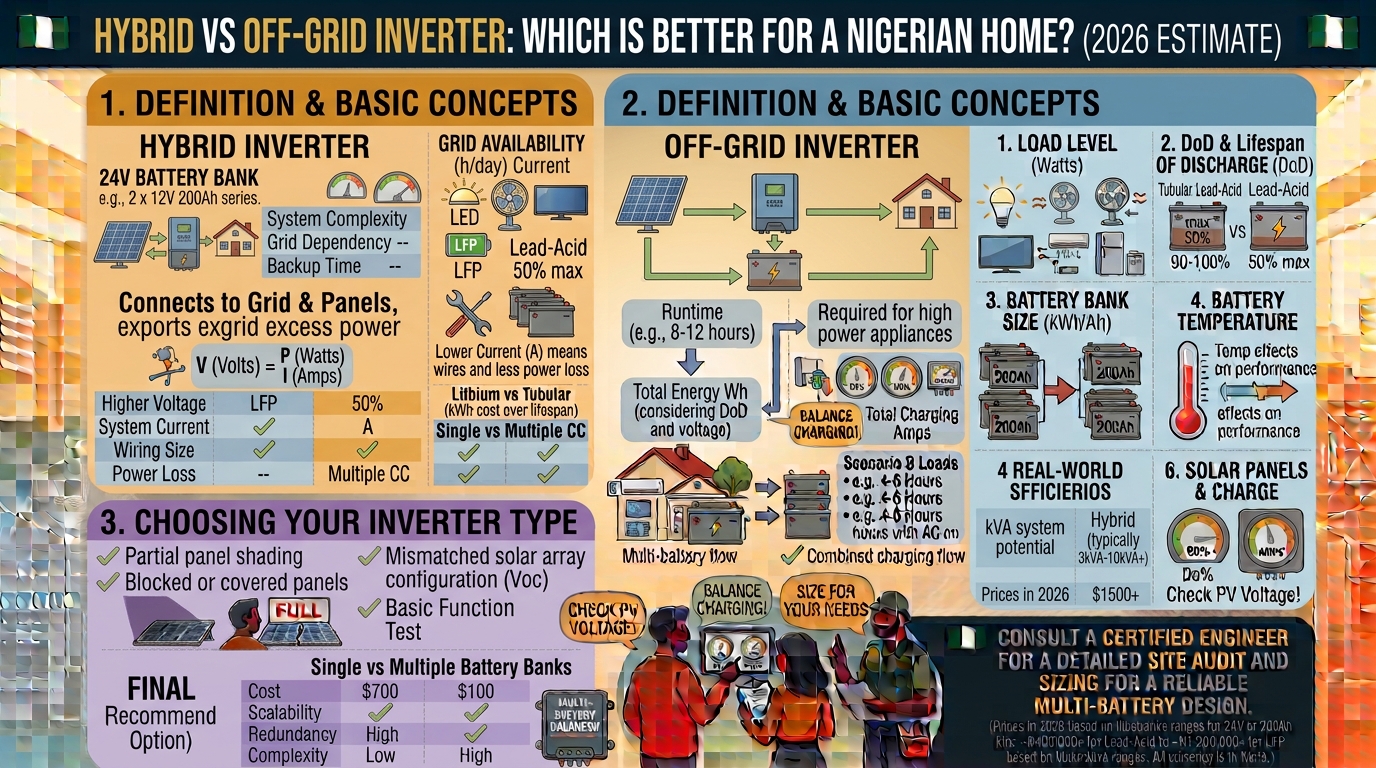
If you are planning to buy a solar inverter, you may come across two common options: hybrid inverters and off-grid inverters.
Both can work with batteries and solar panels, but they are not designed in exactly the same way.
A hybrid inverter can normally manage more than one power source, such as:
Solar + Battery + Grid + Generator
depending on the model.
An off-grid inverter is mainly designed to work as part of a standalone system where the battery and solar panels provide the main power.
So which one is better for a Nigerian home?
For most homes in Nigeria, a hybrid inverter is usually the more flexible choice.
But an off-grid inverter can still make sense if you want a simpler system and do not need the extra features of a hybrid inverter.
Let’s look at the differences.
Hybrid vs Off-Grid Inverter at a Glance
| Feature | Hybrid Inverter | Off-Grid Inverter |
|---|---|---|
| Solar input | Yes, on suitable models | Yes, depending on model |
| Battery | Yes | Yes |
| Grid input | Usually available | Usually not designed around grid use |
| Generator support | Often available | Depends on model |
| Can work with solar + grid | Yes, depending on model | Usually limited |
| Battery charging from grid | Usually available | Depends on model |
| Flexibility | Higher | Lower |
| System complexity | Higher | Simpler |
| Initial cost | Usually higher | Usually lower |
| Best for | Homes using multiple power sources | Standalone solar systems |
These are general differences. Inverter features vary from one brand and model to another, so always check the exact specification before buying.
What Is a Hybrid Inverter?
A hybrid inverter is designed to manage different sources of electricity.
Depending on the model, it may combine:
- Solar panels
- Batteries
- Grid electricity
- Generator
For example, during the day your solar panels may provide power to your appliances while also charging your battery.
When solar production is not enough, the system can use the battery or grid depending on the inverter’s settings.
At night, the battery can supply your appliances.
If the battery becomes low, the inverter may switch to grid or generator power if that feature is supported.
This flexibility is one of the biggest reasons hybrid inverters are becoming popular for homes.
What Is an Off-Grid Inverter?
An off-grid inverter is designed mainly for a system that does not depend on the public electricity grid.
A typical setup can look like:
Solar Panels → Charge Controller → Battery → Inverter → Appliances
Some off-grid inverters have a built-in solar charge controller, while others require a separate controller.
The battery stores energy from the solar panels and provides power when the panels are not producing enough electricity.
An off-grid system can be useful for:
- Remote homes
- Farms
- Rural properties
- Locations without reliable grid electricity
- Standalone solar systems
But some off-grid inverter models can also have additional inputs or charging features, so you should check the exact model rather than judging it only by the name.
What Is the Main Difference?
The biggest difference is how much control the inverter gives you over different power sources.
A hybrid inverter is designed to combine and manage multiple sources.
An off-grid inverter is mainly designed around a standalone solar and battery system.
Think of it this way:
Hybrid inverter
Solar + Battery + Grid/Generator
Off-grid inverter
Solar + Battery
This is a simple way to understand the difference, but actual features vary between models.
Which One Is Better During NEPA/PHCN Outages?
Hybrid is usually better for Nigerian homes.
This is because many homes in Nigeria have more than one source of electricity.
You may have:
- Public electricity
- Solar
- Battery
- Generator
A hybrid inverter can be designed to work with several of these sources.
For example, when public power is available, the inverter can use the grid and charge the battery.
When the grid goes off, the system can switch to battery and solar.
When the battery is low, a compatible generator can potentially provide another source of power.
The exact order and behaviour depend on the inverter’s settings.
This flexibility can be very useful where power supply is not consistent.
Can an Off-Grid Inverter Work Without NEPA?
Yes.
This is actually one of its main purposes.
An off-grid system can operate without public electricity.
If your solar panels produce enough energy and your battery bank is properly sized, your appliances can continue running without grid electricity.
This makes off-grid systems useful in places where grid power is unavailable.
However, you need enough:
- Solar panels
- Battery storage
- Inverter capacity
- Proper wiring
- Protection equipment
If your battery is too small, your system can still run out of energy even if the inverter is large.
Which One Is Better for a Home in Nigeria?
For most homes, I would choose hybrid.
Why?
Because many Nigerian homes do not want to completely disconnect from public electricity.
Instead, they want something like:
Solar during the day → Battery at night → Grid/generator when needed
A hybrid inverter gives you more options for managing these sources.
For example, you may decide to:
- Use solar first
- Charge your battery from solar
- Keep the grid as backup
- Use the battery during outages
- Use a generator only when necessary
The exact settings depend on the inverter.
When Does an Off-Grid Inverter Make More Sense?
An off-grid inverter can make sense when:
- There is little or no grid electricity
- You want a standalone solar system
- You are powering a farm or remote property
- You don’t need grid integration
- You want a simpler setup
- You want to keep the initial inverter cost lower
For example, imagine a farm where grid electricity is not available.
There may be no reason to pay extra for features designed mainly around grid management.
A properly designed off-grid system may be enough.
Which One Is More Expensive?
Hybrid inverters are usually more expensive.
This is because they can have more features.
Depending on the model, a hybrid inverter may include:
- MPPT solar charging
- Grid charging
- Battery charging
- Generator input
- Multiple operating modes
- Wi-Fi monitoring
- Parallel operation
- Lithium battery communication
- Multiple MPPT inputs
However, don’t assume every hybrid inverter is more expensive than every off-grid inverter.
Brand, capacity and features can make a big difference.
You can check current estimated prices in our Hybrid Inverter Prices in Nigeria section.
Does a Hybrid Inverter Need a Separate Charge Controller?
Not always.
Many hybrid inverters already have a built-in MPPT solar charge controller.
That means the inverter can take electricity from your solar panels and manage the charging of the battery.
This can reduce the number of separate components you need to buy.
However, some systems may still use a separate charge controller depending on the design.
Always check the inverter’s specifications.
If you want to understand charge controllers better, see our Solar Charge Controller Prices in Nigeria section.
You can also read:
How Much Is a Solar Charge Controller in Nigeria? 2026 Prices
Which One Is Easier to Install?
Off-grid systems can be simpler.
A basic off-grid setup may look like:
Solar Panels → Charge Controller → Battery → Inverter → Appliances
A hybrid system can have more connections and settings because it may manage:
Solar + Battery + Grid + Generator
This does not mean hybrid systems are difficult to install.
It simply means there are more things to configure correctly.
For both systems, proper installation is important.
Incorrect:
- Cable sizing
- Battery connection
- Protection
- Inverter settings
- Solar panel connection
can cause poor performance or safety problems.
Which One Is Better for Lithium Batteries?
Both can work with lithium batteries.
The important thing is compatibility.
Don’t assume an inverter is compatible with every lithium battery simply because it has a battery connection.
Check:
- Battery voltage
- Maximum charging current
- Maximum discharge current
- BMS compatibility
- Communication protocol
- CAN/RS485 requirements
- Manufacturer-approved battery list
For example, a 48V-class lithium battery may be suitable for one inverter but not another.
You can see the lithium batteries currently listed in our Lithium Battery Prices in Nigeria section.
What About Tubular Batteries?
Hybrid and off-grid inverters can also work with lead-acid batteries such as tubular batteries when the inverter supports the required battery type and charging settings.
However, you should select the correct battery mode and charging parameters.
A lithium battery and a tubular battery do not use exactly the same charging requirements.
This is another reason not to buy the battery first and then look for an inverter afterward.
Choose equipment that is designed to work together.
You can read our comparison:
Lithium vs Tubular Battery: Which Is Better for Solar in Nigeria?
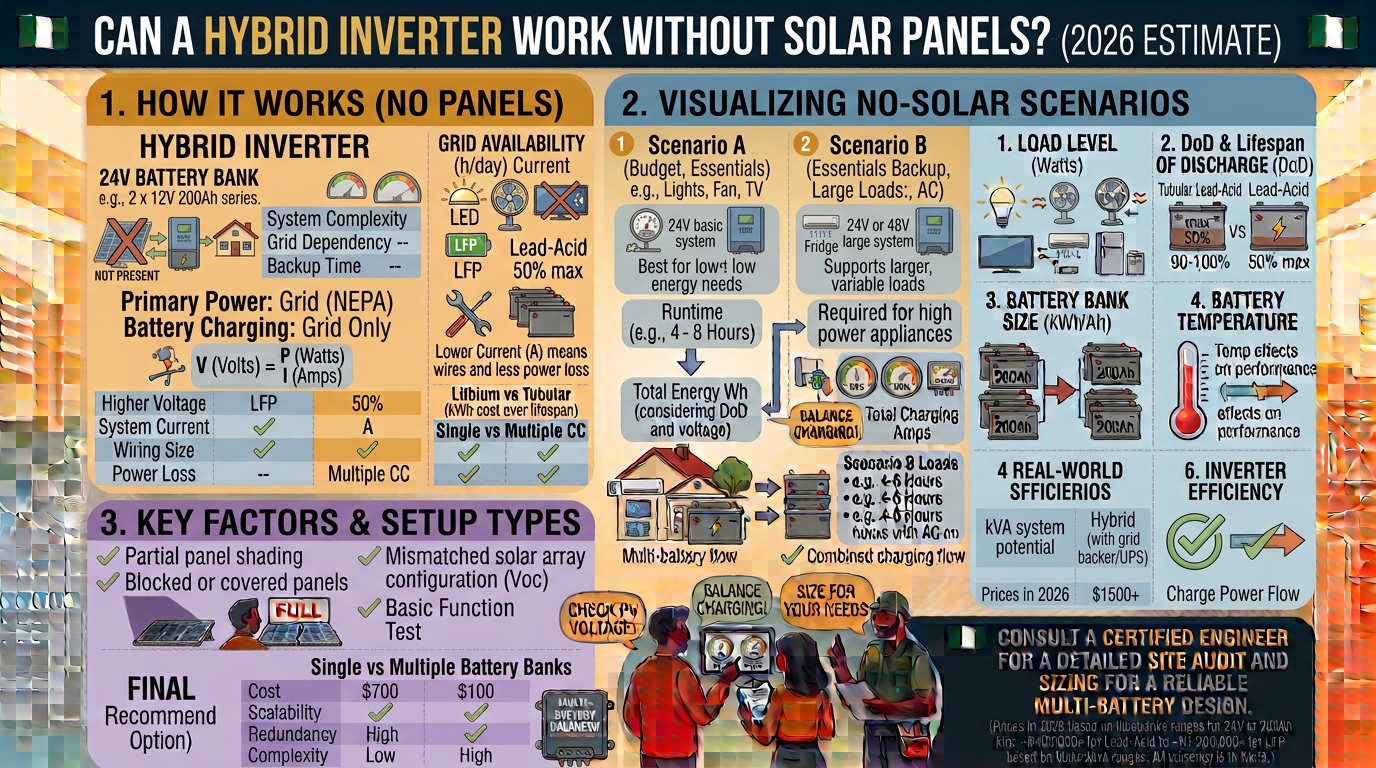
Can a Hybrid Inverter Work Without Solar Panels?
Some can.
Many hybrid inverters can charge their batteries from the grid or generator when solar energy is unavailable.
This depends on the exact model.
For example, you could have:
Grid → Hybrid Inverter → Battery → Appliances
Then when solar panels are added later, the system can use:
Solar + Grid + Battery
if the inverter supports that setup.
This can make some hybrid systems useful for people who want to build their solar system gradually.
Can an Off-Grid Inverter Use a Generator?
Some models can, but don’t assume all can.
Certain off-grid inverter models have generator or AC input.
If generator support is important to you, check the inverter’s specifications before buying.
Look for information about:
- AC input
- Generator compatibility
- Generator charging
- Transfer switching
- Input voltage range
- Maximum AC charging current
A generator-compatible inverter can be very useful in areas where solar production may not always be enough.
Which One Gives Better Backup?
Neither one automatically gives you longer backup.
This is important.
Backup time mainly depends on:
Battery energy ÷ Load
For example, a large battery can give you longer backup regardless of whether the inverter is hybrid or off-grid.
The inverter determines how much power your appliances can use, while the battery determines how much stored energy is available.
Before buying an inverter, use our Battery Calculator to estimate the battery capacity you may need.
You can also use the Inverter Calculator to estimate the inverter capacity based on your appliances.
Which One Is Better for Future Expansion?
Hybrid usually gives you more flexibility.
A good hybrid inverter may support:
- More battery storage
- More solar panels
- Parallel operation
- Generator integration
- Grid integration
- Different battery types
But expansion depends on the exact model.
For example, some inverters may allow you to connect several units together, while others may not.
Before buying, ask:
Can I add more batteries later?
Can I add more solar panels?
Can I connect another inverter?
Can I use a generator?
Can I change from lead-acid to lithium?
The answers should come from the manufacturer’s specifications.
What Size Hybrid or Off-Grid Inverter Do You Need?
Don’t choose the inverter based only on the number of rooms in your house.
A three-bedroom home could need a smaller system than a two-bedroom home if the appliances are different.
For example:
Home A
- Lights
- Fans
- TV
- Decoder
- Router
- Refrigerator
Home B
- Lights
- Fans
- TV
- Refrigerator
- Freezer
- Two air conditioners
- Pump
- Washing machine
Home B will require a much larger system.
This is why you should calculate your actual load first.
Use the SolarPriceNG Inverter Calculator to estimate the inverter size you may need.
You can also read our guide:
How Many kVA Inverters Do I Need for My Home in Nigeria?
What About the Solar Panels?
Your inverter must be able to handle the solar panel array you want to install.
Check the inverter’s:
- Maximum PV voltage
- MPPT voltage range
- Maximum PV current
- Maximum PV power
- Number of MPPT inputs
Two inverters with the same 5kVA rating can have very different solar input capabilities.
For example, one may accept a smaller solar array while another may accept several kilowatts of solar panels.
You can use our Solar Panel Calculator to estimate the solar panel capacity you may need.
Then compare that requirement with the exact inverter’s PV specifications.
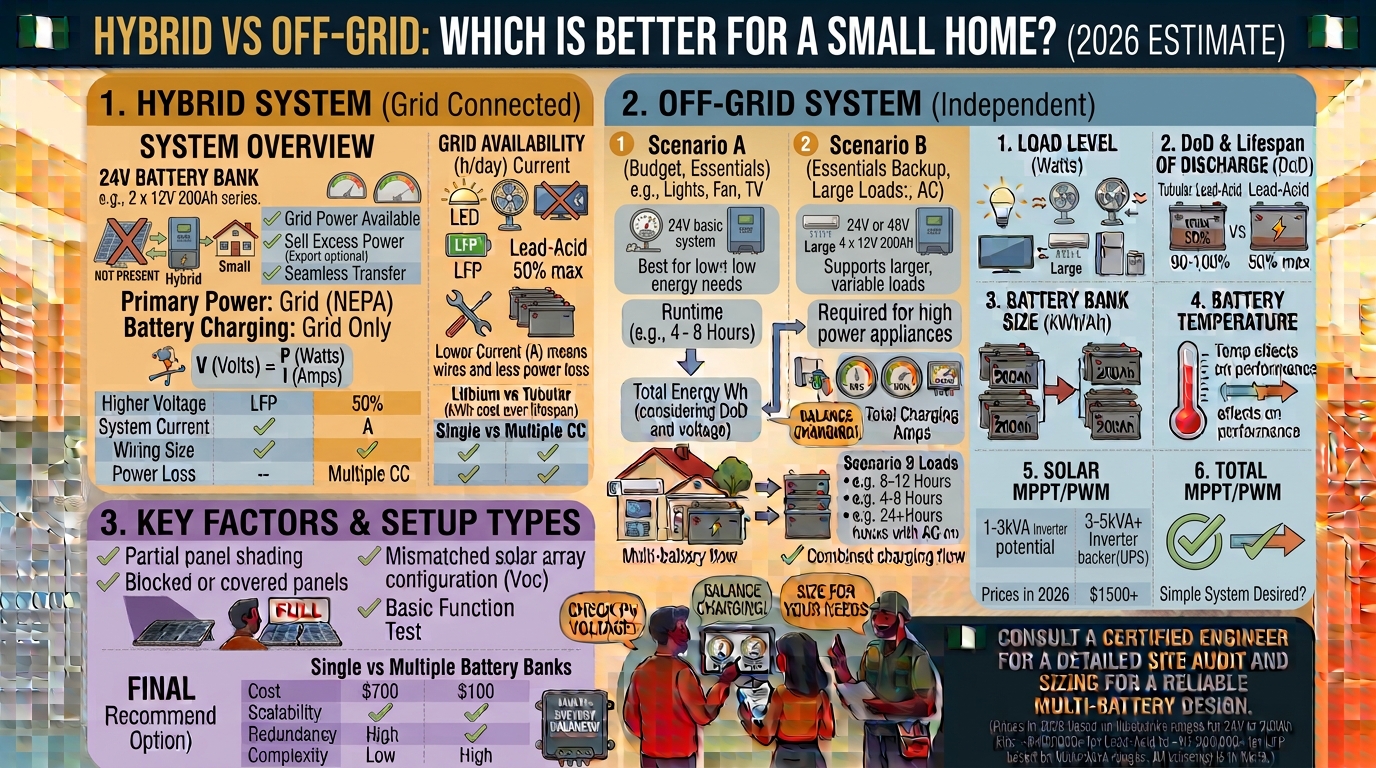
Hybrid vs Off-Grid: Which Is Better for a Small Home?
For a small home with basic appliances, either can work.
If you have:
- Lights
- Fans
- TV
- Decoder
- Router
- Laptop
- Small refrigerator
a small properly sized inverter may be enough.
If you still have reliable grid power and only want solar to reduce your dependence on the grid, a hybrid inverter can be more useful.
If you are in a location where grid power is not available, an off-grid system may make more sense.
Hybrid vs Off-Grid: Which Is Better for a Large Home?
Hybrid is usually the better choice.
Large homes often have more complicated power requirements.
You may have:
- Multiple refrigerators
- Freezers
- Water pumps
- Washing machines
- Computers
- Several TVs
- Air conditioners
- Other heavy appliances
A hybrid inverter can give you more ways to manage these loads with solar, batteries, grid and possibly a generator.
But the inverter must still be correctly sized.
A hybrid inverter does not mean you can run unlimited appliances.
What About the Cost of the Complete System?
Don’t compare only the inverter price.
Your complete solar system may include:
- Inverter
- Batteries
- Solar panels
- Charge controller
- Cables
- Breakers
- Fuses
- Surge protection
- Mounting materials
- Installation labour
- Transportation
- Other accessories
A cheaper inverter can sometimes result in a more expensive system if it requires additional equipment.
This is why you should compare the complete system, not only the inverter.
You can use our Solar Installation Cost Calculator to estimate the likely installation cost.
You can also check Solar Prices in Nigeria for current estimated equipment prices.
Hybrid vs Off-Grid Inverter: Which Should You Buy?
Choose a hybrid inverter if:
- You have unreliable grid electricity
- You want to combine solar and battery with the grid
- You use a generator as another backup
- You want more control over your power sources
- You plan to expand your solar system
- You want a flexible home solar system
Choose an off-grid inverter if:
- You have little or no grid electricity
- You want a standalone solar system
- You are powering a remote property
- You don’t need grid integration
- You want a simpler system
- The inverter’s features meet your exact needs
My Recommendation for Most Nigerian Homes
If I were choosing a system for a typical Nigerian home where public electricity is available but unreliable, I would generally choose a good hybrid inverter.
The reason is flexibility.
You can potentially use:
Solar + Battery + Grid + Generator
instead of depending on only one source.
This is especially useful where electricity supply can change from day to day.
However, don’t buy a hybrid inverter simply because it has more features.
If you don’t need those features, a simpler off-grid inverter may be enough.
The best inverter is the one that matches your:
- Appliance load
- Battery
- Solar panels
- Available power sources
- Budget
- Future plans
Final Verdict
For most Nigerian homes:
Hybrid inverter = Better flexibility
Off-grid inverter = Better simplicity for standalone systems
If your home has grid electricity but you want solar to reduce your dependence on it, hybrid is usually the better choice.
If you are building a solar system for a remote location where grid electricity is not available, off-grid may be the better choice.
But remember:
Hybrid does not automatically mean better quality.
A poor-quality hybrid inverter can be a worse purchase than a good off-grid inverter.
Always check the actual:
- Brand
- Model
- Battery voltage
- Solar input
- Battery compatibility
- Warranty
- Surge capacity
- Maximum load
- Expansion options
- After-sales support
before paying.
Frequently Asked Questions
Is a hybrid inverter better than an off-grid inverter?
For most Nigerian homes with unreliable grid electricity, a hybrid inverter is usually more flexible because it can manage solar, batteries and grid power, and some models also support generators. An off-grid inverter can be better for a standalone system.
Can a hybrid inverter work without NEPA?
Yes, if the system has enough solar and battery capacity. The exact operation depends on the inverter and its settings.
Can an off-grid inverter work with NEPA?
Some off-grid inverter models have AC input or other charging features, but you should not assume that every off-grid inverter can properly integrate with the grid. Check the exact model.
Can I use a generator with a hybrid inverter?
Many hybrid inverters support generator input, but this is model-dependent. Check the manufacturer’s specifications before buying.
Can I use lithium batteries with a hybrid inverter?
Yes, many hybrid inverters support lithium batteries. However, check the battery voltage, BMS communication, charging current and manufacturer’s compatibility requirements.
Can I use tubular batteries with a hybrid inverter?
Yes, if the inverter supports lead-acid/tubular batteries and has the correct charging settings.
Does a hybrid inverter charge batteries from NEPA?
Many hybrid inverters can charge batteries from grid electricity, but the exact charging ability depends on the model.
Does an off-grid inverter need solar panels?
Not necessarily. Some models can receive power from other charging sources such as grid or generator, depending on their design. But solar panels are normally an important part of a true off-grid solar system.
Which inverter is better for a 5kVA solar system?
There is no universal answer. A 5kVA hybrid inverter may be a good choice for a home that needs solar, battery and grid integration, while a 5kVA off-grid inverter may be suitable for a standalone system.
First calculate your actual load using the Inverter Calculator.
How much does a hybrid inverter cost in Nigeria?
The price depends on the inverter size, brand, features and battery voltage. You can see current estimated ranges in our Hybrid Inverter Prices in Nigeria section.
Plan Your Solar System
Before buying an inverter, use our free tools to estimate what your system may need:
Inverter Calculator — Estimate the inverter capacity based on your appliances.
Battery Calculator — Estimate your battery storage requirement.
Solar Panel Calculator — Estimate your solar panel capacity and panel count.
Solar Installation Cost Calculator — Estimate the likely installation cost.
You can also check Solar Prices in Nigeria to compare current estimated prices for inverters, batteries, solar panels, charge controllers and other solar equipment.
Prices and specifications can change. Always confirm the exact specifications, compatibility, warranty and final price with the manufacturer, seller or qualified installer before purchasing.