
Short answer: “How long does a solar generator last?” can mean two different things. It can mean how many hours it powers your appliances on one charge, or how many years the battery remains useful. The first depends mainly on battery capacity and appliance load. The second depends on battery chemistry, charge cycles, heat, storage and how the unit is used.
A portable power station may give you only a few hours of backup on one charge but remain useful for years. It may also still work after its battery has lost some capacity, although the runtime will gradually become shorter.
How Long Does a Solar Generator Run on One Charge?
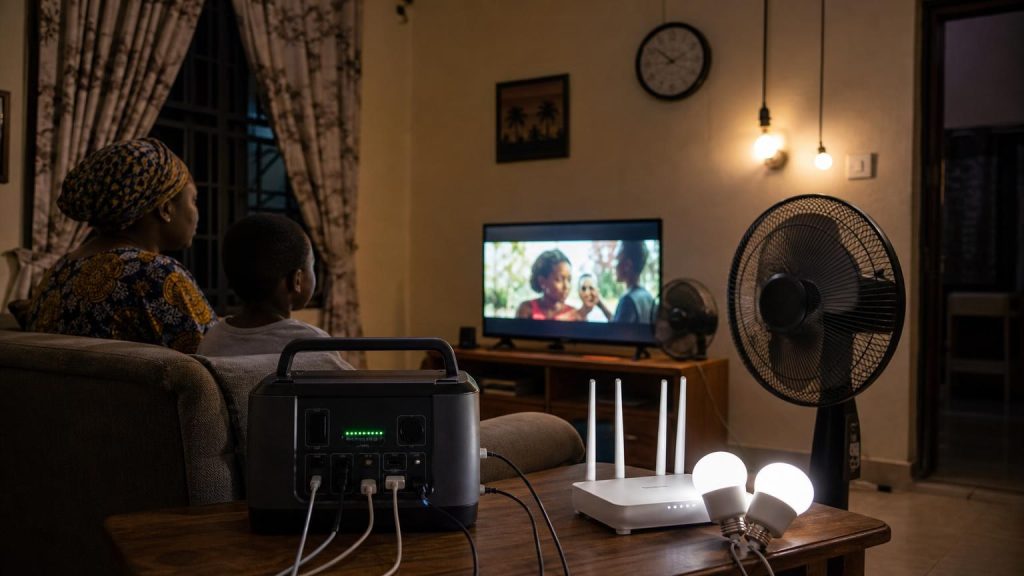
The simplest planning formula is:
Estimated runtime = usable battery energy ÷ appliance load
Solar generators usually show battery capacity in Wh or kWh. The appliance load is measured in watts.
For example, a power station with a 1,000Wh battery connected to a 200W load gives a simple theoretical estimate of:
1,000Wh ÷ 200W = 5 hours
In real use, you should allow for inverter losses, battery-management limits and other system losses. If you use an 85% planning assumption:
1,000Wh × 0.85 ÷ 200W = about 4.25 hours
This is an estimate, not a guaranteed runtime. Actual results depend on the model, battery condition, temperature, appliance behaviour and whether the load changes while you are using it.
Illustrative Runtime Table
The table below uses an 85% planning assumption. It is designed to show how battery size and appliance load interact, not to promise the exact performance of every product.
| Average load | 500Wh unit | 1,000Wh unit | 2,000Wh unit |
|---|---|---|---|
| 100W | About 4.25 hours | About 8.5 hours | About 17 hours |
| 200W | About 2.1 hours | About 4.25 hours | About 8.5 hours |
| 500W | About 0.85 hour | About 1.7 hours | About 3.4 hours |
| 1,000W | About 0.4 hour | About 0.85 hour | About 1.7 hours |
A 500Wh solar generator could therefore be useful for a router, laptop, lights and phones, but it may not provide long backup for a high-power appliance. A 2,000Wh unit stores much more energy, but it still needs enough inverter output to run the appliance safely.
For a more personalised estimate, use the Solar Generator Calculator and compare the result with the manufacturer’s stated battery capacity and output power.
How Many Years Does a Solar Generator Last?
The battery does not usually stop working suddenly on one particular date. Instead, its maximum capacity gradually reduces. A unit that once provided five hours of backup may later provide four hours or less for the same load.
Manufacturers describe battery longevity in two main ways:
- Cycle life: how many equivalent charge-and-discharge cycles the battery is designed to complete before its capacity falls to a stated level.
- Calendar life: how the battery ages simply because time passes, even when it is not being used heavily.
One cycle does not always mean plugging in once. If you use 50% of the battery today and 50% tomorrow, that is approximately one equivalent full cycle. The exact calculation depends on how the manufacturer defines its rating.
As an illustration, if a model is rated for 3,000 equivalent full cycles and you use one full equivalent cycle every two days, the mathematical result is about 16 years of cycling. That does not guarantee 16 years of original capacity because calendar ageing, heat, storage conditions and the manufacturer’s warranty limit also matter.
This is why it is safer to treat cycle-life figures as a planning guide rather than a promise. Always check what capacity level the manufacturer uses, such as capacity remaining at 80%, and whether the rating applies to the complete power station or only the battery cells.
Does Battery Chemistry Affect Lifespan?
Yes. Portable power stations can use different lithium chemistries, and the exact battery design affects weight, capacity, cycle life, charging limits and expected ageing.
Many newer power stations use LiFePO4, also called lithium iron phosphate. These products are commonly selected when long cycle life and frequent use are important. Other models use different lithium chemistry and may be lighter or more compact, but the exact life expectancy is model-specific.
Do not choose only because a product says “lithium”. Before buying, check:
- The battery chemistry
- The stated cycle life and capacity level used for the rating
- The warranty period and warranty conditions
- Recommended charging and storage temperatures
- Whether the battery is replaceable or expandable
- Availability of local support
Battery capacity naturally fades with cycling and time, and higher temperatures can accelerate lithium-ion degradation. This is particularly relevant in Nigeria, where a poorly ventilated room, direct sunlight or a hot vehicle can expose a power station to damaging heat.
What Makes a Solar Generator Lose Capacity Faster?
1. Repeated deep discharge
Using the battery until it shuts down every time can place more stress on it than using a smaller portion of its capacity. Occasional low-battery use may be unavoidable during a long outage, but it should not be the normal daily routine if you want to maximise battery life.
2. Excessive heat
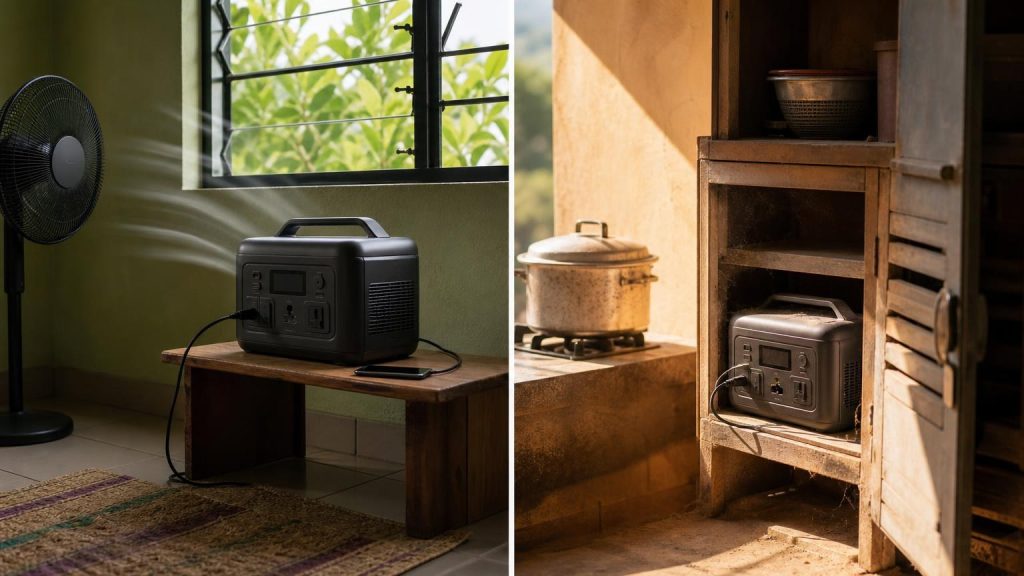
Heat is one of the most important factors to manage. Do not leave the unit in direct afternoon sun, inside a hot car, beside a cooker or in a closed cupboard where the cooling vents are blocked.
3. Staying at 100% for long periods
Keeping a battery fully charged for a short period before an outage is normal. Leaving it at 100% for months when it is not needed can contribute to ageing, depending on the chemistry and the manufacturer’s design. Follow the storage guidance for the exact model.
4. Storing it empty
A power station that is left empty for a long time may fall into a protective shutdown or become difficult to recharge. If you will not use it for several weeks or months, follow the manufacturer’s recommended storage charge and inspection schedule.
5. Overloading the inverter
Connecting appliances above the continuous output or repeatedly triggering overload and surge protection is not a good operating pattern. Check both the running load and the starting power of appliances with motors or compressors.
6. Poor charging conditions
Use the correct charger and solar-input limits. Do not connect panels that exceed the permitted voltage, current or power. Unstable charging equipment, damaged cables and blocked ventilation can also create problems.
How Long Will a Solar Generator Last During a Nigerian Power Outage?
Start with the appliances you genuinely need, not every appliance in the house. A practical essential-load list might include a router, television, laptop, lights and one or two fans.
For example, suppose your estimated load is:
| Appliance | Illustrative load |
|---|---|
| Wi-Fi router | 15W |
| Television | 100W |
| Two fans | 120W |
| LED lights | 40W |
| Total | 275W |
Using the earlier 1,000Wh example and an 85% planning assumption:
1,000Wh × 0.85 ÷ 275W ≈ 3.1 hours
If you reduce the load by switching off the television or one fan, the same battery will last longer. If you add a refrigerator, freezer, pump or pressing iron, the result can change significantly because the appliance may use more power and may have a starting surge.
This is why battery size alone cannot answer the runtime question. You must compare Wh, output watts, surge watts and the actual load.
How Can You Make a Solar Generator Last Longer?
- Keep it cool and ventilated. Leave space around the cooling vents and keep it out of direct sunlight.
- Use the correct charger. Follow the manufacturer’s voltage, current and solar-input limits.
- Avoid unnecessary deep discharge. Turn off loads that are not needed during an outage.
- Store it according to the manual. Do not leave it empty for long periods or keep it fully charged indefinitely without checking the storage instructions.
- Do not overload it. Check running and starting watts before connecting fridges, freezers, pumps or other motor-driven equipment.
- Keep it dry and clean. Protect it from rain, flooding, dust, insects and corrosive conditions.
- Respond to alarms early. Repeated overheating, overload or battery warnings should be investigated rather than ignored.
- Use a surge protector where appropriate. Follow the manufacturer’s guidance for mains charging and sensitive equipment.
For more detailed care guidance, see our article on maintaining a lithium solar battery in Nigeria.
How Do You Know a Solar Generator Battery Is Getting Old?
Battery ageing is more likely when you notice a gradual reduction in performance rather than one isolated shutdown.
- The same appliances run for noticeably fewer hours.
- The displayed state of charge falls unusually quickly.
- The unit shuts down earlier under loads it previously handled.
- Charging takes much longer than it used to.
- The battery becomes unusually hot, swells, smells strange or shows repeated fault warnings.
Short runtime does not always mean the battery is finished. A new appliance, hidden standby load, dirty cooling path, incorrect setting or damaged charger can create similar symptoms. Compare the actual load, charging input and fault history before deciding to replace the unit.
If the battery is swollen, cracked, leaking, smoking, burning hot or producing an unusual smell, stop using it and seek qualified assistance. Do not open or repair the battery yourself.
Is a Solar Generator Worth Buying If the Battery Will Age?
It can be, especially when the convenience of a quiet, portable backup unit is important. The right question is not whether the battery will ever lose capacity. All rechargeable batteries age. The better question is whether the expected runtime, warranty, price and support make sense for your use.
A person who uses a power station occasionally may get many years of useful service before cycle count becomes the main concern. Someone who charges and discharges it heavily every day will reach the rated cycles faster and should pay more attention to chemistry, warranty, thermal protection and battery replacement options.
You can compare current solar generator models and estimated Nigerian prices in the Solar Generator and Portable Power Station Prices in Nigeria category. Do not compare price alone. Check the capacity in Wh, output in W, battery chemistry, stated cycle life and included accessories.
Final answer
A solar generator can last anywhere from a short outage period to many hours on one charge, depending on its battery capacity and the load. Its battery can remain useful for years, but the exact lifespan depends on chemistry, cycle count, temperature, charging habits, storage and product quality.
For a reliable decision:
- Calculate runtime from Wh and appliance watts.
- Check the inverter’s continuous and surge output.
- Read the manufacturer’s cycle-life and warranty information.
- Keep the unit cool, dry and ventilated.
- Do not make deep discharge, overheating or overloading a daily habit.
Buy for the load you actually need, then protect the battery so it can keep doing that job for as long as possible.