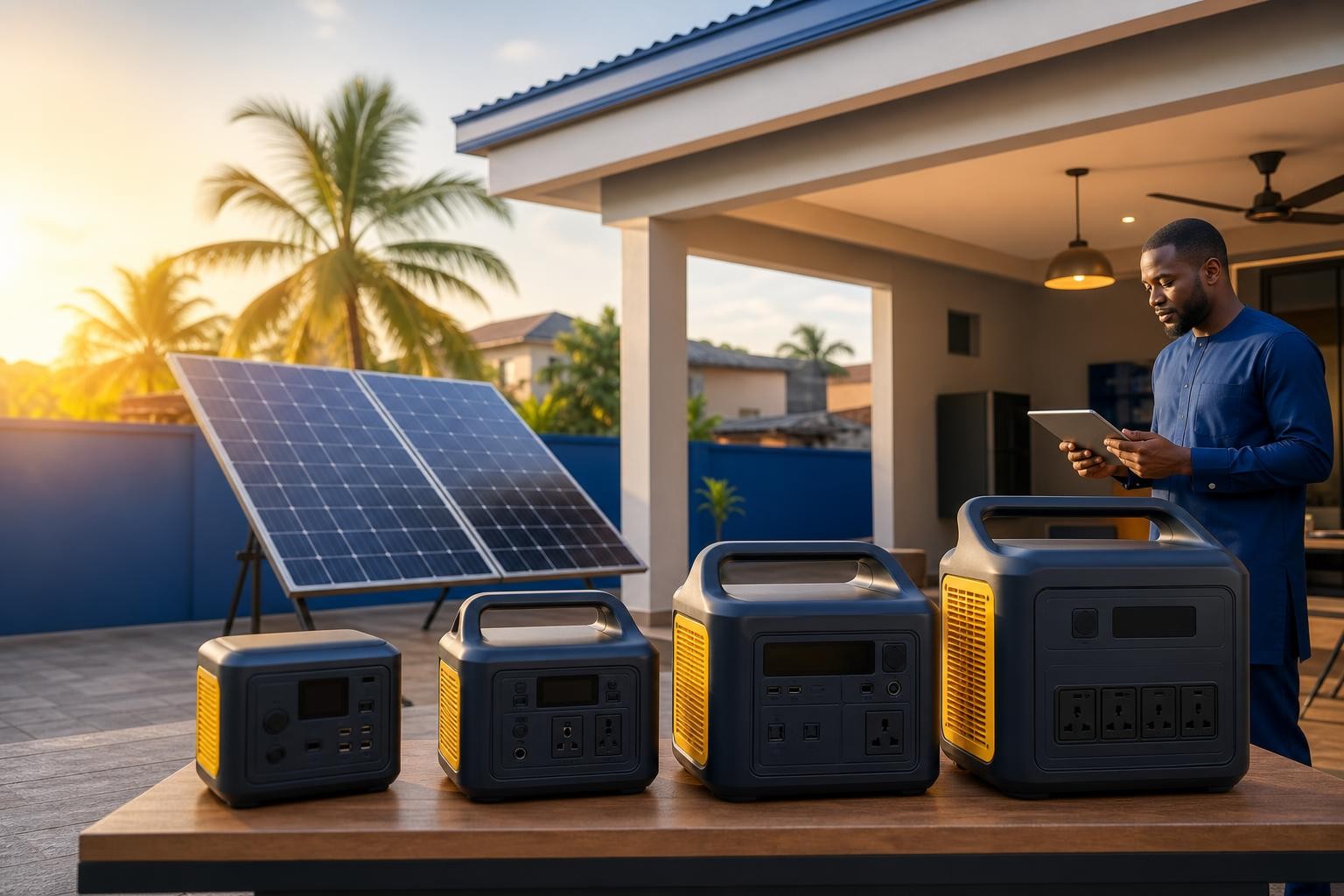
Short answer: Solar generator capacity tells you how much electrical energy the battery can store. A 500Wh unit stores less energy than a 1kWh unit, while a 2kWh unit stores roughly twice as much as a 1kWh unit. The larger the capacity, the longer the backup can last for the same appliance load, but capacity alone does not tell you whether the inverter can start or run the appliance.
When Nigerians compare portable power stations, the most common capacity labels are 500Wh, 1kWh, 1.5kWh and 2kWh. The right size depends on what you want to power, how many hours you need during an outage, and whether your appliances have high starting power.
What Does Solar Generator Capacity Mean?
Capacity is normally shown in watt-hours (Wh) or kilowatt-hours (kWh). It describes the approximate amount of energy stored in the battery.
The basic conversion is:
1kWh = 1,000Wh
So:
- 500Wh is half of 1kWh.
- 1,000Wh is approximately 1kWh.
- 1,500Wh is approximately 1.5kWh.
- 2,000Wh is approximately 2kWh.
A 1,000Wh battery does not mean that every appliance will receive exactly 1,000Wh at the AC socket. Some energy is used by the inverter and other electronics, and the battery-management system may reserve part of the capacity. Treat the advertised figure as the starting point for your calculation.
Capacity Is Not the Same as Output Watts
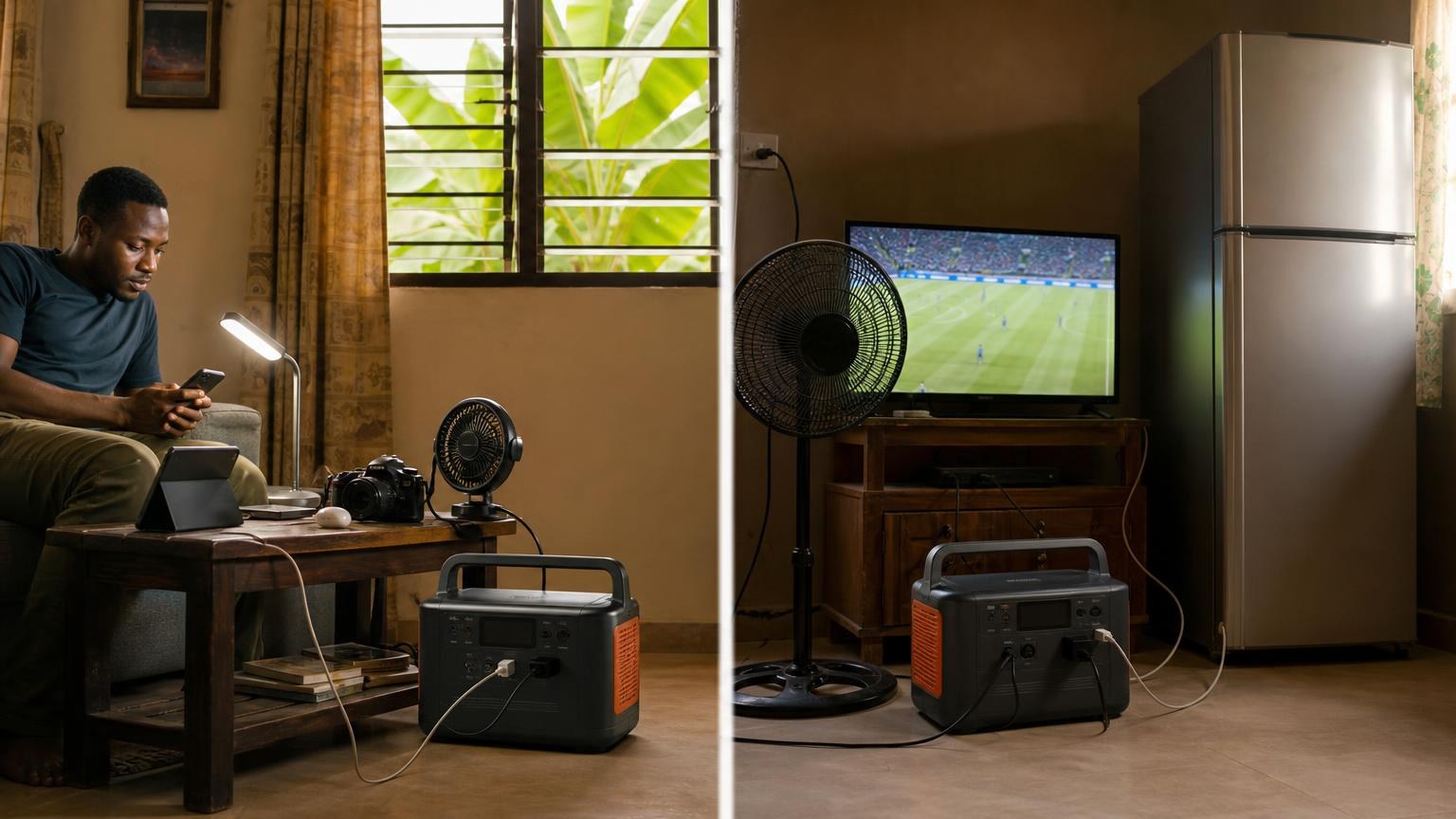
This is the most important distinction when choosing a solar generator.
Capacity in Wh or kWh tells you how much energy the battery stores.
Output in W tells you how much power the inverter can supply at one time.
For example, two power stations could both have 1,000Wh batteries:
| Power station | Battery capacity | Inverter output |
|---|---|---|
| A | 1,000Wh | 500W |
| B | 1,000Wh | 1,800W |
They may store a similar amount of energy, but Power Station B can handle a larger load at one time. Power Station A may be suitable for a TV, fan, router and lights, while it may not be suitable for a refrigerator or pump.
Before buying, check both figures. A large Wh number does not compensate for an inverter that cannot start your appliance.
How Do You Estimate Runtime from Capacity?
A simple planning formula is:
Estimated runtime = usable battery energy ÷ average appliance load
For a simple estimate, you can use an allowance for inverter losses and other system losses. For example, using an 85% planning assumption:
Usable planning energy = advertised capacity × 0.85
If a 1,000Wh solar generator is connected to a steady 200W load:
1,000Wh × 0.85 ÷ 200W ≈ 4.25 hours
This is only a planning estimate. Actual runtime changes with the appliance load, battery age, temperature, inverter efficiency and how deeply the battery is allowed to discharge.
For your own load, use the Solar Generator Calculator and compare the result with the power station’s exact specifications.
500Wh Solar Generators: What Are They Good For?
A 500Wh-class solar generator is a small-to-medium portable power station. It can be useful when your main goal is to keep essential electronics operating during short outages.
Depending on the inverter output and actual appliance loads, it may suit:
- Phones and tablets
- Wi-Fi router
- Laptop
- LED lights
- Small fan
- Television for a limited period
Using the 85% planning assumption, a 500Wh battery gives approximately 425Wh for planning. At a 100W load, that is about 4.25 hours. At a 300W load, it is about 1.4 hours before additional real-world differences are considered.
A 500Wh unit may not be a good choice if you want to run a refrigerator, freezer, pump or several appliances together. The battery may be too small, and the inverter may not have enough surge capacity.
1kWh Solar Generators: A Useful Middle Ground
A 1kWh solar generator has approximately 1,000Wh of advertised battery capacity. It is often a more practical middle ground for a home user who needs more than phone and laptop backup but does not want a very large portable unit.
Depending on the output rating, a 1kWh unit may be useful for a combination such as:
- Television
- One or two fans
- LED lights
- Router and decoder
- Laptop and phone chargers
- Some refrigerators, if the output and surge rating are suitable
With an 85% planning allowance, 1,000Wh becomes approximately 850Wh for a basic runtime estimate. At a 250W average load, that suggests about 3.4 hours. At a 500W average load, it suggests about 1.7 hours.
These figures are not promises. A refrigerator may cycle on and off, while a TV, fan or laptop may use less than its maximum label rating. On the other hand, a compressor or pump may require a large startup surge.
1.5kWh Solar Generators: More Energy for Longer Backup
A 1.5kWh-class unit stores about 1,500Wh before system losses. It can be useful for people who want longer backup for several small appliances or more energy for a refrigerator, TV and fan combination.
Its suitability still depends on the inverter output. A 1.5kWh battery with a low-output inverter may store plenty of energy but remain unsuitable for a high-starting-load appliance.
Using the 85% planning allowance gives approximately 1,275Wh. At a 300W average load, the simple runtime estimate is about 4.25 hours. At a 600W average load, it is about 2.1 hours.
This capacity class can be attractive for a small family, home office or shop that wants more flexibility than a 500Wh or 1kWh unit provides.
2kWh Solar Generators: Larger Home Backup
A 2kWh solar generator has approximately 2,000Wh of advertised battery capacity. It is designed for longer backup and larger loads than small portable power stations, provided the inverter output is also large enough.
A 2kWh-class unit may be considered for loads such as:
- Several fans and lights
- Television, router, decoder and laptops
- Some refrigerators or freezers
- Small office or shop equipment
- Longer use of essential appliances during an outage
Using an 85% planning allowance gives approximately 1,700Wh. At a 400W average load, the simple estimate is about 4.25 hours. At a 700W average load, it is about 2.4 hours.
A 2kWh unit may still be unsuitable for air conditioners, large pumps, electric cookers or multiple heavy appliances. Check the continuous output, surge output, battery capacity and appliance requirements together.
What Does “More Than 2kWh” Mean?
Portable power stations are also available in larger capacities such as 3kWh, 3.8kWh and 4kWh or more. These units can provide more stored energy and may support larger backup plans, but they also become heavier, more expensive and less convenient to move.
At this size, compare the complete system rather than the battery number alone. Check:
- Continuous AC output
- Surge output and surge duration
- Solar charging input
- Battery chemistry and cycle-life rating
- Weight, wheels and portability
- Expansion battery compatibility
- Warranty and local support
A large portable power station can begin to overlap with a fixed home solar system in price and capability. If you need several household circuits, air conditioning, pumps or long daily operation, compare it with a properly designed inverter-and-battery system rather than assuming a portable unit is automatically the best option.
How Much Capacity Do You Need for Common Nigerian Loads?
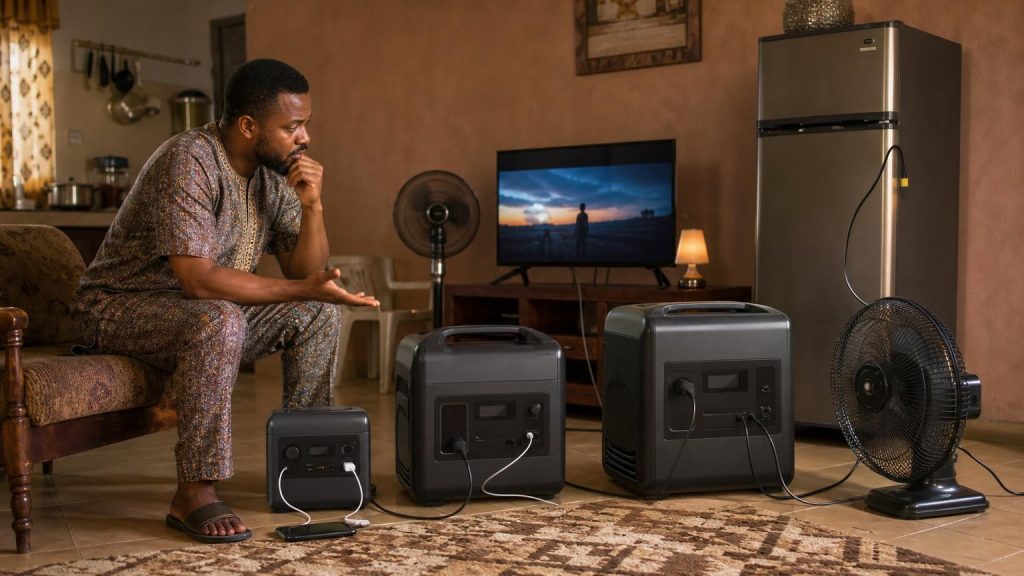
Use these as planning examples, not fixed product guarantees:
| Typical need | Possible capacity starting point | Important check |
|---|---|---|
| Phones, router, laptop and lights | 240Wh–500Wh | Check the combined watts and available ports |
| TV, lights, fan and small electronics | 500Wh–1kWh | Check how many hours you need |
| TV, fans, lights, router and laptop | 1kWh–1.5kWh | Check simultaneous load and inverter output |
| Fridge, TV and fan | 1kWh–2kWh may be more practical | Confirm refrigerator startup surge |
| Fridge, freezer, pump or many appliances | 2kWh or a fixed system | Calculate motor loads and future expansion |
The capacity starting point can move up or down depending on actual appliance wattage, usage hours, battery efficiency, solar charging and the number of loads connected at the same time.
Why the Same Capacity Can Give Different Results
Two solar generators with the same advertised capacity may provide different real-world results because of:
- Different inverter efficiency
- Different battery chemistry
- Different depth-of-discharge limits
- Different standby consumption
- Battery age and temperature
- Different continuous and surge output
- Different solar-input limits
This is why the label should be the beginning of your comparison, not the final decision. Look at capacity, output, surge, charging and warranty together.
Common Capacity Mistakes
- Choosing only by kWh: the inverter may not run the appliance.
- Assuming 1kWh means one hour of any load: runtime depends on watts.
- Ignoring system losses: usable energy is lower than the headline capacity.
- Ignoring surge: refrigerators, freezers and pumps may fail to start.
- Buying too much capacity: a heavy, expensive unit may be unnecessary for a small load.
- Buying too little capacity: short runtime can make the unit frustrating during longer outages.
- Forgetting solar input: a large battery may take a long time to recharge from a small panel.
How to Choose the Right Capacity
Before buying, write down:
- The appliances you want to power.
- Their simultaneous running watts.
- Any starting surge from motors or compressors.
- The number of hours you need each appliance.
- Whether you will recharge from mains, solar panels or both.
- Whether you need portability or future expansion.
Then use the Solar Generator Calculator to estimate the capacity you may need. Compare the result with the exact power station’s Wh capacity, continuous output and surge output.
You can also review how a solar generator works and read what to check before buying one in Nigeria.
For current estimated Nigerian prices and available capacity classes, compare the Solar Generator and Portable Power Station Prices category.
Final Answer
A 500Wh solar generator may be suitable for small electronics and short backup. A 1kWh unit is a useful middle ground for more home electronics and some essential loads. A 1.5kWh or 2kWh unit can provide more energy for longer outages and larger loads, but only if its inverter output and surge capability match the appliances.
Choose capacity based on the hours you need, but choose output watts based on the appliances you want to run.