Last reviewed: September 25, 2026
If your solar inverter shows less power than you expected, that does not automatically mean the panels are bad. The battery may already be nearly full, the inverter may be limiting the solar input, a cloud or shadow may be passing over the array, or the system may have a wiring and connection problem.
The safest way to know whether your solar panels are underperforming is to compare measured solar input with the conditions at the time: the array’s total wattage, sunlight, temperature, shading, battery state of charge, inverter limits and the electricity being used. Do not judge the panels from one low reading.
First, separate low panel output from low battery charging
People often say “my panels are not producing” when the real problem is that the battery is not charging or the inverter is not sending power to the battery. These are related, but they are not the same diagnosis.
- Panel output: the DC power arriving from the solar array.
- Controller or inverter solar input: the amount of that power the equipment accepts.
- Battery charging power: the power left after the inverter’s own demand and any limits imposed by the battery or charger.
- House load: the power being used by appliances at that moment.
For example, a 2.2kW solar array may not show 2.2kW on the inverter display when the battery is at 100% and the house is using only 250W. The controller may reduce solar production because there is nowhere useful to send the extra energy. That is normal curtailment, not proof that the panels have failed.
Check the array’s nameplate size and the inverter’s limits
Start with the information written on the panel labels and the inverter or charge-controller manual.
If you have four 550W panels:
4 × 550W = 2,200W of nominal panel capacity
That 2,200W is a laboratory nameplate value under standard test conditions. It is not a promise that the array will deliver 2,200W every afternoon in Nigeria. Heat, dust, cloud cover, panel angle, shading, cable losses and equipment limits all affect the reading.
Also check whether the inverter can accept the whole array. An inverter may have a lower maximum PV input than the array’s nameplate total. If an inverter accepts only 1,500W, it may limit a 2,200W array around that level in strong sun. In that case, adding more panels without checking the PV voltage, current and power limits will not necessarily increase usable output.
Important specifications to confirm are:
- Maximum PV input power.
- Maximum PV voltage and operating-voltage range.
- Maximum PV current for each MPPT.
- How many MPPT trackers the inverter has.
- Whether the panels are divided into strings that match the MPPT design.
Do not exceed the manufacturer’s voltage or current limits. A qualified installer should handle any live DC testing, string changes or cable work.
Use a proper test day instead of one random reading
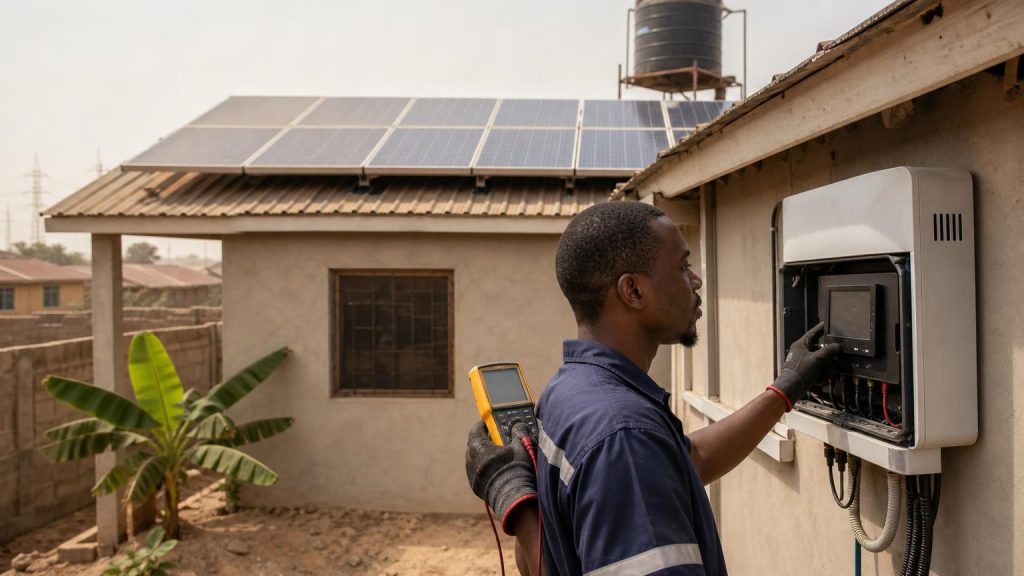
A useful test needs reasonably clear sunlight and a record of the conditions. In many parts of Nigeria, a good test window may be between late morning and early afternoon, but the exact time depends on roof direction, season, cloud cover and shading.
Record the following:
- Date and approximate time.
- Whether the sky is clear, hazy, cloudy or rainy.
- Any shade from a water tank, wall, tree, antenna, satellite dish or nearby building.
- PV voltage, PV current and PV watts shown by the inverter or charge controller, if available.
- Battery state of charge and battery voltage, if displayed.
- House load at the same moment.
- Whether grid or generator charging is also active.
Repeat the check on at least two or three similar days. One cloudy afternoon, a dusty Harmattan morning or a temporary shadow is not enough evidence to condemn a panel.
What readings should make you investigate?
There is no single safe “normal output percentage” for every Nigerian solar installation. A panel’s output changes with sunlight, temperature and system design. Instead, look for a pattern.
Investigation is sensible when all of these are broadly true:
- The sky is reasonably clear and the array is not shaded.
- The battery is not already full or being protected by a charging limit.
- The inverter is capable of accepting the array’s output.
- There is a meaningful load or battery charging demand.
- The PV reading stays unusually low across repeated checks.
- The reading is lower than the system’s previous performance under similar conditions.
For example, if a 2.2kW array repeatedly shows only a few hundred watts around the brightest part of a clear day while the battery is well below its charge limit, the next step is not automatically to buy new panels. Check shading, dirt, string connections, MPPT readings, PV voltage and the inverter’s fault history first.
Check the easiest physical causes first
1. Dust and dirt
Dust can accumulate during Harmattan, especially on a roof beside an unpaved road or in a dry, windy area. Bird droppings and grime can create local shaded spots on a panel. Look at the glass from the ground and compare visibly dirty panels with cleaner ones.
Clean panels only with a safe method recommended by the installer or manufacturer. Avoid climbing onto a roof without proper fall protection, and do not spray water onto hot electrical equipment or damaged panels.
2. Partial shade
A small shadow can affect a string more than many homeowners expect. Check shadows at different times, not only at midday. A parapet, palm tree, overhead cable, tank or neighbouring building may shade the array in the morning or late afternoon.
If only one section of the array is shaded, the effect can still appear as a large reduction in the output of that string. Record which panels are affected and tell the installer exactly when the shadow appears.
3. Loose or damaged connections
Loose connectors, damaged cables, water entry, corrosion or poor crimping can reduce output and create a safety risk. Warning signs include unstable PV readings, one string showing zero current, visible heat or burn marks, inverter isolation faults and output that changes sharply when the cable or connector moves.
Do not unplug PV connectors while the panels are generating. Solar strings can remain electrically live in daylight. Ask a qualified solar technician to isolate the system and test the connections.
4. Incorrect string arrangement
Panels connected in a string must be arranged within the inverter’s voltage range. Different strings connected to the same MPPT may also need similar panel orientation and electrical characteristics. A recent rewiring, panel replacement or extension can introduce a mismatch that looks like a panel problem.
Check whether the battery or inverter is limiting the reading
Before blaming the panels, look at what the rest of the system is doing.
| What you observe | Possible explanation | What to check next |
|---|---|---|
| PV watts are low and battery is nearly full | Normal charging reduction or curtailment | Test again when the battery is lower and there is a useful load |
| PV watts stop at the same ceiling every clear day | Inverter or controller PV limit, or clipping | Compare the display with the manual’s PV input limits |
| PV voltage is present but PV current is nearly zero | Low solar demand, string issue or controller problem | Check battery state, load, MPPT data and installer test results |
| PV voltage is zero | Isolator, fuse, cable, connector or string fault | Stop and arrange qualified DC testing |
| PV output looks reasonable but battery still falls quickly | High load, weak battery, wrong settings or inverter losses | Check the battery, load and inverter separately |
A low PV number can also occur when the inverter is powering the house directly and only the remaining energy is charging the battery. Check the display labels carefully. “PV power”, “charging power” and “AC output” are different values.
If your battery drains unusually fast, use the separate checks in Why Is My Solar Battery Draining So Fast?. If the system stops charging or shuts down, the diagnosis may involve the battery or inverter rather than the panel array. See How Do I Know If My Solar Battery Is Bad or the Inverter Is the Problem?.
Compare daily energy, not only midday watts
Instantaneous watts answer the question “What is the array doing now?” Daily energy in kWh answers “How much energy did it actually produce?” Both matter.
To compare fairly:
- Use the inverter or monitoring app to record daily PV energy.
- Compare days with similar sunlight and similar battery demand.
- Note whether the battery reached full charge early, because that can hide available solar energy.
- Compare the same array after cleaning or after a shade changes.
- Look for a persistent decline rather than a single bad day.
If the system reaches full battery early and then curtails solar, daily PV energy may not represent the array’s maximum possible production. If the battery never reaches its normal charging voltage despite clear weather and a modest load, the charging system deserves closer attention.
A practical Nigerian example
Imagine a home with four 550W panels, a 2.2kW nominal array and a hybrid inverter. During a clear afternoon, the owner sees only 350W on the display.
That reading alone proves very little. The owner should ask:
- Is the battery already at 95–100%?
- Is the house using only 300–400W?
- Is a generator or grid charger also active?
- Is the inverter limited to less than 2.2kW of PV input?
- Are all four panels free of shade from the roof parapet or water tank?
- Does the PV voltage match the expected string arrangement?
- Does the reading remain low when the battery is lower and the load is higher?
If the battery is full and the house load is small, 350W may simply be the power the system can use at that moment. If the battery is at 50%, the sky is clear, the array is unshaded and the inverter accepts the full array, repeated 350W readings would justify a professional inspection.
When should you call an installer?
Get qualified help when the problem involves roof access, live PV cables, high-voltage DC measurements, burnt connectors, water-damaged equipment, repeated insulation faults or an inverter error that returns after a reset.
Ask the installer to provide more than “the panels are fine.” A useful diagnostic report should state:
- PV voltage and current for each string or MPPT.
- Battery voltage and state of charge during the test.
- Inverter PV limits and whether clipping is occurring.
- Any shading, dirt, connector, fuse or cable findings.
- The test conditions, including time and weather.
- What was repaired or changed and how the result was verified.
Do not bypass fuses, isolators, breakers or other protection devices to force a higher reading. Do not mix panels or change string wiring based only on wattage. The voltage, current, connector ratings, MPPT range and installation design must all be compatible.
Final checklist
- Confirm the total panel wattage and the inverter’s PV limits.
- Test on more than one reasonably clear day.
- Record PV watts, voltage, current, battery state and house load together.
- Check shade, dust, dirt, roof obstructions and recent changes.
- Compare daily kWh as well as instantaneous watts.
- Check whether a full battery or low load is causing normal curtailment.
- Have a qualified technician test live DC wiring and strings.
If you are still planning or changing a system, SolarPriceNG’s calculator guide explains how to use the site’s sizing tools. If you are deciding whether extra panels or a bigger battery will solve a backup problem, read Should You Add More Solar Panels or a Bigger Battery First? The right upgrade depends on whether the missing resource is solar energy, battery storage, inverter capacity or simply an avoidable load.
Bottom line
Your solar panels are more likely to be underperforming when their measured output stays unusually low across repeated clear-weather tests, while the battery still needs charging, the inverter can accept the array and there is no shading or obvious installation fault. A single low display reading is not enough. Test the whole energy path—from panels to MPPT, battery and appliances—before spending money on replacement panels or a larger system.
Technical references
The diagnostic principles above reflect common inverter and backup-system behaviour described in manufacturer documentation, including inverter overload and low-battery protection, PV input limits, battery reserve settings and load shedding. For product-specific limits, always use the manual for the exact inverter, battery and charge controller installed.