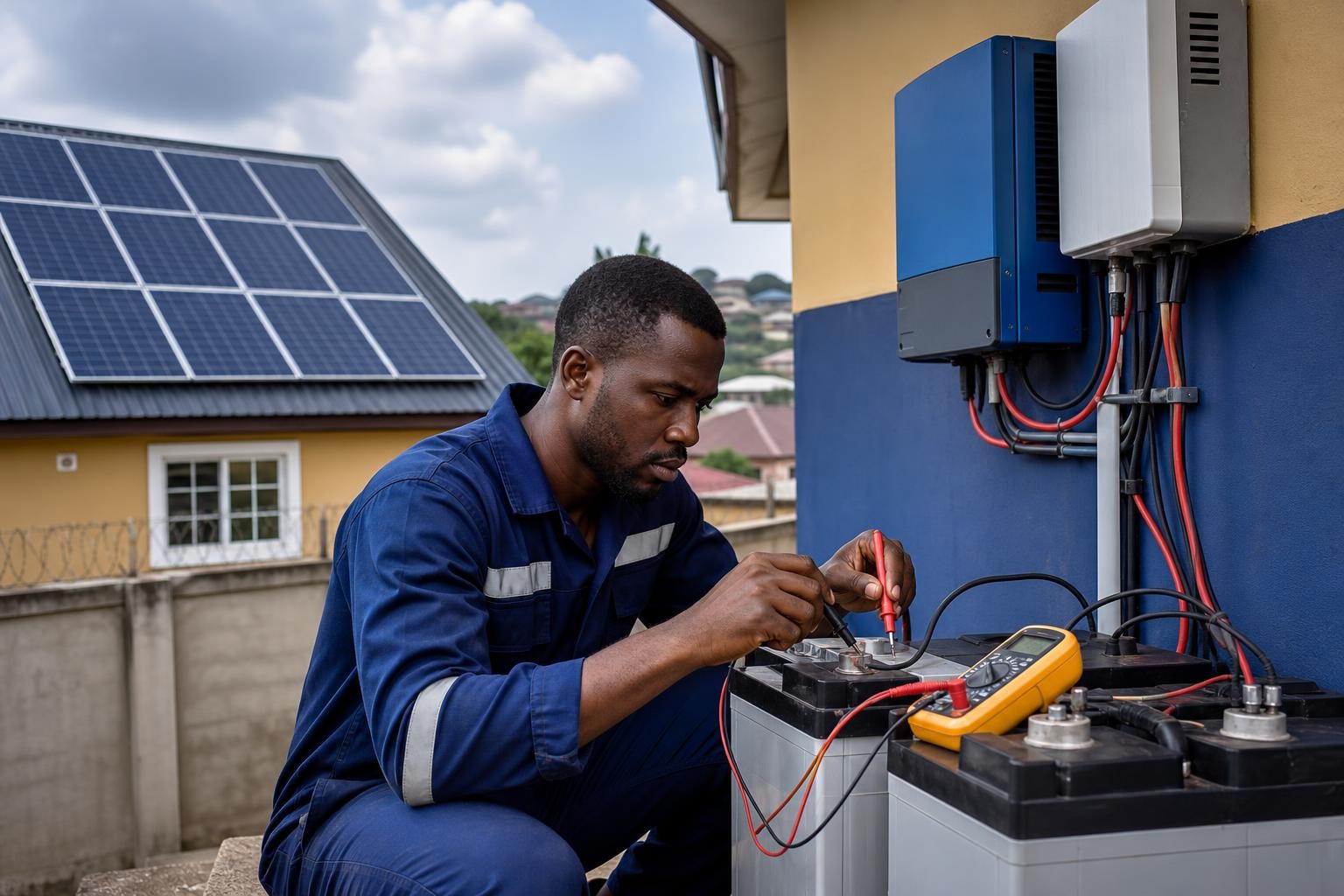
If your solar battery used to last through the night but now reaches low battery much earlier, do not replace it immediately. The change can come from a larger load, a battery that is no longer getting fully charged, reduced battery capacity, high heat, a hidden standby load, or a charging and wiring problem.
The quickest way to find the real cause is to compare the same load over two or three nights while recording what happened during the day. This article gives you a safe, practical test for a Nigerian home or small business, then shows when the result points to the battery, solar panels, inverter or appliance load.
Short answer: why does the battery die earlier than before?
A solar battery usually gives shorter backup for one of five broad reasons:
- the appliances are now using more energy;
- the battery starts the night partly charged;
- the battery has lost usable capacity;
- the inverter or battery settings, cables or connections are causing a problem; or
- heat, dust, shading, rain or another condition has reduced charging and system performance.
“The battery dies early” describes the symptom. It does not, by itself, prove that the battery is bad.
First ask: what changed?
Think back to when the system was still giving the backup time you expected. Has anything changed since then?
- Did you add a freezer, refrigerator, pump, television, decoder, router, computer or air conditioner?
- Are more people using the house or shop at night?
- Are fans, lights or networking equipment now left on for longer?
- Has the rainy season, Harmattan dust or new roof shading reduced solar production?
- Has a generator, grid charger or solar charger stopped working?
- Was the battery moved into a hotter or poorly ventilated room?
- Did someone change the battery type, charging voltage or low-voltage cutoff setting?
- Is one battery in a bank older, hotter or behaving differently from the others?
A change in backup time becomes much easier to diagnose when you compare the old situation with the current one instead of looking only at the percentage displayed by the inverter.
1. Your night-time load may have increased
Battery runtime depends on energy use, not just the battery label. A home using 300W for several hours will normally get much longer backup than the same home using 900W, even if the battery has not changed.
Small changes can add up. A typical evening may include lights, fans, television, decoder, router, refrigerator, freezer, laptop and phone chargers. Adding one pump or air conditioner can change the result sharply because motors and compressors may also have a high starting demand.
Use the actual wattage on the appliance nameplate where possible. If the inverter displays live load, record that reading with the main appliances switched on. Do not rely on a generic internet wattage for an old refrigerator, freezer or air conditioner when you can measure or read the actual equipment rating.
For a quick check, switch off non-essential loads for one night. If the battery suddenly lasts much longer, the battery may be healthy and the main issue may be energy use. You can also compare the appliances in Can My Solar System Power It?.
2. The battery may not be starting the night full
A battery can appear to be losing capacity when it is actually beginning each night with less energy than before. This often happens after several cloudy or rainy days, during heavy daytime use, or when the solar array cannot replace the energy used overnight.
Look at the charging information during the day:
- Does the inverter reach its normal charged or float stage?
- Does solar input rise properly around the strongest sunlight period?
- Are the panels shaded by a new building, tree, water tank or dirt?
- Is a PV breaker, isolator or cable connection switched off or damaged?
- Are daytime appliances consuming most of the solar power before the battery can recharge?
- Is the grid or generator charger available if your system is designed to use it?
Suppose the battery supplies about 5kWh overnight but the solar system replaces only 3kWh the next day. The battery begins the next night with a deficit. After several days, the low-battery alarm will arrive earlier even though the battery has not suddenly changed.
If your system is not charging properly, use Solar Inverter Not Charging the Battery: Causes and What to Check before buying a replacement battery.
3. The battery may have lost usable capacity
Batteries age. Repeated deep discharges, undercharging, overcharging, excessive current and high temperature can shorten battery life. Lead-acid batteries are particularly sensitive to being left partly charged for long periods, while lithium batteries also need the correct charging, discharge and temperature limits set by the manufacturer.
When a battery has degraded, it may still show a high voltage or a “full” message shortly after charging, but the voltage can fall quickly when a real load is connected. That is why one voltage reading is not enough to prove battery health.
For lithium batteries, use the verified energy rating in kWh as the main capacity measure. For tubular, GEL and AGM batteries, use Ah together with voltage. Do not compare a lithium battery and a lead-acid battery by Ah alone.
A rough planning example shows why the rating is not the same as delivered AC energy:
- A 5kWh lithium battery is nominally 5kWh. After a planning allowance for usable energy and inverter losses, the energy available to AC appliances will be lower.
- A 48V, 200Ah lead-acid bank is nominally 9.6kWh because 48 × 200 = 9,600Wh. A planning calculation that uses only part of that energy, then allows for inverter losses, will produce a much lower usable AC figure.
These are planning illustrations, not promises for every product. The battery manufacturer’s limits, the actual load and the inverter efficiency must take priority. SolarPriceNG’s Battery Calculator can help you compare expected runtime with the result you are getting.
4. Heat and poor ventilation can reduce performance
Battery and inverter rooms can become very hot in Nigerian homes, shops and offices, especially when equipment is enclosed, placed near a hot roof or installed where air cannot circulate. High temperature can shorten battery life and can also cause a battery management system or inverter to limit charging or discharge.
Check whether the battery enclosure is:
- dry and protected from rain;
- free from direct afternoon sun;
- clear of stored clothes, cartons and other items blocking ventilation; and
- within the temperature range in the battery and inverter manuals.
Do not cool a battery with water or improvise unsafe ventilation around electrical equipment. If the battery is hot, swollen, leaking, damaged or giving a burning smell, switch off the system only if it is safe to do so and call a qualified technician.
5. The inverter may be using more energy than expected
The inverter consumes some energy even when the connected appliances are using little power. This matters most when the night-time load is small. A television, router and a few lights may look like a light load, but the inverter’s own consumption, battery cables and other losses still come from the battery.
Check the inverter manual for no-load or standby consumption. Also check whether a second inverter, changeover device, CCTV system, network device or DC accessory is connected to the battery. If the inverter’s displayed load is unexpectedly high when appliances are off, have the system inspected instead of disconnecting protection devices yourself.
6. A battery-bank connection or setting may have changed
In a bank made from several batteries, one weak battery, loose connection or incorrect series-parallel arrangement can reduce the performance of the whole bank. Different ages, models, capacities and chemistries should not be mixed casually.
For lithium batteries, expansion and parallel operation must follow the battery manufacturer’s rules, including any communication or BMS requirements. For lead-acid batteries, batteries in the same bank should be properly matched and connected so that current is shared correctly.
Also check whether someone changed:
- battery chemistry or battery-type selection;
- maximum charging current;
- low-voltage cutoff;
- charge and float voltage;
- communication settings; or
- the source priority between solar, grid and generator.
Do not copy a charging voltage from another battery because the case looks similar. Use the exact manual for your battery and inverter, and let a qualified installer change settings you do not understand.
A safe three-night test

This test cannot replace a professional capacity test, but it can separate a load problem from a charging problem or a likely battery problem.
Before night one
- Write down the battery type, voltage and capacity. Use kWh for a verified lithium rating, or Ah and voltage for lead-acid.
- Record the appliances you intend to run and their actual or measured wattage.
- Allow the battery to charge normally. Record whether the inverter reaches its normal charged stage.
- Record the solar input or charging current during the day if the inverter displays it.
- Do not open the battery or change protection and charging settings for this test.
During nights one to three
- Keep the main load as similar as possible each night.
- Record the starting battery state, inverter load and time.
- Record when the inverter gives a low-battery warning, reduces output or shuts down.
- Note anything unusual: an air conditioner starting, a pump running, a freezer working harder or extra people using the system.
- Record the next day’s weather and whether the battery reached its normal charge stage.
If the battery lasts normally when heavy appliances are removed, investigate the load and system sizing. If it lasts poorly even with a stable, modest load and it is fully charged beforehand, investigate battery condition, battery-bank balance, inverter losses and wiring.
How to interpret the result
| What you observe | What it may suggest | What to check next |
|---|---|---|
| Backup falls only when AC, pump, freezer or extra appliances are used | Higher load or motor starting demand | Measure the appliance load and review what must run together |
| Battery is low earlier after cloudy or rainy days | Insufficient recharge | Solar input, shading, panel dirt, charging source and panel size |
| Battery reaches “full” quickly but drops fast under load | Reduced capacity, wrong state-of-charge estimate or a weak battery | Controlled capacity test and battery/inverter inspection |
| One battery in a bank is hot or behaves differently | Imbalance, weak battery or connection problem | Stop expanding the bank and call a qualified technician |
| Inverter load is high when appliances are off | Standby load, hidden circuit or inverter fault | Trace the loads safely with an electrician |
Voltage by itself is not a reliable answer in every situation. A battery monitor estimates state of charge from measured current and voltage, and readings can be affected by charging, discharging, discharge rate, temperature and monitor settings. For lead-acid batteries, a resting voltage check is more meaningful after the battery has been left without charging or discharging for a period. Follow the battery-monitor and battery manufacturer’s instructions.
When should you call an installer?
Get qualified help if the battery is swollen, leaking, unusually hot, physically damaged, repeatedly triggering a BMS fault, or if you smell burning. Professional help is also appropriate when you need to test a battery bank, change charging settings, measure current, inspect high-current cables or compare the battery voltage at the battery terminals and inverter.
Do not bypass a fuse, breaker or battery protection. Do not short the terminals, mix batteries without manufacturer approval, or keep using equipment that is wet or visibly damaged.
Should you buy a bigger battery?
Only after you know what is causing the shorter backup. A bigger battery can help when the measured load and required backup time genuinely exceed the present storage. It will not fix a battery that is not charging, a failed solar input, a hot installation, a weak battery in the bank or an inverter with a hidden fault.
Use the result of the three-night test to decide whether the next step is:
- reducing or rescheduling heavy loads;
- repairing the charging system;
- adding or repositioning solar panels;
- testing or replacing the battery;
- correcting an inverter or battery setting; or
- redesigning the system for the backup time you actually need.
For a broader upgrade decision, read Which Is Cheaper: Adding a Battery, Adding Solar Panels, or Reducing Your Load in Nigeria?.
Final answer
Your solar battery may die earlier than it used to because your load has increased, the battery is not starting fully charged, the battery has lost usable capacity, heat or settings are affecting performance, or another part of the system is wasting or blocking energy.
Start with the same-load, three-night comparison. Record the appliances, starting charge, solar input and actual shutdown time. That evidence is more useful than guessing from a single voltage or percentage reading.
If the battery is fully charged and still gives much shorter backup with a stable load, arrange a proper battery and inverter test before spending money. If the battery is healthy but the system is using more energy than it can store and replace, the solution may be load reduction, more solar, better charging or a complete design change—not simply another battery.
Useful next steps
- Estimate expected battery runtime with the SolarPriceNG Battery Calculator
- Estimate the solar capacity needed for daily loads and battery recharge
- Check whether the battery or inverter is more likely to be at fault
- Plan routine checks for a solar inverter and battery system in Nigeria
Technical note: battery monitoring, temperature limits and charging settings vary by product. Use the exact battery and inverter manuals for your equipment. Manufacturer guidance on state-of-charge monitoring and operating conditions should take priority over general examples.