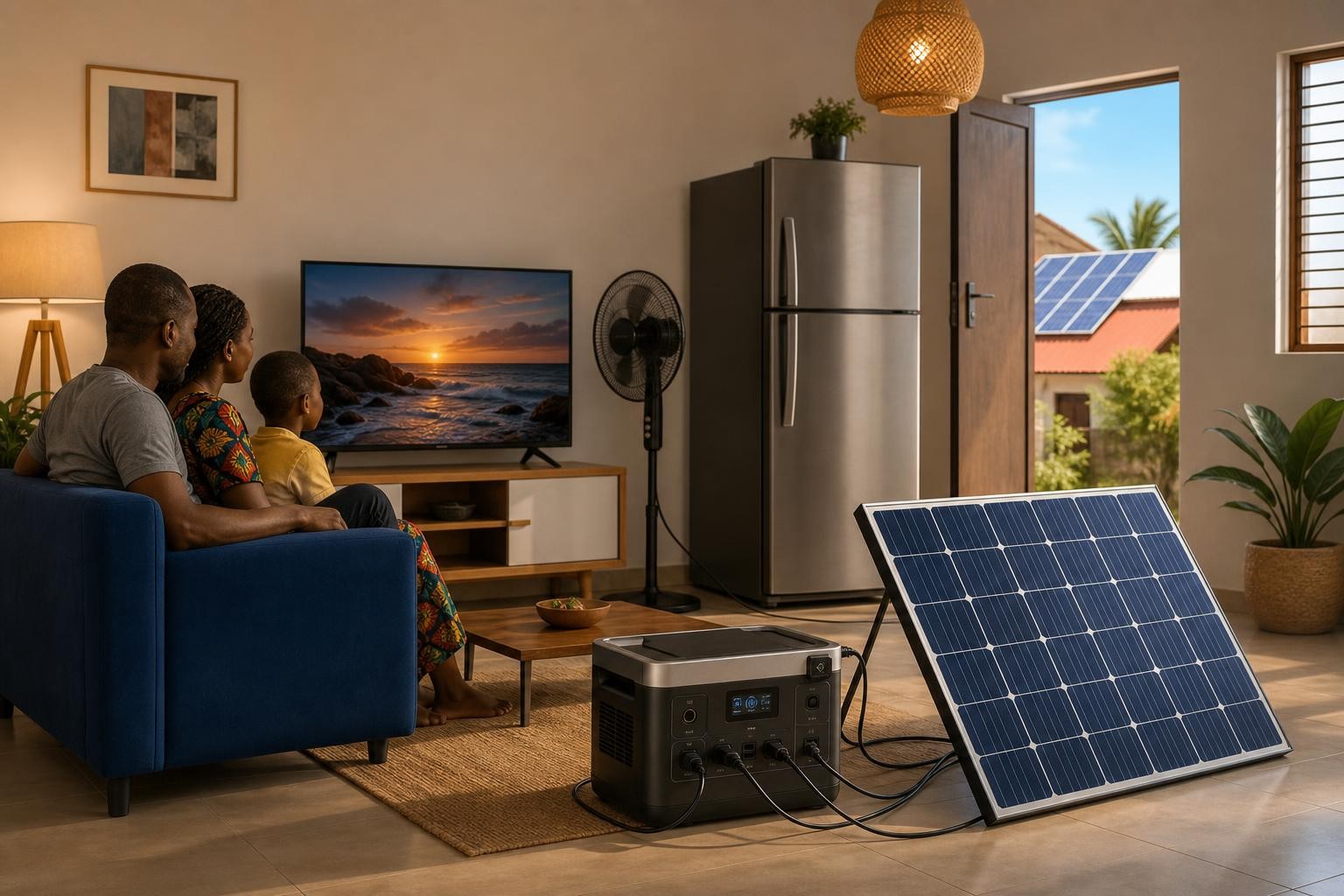
Short answer: A solar generator can power a fridge, TV and fan together, but not every model can do it safely or for long. You need to check three things: the appliances’ combined running load, the refrigerator’s compressor starting surge, and the solar generator’s battery capacity and inverter output.
A small power station may handle a television and fan but fail when the refrigerator compressor starts. Another unit may start all three appliances successfully but provide only a short backup time because its battery is too small.
The correct question is therefore not just “Can a solar generator power a fridge?” It is:
Can this particular solar generator handle my refrigerator’s starting power and run my fridge, TV and fan for the number of hours I need?
What You Need to Check First
Before connecting the appliances, find or estimate these specifications:
- Fridge running watts
- Fridge starting or surge watts
- TV running watts
- Fan running watts
- Solar generator continuous output
- Solar generator surge output
- Battery capacity in Wh or kWh
Do not confuse Wh with W. Wh describes stored battery energy. W describes how much power the inverter can supply at a given moment. You need enough watts to start and run the appliances, and enough watt-hours to keep them operating during the outage.
Why the Refrigerator Is the Difficult Appliance
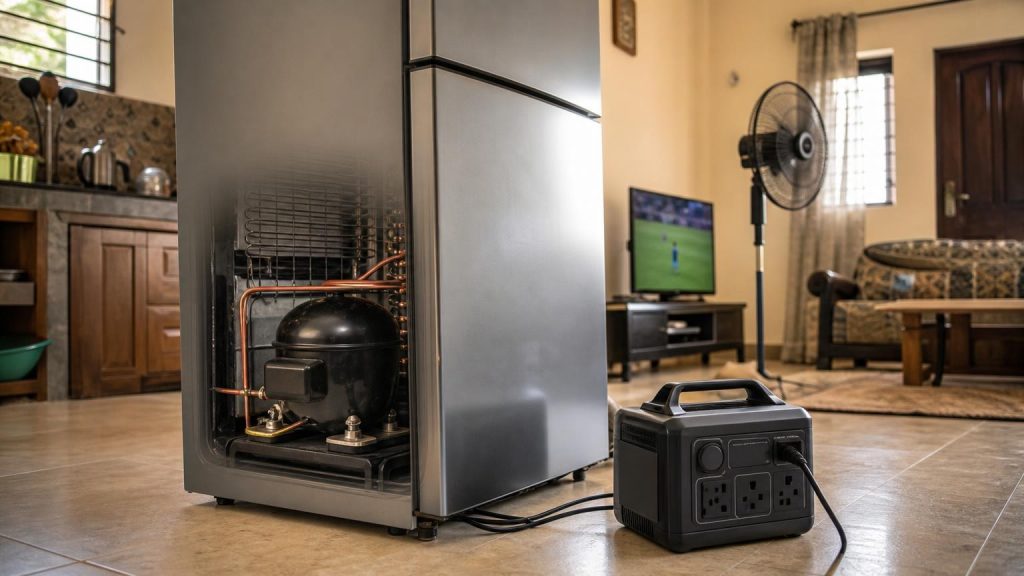
A TV and fan normally have a fairly predictable running load. A refrigerator is different because it has a compressor motor. The compressor can draw a much higher amount of power for a short time when it starts than it uses while already running.
This is called starting power or surge power. The exact surge varies by refrigerator model, compressor design, age, temperature and operating condition. A refrigerator that appears to use a modest amount of power while running can still trip a weak power station at startup.
For safety, check the refrigerator manufacturer’s specifications or have a qualified technician measure the appliance with a suitable power meter. Do not assume that two fridges with similar sizes have the same startup requirement.
If your refrigerator has an energy label, manual or nameplate, look for its electrical input information. If the starting wattage is not shown, ask the seller, manufacturer or a qualified technician for guidance before buying a power station.
Can One Solar Generator Run All Three?
It can, if the inverter and battery are properly matched. The TV and fan add to the refrigerator’s running load, while the refrigerator adds the main startup challenge.
Imagine these illustrative running loads:
| Appliance | Illustrative running load |
|---|---|
| Refrigerator | 120W |
| Television | 100W |
| Fan | 60W |
| Total running load | 280W |
This does not mean that every fridge, TV or fan uses exactly these figures. They are only an example to show the calculation.
A solar generator would need to supply at least the combined running load with room to spare, and its surge rating must also cover the refrigerator compressor when it starts. A unit with a 300W continuous output may be too close to the limit even if the appliances appear to use 280W while running.
A better design leaves practical headroom rather than operating continuously at the inverter’s maximum rating. The exact amount of headroom depends on the power station, the fridge and the other appliances.
How Much Battery Capacity Do You Need?
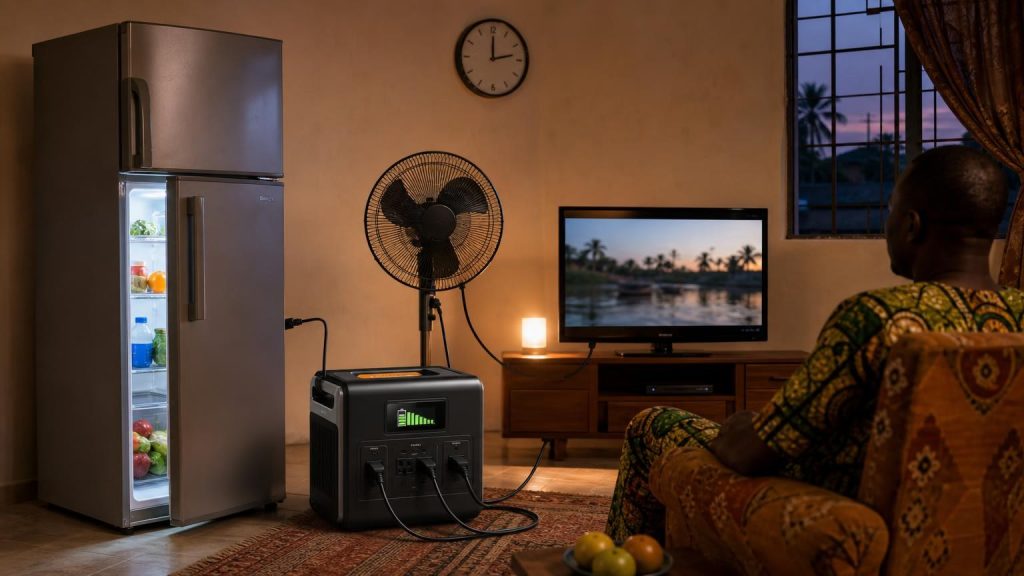
After checking the inverter output, estimate the battery runtime. A simple planning formula is:
Estimated runtime = usable battery energy ÷ average load
Suppose the solar generator has a 1,000Wh battery and you use an 85% planning assumption for conversion and other losses:
1,000Wh × 0.85 = 850Wh of estimated usable energy
If the fridge, TV and fan use 280W continuously in the illustrative example:
850Wh ÷ 280W ≈ 3 hours
This is a conservative way to think about the load because a refrigerator compressor does not run continuously. It switches on and off to maintain the temperature. In real use, the average energy consumption may be lower than the total running wattage multiplied by every minute of the outage.
However, do not treat the compressor’s cycling as a guarantee. Hot weather, frequent door opening, poor ventilation, a large freezer compartment, a faulty door seal or an older appliance can change the energy use.
Illustrative Runtime Guide
The following examples use a 280W average-load assumption and 85% usable energy. They are for planning only.
| Advertised battery capacity | Estimated usable energy | Illustrative runtime at 280W |
|---|---|---|
| 500Wh | About 425Wh | About 1.5 hours |
| 1,000Wh | About 850Wh | About 3 hours |
| 1,500Wh | About 1,275Wh | About 4.5 hours |
| 2,000Wh | About 1,700Wh | About 6 hours |
These numbers do not include the refrigerator’s startup surge because surge affects the inverter’s ability to start the appliance rather than simply adding the same amount of energy every hour.
For your own appliances, use the Solar Generator Calculator, then compare the result with the actual refrigerator data and the solar generator’s specifications.
What Size Solar Generator Is a Practical Starting Point?
There is no universal size because refrigerators vary. Still, the following gives a reasonable way to think about the options.
Small 500Wh-class units
A small unit may run a TV and fan comfortably, but it may be a poor choice for a fridge, TV and fan together unless the refrigerator has low starting demand and the power station has enough surge capacity.
Around 1kWh
A 1kWh-class unit is often a more realistic starting point for a fridge, TV and fan combination, provided its continuous and surge output match the refrigerator. It may offer useful backup for a short outage, but the exact runtime still depends on the appliances.
Around 1.5kWh to 2kWh
This gives you more energy for longer outages and more room for other essential loads. It is still not automatically suitable for every refrigerator. A larger battery does not compensate for an inverter that cannot handle the compressor startup.
Always treat these as starting classes, not fixed buying rules. The refrigerator’s electrical requirements and the power station’s continuous and surge ratings come first.
How Do You Test the Combination Safely?
If you already own the equipment, use a cautious test rather than connecting everything at once during a critical outage.
- Fully charge the solar generator according to its manual.
- Check that the AC output is suitable for the appliances and that the unit uses an appropriate waveform.
- Start with the refrigerator alone and observe whether the compressor starts without an overload or fault.
- Add the TV, then the fan, while watching the displayed load if the unit provides one.
- Listen for repeated alarms, sudden shutdowns, unusual heat or unstable operation.
- Record the battery percentage and runtime so you can plan future outages more realistically.
Do not repeatedly force the unit through overload events. If the refrigerator cannot start, switch off the other loads and check the power station’s surge rating and the refrigerator’s starting requirement.
If you are buying a new unit, do not use an improvised test with expensive appliances. Confirm compatibility from the manuals or ask the seller or a qualified technician to check the load.
What If the Refrigerator Is an Inverter Fridge?
An inverter refrigerator may have a different operating pattern from a traditional fixed-speed compressor refrigerator. It may ramp its compressor speed rather than switching between full power and off in the same way.
That can affect both starting behaviour and average energy consumption, but it does not mean every inverter fridge will work with every solar generator. Check the actual input rating and the power station’s output specifications.
Can a Solar Generator Run a Fridge Overnight?
Possibly, but you should calculate it instead of relying on the battery label.
A refrigerator’s average energy use over several hours can be lower than its compressor running wattage because the compressor cycles. But the result depends on the refrigerator’s efficiency, room temperature, door openings, thermostat setting and condition.
For overnight backup, measure the refrigerator with a suitable energy meter if possible. A short test during the day may not represent a hot night or a period when the compressor runs more often.
If you also need a TV, fan, lights, decoder or router, add those loads to the energy estimate. A refrigerator that can run alone for several hours may provide much less backup when other appliances are connected.
Common Mistakes to Avoid
- Buying based only on Wh: a large battery does not guarantee enough inverter output.
- Buying based only on W: a powerful inverter with a small battery may give very short runtime.
- Ignoring startup surge: the fridge may trip the unit even when the running load looks small.
- Assuming every fridge is the same: size, age, compressor type and condition all affect performance.
- Adding a pressing iron or kettle: high-power heating appliances can consume much more than a fridge, TV and fan.
- Using a damaged extension cable: poor cables can create heat and voltage drop.
- Backfeeding the house: never connect a portable power station through a wall socket to energise household wiring.
Should You Buy a Solar Generator for These Three Appliances?
A solar generator can be a sensible choice if you want quiet backup for a small number of essential appliances and you are willing to calculate the load properly. It may be especially useful for a tenant, small household, home office or shop that needs temporary power without a permanent installation.
A separate inverter and battery system may make more sense if you want longer backup, several household circuits, a larger refrigerator or freezer load, a water pump, air conditioning or future expansion.
For current estimated models and Nigerian prices, compare the Solar Generator and Portable Power Station Prices in Nigeria category. Also read what to look for before buying a solar generator so you can compare battery capacity, output, surge rating, solar input and warranty.
Final Answer
Yes, a solar generator can power a fridge, TV and fan, but only if its inverter can handle the combined load and the refrigerator’s starting surge. The battery must also be large enough to provide the backup time you want.
Before buying, check the refrigerator running watts, starting or surge watts, TV and fan wattage, solar generator continuous output, solar generator surge output, battery capacity in Wh or kWh, and the unit’s waveform and protection specifications.
Do not choose by battery size alone. Match the inverter to the refrigerator, then match the battery to the number of hours you need.