Last reviewed: September 26, 2026
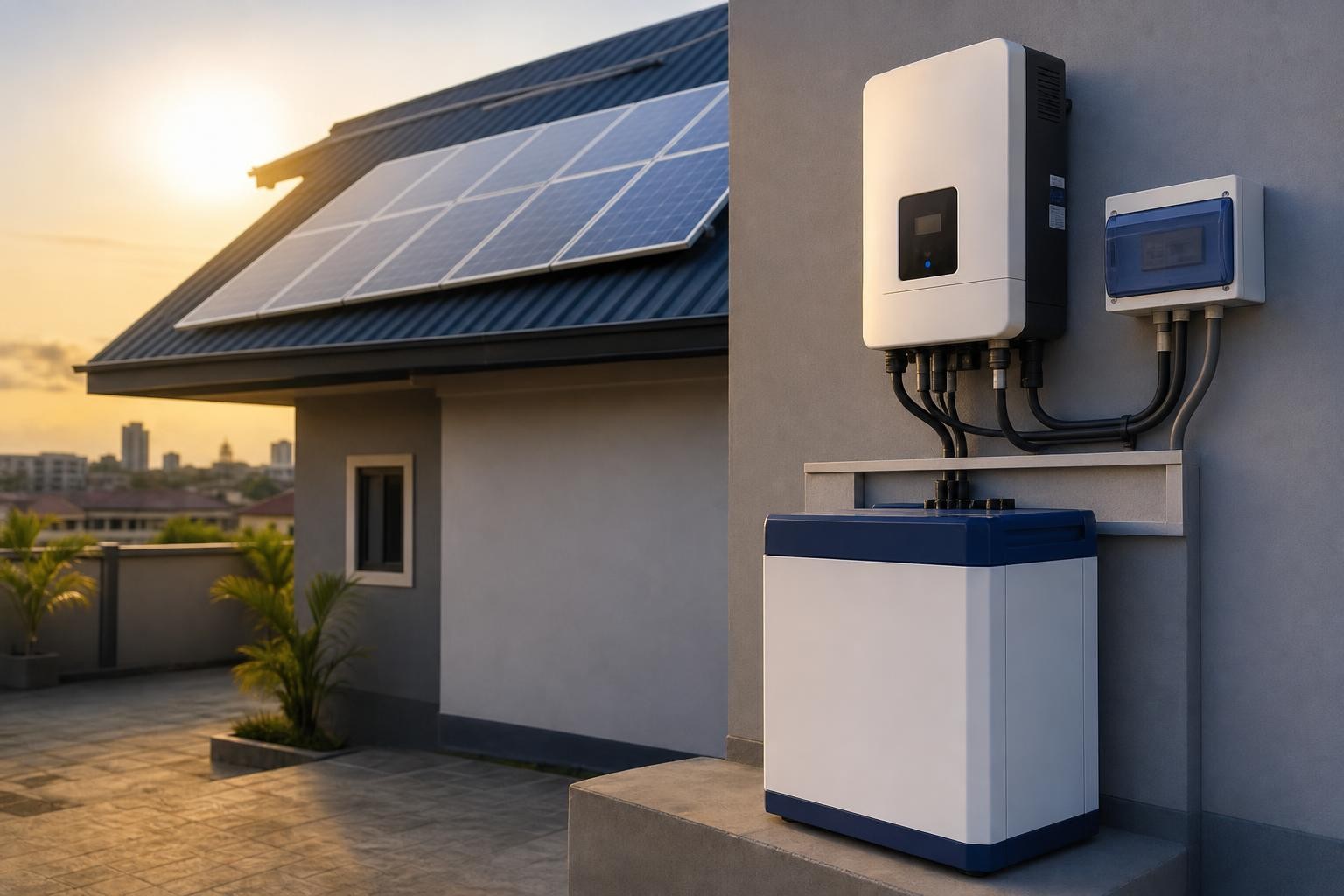
Short answer: a 1kW solar array may be enough to replace a small part of a 5kWh battery’s energy, but it is often too small if you want to recharge the battery fully in one sunny day while also powering daytime appliances. For a 5kWh lithium battery, a practical starting range is usually about 1.3kW to 2.0kW of panels for a normal recharge target, with more capacity needed when the roof is shaded, panels are dusty, the weather is poor, or the home uses power during the day.
That is a planning range, not a universal rule. The correct array size depends on how much energy you actually remove from the battery, your location in Nigeria, the season, panel orientation, heat, Harmattan dust, shading, the inverter’s PV limit and the battery’s maximum charging current.
What “1kW solar array” means
A 1kW array means the combined nameplate rating of the solar panels is about 1,000 watts under standard test conditions. It does not mean the panels will deliver 1,000 watts continuously from morning to evening.
For example, two 550W panels would have a combined nameplate rating of 1.1kW. Three 550W panels would be 1.65kW, and four would be 2.2kW. The actual number of panels is only the first step. The panels must also be connected in a series or parallel arrangement that stays within the inverter or MPPT charge controller’s permitted PV voltage, current and power range.
Solar production changes through the day. Heat, clouds, rain, dust, roof angle, shading and wiring losses all reduce the energy that reaches the battery. This is why the calculation should use expected daily energy rather than the panel label alone.
The simple calculation: battery energy ÷ daily solar yield
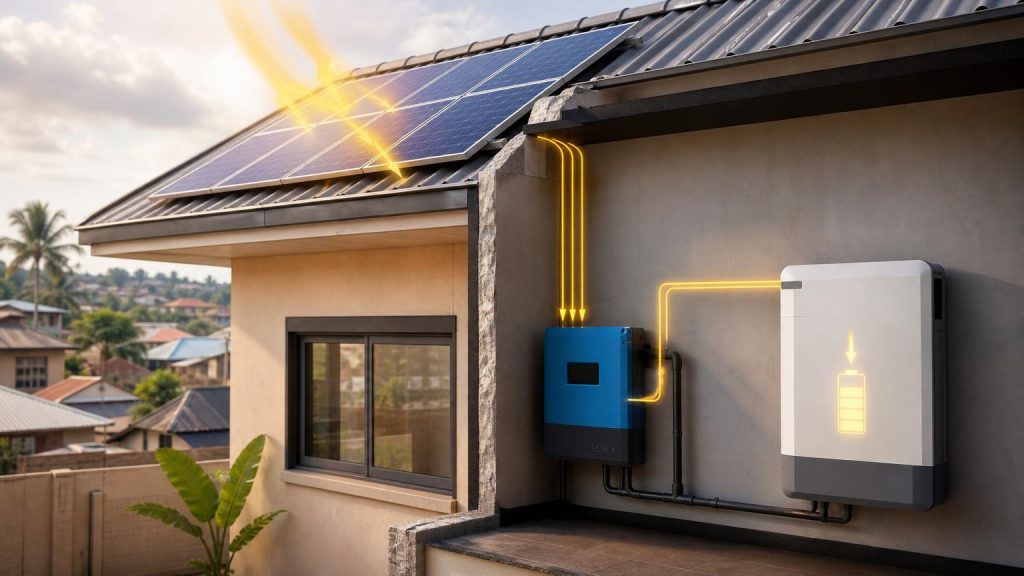
Use this planning formula:
Required solar-array size (kW) = energy to replace ÷ (usable solar hours × effective system factor)
The “effective system factor” allows for the difference between panel nameplate output and energy that is actually available after heat, dust, wiring, MPPT and inverter/charger losses. For an early estimate, you can test a range such as 70% to 85% instead of pretending that every system performs perfectly.
The energy to replace is not automatically the battery’s advertised capacity. A 5kWh battery may be rated at 5kWh nominal energy, but you may not use all of it. If you use 90% of the battery’s energy window, the energy removed during a deep cycle is approximately:
5kWh × 90% = 4.5kWh
You must then add any daytime appliances that the solar array will run while it is charging the battery. If the house uses 1kWh during daylight, the panels need to provide roughly 5.5kWh for the day before extra losses are considered.
Worked example: recharging a 5kWh lithium battery
Assume the following:
- Battery rating: 5kWh lithium
- Energy removed before recharge: 4.5kWh
- Daytime appliances while charging: 1.0kWh
- Total useful energy target: 5.5kWh
- Planning assumption: 4.5 effective solar hours
- Effective system factor: 80%
The estimated array size is:
5.5kWh ÷ (4.5 hours × 0.80) = 1.53kW
In practice, you would not normally install exactly 1.53kW and assume the result is guaranteed. You might choose about 1.6kW to 2.0kW, subject to the inverter’s PV-input limits and the available roof space.
If the battery is only partly discharged, the answer can be smaller. If it is deeply discharged, the home is using a fridge, freezer, router, fans or other appliances during the day, or the panels are affected by dust and shade, the answer can be larger.
How the answer changes with Nigerian weather and site conditions
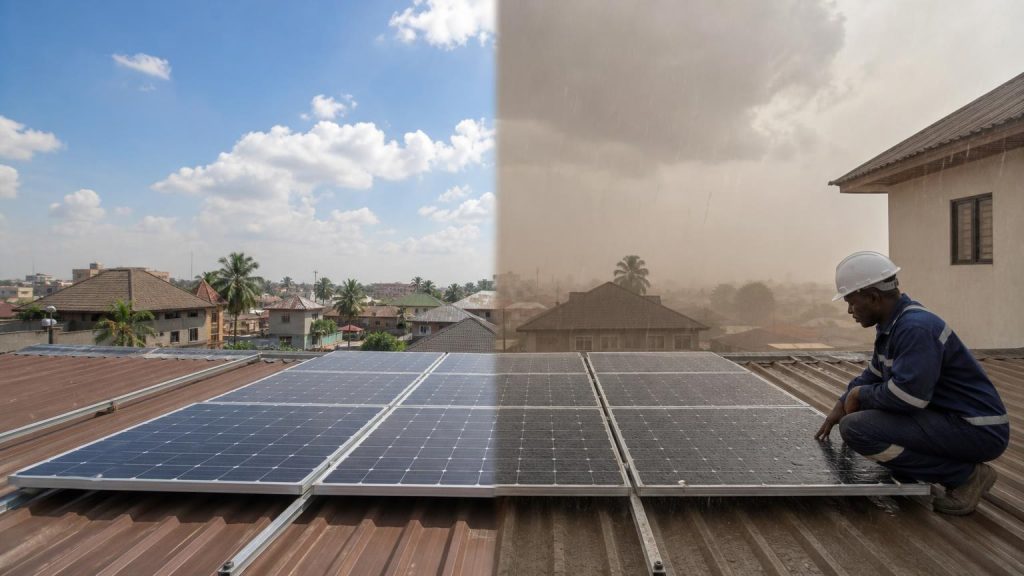
Nigeria does not have one identical solar condition everywhere. A rooftop in the north, a humid coastal location and a shaded urban roof may produce different results even with the same panel rating. Rainy periods, Harmattan haze, dust on the module surface, high panel temperature and nearby buildings can all reduce daily harvest.
Here is the same 4.5kWh battery-recharge target with no daytime appliance allowance:
| Planning case | Effective solar hours | System factor | Estimated array | Practical interpretation |
|---|---|---|---|---|
| Strong day, clean and unshaded roof | 5.0 | 85% | About 1.1kW | A 1kW array may be close, but there is little margin for daytime loads. |
| Normal planning case | 4.5 | 80% | About 1.25kW | About 1.3kW to 1.5kW is a more comfortable starting point. |
| Hot, dusty or partly shaded roof | 4.0 | 75% | About 1.5kW | Allow extra array capacity and keep the panels clean. |
| Cloudy or poor production day | 3.0 | 70% | About 2.1kW | Do not expect the array to restore a deeply discharged battery quickly. |
These are planning scenarios, not a promise of daily output for every Nigerian location. For a final design, check the site, roof direction, shading and the inverter’s monitoring data. If the system regularly underperforms, first check whether the battery is already full or whether the inverter is limiting PV input before replacing the panels.
For more on weather-related battery planning, see how many cloudy or rainy days a solar battery can survive in Nigeria and how much extra solar is needed after a cloudy day.
When is a 1kW array enough for a 5kWh battery?
A 1kW array can be reasonable when:
- You are not trying to recharge the whole 5kWh battery every day.
- The battery is only partly discharged during normal use.
- Daytime loads are small or are supplied directly by the grid.
- The roof is open, clean and correctly oriented.
- The inverter or MPPT controller accepts the array’s voltage, current and power.
- You can accept a slower recharge after several cloudy or rainy days.
For example, if you normally remove only 2.5kWh from the battery, a 1kW array may be able to replace that energy on a good day under reasonable conditions. It may still struggle if the battery is heavily discharged and the house is using energy at the same time.
The common mistake is to look only at “5kWh battery” and “1kW panels” without asking how many kWh the home uses each day. The battery stores energy; the panels produce energy over time. They must be matched to the daily energy pattern, not just to each other’s labels.
When should you use more than 1kW?
Consider a larger array if:
- You want the battery recovered from a deep discharge in one sunny day.
- The battery also supplies a fridge, freezer, fans, lights, router or office equipment during daylight.
- The system must recover after cloudy or rainy weather.
- Panels are installed on different roof faces or one section is shaded.
- Harmattan dust or nearby construction creates regular soiling.
- You want to reduce generator use by producing more daytime energy.
More panels do not automatically solve every backup problem. If the battery is old, the inverter is incorrectly configured, a fuse or cable connection is faulty, or the MPPT input is being clipped, adding panels may not produce the expected improvement. Test the system first.
SolarPriceNG’s guide on how to test whether solar panels are underperforming in Nigeria covers the checks that can separate a panel problem from a battery, inverter or measurement problem.
Do not forget the inverter and charge-controller limits
A 1.5kW or 2kW array is only suitable if the inverter or charge controller can accept it. Check the equipment manual for:
- Maximum PV array power
- Maximum PV voltage, including the cold-weather open-circuit voltage of the panels
- Maximum PV input current
- Maximum battery charging current
- Permitted battery voltage and chemistry settings
- Whether the inverter can use solar and grid/generator charging at the same time
Do not connect extra panels simply because the total wattage looks reasonable. A series string can exceed the inverter’s maximum voltage, while a parallel arrangement can exceed the input-current limit. A qualified installer should confirm the design, protection devices, cable sizes and isolators before the system is energised.
Also remember that a 1kW array does not equal one fixed charging current. At a simple 48V calculation, 1,000W divided by 48V is about 21A before conversion losses and controller behaviour. A 24V battery system would imply roughly 42A under the same simplified calculation. The actual charging current depends on the MPPT operating voltage, battery state, temperature and the controller’s limits.
What if the battery is tubular, GEL or AGM?
If the battery is lead-acid, do not assume that a “5kWh” label is equivalent to a 5kWh lithium battery. Many lead-acid quotes are given in Ah and voltage, such as 12V 200Ah. Convert the bank to nominal energy using:
Voltage × Ah × number of batteries
Then apply a conservative usable fraction and the inverter or charger losses. Lead-acid batteries also need the correct charging profile and may lose useful capacity when regularly discharged deeply or operated under heavy loads.
For battery comparisons, use kWh for lithium where that is the verified specification, and use Ah together with voltage for tubular, GEL and AGM batteries. Do not compare “200Ah” and “5kWh” as if they were the same unit. Before paying for a system, use the checks in how to verify the battery capacity on a solar quote.
A practical panel-sizing checklist
- Confirm the battery’s real specification. Record chemistry, nominal energy or Ah, voltage, usable-energy limit and recommended charge current.
- Estimate daily energy removed. Do not use the full battery label unless you genuinely plan to discharge it that far.
- Add daytime loads. Include the fridge, freezer, fans, lights, router, TV or office equipment that will run while the battery is charging.
- Choose a realistic solar-yield assumption. Test a good-day case and a poorer-day case instead of relying on one perfect number.
- Apply a system factor. Allow for heat, dust, shading, wiring, conversion and availability losses.
- Check the inverter or MPPT limits. Verify PV watts, voltage, current and battery charging limits.
- Leave useful margin. A design that works only at midday on a clean, cool day is not a robust Nigerian design.
- Measure after installation. Compare PV power, battery state of charge, battery voltage/current and daily energy over several different weather conditions.
Bottom line
For a 5kWh lithium battery, a 1kW solar array can work when the battery is only lightly used and daytime loads are small. If you want reliable daily recovery from a deeper discharge, a more realistic starting point is often about 1.3kW to 2.0kW, with the final figure adjusted for your location, roof, weather, dust, shading and daytime energy use.
Do not buy panels by matching the two labels alone. Start with the kWh you need to replace, add the energy used while charging, allow for real-world losses, and then check that the inverter or charge controller can safely accept the proposed array. If your system has recently stopped lasting as long as it used to, compare the cost and likely benefit of adding panels, adding battery capacity or reducing the load before spending money; this SolarPriceNG upgrade guide can help with that decision.