Last reviewed: September 22, 2026
There is no single number of cloudy or rainy days that every solar battery can survive in Nigeria. The answer depends on four things: your usable battery energy, the electricity your appliances consume each day, how much solar power the panels still produce in the bad weather, and whether the grid or a generator can provide backup.
A useful way to think about it is:
Rainy-day autonomy = usable battery energy ÷ daily energy shortfall
If your panels still produce enough energy for your daytime loads, the battery may only need to cover the night. If your home uses more energy than the panels produce, the battery covers the difference and can run down after one or more cloudy days. A system designed only for one normal night should not be expected to carry a heavy load through a long period of dark rain.
What does “survive rainy days” mean?
For this article, surviving means keeping your chosen critical loads running without taking the battery below the safe limit set by the battery manufacturer or inverter installer. It does not mean running every appliance in the house as if the weather were sunny.
Your critical loads might include lights, a television, Wi-Fi router, phone charging, a small refrigerator, CCTV, a fan or a POS terminal. Air conditioners, electric irons, kettles, water heaters, pressing irons, cookers and pumps can use much more energy and may also have high starting or heating demand.
This distinction matters in Nigeria because a battery that comfortably supports lights and a router may last far less time when a freezer, borehole pump or air conditioner is added.
Cloudy weather does not always mean zero solar power
Solar panels can still produce electricity from diffused daylight when the sky is cloudy, but output can fall sharply. Light cloud, thick cloud, heavy rain, shading, dust and the direction of the panels can all produce different results. During very dark rain, the energy harvested may be small enough that the battery continues discharging.
That is why a fixed promise such as “this battery will last three rainy days” is unsafe unless the load, battery chemistry, panel array and actual weather assumptions are stated. A partly cloudy day in Enugu, a long rainy spell in Lagos and a dusty Harmattan day in Kano will not produce the same solar energy.
The U.S. Department of Energy explains that photovoltaic systems can continue producing from diffused light on cloudy days, while thick cloud cover can reduce solar radiation substantially. For your own system, the inverter or charge-controller production reading is more useful than a generic weather rule.
The calculation you should use
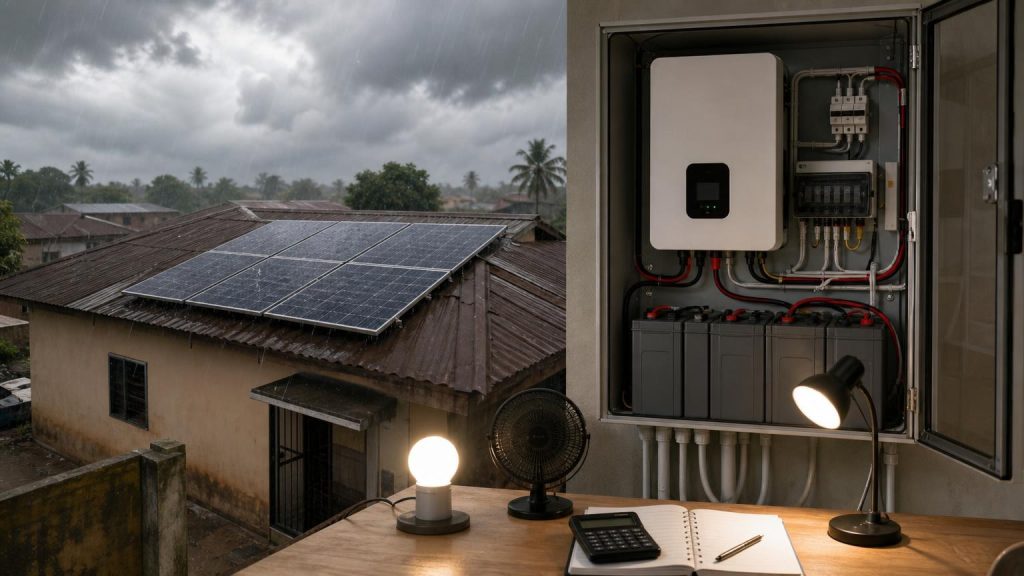
Work through these five figures:
- Measure or estimate the energy your critical appliances use in 24 hours.
- Calculate the battery energy that is actually available for AC loads.
- Estimate the solar energy available on a cloudy or rainy day.
- Subtract cloudy-day solar energy from daily consumption.
- Divide usable battery energy by the remaining daily shortfall.
1. Find your daily load
For each appliance, multiply its approximate running watts by the number of hours it operates:
Energy used in watt-hours = watts × hours
For example, a 60W fan used for 8 hours uses about 480Wh. A 100W television used for 5 hours uses about 500Wh. Add the lights, router, phone charging and refrigerator energy rather than looking only at the biggest appliance.
Where possible, use a plug-in energy meter or the inverter’s monitoring data. Nameplate watts are only an estimate: refrigerators cycle on and off, while motors and pumps can draw a high starting surge.
2. Calculate usable battery energy
Do not treat the battery label as if every watt-hour can safely reach your appliances. You need to allow for the battery’s permitted depth of discharge, inverter losses, temperature, battery age and, for lead-acid batteries, the effect of discharge rate.
For a lithium battery, start with its verified kWh rating and apply the permitted usable fraction from the battery and inverter documentation. For a tubular, GEL or AGM battery, use voltage together with Ah:
Nominal battery energy = battery voltage × battery capacity in Ah
Then allow for the manufacturer’s safe discharge limit and inverter efficiency. Do not compare a lithium battery and a lead-acid battery by Ah alone.
Illustrative example: a 24V, 200Ah lead-acid bank has a nominal energy value of 4,800Wh. If a planning assumption allows only half of that energy for battery life and the inverter is 90% efficient, the estimated AC energy is:
4,800Wh × 0.50 × 0.90 = 2,160Wh, or about 2.16kWh.
This is an example calculation, not a universal rule. Your battery manufacturer may specify a different usable limit, and an old or heavily loaded lead-acid battery may deliver less than its label suggests.
3. Estimate rainy-day solar contribution
The safest estimate comes from your own inverter or solar-monitoring history. Record the PV energy produced on several cloudy and rainy days, not just the panel wattage printed on the modules.
If you have no monitoring data, you can make a temporary planning estimate:
Cloudy-day solar energy ≈ panel array watts × equivalent useful sunlight hours × system factor
For example, a 2,200W panel array producing the equivalent of 1.2 useful full-output hours, with a 0.75 allowance for system losses and weather, would produce roughly:
2,200W × 1.2 × 0.75 = 1,980Wh, or about 1.98kWh.
Do not present that result as a Nigerian rainy-season average. It is only an illustration of the method. Thick cloud, rain, dust, shade, hot panels, poor orientation, damaged wiring and daytime appliance use can make the real number much lower.
4. Work out the daily shortfall
If your critical loads use 1,800Wh in a day and your panels provide 800Wh during a very poor-weather day, the battery must cover:
1,800Wh − 800Wh = 1,000Wh per day
Using the illustrative 2.16kWh of usable AC battery energy above:
2,160Wh ÷ 1,000Wh = about 2.16 days
In a darker period where solar contributes only 200Wh, the shortfall becomes 1,600Wh per day and the same battery provides only about 1.35 days. If the panels produce more than the loads consume, there is no battery shortfall on that day, although the battery may still be needed at night.
Why your real autonomy may be shorter than the calculation
- Hidden loads: routers, decoders, CCTV, chargers, standby appliances and inverter self-consumption continue using energy.
- Starting surge: a refrigerator, freezer, pump or air conditioner can make the inverter shut down even when the daily energy total looks acceptable.
- Battery age: a battery can show a normal voltage but have much less usable capacity than when it was new.
- Lead-acid discharge rate: drawing energy quickly can reduce the effective capacity compared with the label.
- Heat and ventilation: high temperatures and poor ventilation can affect equipment performance and protection limits.
- Dust and shade: Harmattan dust, bird droppings, nearby trees and roof shading can reduce the energy available for charging.
- Incomplete charging: several weak solar days can leave the battery starting each night at a lower state of charge.
- Weather location: cloud and rain patterns vary across Nigeria, so one city’s experience should not be used as a promise for another.
How to prepare for a long cloudy spell in Nigeria
You do not always need to buy a larger battery. Start with the cheapest safe changes:
- Choose critical loads. Keep lights, communication, security and essential refrigeration ahead of comfort loads.
- Move flexible loads to the daytime. Where solar is available, use it for pumping, washing or other planned work instead of making the battery supply everything at night.
- Reduce the load temporarily. Avoid electric heating, pressing irons, kettles and air conditioning when the battery is not recovering.
- Check the panels and charging path. Look for shade, dust, alarms and abnormal PV readings. Cleaning and electrical work should follow safe procedures.
- Keep a safe reserve. Use the inverter and battery manufacturer’s low-voltage, state-of-charge and discharge settings. Do not bypass protection to force more energy out.
- Use grid or generator support when appropriate. A hybrid system can use another available source to prevent repeated deep discharge during extended poor weather.
Should you add more panels or a bigger battery?
Look at what happens at the end of a normal sunny day:
- If the battery is full or nearly full but runs out before morning, you may need more usable battery energy, a smaller night load or a better load schedule.
- If the battery is rarely full because the panels cannot replace the previous night’s use, adding panels or correcting a charging problem may help more than adding battery capacity.
- If the inverter shuts down when a motor or heating appliance starts, the issue may be inverter power, starting surge, cables or connections rather than battery size.
- If one battery in a bank behaves differently, test the bank before buying more batteries. Mixing old and new batteries can create further imbalance.
Use the decision method in Should You Add More Solar Panels or a Bigger Battery First in Nigeria? and verify the inverter’s maximum PV voltage, current and power before changing the array.
A practical test using your own rainy-day data
For the next cloudy or rainy period, record the following at roughly the same times each day:
- battery state of charge or battery voltage shown by the system;
- PV energy produced that day;
- energy consumed or the main appliances used;
- the time the battery reaches its low limit;
- weather conditions, shade and whether grid or generator charging was available.
After three or more comparable days, you can see whether the battery is losing energy because solar input is too low, because the load is too high, or because the battery is no longer holding the energy it should. A battery monitor can estimate state of charge and time remaining, but those readings depend on correct configuration and should be treated as guidance rather than proof of battery health.
For a first estimate of backup time, use the SolarPriceNG Battery Calculator, then compare the result with your measured rainy-day data and the manufacturer’s specifications.
When the problem is not simply the weather
If your system suddenly performs much worse than it did during similar weather, investigate the equipment before blaming the rain. A loose or corroded connection, wrong charging setting, tripped protection device, shaded panel, failed charge controller or weak battery can all reduce backup time.
Read Why Is My Solar Battery Not Charging? if the battery is not gaining energy during daylight, and Why Is My Solar Battery Draining So Fast? if the state of charge falls unusually quickly.
Do not open an inverter, remove high-current battery cables, bypass a fuse or breaker, change lithium-battery protection settings, or alter series and parallel connections unless the work is being done by a qualified professional following the equipment manuals.
Bottom line
Your solar battery can survive one, two or more cloudy days only if its usable energy is large enough for the daily shortfall after cloudy-day solar production is included. The same battery may last several days with lights, a router and a small refrigerator, but only part of a day if it is also supplying heavy heating, cooling or pumping loads.
Measure your real load, use kWh for lithium and Ah together with voltage for lead-acid batteries, allow for safe discharge and inverter losses, and use your own cloudy-day production data. During a long rainy spell, reduce non-essential loads and use available grid or generator support rather than forcing the battery below its safe limit.
Related SolarPriceNG guides
- Should You Add More Solar Panels or a Bigger Battery First in Nigeria?
- How Many Solar Panels Do I Need for My House in Nigeria?
- Why Is My Solar Battery Not Charging?
- Why Is My Solar Battery Draining So Fast?
- SolarPriceNG Battery Calculator