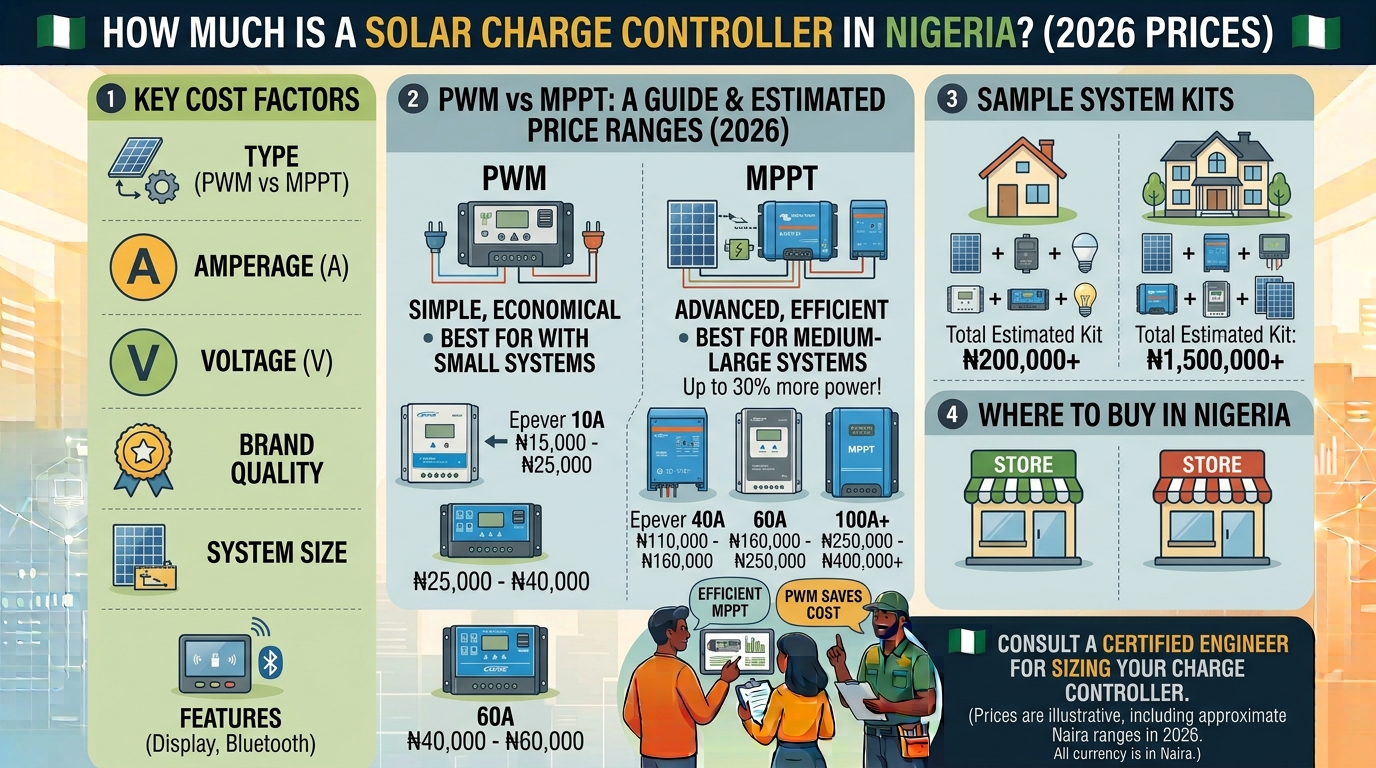
A solar charge controller is an important part of many solar power systems. It controls the electricity coming from the solar panels before it goes into the battery.
If you are planning to install solar in Nigeria, you may be asking:
How much is a solar charge controller in Nigeria?
The answer depends on the type, size, brand, battery voltage and quality of the controller.
In this guide, we will look at the current estimated prices of solar charge controllers in Nigeria, the difference between PWM and MPPT, how to choose the right size, and what you should check before buying one.
You can also use our Solar Charge Controller Calculator to estimate the size you need.
Note: Solar equipment prices in Nigeria change regularly because of exchange rates, import costs, brand and seller pricing. The prices below should therefore be treated as estimated Nigerian market ranges, not fixed prices.
Solar Charge Controller Prices in Nigeria
The following table gives a general idea of what you may expect to pay in Nigeria.
| Charge Controller | Type | Estimated Price |
|---|---|---|
| 10A | PWM | ₦6,000 – ₦12,000 |
| 20A | PWM | ₦7,000 – ₦18,000 |
| 30A | PWM | ₦8,000 – ₦25,000 |
| 40A | PWM | ₦12,000 – ₦35,000 |
| 50A | PWM | ₦15,000 – ₦45,000 |
| 60A | PWM | ₦20,000 – ₦65,000 |
| 20A | MPPT | ₦15,000 – ₦45,000 |
| 30A | MPPT | ₦25,000 – ₦75,000 |
| 40A | MPPT | ₦35,000 – ₦100,000 |
| 50A | MPPT | ₦45,000 – ₦150,000 |
| 60A | MPPT | ₦50,000 – ₦200,000 |
| 80A | MPPT | ₦100,000 – ₦250,000 |
| 100A+ | MPPT | ₦120,000 – ₦300,000+ |
These are general market estimates. A particular brand or model can be cheaper or more expensive.
For a more detailed list of solar equipment and current Nigerian price estimates, see our Solar Prices in Nigeria page.
What Is a Solar Charge Controller?
A solar charge controller is the device that manages the power going from your solar panels to your battery.
Without proper charging control, a battery can receive too much voltage or current, which can reduce its life or cause damage.
A charge controller helps manage the charging process and protects the battery from problems such as overcharging.
There are two main types:
- PWM charge controllers
- MPPT charge controllers
How Much Is a PWM Charge Controller in Nigeria?
PWM stands for Pulse Width Modulation.
PWM controllers are usually cheaper than MPPT controllers.
You can find them in sizes such as:
- 10A
- 20A
- 30A
- 40A
- 50A
- 60A
Estimated Nigerian prices can range from about ₦6,000 to ₦65,000, depending on the size, brand and quality.
Small PWM controllers are commonly used for simple solar systems.
For example, a small setup powering:
- LED bulbs
- phones
- small fans
- TV
- small electronics
may not require an expensive controller.
However, you should still make sure the controller is correctly matched to the solar panel and battery.
How Much Is an MPPT Charge Controller in Nigeria?
MPPT means Maximum Power Point Tracking.
MPPT controllers are normally more expensive than PWM controllers because they use a more advanced charging method.
Depending on the size and brand, an MPPT controller can cost from around ₦15,000 to over ₦300,000 in Nigeria.
Larger controllers such as 60A, 80A and 100A models are usually more expensive.
MPPT controllers are commonly preferred for larger solar systems because they can make better use of the available power from the solar panels.
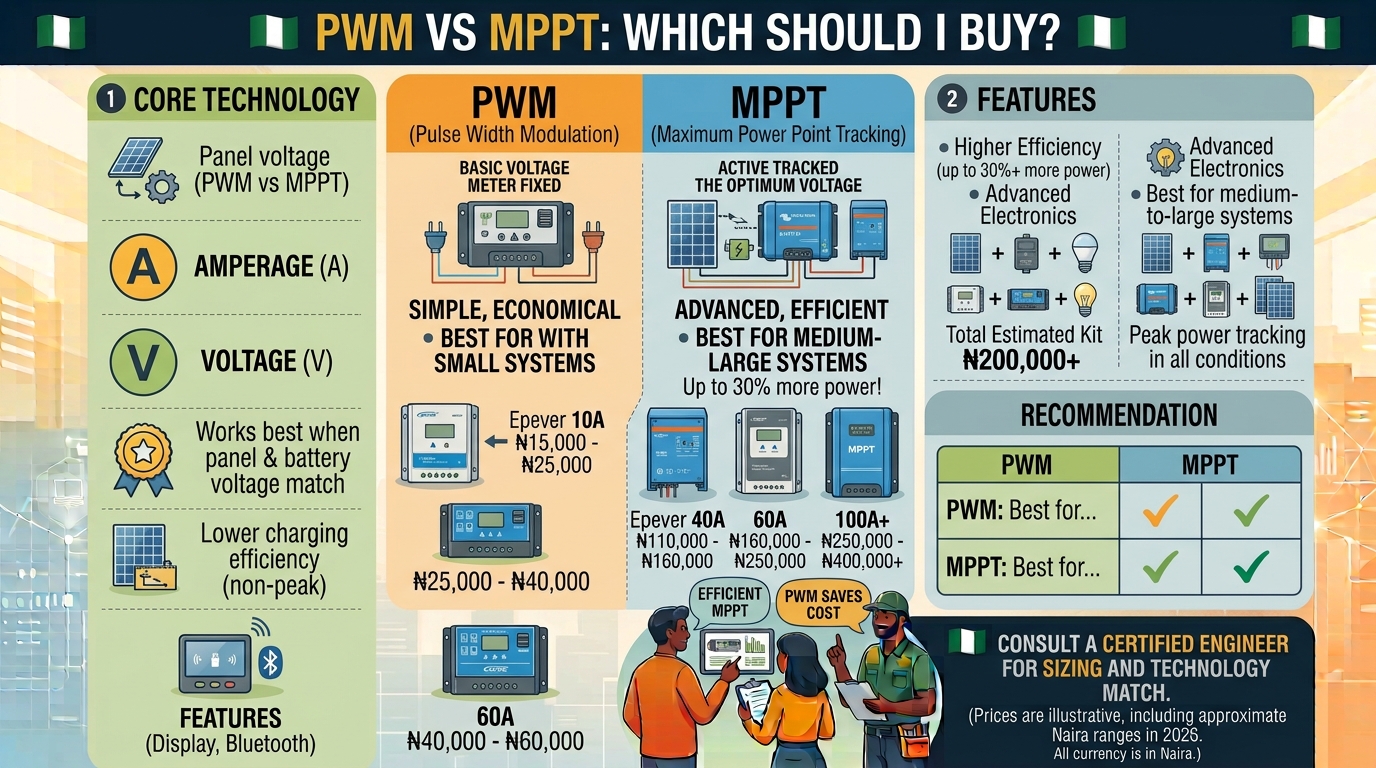
PWM vs MPPT: Which Should I Buy?
The best choice depends on your solar system.
PWM
PWM is usually:
- cheaper
- simpler
- suitable for small systems
- easy to find
MPPT
MPPT is usually:
- more expensive
- more efficient in many system setups
- better suited to larger systems
- more flexible with panel voltage
If you are building a larger solar system, MPPT is often worth considering.
If you are building a small and simple system where cost is very important, PWM may be enough.
For a deeper explanation, we can also cover PWM vs MPPT in a separate article.
What Size Solar Charge Controller Do I Need?
This is more important than simply asking for the cheapest controller.
The controller size depends mainly on:
- Total solar panel wattage
- Battery voltage
- Controller type
- Maximum PV voltage
- Maximum charging current
For example, suppose you have:
1,000W of solar panels
and a:
24V battery system
A simple calculation is:
1,000W ÷ 24V = 41.7A
This means you would not normally choose a controller that is only rated at 20A or 30A.
A controller with a higher suitable current rating may be required.
But there is more to the calculation than just dividing watts by volts.
You also need to check the controller’s maximum solar input and voltage limits.
That’s why it is better to use our:
Solar Charge Controller Calculator
How Many Amps Does My Charge Controller Need?
Charge controllers are often described by their current rating.
For example:
- 20A
- 30A
- 40A
- 50A
- 60A
- 80A
- 100A
The correct size depends on your solar array and battery voltage.
For example, a 600W solar array will require a different controller depending on whether the battery bank is 12V, 24V or 48V.
This is why simply saying:
“I have 600W of panels, so I need a 60A controller”
is not always correct.
The battery voltage matters.
Can a 60A Charge Controller Handle 1,000W Solar Panels?
It can, depending on the battery voltage and the controller’s specifications.
For example:
With a 24V battery system
1,000W ÷ 24V = approximately 41.7A
A 60A controller may be suitable from the current point of view, but you must still check its maximum PV power and voltage.
With a 48V battery system
1,000W ÷ 48V = approximately 20.8A
The required charging current is much lower.
This shows why battery voltage is important when selecting a charge controller.
Can I Use a 30A Charge Controller for 500W Solar Panels?
It depends on your battery voltage and controller type.
For example:
500W ÷ 12V = 41.7A
A 30A controller would not be enough for that simple 12V calculation.
But:
500W ÷ 24V = 20.8A
A 30A controller could potentially be suitable from the current point of view, provided its other specifications are suitable.
This is why you should calculate your system before buying.
12V vs 24V vs 48V Solar Systems
The battery voltage makes a big difference.
For the same solar panel capacity, a higher battery voltage means lower charging current.
For example:
| Solar Array | 12V | 24V | 48V |
|---|---|---|---|
| 500W | Higher current | Lower current | Lower current |
| 1,000W | Higher current | Lower current | Lower current |
| 2,000W | Very high current | Higher | Lower |
This is one reason larger solar systems often use 24V or 48V battery systems.
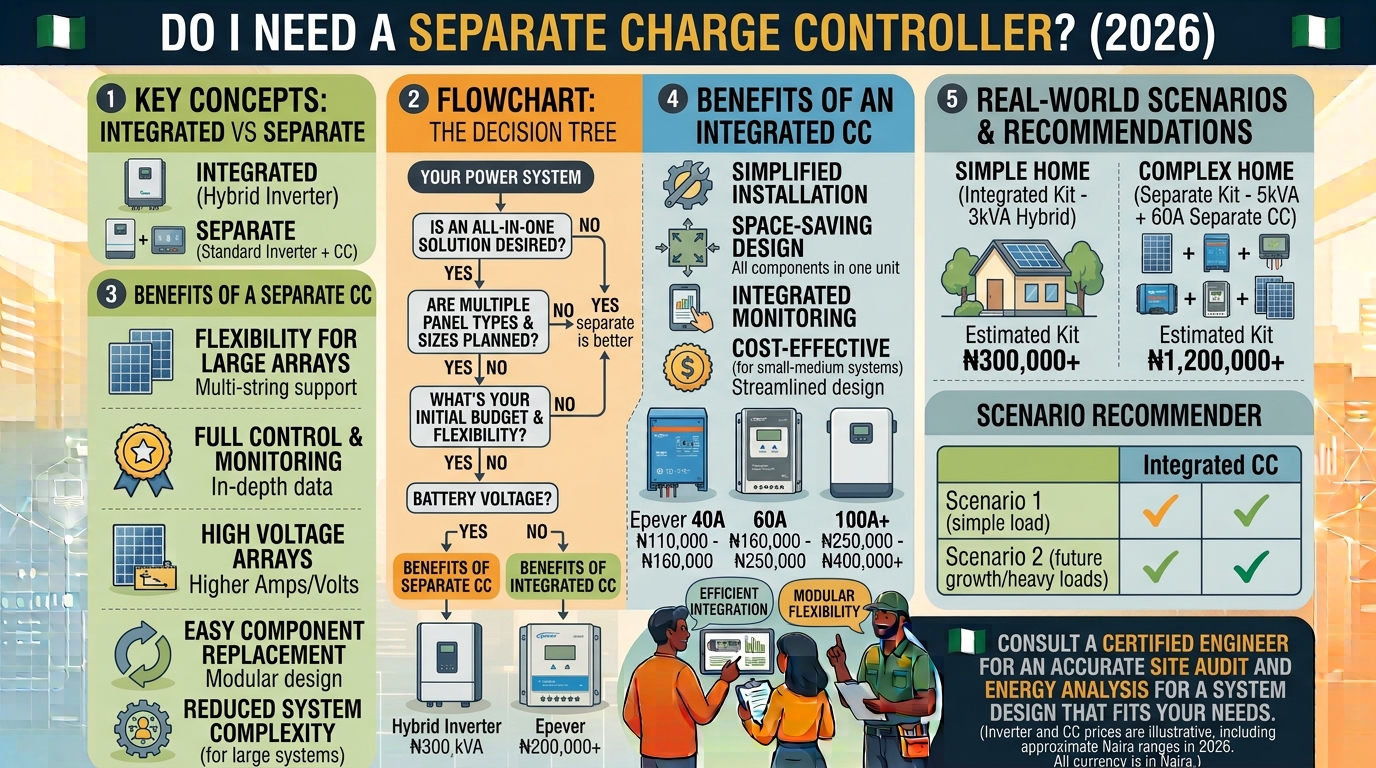
Do I Need a Separate Charge Controller?
Not always.
This is something you should check before buying.
Many modern hybrid solar inverters already have a built-in MPPT solar charge controller.
If your inverter already has a suitable MPPT controller, you may not need to purchase another separate controller.
However, you must check the inverter’s specifications.
Look for:
- Maximum PV power
- Maximum PV voltage
- MPPT voltage range
- Maximum charging current
If your solar panels exceed those limits, the system may need a different design.
Charge Controller Brands in Nigeria
You will find many different charge controller brands in the Nigerian market.
Some names you may come across include:
- Tasha
- GBox
- EPEVER
- SRNE
- Victron
- MUST
- PowMr
- Felicity Solar
- and other imported and locally available brands.
However, don’t buy a controller simply because you recognize the brand.
Check the actual specifications.
A 60A controller from one brand may have very different specifications from another 60A controller.
What Should I Check Before Buying a Charge Controller?
Before you buy, check these things.
1. Is it PWM or MPPT?
Know what type you are buying.
2. What is the current rating?
Check whether it is 20A, 30A, 40A, 60A, 100A or another size.
3. What battery voltage does it support?
Make sure it supports your 12V, 24V or 48V system.
4. What is the maximum PV voltage?
This is especially important when connecting multiple panels in series.
5. What is the maximum PV power?
Make sure your solar array does not exceed the controller’s allowed input.
6. Does it support your battery type?
Check whether it supports your lithium, tubular, gel or other battery type.
7. Is there a warranty?
A warranty can be important when buying expensive equipment.
How Much Does a 30A MPPT Charge Controller Cost?
A 30A MPPT controller can generally fall around:
₦25,000 – ₦75,000
depending on the brand, quality and specifications.
Don’t compare it directly with a cheap 30A PWM controller.
They are different technologies.
How Much Does a 60A MPPT Charge Controller Cost?
A 60A MPPT controller can generally fall around:
₦50,000 – ₦200,000
Some premium models can cost more.
Before buying, check the controller’s maximum PV voltage and maximum PV power.
How Much Does a 100A MPPT Charge Controller Cost?
A 100A MPPT controller can cost approximately:
₦120,000 – ₦300,000+
The price can vary significantly depending on the brand and specifications.
Large controllers are generally intended for larger solar systems.
Don’t buy a 100A controller simply because it sounds better.
Buy according to your actual solar array and battery system.
Can a Charge Controller Be Too Big?
Yes.
A bigger controller is not automatically better.
For example, if your solar system only needs a 30A controller, buying a 100A controller may mean spending more money without getting a useful benefit.
The important thing is to choose a controller that properly matches your system.
Can a Charge Controller Be Too Small?
Yes, and this can be a bigger problem.
If your solar panels can produce more current than the controller is designed to handle, the controller may be overloaded or operate outside its recommended limits.
This is why you should calculate the required size before buying.
Use our Charge Controller Calculator to make the calculation easier.
Charge Controller vs Solar Inverter
These two devices are not the same.
A charge controller manages the charging of the battery from solar panels.
An inverter changes DC electricity from the battery into AC electricity that household appliances can use.
Some hybrid inverters combine both functions.
If you are not sure what size inverter you need, use our:
You can also read our guide:
How Much Is a Solar Inverter in Nigeria? Current Prices and Buying Guide

How Does the Charge Controller Fit Into the Complete Solar System?
A simple solar system can look like this:
Solar Panels → Charge Controller → Battery → Inverter → Appliances
Each part has a different job.
The solar panels produce electricity.
The charge controller manages battery charging.
The battery stores energy.
The inverter converts the battery’s DC power into AC power for your appliances.
If you want to estimate the complete installation cost, use our:
Solar Installation Cost Calculator.
Check Current Solar Equipment Prices in Nigeria
Solar equipment prices can change quickly in Nigeria.
Instead of relying on one old price, check our Solar Prices in Nigeria page for estimated prices across different solar equipment categories.
You can find information for:
- Solar panels
- Solar inverters
- Lithium batteries
- Tubular batteries
- Gel batteries
- Charge controllers
- Different capacities and sizes
We will continue updating the database as market prices change.
Final Advice
When buying a solar charge controller in Nigeria, don’t focus only on the price.
First find out:
How many watts of solar panels do I have?
What battery voltage am I using?
Do I need PWM or MPPT?
What is the maximum PV voltage?
What is the maximum PV power?
Then choose a suitable controller.
For a quick estimate, use our Solar Charge Controller Calculator.
And when you are ready to check equipment prices, visit our Solar Prices in Nigeria page.
If you are planning the complete system, you can also use our:
And for beginners, start with our How to Choose the Right Solar System for Your Home in Nigeria guide.