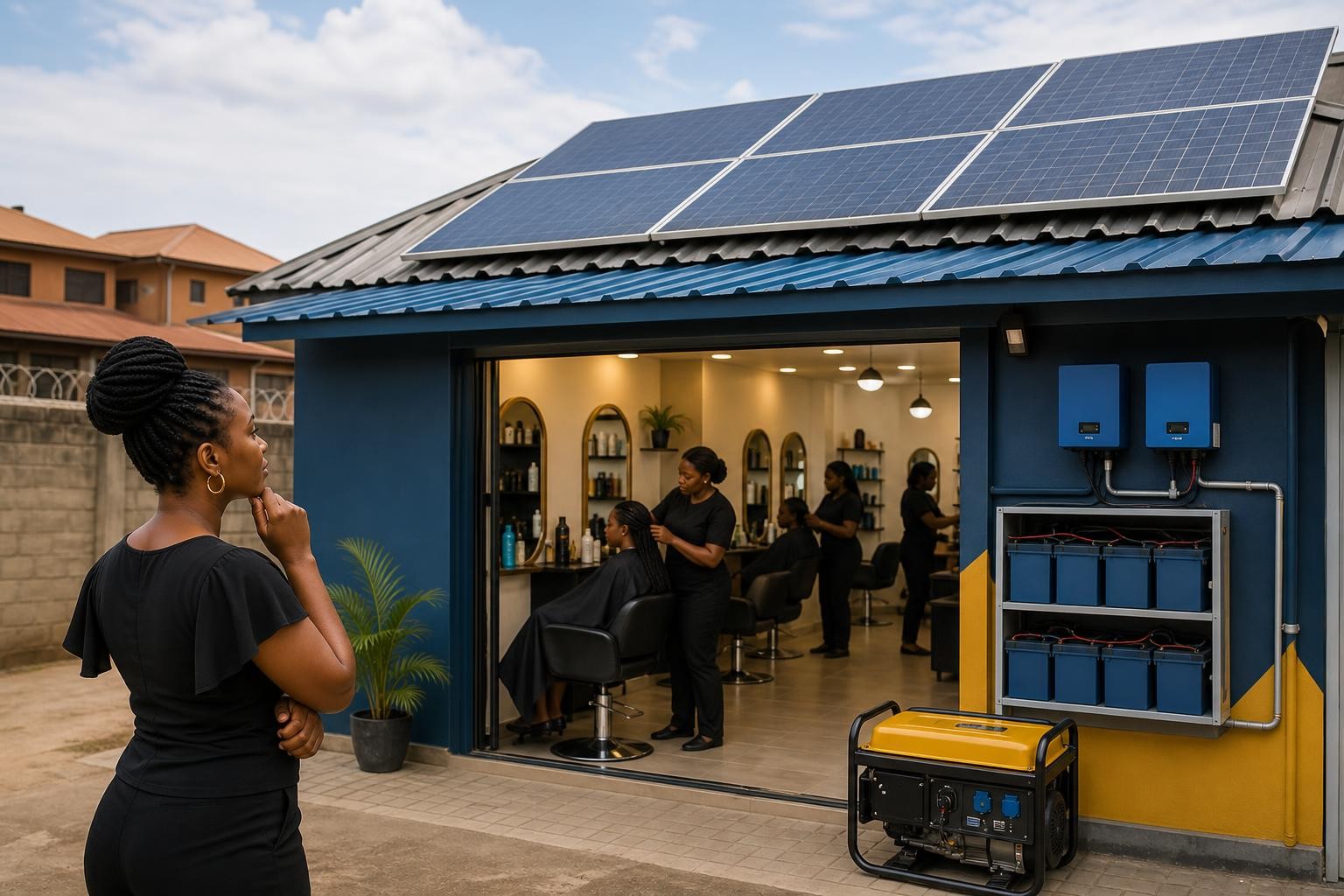
If you run a small salon in Nigeria, you may not need a solar system large enough to power every appliance at the same time. The practical approach is to separate your essential salon loads from high-wattage heat equipment such as hair dryers, hood dryers, straighteners and pressing tools.
For a small salon that mainly wants to keep lights, fans, clippers, a router, CCTV and phone charging available during outages, a system in the rough range of a 2kVA inverter, about 4–6kWh of nominal lithium storage, and roughly 1.5–2kW of solar panels may be a sensible starting point for investigation. That is not a fixed recommendation: your actual equipment, operating hours, battery chemistry, roof conditions and inverter specifications decide the final size.
If you also want to run a hood dryer or a powerful hand dryer from the battery, the system can become much larger very quickly. The right answer comes from your appliance list and the hours you want to work without public power or a generator.
The first decision: what must stay on during an outage?
A salon usually has two different types of electrical demand:
- Business-critical loads: lights, fans, clippers, trimmers, a phone charger, router, CCTV, POS device and sometimes a small refrigerator.
- High-energy tools: hand dryers, hood dryers, hair steamers, straighteners, curling irons, pressing irons and other heating equipment.
The first group can often be supported with a modest system. The second group determines whether you need a much larger inverter, more battery storage and more solar panels. It may also be cheaper to use some high-wattage tools while the sun is available or when grid/generator power is present, instead of asking the battery to supply all the heat.
What a Salon Usually Needs During an Outage
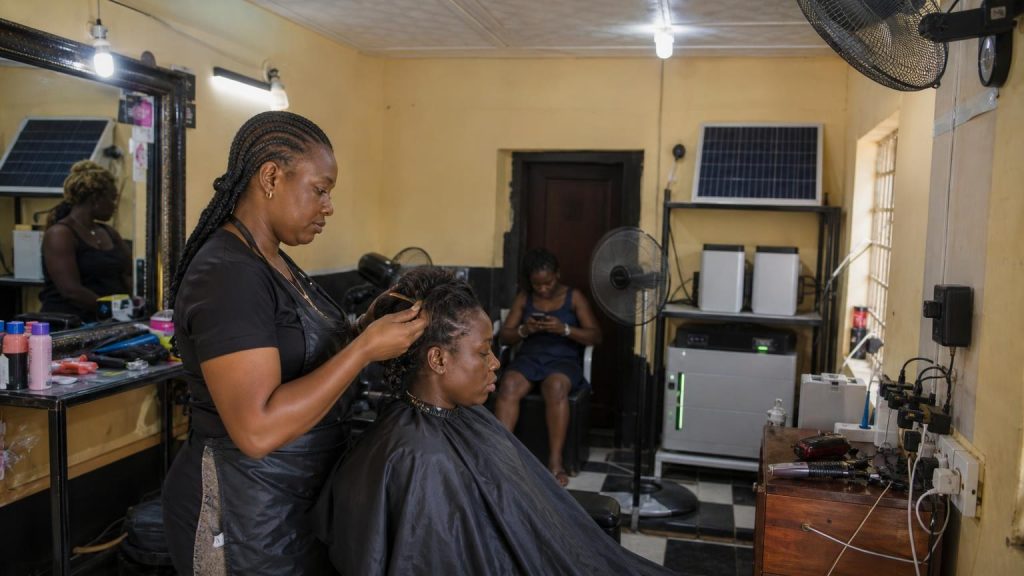
Do not use a generic “salon wattage” figure. Check the rating label on each appliance, because similar-looking equipment can have very different power requirements. The table below is an illustration for planning, not a replacement for your own nameplate readings.
| Load | Illustrative quantity | Illustrative running power | How to use the figure |
|---|---|---|---|
| LED lights | 6 | 10W each | 60W total; confirm the bulb labels |
| Standing or wall fans | 2 | 60W each | 120W total; speed changes consumption |
| Clippers and trimmers | Several | Intermittent | Use the charger or equipment label |
| Router, CCTV and phone charging | One small group | About 40–80W combined | Measure where possible |
| Hand hair dryer | 1 | Often 1,200–2,100W or more | Never guess; check the exact model |
| Hood or standing dryer | 1 | Often around 1,000–1,300W | Check the nameplate before sizing |
As one real example of why the label matters, Philips Nigeria lists a SalonDry Pro hand dryer at 2,100W and 220–240V. A professional hooded dryer can have a different rating; one manufacturer specification lists a standing dryer at 1,200W and 220V. These are examples, not values to apply to every dryer. Your own model may be lower or higher.
If you only want to back up the first four rows, your working load may remain below 500W. If you add a 2,100W hand dryer, the inverter must handle more than 2,500W when the other salon loads are running together. That is why “small salon” does not automatically mean “small inverter”.
Three practical solar sizes for a small salon
Option 1: Essential backup only
This is the most affordable and usually the easiest system to keep reliable. It can cover lights, fans, clippers, CCTV, internet, phone charging and similar low-power loads. High-wattage dryers remain on grid or generator power, or are used mainly during strong daytime solar production.
Illustrative sizing direction: a 1.5–2kVA inverter, roughly 3–5kWh of usable battery energy depending on the hours required, and around 1.5–2kW of panels. The inverter still needs enough continuous output for the actual simultaneous load, and any refrigerator or other motor load must be checked for starting demand.
Option 2: Essential loads plus one moderate dryer
Suppose the essential salon load is about 370W and one hood dryer is rated at 1,200W. If both operate at the same time, the simple total is:
370W + 1,200W = 1,570W
That is before allowing for equipment tolerances, other small devices and any starting demand. A 2kVA inverter may be close to the limit in some installations; a larger inverter may be more appropriate if the dryer must run together with other loads. The exact continuous and surge ratings of the selected inverter matter more than the label “2kVA” alone.
Option 3: Frequent use of powerful hand dryers and heating tools
A 2,100W hand dryer plus the same 370W essential load gives an illustrative simultaneous load of:
2,100W + 370W = 2,470W
This points toward a system with more inverter headroom, often in the 3kVA or larger class depending on the full equipment list and the manufacturer’s continuous and surge ratings. If a straightener, steamer, iron or another heater is used at the same time, the required inverter output can increase again.
For this type of salon, it may be more sensible to design a hybrid operating schedule: keep lights, fans, clippers and digital equipment on the battery, but run the highest-wattage heat tools during the solar window or on another supply. This can reduce battery size and improve the number of working hours you get from the system.
How to calculate the battery you need
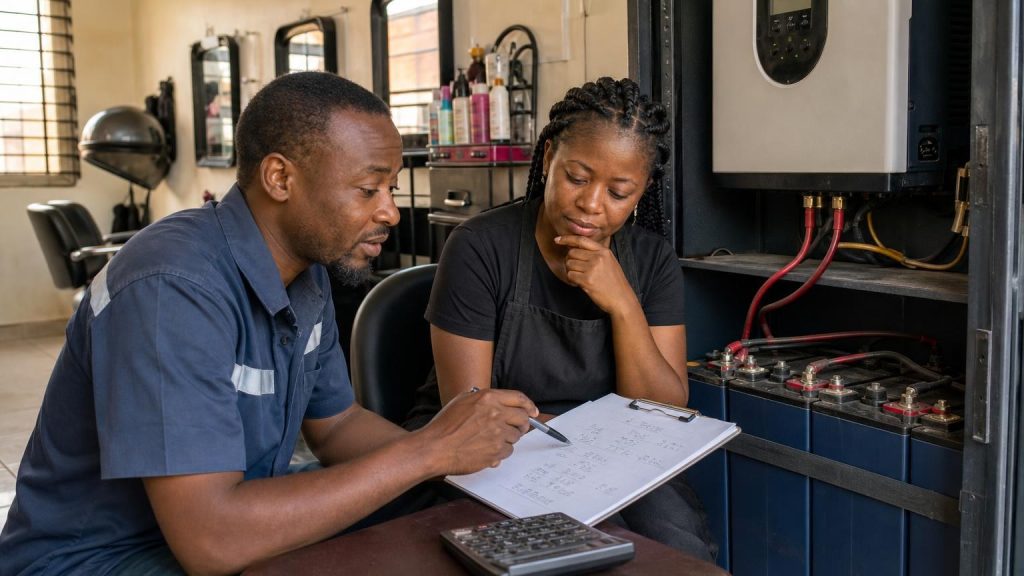
Battery size is about energy, not just the inverter’s kVA rating. Start with the loads you want the battery to carry and multiply their power by the hours of use:
Energy used = watts × hours ÷ 1,000
For example, if your essential salon loads average 370W for eight hours:
370W × 8 hours = 2,960Wh, or 2.96kWh
That is the appliance-side energy before inverter losses. If you plan with an illustrative 90% inverter efficiency, the battery must supply roughly:
2.96kWh ÷ 0.90 = 3.29kWh
A lithium battery should not normally be selected by assuming every kilowatt-hour is available to the appliances. If you plan around 80% usable depth of discharge, the nominal storage implied by this example is approximately:
3.29kWh ÷ 0.80 = 4.11kWh nominal
So a nominal lithium battery around 4–5kWh could be a starting point for that particular essential-load example, subject to the battery and inverter specifications. If the salon adds two hours of a 1,200W dryer, that dryer alone uses about 2.4kWh before losses. The storage requirement then rises quickly.
For lithium batteries, use kWh as the main capacity measure. For tubular, GEL or AGM batteries, use Ah together with voltage. Do not compare a 200Ah 12V battery directly with a 200Ah 48V lithium battery: their nominal stored energy is not the same, and their usable energy may differ further.
You can use the SolarPriceNG Battery Calculator to work through a specific load list and backup time, then check the result against the exact battery’s voltage, recommended depth of discharge, maximum current and warranty conditions.
How many solar panels does the salon need?
The panels must do more than run the salon during daylight. They may also need to replace the energy removed from the battery after an outage. A simple planning formula is:
Panel capacity ≈ daily energy to replace ÷ (useful sunlight hours × planning efficiency)
For an illustration, suppose the salon needs about 3.3kWh from the battery each day, you plan with four useful sunlight hours, and you use a 75% planning factor to allow for heat, dust, wiring, conversion and other losses:
3.3 ÷ (4 × 0.75) = 1.1kW of panels
That calculation suggests a panel array around 1.1kW as a mathematical starting point. In practice, you may choose a larger array, such as roughly 1.5kW, to give more recharge margin. If the salon also uses several kilowatt-hours for dryers during the day, the panel requirement can move closer to 3kW or more, depending on the schedule and whether the grid or generator shares the work.
Do not choose the panel count from the inverter label alone. Check the inverter’s maximum PV power, MPPT voltage range, maximum PV voltage and current. Roof shade, dust, orientation, heat and the actual weather will also affect production. The SolarPriceNG Solar Panel Calculator can help you build an initial estimate, but the final panel arrangement should follow the equipment manual.
A better way to operate a salon solar system in Nigeria
- Put essential circuits first: lights, fans, clippers, router, CCTV, POS and charging points should not compete with a high-power dryer on a small inverter.
- Schedule heat tools: use dryers and steamers when solar production is strongest or when another supply is available, if your work pattern allows it.
- Do not rely on guessed wattage: record the rating of every dryer, straightener, steamer and iron you intend to use.
- Leave inverter headroom: avoid designing the system so the normal salon load is already at the inverter’s continuous limit.
- Watch battery temperature and ventilation: Nigerian heat can affect equipment performance, so the battery and inverter need a suitable, dry and ventilated location.
- Separate high-load circuits correctly: a qualified installer should design the changeover, breakers, cables, earthing and protection. Do not bypass protection to force a dryer to run.
What to ask for in a salon solar quotation
Ask the installer to show the assumptions rather than writing only “solar for salon” on the quotation. The quote should state:
- Which salon appliances are included and which are excluded.
- The running load and the maximum simultaneous load.
- Whether the inverter’s continuous and surge ratings have been checked.
- Battery chemistry, voltage, nominal energy or Ah rating, usable energy assumption and warranty.
- Solar-panel wattage, number of panels and the inverter’s PV limits.
- Protection devices, cabling, mounting, changeover arrangement and installation scope.
- What happens when the battery is low or when you want to use a high-wattage dryer.
When comparing two quotes, compare the same loads and backup promise. A cheaper quote may simply leave out the battery capacity, protection or installation work needed for the salon. SolarPriceNG’s guide on comparing solar installation quotes in Nigeria can help you check whether the proposals are genuinely comparable.
So, what size solar system is best for your salon?
| Your main goal | Planning direction | Main warning |
|---|---|---|
| Keep lights, fans, clippers and connectivity running | Often a modest inverter, around 4–6kWh nominal lithium storage and about 1.5–2kW of panels may be investigated | Confirm the real load and backup hours |
| Run one moderate dryer with essential loads | Consider more inverter headroom and additional storage; size from the simultaneous wattage | Do not treat 2kVA as automatically sufficient |
| Run powerful dryers and several heating tools frequently | Plan a larger system or a hybrid schedule that uses solar daytime/grid/generator for heat tools | Battery energy and panel recharge needs rise quickly |
The safest answer is not “every salon needs a 5kVA system.” The better answer is: size the inverter for the appliances that may run together, size the battery for the hours of backup, and size the panels for the daily energy plus battery recharge.
Start by listing every appliance in the salon and its actual wattage. Then decide which loads must work during a blackout and which can wait for strong daylight, public power or a generator. You can use the SolarPriceNG Solar Calculator for the first estimate, followed by the inverter and battery checks before accepting a quotation.
Related SolarPriceNG guides
- How Much Solar Power Do I Need to Run My House in Nigeria?
- How Much Generator Use Can I Eliminate Without Going Fully Off-Grid in Nigeria?
- SolarPriceNG Inverter Calculator
- Can My Solar System Power It?
Equipment ratings change by model. Always check the product nameplate and manufacturer manual before buying or connecting a solar system. Electrical installation, protection and changeover work should be handled by a qualified professional.