Last reviewed: September 25, 2026
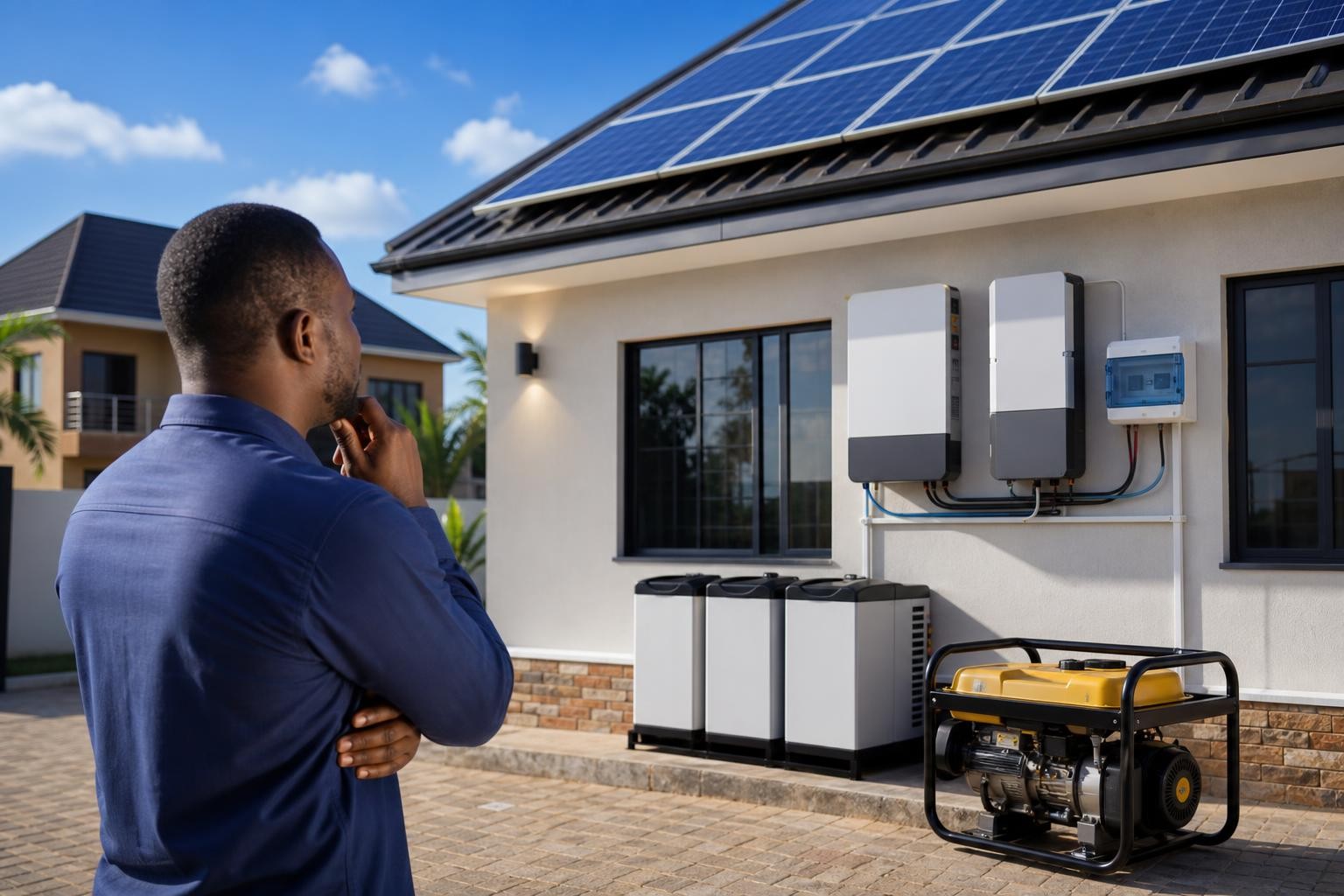
You can often reduce generator use substantially without trying to run every appliance from solar. The practical target is usually a hybrid system: solar panels supply daytime loads and recharge the battery, the battery carries selected loads when the sun is gone, and the generator remains available for heavy appliances, long cloudy periods or an unusually large outage.
There is no honest single percentage that applies to every Nigerian home or business. The amount of generator use you can remove depends on four things: the energy your appliances use, when you use them, the solar energy available at the site, and the usable battery capacity. The right way to estimate it is to measure your present generator hours and energy first, then compare that baseline with the load your proposed solar-and-battery system can actually carry.
In simple terms: solar can eliminate generator hours when it powers the load directly or when it stores enough energy for later. It cannot eliminate generator use for loads that are larger than the inverter, run longer than the battery can support, or need more energy than the panels can replace.
What does “eliminate generator use” mean?
People use the phrase in three different ways. Keep them separate when comparing a quotation or judging whether a system is working.
- Generator runtime: how many hours the generator runs.
- Generator energy: how many kilowatt-hours the generator actually supplies.
- Generator fuel and maintenance: how much fuel, oil and running maintenance you avoid.
These measures do not always move together. A solar system may remove many quiet evening hours while the generator is still used for a short period to run a pump, freezer, iron or other high-power load. Conversely, a smaller number of generator hours may supply a large amount of energy if the remaining loads are heavy.
Start with a two-week generator baseline
Before asking an installer for a system size, record what happens now. A short log is more useful than saying, “The generator runs almost every day.” Track at least two weeks, and longer if your power supply changes between weekdays and weekends.
| Record | What to write down |
|---|---|
| Generator start and stop time | How long it ran for each session |
| Appliances used | Lights, fans, fridge, freezer, pump, television, office equipment and heavy loads |
| Approximate load | Inverter or plug-in meter reading if available; otherwise use appliance nameplate values as an estimate |
| Fuel added | Litres added and the date, without mixing different generator sizes in one total |
| Reason for running | Night backup, pumping water, refrigeration, business operation, charging phones or another need |
| Grid condition | Whether the generator replaced a short outage or a long period without public supply |
Also note which appliances you would be willing to stop using during an outage. A system designed for lights, fans, internet, charging, security equipment and refrigeration is a different project from one designed to run air conditioners, electric cookers, pressing irons, water heaters and borehole pumps.
Use two calculations, not one
Once you have a baseline, calculate both the runtime reduction and the energy reduction.
Generator runtime reduction (%)
(baseline generator hours − new generator hours) ÷ baseline generator hours × 100
Generator energy reduction (%)
(baseline generator kWh − new generator kWh) ÷ baseline generator kWh × 100
If you do not have an energy meter, estimate generator energy like this:
average load in kW × generator operating hours = estimated energy in kWh
This is only an estimate. A generator’s fuel consumption is not fixed because loading, generator size, condition and maintenance all affect it. Measure litres per week before and after the installation if fuel saving is important to your decision.
How solar and batteries remove generator hours
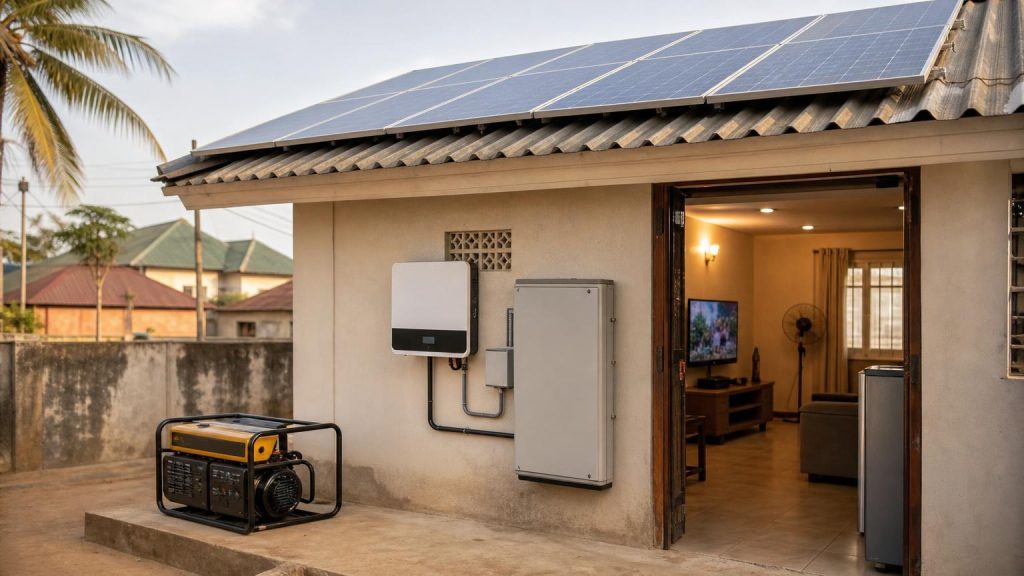
A hybrid system reduces generator use through three separate jobs.
1. Solar panels supply daytime loads directly
When the panels are producing enough power, the inverter can use that energy for appliances instead of starting the generator. This works best when some of your electricity use happens during daylight: office equipment, point-of-sale equipment, fans, refrigeration, networking equipment, pumping or other planned loads.
Panel nameplate wattage is not the same as the energy you will receive every day. Clouds, rain, dust, heat, shading, orientation, wiring losses and the inverter’s solar-input limits affect actual output. Solar energy production also changes with the weather and time of day, so do not size a system from panel watts alone.
2. The battery carries selected loads later
The battery lets solar energy produced in the afternoon support loads in the evening or during a night outage. Battery capacity is an energy question, measured primarily in kWh for lithium batteries. The inverter’s output rating is a power question: it must be able to run the appliances at the same time and handle starting demand from motors and compressors.
For tubular, GEL and AGM batteries, use Ah together with voltage. For example, a 24 V 200 Ah bank has about 4.8 kWh of nominal energy before considering the recommended depth of discharge, inverter losses, battery age and the discharge rate. Do not compare a lithium battery and a lead-acid battery by Ah alone.
3. Load control keeps the generator for the difficult jobs
A hybrid system becomes more useful when it has a clear priority list. Keep essential loads on the battery, shift flexible loads to daylight, and reserve the generator for loads that the inverter or battery should not carry continuously.
That may mean using solar and battery for lights, fans, router, phone charging, television, security equipment and a carefully checked refrigerator, while using the generator only when you need a pump, heavy workshop equipment, an air conditioner or a long recharge after several poor-weather days.
A worked example for a Nigerian home
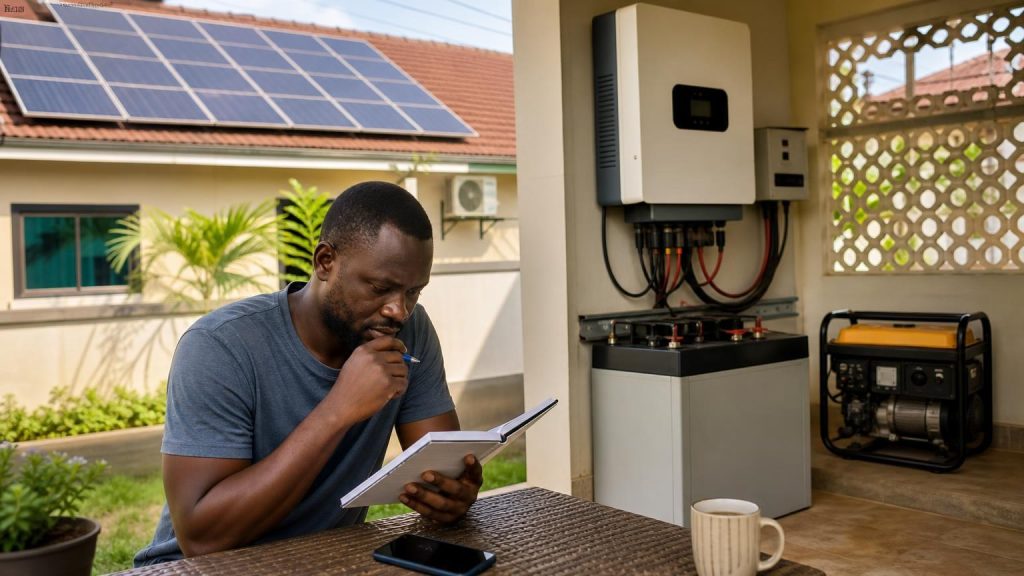
Consider this example. It is a planning illustration, not a promise about every home.
Before solar:
- The generator runs for 30 hours per week.
- The average electrical load while it is running is about 1.2 kW.
- Estimated generator energy is therefore 30 × 1.2 = 36 kWh per week.
After installing a hybrid system:
- Solar and battery handle lights, fans, internet, charging, television and a selected refrigerator load.
- The generator runs for 10 hours per week for a pump and heavier appliances.
- The remaining generator load averages 1.5 kW, so estimated generator energy is 10 × 1.5 = 15 kWh per week.
In this example:
- Runtime reduction: (30 − 10) ÷ 30 = about 67%.
- Estimated generator-energy reduction: (36 − 15) ÷ 36 = about 58%.
The fuel reduction may be different from 58% because the generator is now running at a different load. The sensible way to validate the result is to compare litres used per week over similar periods, while recording unusual events such as long rain, visitors, a business change or a failed appliance.
What determines whether your result is closer to 30% or 80%?
Your load profile
A home that mainly needs lights, fans, internet and charging is easier to support than a home that runs multiple air conditioners, pumps, freezers and heating appliances. The important number is not the number of rooms. It is the power and energy of the appliances you want to use during an outage.
Your daytime energy use
Using appliances while the sun is available reduces the amount that must pass through the battery. If every major load happens at night, you need more usable storage and a larger solar array to recharge it.
Your usable battery capacity
A battery’s advertised capacity is not always the amount you should plan to deliver to your appliances. Charging and conversion losses, recommended depth of discharge, temperature, age and the battery management system all matter. Oversizing the inverter without enough usable battery energy will not create longer backup.
Your solar recovery capacity
The system must replace the energy it used. If the panels only cover today’s daytime load but cannot recharge the battery for tonight, generator use will return quickly. Dust and Harmattan, shading, rain and poor orientation can reduce the energy available for recovery.
Your wet-season and exceptional-load plan
A system designed for normal sunny days may still need generator support during long cloudy or rainy periods. That is not necessarily a design failure. Keeping a generator as a reserve can be more practical and less expensive than sizing the battery and panels for every extreme condition.
How to choose the right target
Instead of asking an installer to “eliminate the generator,” set a clear target:
| Target | What it means | What must be checked |
|---|---|---|
| Quiet essential backup | No generator for lights, fans, internet and charging during ordinary outages | Critical-load watts, battery kWh and night runtime |
| Daytime generator reduction | Solar carries planned daytime work and reduces fuel use | Daytime load, panel output, inverter solar limit and shading |
| Heavy-load support | Generator remains for pump, air conditioner or workshop loads | Generator and inverter compatibility, transfer method and surge demand |
| Near-zero routine generator use | Generator is reserved for prolonged bad weather or unusual demand | Large enough solar array, usable storage, automatic controls and a realistic rainy-season plan |
For many households, the first target gives the best value. Start with the critical appliances rather than paying to back up every load. SolarPriceNG’s guide to keeping only critical appliances running during a blackout explains how to make that list safely.
What to ask for in a hybrid solar quotation
Ask the installer to show the assumptions, not only the inverter brand and battery count.
- Which appliances are included in the backed-up load?
- What is the simultaneous running load in watts?
- Which appliance has the highest starting or surge demand?
- How many usable kWh will the battery provide, and at what discharge limit?
- How much solar energy is expected on ordinary days and during the rainy season?
- What happens when the battery is low?
- Can the inverter accept a generator input, and what does the manufacturer require?
- Are the grid, generator and inverter sources separated through the correct changeover or transfer equipment?
- What will be tested at handover?
If your existing system is not lasting long enough, do not automatically buy a bigger battery. First check whether the problem is excessive load, insufficient solar recovery, poor settings or battery condition. Use Should You Add More Solar Panels or a Bigger Battery First in Nigeria? and Why Is My Solar Battery Draining So Fast? as practical checks.
Safety: do not improvise the generator connection
A hybrid solar system may involve several power sources: public supply, solar PV, battery and generator. They must not be joined through a homemade cable or by feeding a generator or inverter into a wall socket.
Use the connection method specified by the inverter and generator manufacturers. A permanent installation should have correctly rated protection, isolators, cables, earthing and a properly designed changeover or transfer arrangement. The transfer equipment must prevent incompatible sources from being connected together. A qualified installer should verify the backup circuits and test the system before handover.
The U.S. Consumer Product Safety Commission’s transfer-switch guidance illustrates the basic safety principle: the backed-up circuits are connected through a transfer arrangement so that the household wiring is not supplied by incompatible sources at the same time. The exact equipment for a Nigerian installation must follow the applicable local requirements and the manufacturer’s instructions.
A sensible way to reduce generator use in stages
- Measure the baseline. Record generator hours, loads and fuel for at least two weeks.
- Choose critical loads. Keep the first system focused on appliances that matter most.
- Move flexible use to daylight. Charge devices and run planned loads when solar is available.
- Size the inverter for power. Include simultaneous running watts and starting demand.
- Size the battery for energy. Use usable kWh for lithium or Ah together with voltage for lead-acid types.
- Size the panels for recovery. They must power daytime loads and replace the battery energy you use.
- Keep the generator as reserve. Use it for exceptional weather, heavy loads or emergency recharge unless a larger off-grid design is justified.
- Measure after installation. Compare generator hours, estimated kWh and litres used with the same baseline period.
If you are still deciding how much of the house to support, start with How Much Solar Power Do I Need to Run My House in Nigeria? For a quote, compare the equipment scope and protection rather than choosing the lowest total alone; see How Can I Compare Two Solar Installation Quotes in Nigeria?.
Bottom line
You do not need to go fully off-grid to make a meaningful reduction in generator use. A properly sized hybrid system can remove generator hours by powering selected loads during the day, storing solar energy for the evening and keeping heavy or exceptional loads under control.
Calculate the result from your own baseline. Track both generator hours and estimated energy, because a system can reduce runtime and energy by different amounts. Be honest about cloudy weather, Harmattan dust, battery limits, motor starting demand and the appliances you are unwilling to switch off. In many cases, the best first design is not “solar for everything”; it is solar and battery for the important loads, with the generator retained as a safe reserve.
Technical references
- U.S. Department of Energy: Solar Integration and Solar Energy Storage Basics — explains the difference between storage energy capacity and power capacity, and why solar output varies with conditions.
- U.S. Consumer Product Safety Commission: Typical Transfer Switch Setup for a Portable Generator — illustrates safe separation of utility, generator and backed-up circuits.
- Nigerian Electricity Regulatory Commission FAQs — background on service-based supply bands and customer electricity issues in Nigeria.