
If you are planning to buy a battery for your solar or inverter system, you will likely come across two popular choices: lithium batteries and tubular batteries.
Both can store energy for use when there is no electricity from the grid or enough sunlight from your solar panels.
But they are different in price, lifespan, maintenance, charging speed and how much of the stored energy you can normally use.
So, which one is better?
For most people who want a solar system for long-term and frequent use, lithium is usually the better choice if the higher initial cost is within your budget.
However, tubular batteries can still be a good option when keeping the initial cost low is more important.
Let’s compare them.
Lithium vs Tubular Battery at a Glance
| Feature | Lithium Battery | Tubular Battery |
|---|---|---|
| Initial cost | Higher | Lower |
| Usable capacity | Higher | Lower |
| Charging speed | Faster | Slower |
| Maintenance | Very low | Higher |
| Weight | Lighter | Heavier |
| Cycle life | Generally higher | Generally lower |
| Daily cycling | Very suitable | Suitable with proper use |
| Space required | Less | More |
| Best for | Long-term frequent use | Lower initial budget |
These are general differences. Actual performance depends on the battery brand, model, specifications, installation and how the battery is used.
What Is a Lithium Battery?
Most modern solar lithium batteries use LiFePO4 (Lithium Iron Phosphate) technology.
They are designed to store electricity and provide power when your solar panels or the electricity grid cannot supply your appliances.
One of the biggest advantages of lithium is that you can normally use a larger percentage of its rated capacity compared with traditional lead-acid batteries.
Many lithium batteries also have a Battery Management System (BMS) that helps monitor and protect the battery.
This is one reason lithium batteries have become common in modern solar installations.
What Is a Tubular Battery?
A tubular battery is a type of deep-cycle lead-acid battery commonly used for inverter and solar systems.
They are popular in Nigeria because they are generally cheaper to buy than an equivalent lithium battery.
Tubular batteries can provide good backup when properly sized and maintained.
However, flooded tubular batteries usually require more maintenance than lithium batteries. Depending on the battery design, this can include checking the electrolyte level and adding distilled water as recommended by the manufacturer.
They are also heavier and usually require more physical space.
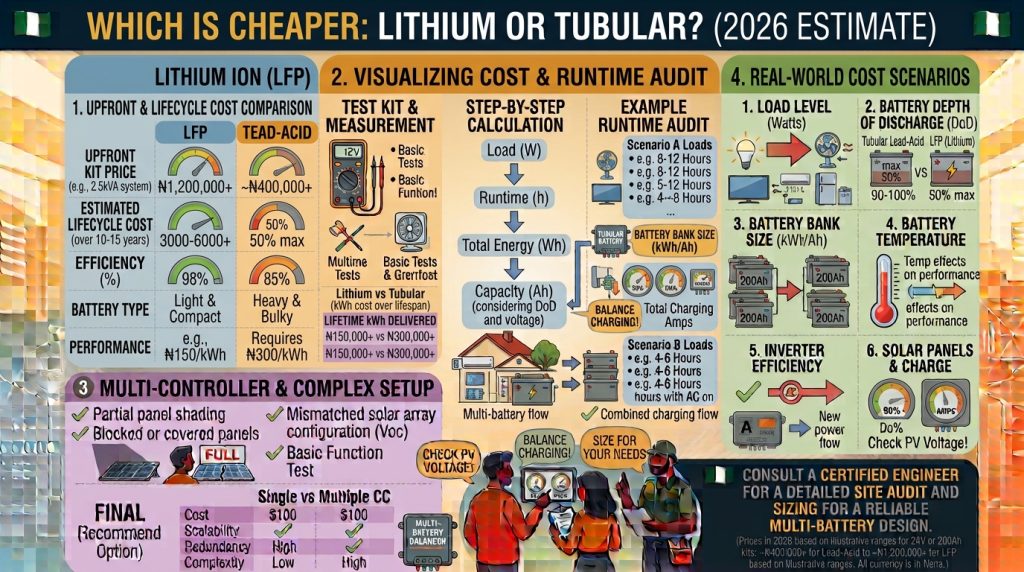
Which Is Cheaper: Lithium or Tubular?
Tubular is usually cheaper to buy.
This is one of the main reasons people choose tubular batteries.
If your budget is limited, tubular batteries can allow you to build a battery backup system without spending as much money at the beginning.
Lithium batteries normally have a higher upfront cost.
But the purchase price is not the only thing you should consider.
A battery can be cheaper today but cost more over several years if it needs to be replaced more often.
You should consider:
- Initial price
- Usable capacity
- Cycle life
- Maintenance
- Charging efficiency
- Replacement cost
- How often you will use the battery
For current estimated battery prices in Nigeria, you can check our Solar Prices in Nigeria page.
Which Battery Gives More Usable Energy?
Lithium usually gives you more usable energy from the same nominal capacity.
Battery capacity can be shown in Ah (amp-hours) or kWh (kilowatt-hours).
For example:
12V × 200Ah = 2,400Wh
That is:
2.4kWh
But you should not assume that the entire 2.4kWh should be used regularly.
The amount of energy you can safely use depends on the battery technology and the manufacturer’s recommended depth of discharge.
Lithium batteries can generally be discharged more deeply than traditional lead-acid batteries.
For simple planning, you may see figures such as:
- Lithium: around 80–90% usable capacity
- Lead-acid/tubular: around 50% usable capacity
The actual recommended value depends on the battery manufacturer and model.
This is why two batteries with the same Ah rating may not provide the same amount of useful energy.
You can read more about this in our guide on How Many Batteries Do I Need for a Solar System in Nigeria?.
Which Battery Charges Faster?
Lithium usually charges faster.
Lithium batteries generally accept charge more efficiently and can often be charged faster than tubular batteries when the battery and inverter support the required charging rate.
This can be useful when you have limited sunlight available to recharge your battery.
For example, if your battery was heavily discharged overnight, you want your solar panels to put enough energy back into the battery during the available sunlight hours.
However, you should always check the manufacturer’s charging specifications.
Do not assume every lithium battery can be charged at the same speed.
Which Battery Requires More Maintenance?
Lithium requires less maintenance.
This is another major advantage of lithium batteries.
A flooded tubular battery may require regular checks and distilled water according to the manufacturer’s instructions.
You also need to make sure the battery terminals and surrounding area are kept in good condition.
Lithium batteries generally do not require this type of routine maintenance.
However, low maintenance does not mean you can install a lithium battery carelessly.
You still need:
- Correct inverter settings
- Correct charging voltage
- Proper cables
- Proper protection
- Correct battery sizing
- Suitable installation conditions
Which Battery Lasts Longer?
Lithium generally lasts longer.
Battery lifespan depends on several factors, including:
- Number of charge and discharge cycles
- Depth of discharge
- Temperature
- Charging conditions
- Battery quality
- How the battery is used
Quality lithium batteries generally have a much higher cycle-life rating than traditional lead-acid batteries.
Tubular batteries can also last for several years when properly installed, charged and maintained.
But frequent deep discharge and poor charging can shorten the life of a lead-acid battery.
This is why you should look at the cycle-life rating when comparing batteries instead of looking only at the purchase price.
Which Is Better for Frequent Power Outages?
Lithium is usually the better choice.
If your battery is being charged and discharged almost every day, cycle life becomes very important.
For example, someone who uses solar every night will put much more demand on a battery than someone who only uses backup power occasionally.
For frequent daily use, the longer cycle life and higher usable capacity of lithium can make the higher initial cost easier to justify.
When Does a Tubular Battery Make Sense?
Tubular batteries still have their place.
A tubular battery may make sense if:
- Your initial budget is limited
- You want a lower-cost backup system
- Your battery will not be heavily cycled every day
- You are comfortable with regular maintenance
- You have enough space for the battery bank
- You understand the limitations of lead-acid batteries
The important thing is to use a battery designed for solar or deep-cycle applications.
A normal car battery is designed mainly for starting an engine and should not be treated as a direct replacement for a solar deep-cycle battery.
When Should You Choose Lithium?
Lithium is usually a better choice if:
- You want a system for long-term use
- You use the battery frequently
- You want less maintenance
- You want more usable energy
- You want faster charging
- You want a smaller and lighter battery bank
- You can afford the higher initial cost
For a new solar installation that will be used regularly, I would generally choose a quality LiFePO4 battery when the budget allows it.
Lithium vs Tubular: Which One Should You Buy?
The simple answer is:
Choose tubular if your main concern is initial cost.
Tubular batteries are generally cheaper to buy and can provide reliable backup when properly sized and maintained.
Choose lithium if you want better long-term value.
Lithium normally costs more at the beginning, but its longer cycle life, higher usable capacity, lower maintenance and faster charging can make it a better choice for frequent use.
Don’t Choose a Battery by Ah Alone
This is one of the biggest mistakes people make when buying batteries.
Someone may tell you:
“This is a 200Ah battery.”
But that information alone is not enough.
You also need to know:
- Battery voltage
- Battery chemistry
- Usable capacity
- Depth of discharge
- Cycle life
- Maximum charging current
- Maximum discharge current
- Warranty
- Inverter compatibility
For example:
12V 200Ah
12 × 200 = 2.4kWh
24V 200Ah
24 × 200 = 4.8kWh
48V 200Ah
48 × 200 = 9.6kWh
All three are called 200Ah, but they do not store the same amount of energy.
This is why comparing batteries using only Ah can be misleading.
How Much Battery Do You Actually Need?
Before deciding between lithium and tubular, first calculate the amount of energy your appliances require.
Think about the appliances you want to power:
- Lights
- Fans
- TV
- Decoder
- Refrigerator
- Freezer
- Router
- Laptop
- Water pump
- Air conditioner
- Other appliances
Then decide how many hours you want them to run during an outage.
Our Battery Calculator can help you estimate the battery capacity you may need based on your appliances and backup requirement.
You can also use the Inverter Calculator to estimate the inverter size and the Solar Panel Calculator to estimate the solar panel capacity needed for your system.
Lithium vs Tubular Battery: Simple Comparison
| If your priority is… | Better option |
|---|---|
| Lower initial cost | Tubular |
| Long-term use | Lithium |
| Frequent daily cycling | Lithium |
| Low maintenance | Lithium |
| Higher usable capacity | Lithium |
| Faster charging | Lithium |
| Lighter battery bank | Lithium |
| Lower upfront investment | Tubular |
| Long-term value | Lithium |
Final Verdict
If you are building a solar system that you plan to use regularly for many years, a quality lithium battery is generally the better option if you can afford the initial cost.
It gives you higher usable capacity, longer cycle life, faster charging and much less routine maintenance.
However, tubular batteries are still useful when your main concern is reducing the initial cost of your solar installation.
So don’t simply ask:
“Which battery is cheaper?”
Ask:
“Which battery gives me the best value for the way I will use my solar system?”
Before buying, calculate your energy requirement and check the battery’s voltage, usable capacity, cycle life, warranty and compatibility with your inverter.
You can also check our Solar Prices in Nigeria page to see current estimated prices for lithium, tubular, GEL batteries, solar panels, inverters and other solar equipment.
Frequently Asked Questions
Is lithium better than tubular for solar?
For most frequently used solar systems, lithium is generally the better option because it offers higher usable capacity, longer cycle life, faster charging and lower maintenance. Tubular can still be a good choice when the initial budget is more important.
Is tubular battery cheaper than lithium?
Yes. Tubular batteries generally have a lower upfront purchase price than lithium batteries. However, you should also consider lifespan, maintenance and usable capacity when comparing the total cost.
Can I replace my tubular batteries with lithium?
In many cases, yes, but you should first confirm that your inverter or charger supports the lithium battery’s charging requirements. The battery voltage, charging settings, BMS and communication requirements should also be checked.
Can I mix lithium and tubular batteries?
You should not mix lithium and tubular batteries in the same battery bank unless the manufacturer specifically supports the setup. They have different charging and discharge characteristics.
Which battery is better for a 5kVA inverter?
A 5kVA inverter does not automatically tell you which battery you need. The correct battery capacity depends on your appliances, backup time, battery voltage and the inverter’s specifications.
Use our Battery Calculator to estimate your battery requirement.
How long does a lithium battery last?
The lifespan depends on the battery model, cycle count, depth of discharge, temperature, charging conditions and usage. Always check the manufacturer’s cycle-life rating and warranty.
How long does a tubular battery last?
The lifespan depends on battery quality, maintenance, depth of discharge, charging and temperature. Proper use and maintenance can significantly affect how long the battery lasts.
Plan Your Solar System
Before buying any equipment, use our free tools to estimate what your system may need:
Battery Calculator— Estimate your battery capacity.
Inverter Calculator — Estimate your inverter size.
Solar Panel Calculator — Estimate the solar panel capacity and number of panels.
Solar Installation Cost Calculator — Estimate the likely cost of installing your solar system.
You can also check Solar Prices in Nigeria for current estimated market prices.
Prices and specifications can change. Always confirm the final price, warranty and technical specifications with the seller or manufacturer before purchasing.