Last updated: August 2026
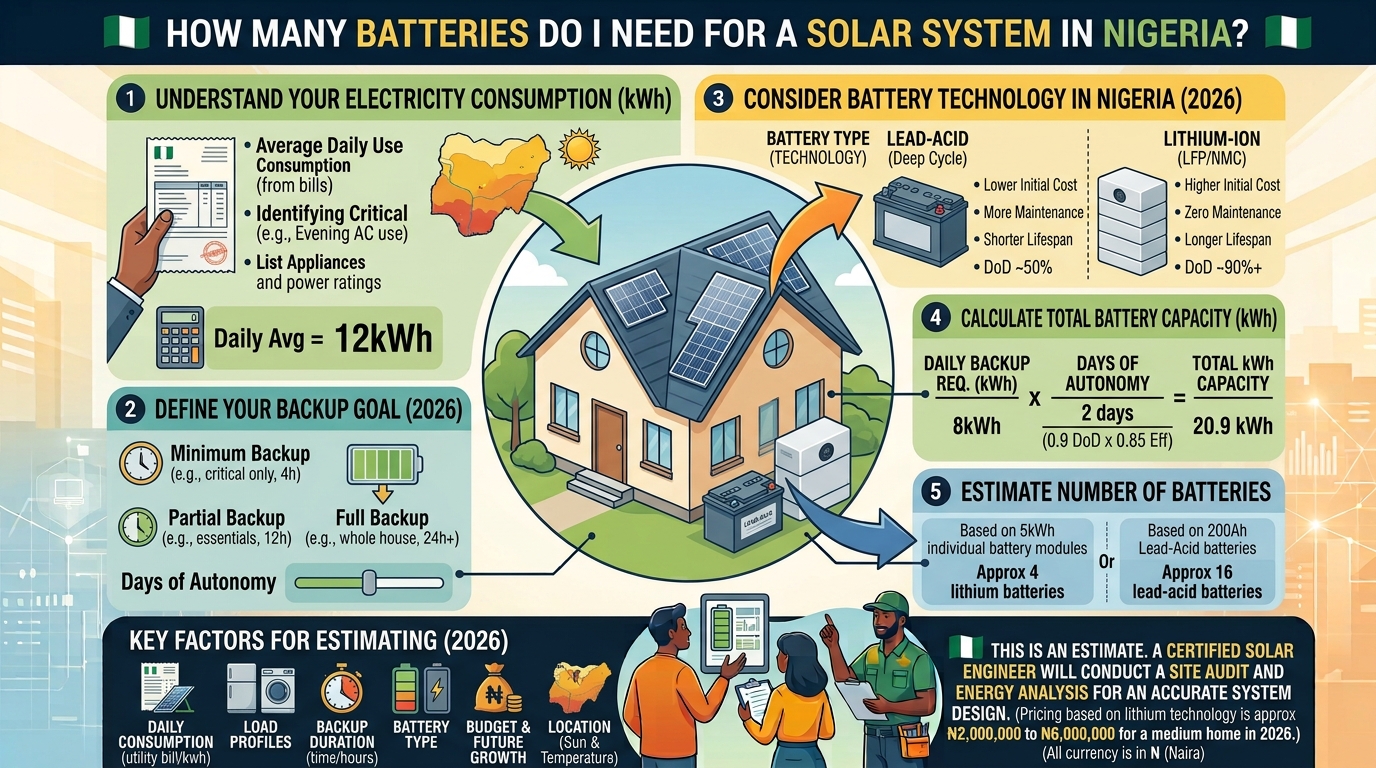
One of the most common questions people ask when planning a solar system is: How many batteries do I need for my inverter or solar system?
The answer is not simply “2 batteries” or “4 batteries.”
The number of batteries you need depends on:
- Your appliance load
- How many hours of backup you want
- Battery voltage
- Battery capacity
- Battery type
- Depth of discharge
- Inverter efficiency
- Your inverter’s battery-voltage requirement
This is why two people with the same 5kVA inverter can need completely different battery sizes.
For example, one person may only want to power lights, fans and a TV, while another may want to run a refrigerator, freezer, air conditioner and water pump.
The inverter size tells you how much power the system can supply. The battery size tells you how much energy you can store.
How Many Batteries Do I Need?
There is no fixed number.
As a simple example, a 48V inverter using traditional 12V batteries will normally require:
4 × 12V batteries = 48V
But that does not mean four batteries will automatically give you enough backup.
You also need to consider the battery’s Ah capacity.
For example:
4 × 12V 200Ah batteries
are very different from:
4 × 12V 100Ah batteries.
Both have four batteries, but the first bank has twice the nominal energy capacity.
How Do I Calculate the Number of Batteries?
A simple battery-sizing process is:
Step 1: Find your load
Add the power of the appliances you want to run.
For example:
- TV = 100W
- 2 fans = 150W
- Lights = 60W
- Refrigerator = 150W
- Router = 15W
Total:
475W
Step 2: Decide how many hours of backup you need
Suppose you want:
8 hours
of backup.
Your basic energy requirement becomes:
475W × 8 hours = 3,800Wh
or:
3.8kWh
Step 3: Account for losses
The inverter and battery system are not 100% efficient.
So you need more battery capacity than the simple 3.8kWh calculation suggests.
Step 4: Consider depth of discharge
You should not assume that all of a battery’s rated capacity is available for use.
Lithium and lead-acid batteries have different recommended usable capacities.
Step 5: Select the battery
Once you know the required battery capacity, you can determine how many batteries or battery modules are needed.
Our Battery Calculator can make this calculation easier.
Battery Capacity Is More Important Than Battery Count
This is one of the most important things to understand.
Imagine you have:
2 × 12V 200Ah batteries
The nominal energy is:
12V × 200Ah × 2 = 4,800Wh
or:
4.8kWh
Now imagine you have:
4 × 12V 100Ah batteries
Their nominal energy is:
12V × 100Ah × 4 = 4,800Wh
Again:
4.8kWh
So although one system has two batteries and the other has four, both have the same nominal energy capacity.
This is why you should not ask only:
“How many batteries do I need?”
A better question is:
“How much battery capacity do I need?”
How Many Batteries Do I Need for a 1kVA Inverter?
A small 1kVA inverter may use a 12V or 24V battery system, depending on the model.
For example, a 12V system could use:
1 × 12V battery
while a 24V system could use:
2 × 12V batteries
in series.
But the number of batteries also depends on how much backup you want.
A system powering only:
- LED bulbs
- TV
- router
- decoder
- small fan
may need much less battery capacity than a system powering a refrigerator and other appliances.
Always check the inverter’s required battery voltage before buying batteries.
How Many Batteries Do I Need for a 2kVA Inverter?
A 2kVA inverter may use a:
- 12V
- 24V
- or sometimes another battery configuration
depending on the exact model.
For a 24V system using 12V batteries, you need at least:
2 × 12V batteries
to create the required 24V battery bank.
But you could need more batteries if you want greater backup capacity.
For example, two 12V 200Ah batteries provide a very different backup time from two 12V 100Ah batteries.
How Many Batteries Do I Need for a 3kVA Inverter?
Many 3kVA systems use 24V battery banks, although the exact requirement depends on the inverter.
A 24V system using 12V batteries would require:
2 batteries in series
to reach 24V.
For example:
2 × 12V 200Ah = 24V 200Ah
The energy is:
24 × 200 = 4,800Wh
or:
4.8kWh
If you need more energy storage, additional compatible batteries can be added in parallel where the inverter and battery system support it.
How Many Batteries Do I Need for a 5kVA Inverter?
This is one of the most common questions in Nigeria.
Many modern 5kVA solar inverters use a 48V battery bank, although you should always check the exact model before buying. Current Nigerian guides also commonly describe 48V as the standard arrangement for many 5kVA systems.
If you are using 12V batteries:
4 × 12V = 48V
So you may need at least four 12V batteries to create the required voltage.
But again, four batteries do not automatically mean good backup.
For example:
4 × 12V 200Ah tubular batteries
Nominal capacity:
48V × 200Ah = 9.6kWh
4 × 12V 100Ah batteries
Nominal capacity:
48V × 100Ah = 4.8kWh
The first system has twice the nominal energy.
How Many Lithium Batteries Do I Need for a 5kVA Inverter?
Lithium batteries are often sold differently from traditional 12V lead-acid batteries.
You may see:
- 12V 100Ah
- 12V 200Ah
- 24V 100Ah
- 48V 50Ah
- 48V 100Ah
- 48V 200Ah
- 5kWh
- 10kWh
For example, a:
48V 100Ah lithium battery
has approximately:
48 × 100 = 4,800Wh
or:
4.8kWh
A:
48V 200Ah
battery has:
9.6kWh
So a 5kVA inverter could potentially use one 48V 100Ah battery, two, three or more depending on the load and desired backup.
The inverter rating alone cannot tell you the correct number.
How Many Batteries Do I Need for 8 Hours of Backup?
Let’s use a simple example.
Suppose your average load is:
1,000W
and you want:
8 hours
of backup.
Energy required:
1,000 × 8 = 8,000Wh
or:
8kWh
You then need to account for inverter losses and the amount of battery capacity you can safely use.
For lithium, if you plan around 90% usable capacity, the required installed capacity would be roughly:
8kWh ÷ 0.90 = 8.9kWh
before allowing for inverter losses.
So a battery around:
9.6kWh
could be a reasonable starting point for this example.
But actual sizing should use your real load and the manufacturer’s specifications.
Lithium vs Tubular Battery Capacity
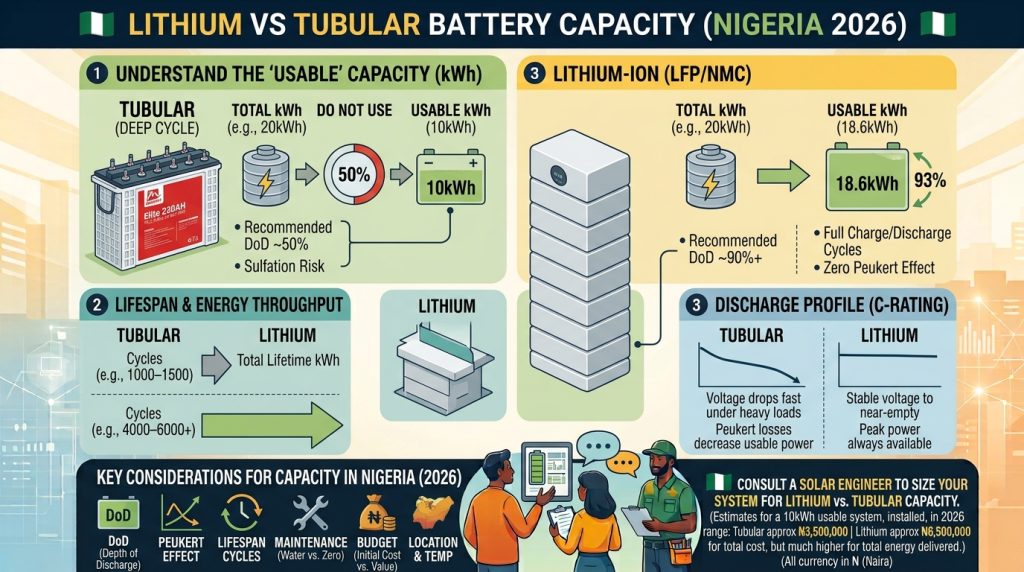
Battery chemistry makes a big difference.
A lithium battery can normally be discharged more deeply than a traditional lead-acid battery.
For simple planning, you might see figures such as:
Lithium: around 80–90% usable capacity
Lead-acid/tubular: around 50% usable capacity
The exact recommended value depends on the manufacturer and battery model.
For example, suppose you need about 5kWh of usable energy.
A simplified calculation could look like:
Lithium
5kWh ÷ 0.90 ≈ 5.6kWh installed
Lead-acid
5kWh ÷ 0.50 = 10kWh installed
This helps explain why lithium systems can require less nominal battery capacity to provide the same usable energy.
Current battery-sizing guidance also uses load, backup hours, system voltage, inverter efficiency and depth of discharge as the key inputs.
How Many 200Ah Batteries Do I Need?
This depends on the system voltage.
For example:
12V 200Ah
Energy:
12 × 200 = 2.4kWh
24V 200Ah
Energy:
24 × 200 = 4.8kWh
48V 200Ah
Energy:
48 × 200 = 9.6kWh
This is why saying:
“I need a 200Ah battery”
is not enough.
You need to know the voltage as well.
12V vs 24V vs 48V Battery Systems
The higher the system voltage, the less current is needed for the same amount of power.
For example, a 2,400W load would theoretically draw:
2,400W ÷ 12V = 200A
At 24V:
2,400W ÷ 24V = 100A
At 48V:
2,400W ÷ 48V = 50A
This is one reason larger solar systems commonly use higher battery voltages.
However, you should never change the battery voltage simply because a higher voltage looks better.
The inverter determines the required battery voltage.
Series vs Parallel Batteries
This is another area that confuses many buyers.
Series connection
Connecting batteries in series increases voltage.
For example:
2 × 12V 200Ah
in series becomes:
24V 200Ah
The Ah rating remains 200Ah.
Parallel connection
Connecting batteries in parallel increases capacity while keeping the voltage the same.
For example:
2 × 12V 200Ah
in parallel becomes:
12V 400Ah
You need to follow the battery and inverter manufacturer’s instructions when designing these connections.
Can I Add More Batteries Later?
Sometimes yes.
But you should plan for expansion before buying your system.
Check whether:
- the inverter supports additional battery capacity
- the battery supports expansion
- the batteries can be connected in parallel
- the batteries are compatible
- the manufacturer allows the planned configuration
You should also avoid mixing batteries that are very different in:
- age
- capacity
- chemistry
- model
- condition
A properly designed battery bank should use compatible batteries.
How Long Will My Battery Last?
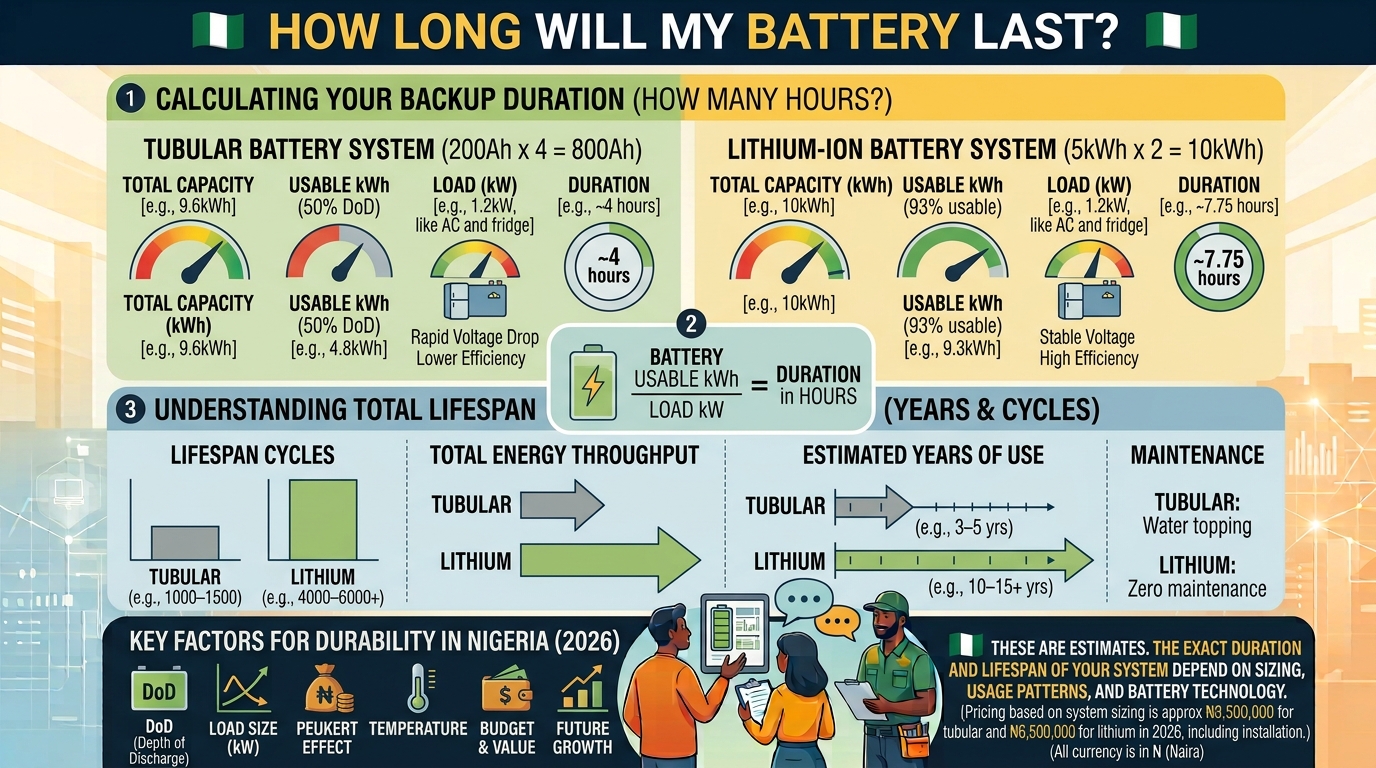
Battery runtime depends on your load.
For example, suppose you have a battery bank with:
5kWh usable energy
and your average load is:
500W
A simple estimate is:
5,000Wh ÷ 500W = 10 hours
If the load increases to:
1,000W
then:
5,000Wh ÷ 1,000W = 5 hours
This is only a simple estimate.
Real runtime will be affected by inverter efficiency, battery condition, temperature, battery discharge limits and changes in appliance load.
What Happens If Your Battery Is Too Small?
An undersized battery can cause:
- short backup time
- frequent deep discharge
- battery stress
- reduced battery life
- inability to run important appliances
- frequent switching back to grid or generator
For example, buying a 5kVA inverter does not mean that you automatically have enough battery to run a 5kW load for several hours.
The battery must be sized for the actual energy requirement.
What Happens If Your Battery Is Too Large?
A larger battery is not necessarily bad.
It can provide longer backup.
However, you also need enough solar charging capacity to recharge it.
For example, installing a very large battery bank while using a very small solar array can mean that the battery takes too long to recharge.
This is why:
Inverter + battery + solar panels
should be designed as one system.
Use our Solar Panel Calculator to estimate the solar capacity needed to recharge your battery.
How Many Batteries Do I Need for a House?
Don’t start with the number of bedrooms.
Start with your appliances.
For example:
| Appliance | Approx. Power |
|---|---|
| 6 LED bulbs | 60W |
| TV | 100W |
| Decoder | 25W |
| 2 standing fans | 150W |
| Refrigerator | 150W |
| Router | 15W |
| Laptop | 65W |
The total running load is approximately:
565W
But you also need to know how long each appliance runs.
A refrigerator may cycle on and off instead of consuming its full rated wattage continuously.
The same applies to inverter air conditioners.
This is why actual daily energy use is more useful than simply adding the maximum wattage of every appliance.
What Battery Size Do I Need for an Air Conditioner?
An air conditioner can greatly increase your battery requirement.
For example, if an air conditioner uses an average of:
600W
for:
5 hours
the energy used would be:
600 × 5 = 3,000Wh
or:
3kWh
That’s just the air conditioner.
You still have to add your:
- refrigerator
- fans
- lights
- TV
- router
- freezer
- pumps
- other appliances
So adding an air conditioner to a solar system can require a much larger battery bank.
What Battery Size Do I Need for a Refrigerator?
A refrigerator does not normally consume its full rated wattage continuously.
It switches its compressor on and off.
This means you should use a realistic estimate of its energy consumption rather than simply multiplying its maximum wattage by 24 hours.
Also remember that refrigerators have a starting surge.
Your inverter therefore needs to handle the startup load, not just the normal running load.
How Much Does a Solar Battery Cost in Nigeria?
The cost depends heavily on the type and capacity.
You can find batteries ranging from smaller 12V units to large 48V lithium systems.
For current Nigerian price ranges, see our:
You can also read:
How Much Is a Lithium Battery in Nigeria? 2026 Prices by Capacity
and:
Inverter Battery Price in Nigeria: Lithium vs Tubular vs GEL
These pages give you a better idea of the different battery types and capacities available.
How Do I Know the Right Battery for My Inverter?
Before buying, check these specifications:
1. Battery voltage
Does the inverter require 12V, 24V or 48V?
2. Battery capacity
How many Ah or kWh do you need?
3. Maximum charging current
Can the inverter safely charge the battery?
4. Maximum discharge current
Can the battery provide enough current for the inverter and your load?
5. Battery chemistry
Is the inverter compatible with lithium, tubular or another battery type?
6. Communication
Some lithium batteries communicate with compatible inverters through CAN or RS485.
7. Expansion
Can you add another battery later?
Don’t Size Your Battery by Inverter kVA Alone
This is probably the biggest mistake people make.
A:
5kVA inverter
does not automatically require:
4 batteries
or:
6 batteries.
The correct battery size depends on the energy you want to store.
For example, two people can have identical 5kVA inverters.
Person A wants to run:
- lights
- TV
- fans
- router
for 6 hours.
Person B wants to run:
- refrigerator
- freezer
- fans
- TV
- lights
- 1.5HP AC
for 10 hours.
They will need very different battery banks.
Current Nigerian battery-sizing content makes the same point: battery count should be based on actual load, backup time, system voltage and battery characteristics rather than simply the inverter’s kVA rating.
Use Our Battery Calculator
If you don’t want to do all these calculations manually, use our:
Enter your appliances and expected usage, then use the result as a starting point for choosing your battery capacity.
You can then use:
to check the inverter requirement.
And:
to estimate the solar array needed to power the system and recharge the battery.
Finally, our:
Solar Installation Cost Calculator
can help you estimate the overall installation cost.
Final Advice
The right number of batteries is determined by energy requirement, not just inverter size.
The basic process is:
List your appliances → calculate your load → decide backup hours → choose battery voltage → account for usable capacity → choose battery capacity → calculate the number of batteries.
And remember:
A bigger inverter does not automatically mean you need more batteries. A bigger load and longer backup time is what will determine that.
Before buying, make sure the battery is compatible with your inverter and that the entire system is properly designed.
For Nigerian battery prices, visit our Solar Prices in Nigeria page.
You can also continue with:
- How Much Is a Lithium Battery in Nigeria? 2026 Prices by Capacity
- Inverter Battery Price in Nigeria: Lithium vs Tubular vs GEL
- How Much Is a Solar Inverter in Nigeria? Current Prices and Buying Guide
- How Much Is a Solar Panel in Nigeria? 2026 Prices by Wattage
- Solar Installation Cost in Nigeria: 2026 Complete Price Guide
- How Many Solar Panels Do I Need for My House in Nigeria?
- How to Choose the Right Solar System for Your Home in Nigeria