Choosing between a PWM and MPPT solar charge controller can be confusing, especially if you are buying your first solar system.
Both types are designed to control how electricity from your solar panels charges your battery, but they work differently.
The big question is:
Should you buy a cheaper PWM controller or spend more on an MPPT controller?
For many larger solar systems, MPPT is the better choice. But PWM can still make sense for some small and simple systems.
In this guide, we will explain the difference in simple terms and help you decide which one is good for your solar system in Nigeria.
If you don’t know what size controller you need, you can also use our Solar Charge Controller Calculator.
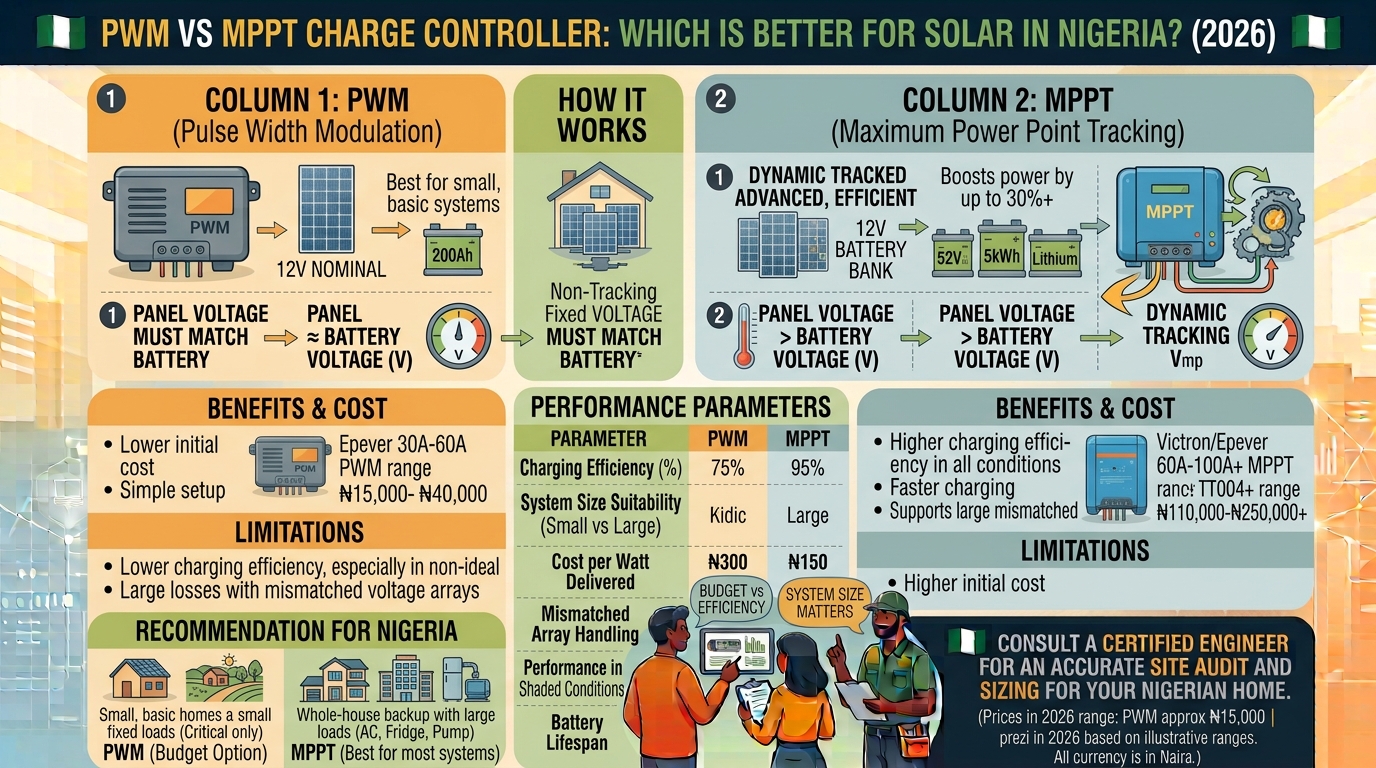
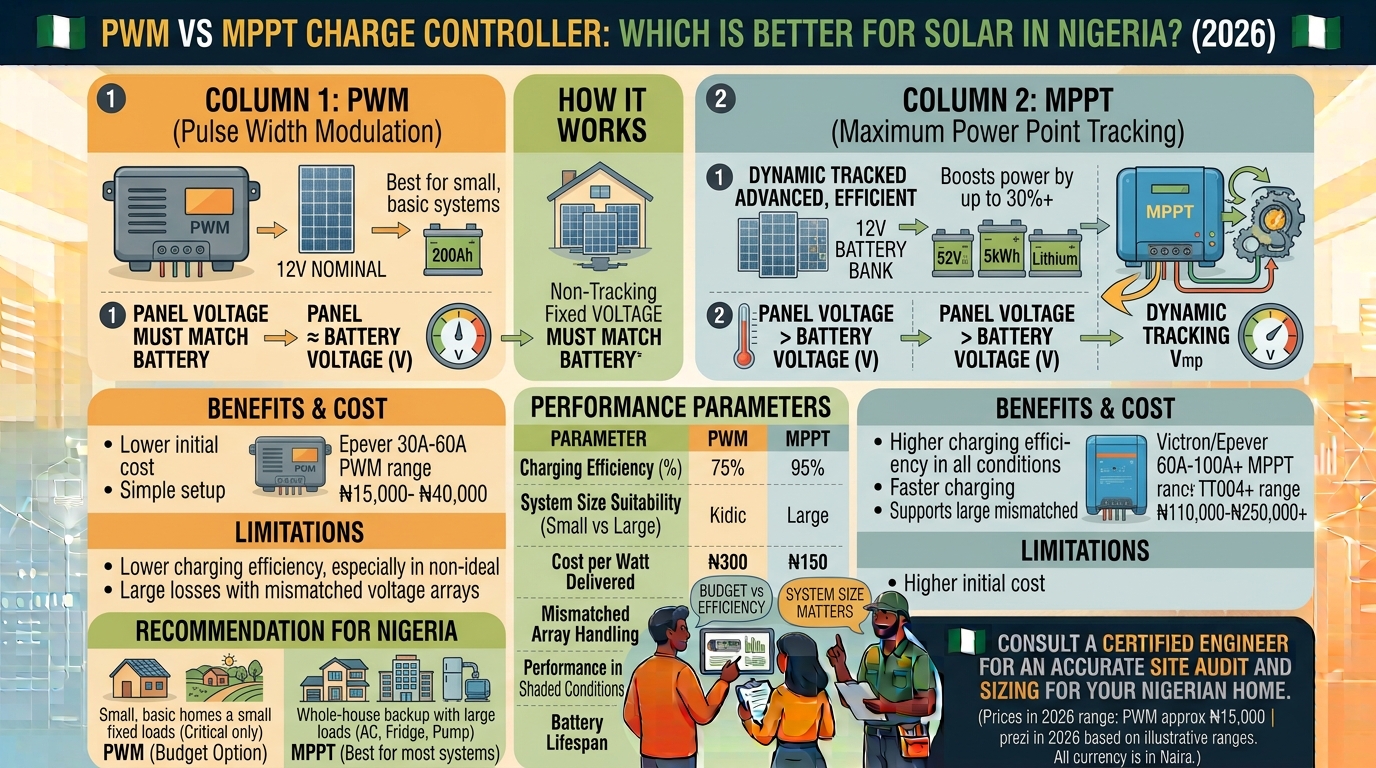
PWM vs MPPT at a Glance
| Feature | PWM | MPPT |
|---|---|---|
| Full name | Pulse Width Modulation | Maximum Power Point Tracking |
| Price | Usually cheaper | Usually more expensive |
| Efficiency | Lower in mismatched systems | Generally higher |
| Small solar systems | Good option | Can also be used |
| Larger solar systems | Less suitable in many setups | Usually better |
| Higher-voltage panels | Limited | Better suited |
| Panel and battery voltage matching | More important | More flexible |
| Series-connected panels | Limited | Better suited |
| Complexity | Simpler | More advanced |
| Best use | Small, budget systems | Medium and larger systems |
The actual performance difference depends on the panel, battery, temperature, wiring and system design. It is not correct to assume that MPPT will always produce a fixed percentage more power.
What Is a PWM Charge Controller?
PWM stands for Pulse Width Modulation.
It is the simpler type of solar charge controller.
A PWM controller regulates the charging process by rapidly switching the connection between the solar panel and battery. In doing so, the solar panel’s operating voltage is pulled closer to the battery voltage.
For example, a typical 12V solar panel can have a working voltage higher than the battery’s charging voltage.
With PWM, much of that extra voltage is not converted into additional charging power.
This is one of the main differences between PWM and MPPT.
What Is an MPPT Charge Controller?
MPPT stands for Maximum Power Point Tracking.
An MPPT controller continuously looks for the operating point where the solar panel can produce the most power.
It then converts that available power into a suitable voltage and current for the battery.
This allows the panel and battery to operate at different voltages. For example, an MPPT controller can allow a higher-voltage solar array to charge a lower-voltage battery while converting the available power appropriately.
This is one reason MPPT controllers are commonly used for larger solar systems.
What Is the Main Difference Between PWM and MPPT?
The easiest way to understand it is this:
PWM
The panel voltage is pulled closer to the battery voltage.
MPPT
The controller can operate the solar panels around their maximum-power point and convert the power to the voltage needed by the battery.
So if your solar panels can produce useful power at a voltage much higher than your battery voltage, an MPPT controller can make better use of that difference.
Is MPPT More Efficient Than PWM?
Generally, yes, especially when the panel voltage is significantly higher than the battery voltage.
But you should be careful with claims such as:
“MPPT is always 30% better.”
There is no single percentage that applies to every solar system.
The difference depends on:
- Solar panel voltage
- Battery voltage
- Temperature
- Sunlight conditions
- Panel configuration
- Wiring
- Controller quality
- System size
In some setups the difference can be significant, while in others it may be much smaller.
Why Can MPPT Produce More Power?
Let’s use a simple example.
Suppose a solar panel is operating around:
18V × 10A = 180W
But your battery is a 12V battery.
A PWM controller may pull the panel’s operating voltage down closer to the battery voltage.
If the panel is effectively operating around 14V while charging, the available charging power can be much lower than the panel’s maximum-power-point output.
An MPPT controller can instead use the higher panel voltage and convert it into additional charging current at the lower battery voltage.
This is the basic reason MPPT can extract more useful energy from the same solar array.
PWM vs MPPT in Nigeria
Nigeria’s climate is an important part of the discussion.
Solar panels operate differently as temperature changes, and panel voltage can fall as panel temperature rises.
This means you should not choose a controller simply by looking at the panel’s advertised wattage.
You should also consider:
- Panel Voc
- Panel Vmp
- Battery voltage
- Controller PV voltage limit
- Panel arrangement
- Temperature
This is especially important when several panels are connected together.
When Should I Use a PWM Charge Controller?
PWM can make sense when:
- You have a small solar system.
- Your budget is limited.
- Your panel voltage is closely matched to your battery voltage.
- You are running simple loads.
- You don’t need the extra flexibility of MPPT.
- The system is properly designed around the PWM controller.
For example, a small setup used mainly for:
- lights
- phone charging
- a small TV
- small fans
may not need an expensive MPPT controller.
PWM controllers are also generally cheaper, which can be important for very small systems.
When Should I Use an MPPT Charge Controller?
MPPT becomes more attractive when:
- Your solar system is larger.
- Your solar panels have a much higher voltage than your battery.
- You want to connect panels in series.
- You want to make better use of available panel power.
- Your solar array is several hundred watts or more.
- You are building a more advanced residential solar system.
For larger installations, MPPT can also make panel wiring easier because higher-voltage panel strings can reduce current for the same amount of power, which can help with cable sizing and voltage drop.
Is PWM Good for a 250W Solar Panel?
It can be.
This is important because not every solar system in Nigeria is a large residential installation.
Small panels such as:
- 100W
- 150W
- 200W
- 250W
are still useful for smaller systems.
If the panel and battery voltage are properly matched, PWM can be a practical low-cost option.
But if you are using a higher-voltage panel or planning to expand the system, MPPT may be a better choice.
Is MPPT Worth It for 500W Solar Panels?
It can be, especially if the panel arrangement and battery voltage create a significant voltage difference.
For example, if you have:
500W of solar panels + 12V battery
the charging current can become quite high.
Moving to a higher battery voltage or using an appropriately sized MPPT controller can make the system easier to manage.
The important thing is to look at the complete system, not just the 500W figure.
What About 1,000W of Solar Panels?
For a 1,000W system, MPPT becomes much more attractive.
Suppose you have:
1,000W solar array
and a:
24V battery bank
A basic current calculation is:
1,000W ÷ 24V = 41.7A
With a planning margin, you may be looking at a controller around 60A, depending on the actual system specifications.
Now imagine trying to handle the same power on a 12V battery system.
The current requirement becomes much higher.
This is one reason larger systems often move toward 24V or 48V battery banks.
You can use our Charge Controller Calculator to estimate the controller size for your own system.
Can MPPT Work With 12V, 24V and 48V Batteries?
Yes, depending on the particular controller.
Many MPPT controllers support multiple battery voltages, such as:
- 12V
- 24V
- 48V
But don’t assume every MPPT controller supports all three.
Always check the specifications before buying.
Can PWM Work With 12V and 24V Batteries?
Yes, many PWM controllers support automatic or selectable 12V and 24V systems.
Some models also support other battery voltages.
Again, check the manufacturer’s specifications.
Can I Connect High-Voltage Solar Panels to a PWM Controller?
This is where you need to be careful.
PWM controllers work best when the solar panel voltage is properly matched to the battery system.
An MPPT controller is generally better suited when you want to use a solar array with a significantly higher voltage than the battery.
Never connect panels to a controller without checking the controller’s maximum PV voltage and the panel’s specifications.
Can I Connect Solar Panels in Series With MPPT?
Yes, this is one of the useful features of MPPT systems.
When panels are connected in series:
Voltage increases while current stays roughly the same.
For example, if one panel has:
40V Vmp
two panels in series could have approximately:
80V Vmp
Three could have approximately:
120V Vmp
But you must also check Voc, especially because the panel’s open-circuit voltage can rise under certain conditions.
The total string voltage must stay within the controller’s maximum PV input.
Can I Connect Solar Panels in Parallel?
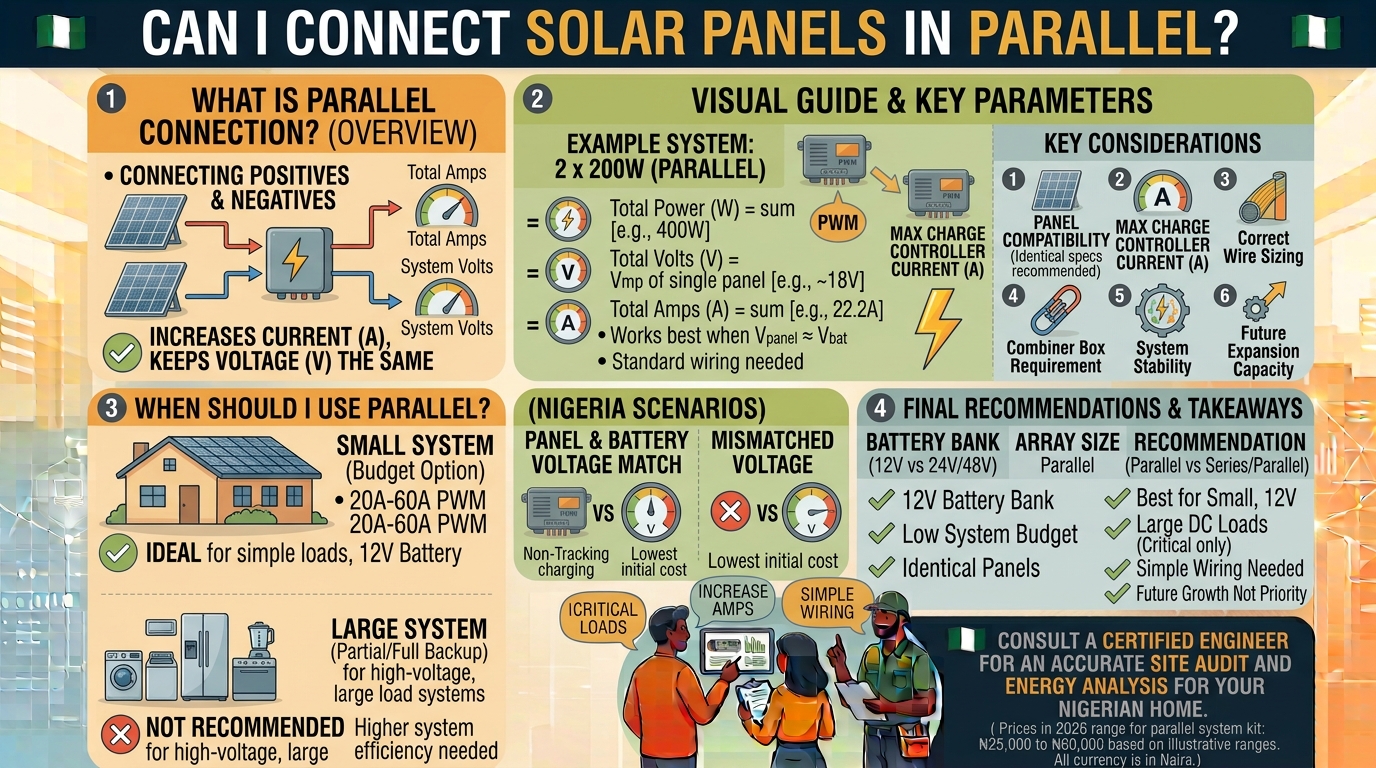
Yes.
When panels are connected in parallel:
Current increases while voltage stays roughly the same.
Both series and parallel connections can be useful.
The best arrangement depends on:
- Panel specifications
- Battery voltage
- Charge controller
- Cable length
- Controller PV voltage limit
- Desired system design
PWM vs MPPT: Which One Is Cheaper?
PWM is normally cheaper.
This is one of its biggest advantages.
Our Solar Prices in Nigeria page includes different charge-controller sizes and types so you can compare estimated Nigerian market prices.
You may find small PWM controllers at relatively low prices, while quality MPPT controllers can cost considerably more.
The price difference is one reason PWM continues to make sense for some small systems.
Is the Cheapest Charge Controller the Best Choice?
No.
A cheap controller can become expensive if it is poorly matched to your system.
Before buying, check:
- Controller type
- Current rating
- Maximum PV voltage
- Maximum PV power
- Battery voltage
- Battery type
- Warranty
- Build quality
Also be careful with very cheap controllers that advertise unusually high amp ratings for their size.
The number printed on the casing is not enough.
How Do I Know Which Charge Controller I Need?
Start with these questions:
1. How many solar panels do I have?
Add the wattage together.
For example:
4 × 250W = 1,000W
2. What battery voltage am I using?
Is it:
12V, 24V or 48V?
3. What type of controller do I want?
PWM or MPPT?
4. What is the panel voltage?
Check:
- Vmp
- Voc
- Imp
- Isc
5. What can the controller handle?
Check:
- Maximum PV voltage
- Maximum PV power
- Maximum charging current
Then choose the controller.
Use Our Charge Controller Calculator
If all these calculations look confusing, you don’t need to calculate everything manually.
Use our:
Solar Charge Controller Calculator
It helps you estimate the charge controller size based on your solar system.
After finding the required size, you can then visit our Solar Prices in Nigeria page to see the estimated prices of available charge controllers.
This gives you a simple process:
Calculate → Find the correct size → Check Nigerian prices → Compare → Buy
What About a Hybrid Solar Inverter?
There is another important point.
Many modern hybrid inverters already have a built-in MPPT solar charge controller.
If your inverter has an MPPT controller, you may not need to purchase a separate charge controller.
But you must check its specifications.
For example, an inverter might have:
- Maximum PV power
- Maximum PV voltage
- MPPT voltage range
- Maximum solar charging current
If your solar panels fall within those limits, the built-in controller may be enough.
You can use our Inverter Calculator if you are still trying to determine the right inverter size.
PWM vs MPPT: Which Is Better?
There is no answer that fits every solar system.
Choose PWM when:
- You have a small system.
- You want to keep the cost low.
- Your panel and battery voltages are properly matched.
- You don’t need the extra flexibility of MPPT.
Choose MPPT when:
- You have a larger system.
- Your panel voltage is much higher than your battery voltage.
- You want to connect panels in series.
- You want better use of available panel power.
- You are building a more advanced residential system.
For many Nigerian homes installing a medium or large solar system, MPPT will usually be the option worth considering first.
But the final choice should be based on the actual system design rather than simply choosing MPPT because it is more expensive.
Final Advice
If you are building a very small solar system, you don’t necessarily need to spend a lot of money on an MPPT controller.
A properly matched PWM controller can do the job.
But as your solar system becomes larger, the advantages of MPPT become more useful.
The most important thing is not simply:
PWM or MPPT?
It is:
Which controller is correct for my panels and battery?
Before buying, use our Solar Charge Controller Calculator to estimate the controller size you need.
Then check our Solar Prices in Nigeria page to compare current estimated market prices.
You can also use our other calculators:
And if you are new to solar, our guide on How to Choose the Right Solar System for Your Home in Nigeria can help you understand the bigger picture.