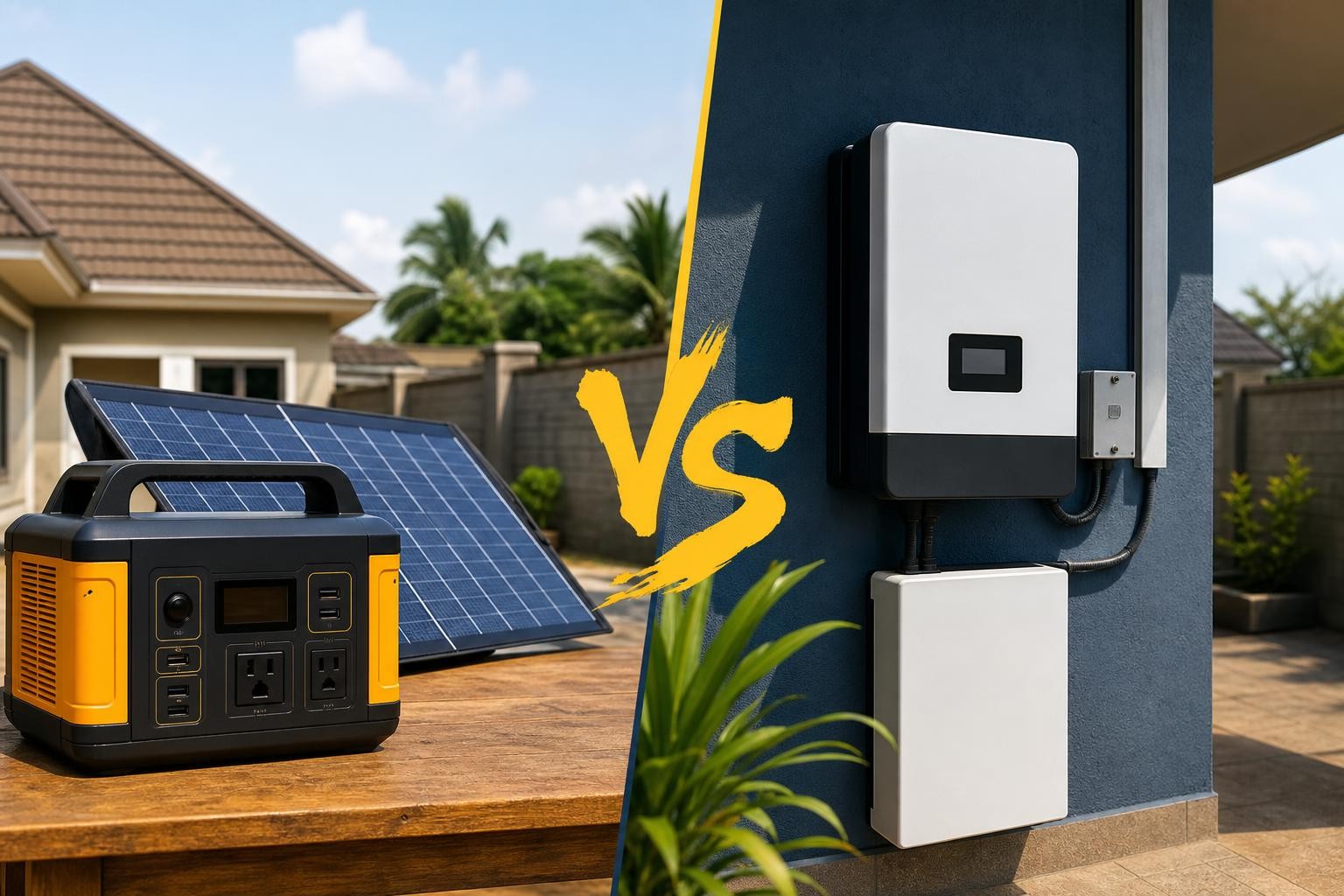
Short answer: A solar generator is usually better if you want simple, portable backup power for essential appliances. A separate inverter-and-battery system is usually better if you want to power a larger part of your Nigerian home, run appliances for longer, or expand the system later.
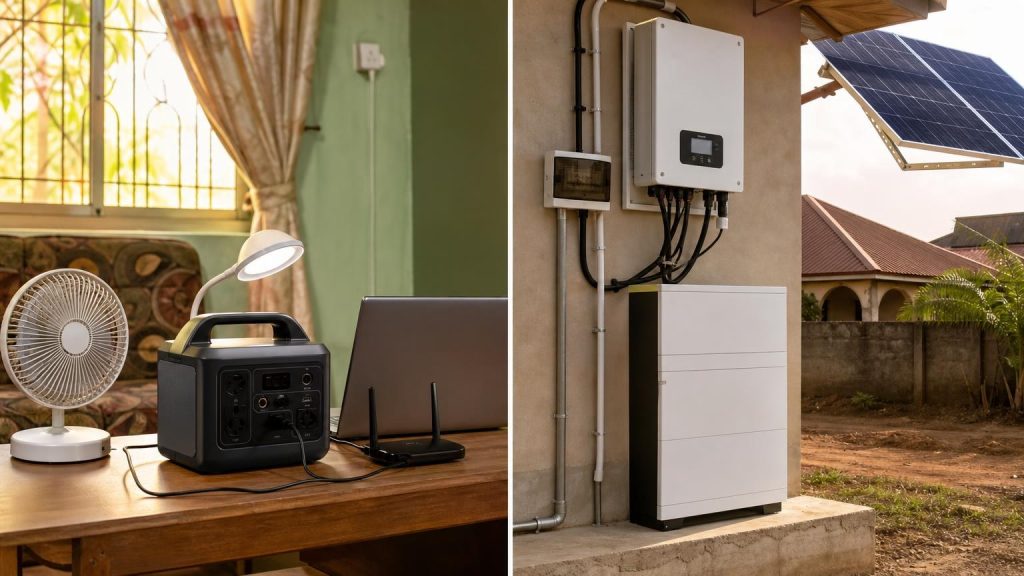
These are not exactly the same kind of product. A solar generator, also called a portable power station, normally combines a battery, inverter, charging system and outlets inside one unit. A conventional home inverter system uses separate equipment that is installed and sized around the home.
The better choice depends on what you want to power, how long you need backup during outages, whether you want portability, and how much flexibility you need in the future.
Solar Generator vs Inverter at a Glance
| Feature | Solar generator | Separate inverter system |
|---|---|---|
| Design | Battery, inverter and charging electronics in one portable unit | Inverter, batteries, solar equipment and protection installed separately |
| Installation | Usually quick to set up | Requires proper design, wiring and installation |
| Portability | Easy to move, depending on size | Normally fixed in one location |
| Best for | Essential loads, temporary backup and portable use | Longer backup and larger household loads |
| Expansion | Depends on whether the model supports extra batteries | Usually more flexible to expand |
| Solar panels | May be supported, but may not be included | Normally designed as part of the complete system |
| Upfront simplicity | Higher | Lower |
| Design flexibility | Lower | Higher |
This is the general difference. Features vary by brand and model, so check the exact specifications before buying either option.
What Is a Solar Generator?
A solar generator is a battery-based backup device with a built-in inverter and charging electronics. You charge the internal battery and then use the stored energy through AC outlets, USB ports or DC outputs.
Depending on the model, you may be able to charge it from solar panels, ordinary mains electricity, a vehicle or another supported source.
The name can be confusing because the device does not generate electricity with an engine like a petrol generator. It stores electricity and supplies it later. Solar panels are one way to recharge the battery.
When comparing a solar generator, pay attention to two separate ratings:
- Wh or kWh: the battery’s stored energy capacity.
- W: the inverter’s output power.
A unit with 1,000Wh of battery capacity does not automatically have a 1,000W inverter. One product could have a 600W output while another 1,000Wh product could have a much higher output. You need both figures to decide whether it can run your appliances and for how long.
You can read our guide on what a solar generator is and how it works for a fuller explanation of the components inside one.
What Do People Mean by an Inverter System?
When many Nigerians say they want to buy an “inverter”, they may actually mean a complete backup system. The inverter is only one part of that system.
A typical installed system may include an inverter, one or more batteries, solar panels where solar charging is included, a built-in or separate charge controller, cables, breakers, fuses, mounting equipment and installation.
The inverter converts DC electricity from the battery into AC electricity for household appliances. The battery stores the energy. The panels, if installed, help recharge the battery. Protection equipment and correctly sized wiring make it possible to connect the equipment safely.
This arrangement takes more planning than plugging an appliance into a portable power station, but it gives you more control over the size and design of the system.
Which Option Is Easier to Set Up?
Solar generator: easier for immediate backup
A solar generator normally arrives as one unit. You charge it, place it where you need it and connect compatible appliances to the correct outlets.
This can be useful for a tenant, student, remote worker, small shop or household that needs backup for a router, laptop, television, lights and fans without carrying out a fixed installation.
Inverter system: more installation work
A separate inverter system needs to be designed around the battery voltage, expected load, solar input, cable sizes, protection and the location of the equipment. It may also need a qualified installer to connect selected circuits in the home.
That extra work is not a disadvantage by itself. It is what allows the system to be designed for longer backup and larger loads. It does mean that an installed system should not be treated as a simple plug-and-play appliance.
Which One Gives Longer Backup?
Neither option automatically gives longer backup. Backup time depends mainly on the energy stored in the battery and the power used by your appliances.
A simple planning formula is:
Estimated runtime = usable battery energy ÷ appliance load
For example, imagine a solar generator has a 1,000Wh battery. If you use a planning assumption that about 85% is available after conversion and other losses, the usable energy would be approximately:
1,000Wh × 0.85 = 850Wh
If your connected appliances use about 275W together, the simple estimate is:
850Wh ÷ 275W ≈ 3.1 hours
This is only an estimate. Actual runtime can be shorter because appliance wattage changes, the inverter consumes some power, and batteries are not always discharged to the same level.
An installed inverter system can provide longer backup because you can specify a larger battery bank. But a large inverter with a small battery will still run out quickly. Use the Battery Calculator to estimate the storage you may need.
Which Option Can Power More Appliances?
A separate inverter system normally gives you more room for larger household loads, but the exact answer depends on the inverter model, battery bank and installation.
A small solar generator may be well suited to phones, laptops, Wi-Fi routers, televisions, LED lights and fans. Larger units may also run a refrigerator or freezer, but you must check the appliance’s running and starting power against the power station’s continuous and surge ratings.
A separate inverter system can be designed for a broader essential-load circuit, including refrigerators, freezers, several fans, lights, televisions, routers, computers and selected pumps. However, an inverter rating alone does not guarantee that the system can run all of those appliances together.
For a practical load estimate, use the Inverter Calculator before choosing an inverter size.
What About Refrigerators, Freezers and Water Pumps?
Motor-driven appliances deserve extra care. A refrigerator, freezer or pump can use one amount of power while running and a higher amount for a short period when starting.
This is why a product that appears large enough based only on average running watts can still trip or shut down when the motor starts.
Before connecting one of these appliances, check its running wattage, starting or surge requirement, the inverter’s continuous output, the inverter’s surge capability, and the battery capacity.
A solar generator can run some refrigerators and freezers, but not every model can do so. A properly sized inverter system may be more suitable when these appliances are an important part of your backup plan.
Which Option Is Better for Solar Charging?
Both options can use solar energy, but they handle solar charging differently.
A solar generator has a stated solar-input limit. You must match the panels to its permitted voltage, current, connector and maximum input power. The panels may be sold separately, so do not assume that “solar generator” means a solar panel is included.
With a separate system, the solar array can be selected around the inverter’s MPPT range, maximum PV voltage, current limit, maximum PV power and battery charging requirement. This gives you more design flexibility, but it also creates more opportunities for an incorrect connection.
Use the Solar Panel Calculator to estimate the panel capacity you may need, then confirm the exact electrical limits in the inverter or power station manual.
Which One Is Better for a Nigerian Tenant or Renter?
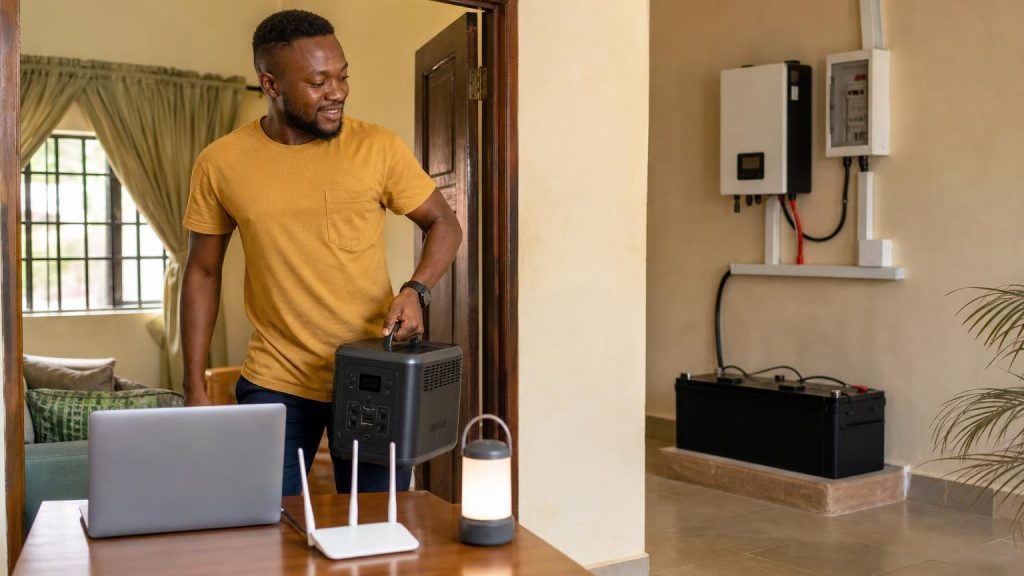
A solar generator is often the more practical choice for a tenant because it does not normally require permanent changes to the building. You can move it when you change apartments and use it in different rooms if the load is suitable.
It can also be useful if your backup need is limited to work equipment, a router, lights, fans and entertainment devices.
A fixed inverter system may still be possible in a rented property, but you should discuss the installation with the landlord and use a qualified installer. It makes more sense when you expect to stay for a long time or need more substantial backup.
Which One Is Better for a Family Home?
For a family home, the answer depends on the essential appliances you want to keep running.
A solar generator may be enough if the goal is to keep a small group of appliances working during outages, such as lights, fans, a television, a Wi-Fi router, laptops and phones.
A separate inverter system is usually more appropriate when the family wants longer backup, more circuits, a larger battery bank, or the ability to expand later. It can also be planned around a dedicated essential-load board rather than trying to power every appliance in the home at once.
Do not choose based only on the number of bedrooms. A small home with a freezer, pump and air conditioner may need more capacity than a larger home using only lights, fans and electronics.
Which Option Is Better for a Shop or Small Office?
A solar generator can be convenient for a small office, POS location or shop that mainly needs lights, phones, a router, laptops and other electronics. Its portability can also be helpful if the business operates from different locations.
A fixed inverter system may be better if the shop needs longer daily operating hours, refrigeration, printing equipment, security equipment or several loads at once. In that situation, calculate the daily energy requirement rather than choosing by the inverter’s label alone.
Cost: Which One Gives Better Value?
There is no universal winner on price. A solar generator may cost more than expected for its capacity because you are paying for portability, built-in electronics, a display, outlets and a ready-to-use design. A separate inverter system may look cheaper when you compare only the inverter, but the complete installation also needs batteries, panels where required, protection, wiring and labour.
The right comparison is not simply “price of solar generator versus price of inverter”. Compare the complete solution you need: the appliances it will run, the number of backup hours, whether you will recharge from solar, installation requirements, expansion options, warranty and local support.
For current estimated product prices, compare the Solar Generator and Portable Power Station Prices in Nigeria page. If you are considering an installed system, the wider Solar Prices in Nigeria database can help you compare the main equipment categories.
Safety Checks Before You Buy
- Do not connect solar panels outside the voltage, current or power limits stated by the manufacturer.
- Do not backfeed a home through a wall socket.
- Do not connect a portable power station to household wiring unless the manufacturer-approved transfer equipment and installation method are used.
- Use the correct battery voltage and charging settings.
- Keep equipment dry, ventilated and away from excessive heat.
- Use a qualified solar installer for fixed wiring, protection and changeover work.
So, Which Is Better for a Nigerian Home?
Choose a solar generator if:
- You want portable backup power.
- You mainly need to run electronics, lights and fans.
- You are renting or do not want a permanent installation.
- You want a quick setup with fewer separate components.
- Your expected load fits within the unit’s continuous and surge ratings.
Choose a separate inverter system if:
- You want longer backup from a larger battery bank.
- You need to power several essential household circuits.
- You want more freedom to choose the inverter, battery and solar array separately.
- You expect your power needs to grow.
- You are comfortable with a proper fixed installation.
For many Nigerian homes, the decision comes down to convenience versus capacity and flexibility. A solar generator is a convenient all-in-one backup device. A separate inverter system is a more customisable home energy system.
Start by listing the appliances you want to run, their wattage and the number of hours you need them during an outage. Then calculate the inverter, battery and solar requirements before spending money.
Frequently Asked Questions
Is a solar generator the same as an inverter?
No. A solar generator normally contains an inverter as one part of an all-in-one battery system. A conventional inverter is usually one component of a larger system that includes separate batteries and other equipment.
Can a solar generator power a whole house?
Some larger units may support a selected group of household loads, but you should not assume that every solar generator can power an entire home. Check its output, surge rating, battery capacity and connection method.
Is an inverter better than a solar generator?
An inverter system is usually better for larger fixed home backup and future expansion. A solar generator is usually better for portability, convenience and smaller essential loads.
Can I use a solar generator without solar panels?
Yes, if the model supports mains or another charging method. Solar panels are one way to recharge the battery, but they may not be included with the unit.
Can I connect a solar generator to my house wiring?
Do not connect it through a wall socket or improvise a backfeed connection. Use only a manufacturer-approved transfer arrangement installed correctly by a qualified professional.
How do I choose between the two?
Calculate your appliance load first. Choose the solar generator if its output and battery capacity meet your needs and you value portability. Choose a properly designed inverter system if you need more capacity, longer backup or future expansion.
Calculate first. Buy second.