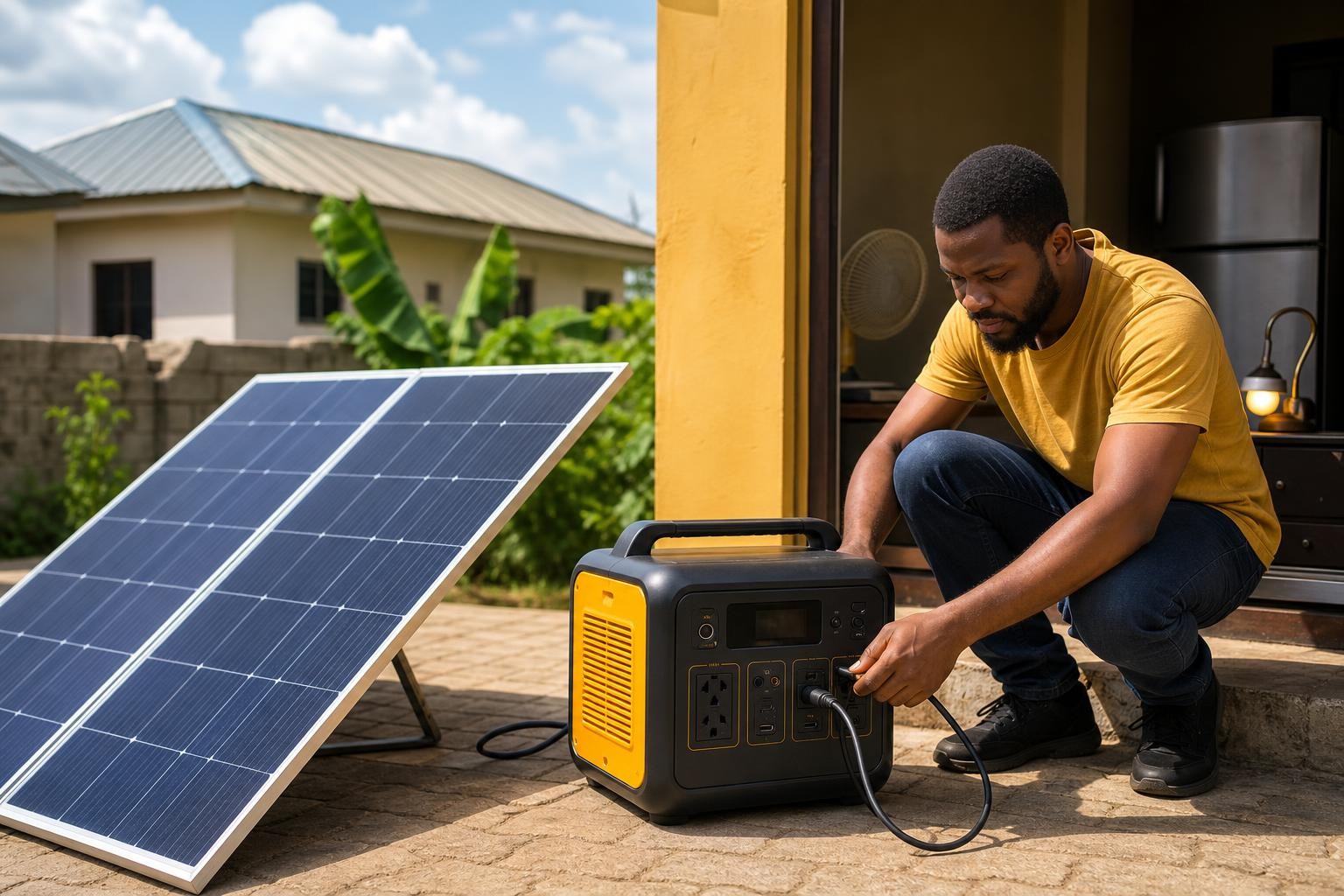
Short answer: A solar generator can be recharged with solar panels if the panels match the power station’s solar-input limits. You need the right panel voltage, current, total wattage, connectors and a safe setup. The panels do not power the appliances directly in the usual arrangement; they send electricity through the solar generator’s charging system into its battery, which later supplies your appliances.
For a Nigerian home, this can be useful when you want quiet backup power for lights, fans, a television, router, laptop or other essential appliances without installing a complete fixed solar system. But buying a solar generator and adding any available panel is not enough. A panel that is too high in voltage can damage the unit, while a panel that is too small may take too long to recharge the battery.
This guide explains how the combination works, what you need to check before buying, how to estimate charging time and how to avoid common connection mistakes.
How Does a Solar Generator Work With a Solar Panel?
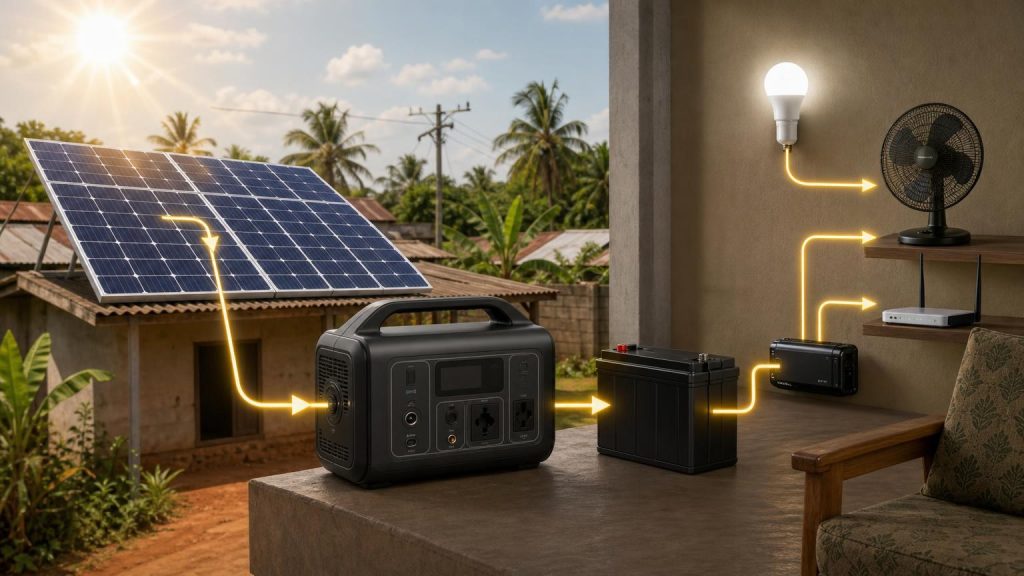
The energy path is straightforward:
Sunlight → Solar panel → Solar input/MPPT controller → Battery → Inverter → Appliance
The solar panel converts sunlight into DC electricity. The solar generator receives that electricity through its solar input. Inside the unit, a charge controller—often an MPPT controller—manages the incoming power and sends suitable charging power to the battery.
When you connect an appliance, the battery supplies DC energy to the built-in inverter. The inverter converts it into AC electricity for compatible household appliances. USB and DC outputs may use the battery’s DC electricity more directly.
A solar generator can therefore be charging from panels and powering appliances at the same time on some models. Whether this works, how much solar power is available to the battery and whether the unit supports pass-through charging depend on the manufacturer’s design.
Does a Solar Generator Come With Solar Panels?
Not always. A product may be advertised as a solar generator even when the box contains only the portable power station. Some sellers offer a separate panel, while others sell a bundle containing the power station, one or more panels and the required cable.
Before paying, confirm:
- Whether a solar panel is included.
- The panel’s total wattage.
- The cable and connector supplied.
- The maximum solar input accepted by the power station.
- Whether the panel is suitable for the unit’s voltage and current range.
- Whether the seller is quoting the power station price only or the complete solar package.
If you are still learning the basic parts of a portable power station, read our guide to what a solar generator is and how it works.
The Five Solar-Input Numbers You Must Check
Do not match a panel to a solar generator by wattage alone. Read the power station manual or datasheet and compare the panel’s electrical specifications with these limits.
1. Maximum solar input power in watts
This is the maximum amount of solar power the unit is designed to accept, such as 200W, 400W, 500W or more. Connecting more panel wattage than the input limit may not make the unit charge faster. The charging system may limit the input, and an incorrect setup can create unnecessary electrical risk.
2. Maximum input voltage
Look at the panel’s open-circuit voltage, called Voc, and the power station’s maximum solar-input voltage. The panel or panel arrangement must remain below the power station’s limit, including the combined voltage when panels are connected in series.
3. Operating or MPPT voltage range
The unit may have a working voltage range in which its MPPT controller can harvest solar power effectively. A panel arrangement can be below the absolute maximum voltage but still perform poorly if it does not reach the controller’s required operating range in real conditions.
4. Maximum input current
Compare the panel’s operating current, usually marked Imp, and short-circuit current, usually marked Isc, with the power station’s current limit. When panels are connected in parallel, the current adds up, so this limit is especially important.
5. Connector and polarity
The plug must fit correctly and the positive and negative connections must be correct. A cable that physically fits is not automatically safe or electrically suitable. Use the approved cable or a correctly rated adapter, and never guess the polarity.
How Many Solar Panels Do You Need?
The answer depends on two different questions:
- How much solar power can the solar generator accept?
- How much energy do you want to put back into the battery each day?
For example, suppose a power station accepts a maximum of 400W from solar. A 400W panel arrangement is the largest rated input you would normally plan around, but the actual energy collected will vary with sunlight, angle, heat, dust, shading, cable losses and cloud cover.
You could reach approximately 400W with one 400W panel or several smaller panels, but the voltage and current arrangement must still match the power station. Two panels with a combined rating of 400W are not automatically safe if their combined voltage or current exceeds the input limits.
For a first estimate of the panel size for your energy needs, use the Solar Panel Calculator. Then compare the result with the portable power station’s own solar-input limits.
Series or Parallel: How Should Panels Be Connected?
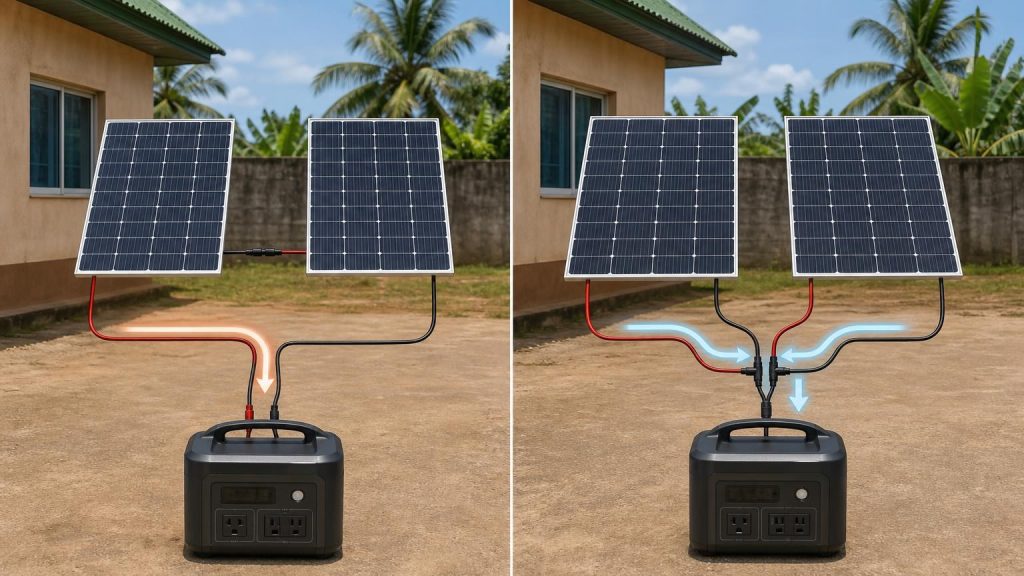
When more than one panel is used, the connection method changes the electrical values:
| Connection | What increases | Main limit to watch |
|---|---|---|
| Series | Voltage | Combined Voc must stay below the maximum input voltage |
| Parallel | Current | Combined Imp and Isc must stay within the current limit |
Suppose one panel has a Voc of 24V and an operating current of 8A. Two similar panels in series may produce about 48V of open-circuit voltage, while the current remains close to 8A. Two in parallel may keep the voltage close to 24V while the current becomes about 16A.
That is only an illustration. Use the actual figures printed on the panel label and the exact limits in the solar generator manual. Also remember that panel voltage can change with conditions, so do not design right at the maximum limit without proper technical guidance.
A Simple Solar Charging-Time Example
Solar charging time is not calculated by dividing the battery capacity by panel wattage and treating the result as a guarantee. The panel rarely produces its full rated output throughout the day, and the power station has charging losses and an input limit.
Use this as a planning example:
- Solar generator battery: 1,000Wh
- Solar array: 400W
- Useful solar-equivalent time assumed for planning: 3.5 hours
- Overall planning allowance for real-world losses: 75%
Estimated daily energy into the battery would be:
400W × 3.5 hours × 0.75 = 1,050Wh
In this simplified example, the array could theoretically replace about 1,000Wh of used energy during a reasonably productive day. It may take longer during heavy cloud, rain, shading, poor positioning or a short usable sunlight period. The 3.5-hour figure is an assumption for the example, not a promise for every Nigerian location or every day.
If the power station accepts only 200W, adding 400W of panels will not necessarily give 400W of charging. The unit may cap the input at its own limit. The product’s maximum solar-input wattage remains the controlling figure.
What Does Solar Charging Look Like in Nigeria?
Solar charging performance changes throughout the day. A panel may produce useful power under bright cloud, but output can fall when the sky is heavily overcast. Dust, bird droppings, nearby buildings, trees, roofing shadows and a poor panel angle can also reduce production.
For a Nigerian home, place portable panels where they can receive the clearest available sunlight for the intended charging period. Avoid leaving part of a panel in shade while the rest is in full sun, especially when several panels are connected together. Keep the panel surface reasonably clean and secure the panel against wind.
Do not assume that a panel marked “200W” will deliver 200W continuously. That is normally a rated condition, not an all-day output promise.
What Else Do You Need Besides the Solar Generator and Panel?
- Correct solar cable: use the connector and cable type approved for the power station.
- Panel stand or mounting arrangement: keep the panel at a useful angle and prevent it from falling.
- Weather protection: keep the power station dry unless the manufacturer specifically rates it for outdoor exposure.
- Extension cable only when suitable: a long or undersized cable can create voltage drop and heating.
- Surge protection and safe storage: follow the manufacturer’s instructions for the unit and battery.
- A multimeter or installer assistance when needed: do not test unfamiliar high-voltage connections casually.
For a small plug-and-play setup, use the manufacturer’s supplied accessories whenever possible. For a larger panel arrangement or fixed installation, ask a qualified solar installer to verify the design.
Common Solar Generator and Panel Mistakes
| Mistake | Why it causes trouble | Better approach |
|---|---|---|
| Choosing only by panel watts | Voltage or current may exceed the power station limit | Check Voc, Imp, Isc and the full input specification |
| Assuming the panel is included | The advertised price may be for the power station alone | Confirm the box contents in writing |
| Connecting panels in series without checking Voc | The combined voltage may damage the solar input | Add the panel Voc values and compare with the limit |
| Using random adapters | Wrong polarity, poor contact or unsuitable ratings can create faults | Use approved or correctly rated cables |
| Expecting rated output all day | Cloud, heat, shade and angle reduce real production | Plan with a realistic allowance |
| Leaving the unit in rain or heat | Moisture and excessive temperature can damage electronics | Follow the operating environment in the manual |
A Practical Buying Checklist
Before buying a solar generator with a panel, write down the following:
- Battery capacity in Wh or kWh.
- Continuous AC output in watts.
- Surge output for refrigerators, freezers, pumps and other motor loads.
- Maximum solar-input wattage.
- Minimum and maximum solar-input voltage.
- Maximum solar-input current.
- Panel Voc, Vmp, Imp and Isc.
- Connector type, cable length and polarity.
- Whether pass-through charging is supported.
- Warranty, seller support and replacement-cable availability in Nigeria.
For current estimated Nigerian prices, you can compare the Solar Generator and Portable Power Station Prices category. Keep the product’s Wh capacity separate from its W output when comparing models.
You can also use the Solar Generator Calculator to estimate the storage you may need for your appliances, then check whether the chosen unit and panel arrangement can support that plan.
Safety Checks Before Connecting a Panel
- Read the solar generator manual before making the connection.
- Confirm the panel’s Voc is below the unit’s maximum input voltage.
- Confirm the current and total wattage are within the input limits.
- Confirm positive and negative polarity before plugging in.
- Do not connect household AC power into the solar/DC input.
- Do not connect the solar generator to home wiring or backfeed through a wall socket.
- Keep the unit and connections dry and ventilated.
- Use a qualified technician for high-voltage, fixed or unfamiliar installations.
Frequently Asked Questions
Can any solar panel charge any solar generator?
No. The panel’s voltage, current, wattage, connector and polarity must be compatible with the solar generator’s input. Check the manual rather than relying on the plug shape alone.
Can I use a bigger solar panel than the generator’s rating?
Some manufacturers allow limited panel oversizing, but this is product-specific. Never exceed the stated voltage or current limits. If the manual does not clearly allow oversizing, stay within the published input rating.
Can I use two solar panels together?
Possibly, if the solar generator accepts the combined voltage, current and wattage. Series connections increase voltage, while parallel connections increase current. Confirm the numbers before connecting them.
Can a solar generator charge and power appliances at the same time?
Some models support this, while others limit or disable certain outputs during charging. Check the manufacturer’s pass-through or simultaneous charging specification.
Will solar panels charge the generator during rain?
Panels can produce some electricity in cloudy conditions, but output may fall significantly. Heavy cloud, rain, shade and poor positioning can make charging much slower.
Do I need a separate charge controller?
Usually not when connecting compatible panels directly to a solar generator’s dedicated solar input, because the unit normally has its own charging electronics. Do not add a separate controller unless the manufacturer or installer specifically designs the system that way.
Final Advice
A solar generator with a solar panel can be a practical backup option in Nigeria, but the panel and power station must be treated as one electrical system. Start with the appliances and the battery energy you need. Then check the solar generator’s input voltage, current, wattage and connector requirements before choosing a panel.
Do not buy by panel watts alone. Match the complete electrical specification, plan for real Nigerian weather and shading conditions, and follow the manufacturer’s connection instructions.