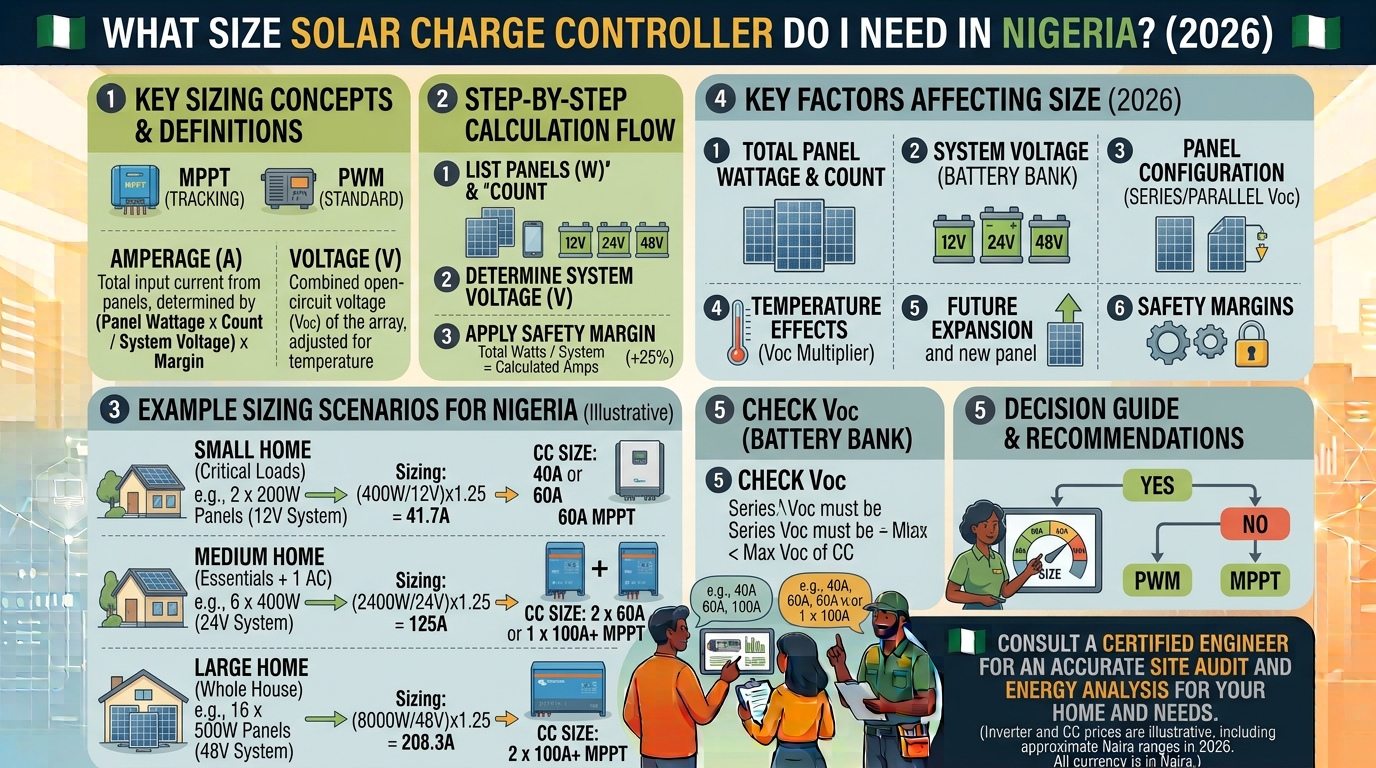
Choosing the right charge controller is important when building a solar system.
A controller that is too small may not handle the power coming from your solar panels properly. On the other hand, buying a much larger controller than you need can increase the cost of your system without giving you much benefit.
So, what size solar charge controller do you need?
It depends mainly on:
- Total solar panel wattage
- Battery voltage
- Whether you are using PWM or MPPT
- Panel voltage and current
- The controller’s maximum PV input
- Your future expansion plans
In this guide, we will show you how to calculate the right size using simple examples that apply to solar systems in Nigeria.
You can also use our Solar Charge Controller Calculator to do the calculation quickly.
Quick Charge Controller Size Guide
For an MPPT controller, a simple starting point is:
Controller current = Solar panel watts ÷ Battery voltage
A safety margin is then added, and you normally move up to the next available controller size. Current sizing guides commonly use a 25% margin for this planning calculation.
Here is a simple guide:
| Solar Panel Capacity | 12V Battery | 24V Battery | 48V Battery |
|---|---|---|---|
| 100W | 10A | 10A | 10A |
| 200W | 20A | 10A | 10A |
| 300W | 40A | 20A | 10A |
| 400W | 40A | 20A | 10A |
| 500W | 60A | 30A | 20A |
| 600W | 60A | 30A | 20A |
| 800W | 80A | 40A | 20A |
| 1,000W | 100A | 60A | 30A |
| 1,200W | 100A+ | 60A | 40A |
| 1,500W | 100A+ | 80A | 40A |
| 2,000W | 100A+ | 100A | 60A |
| 3,000W | 100A+ | 100A+ | 80A |
This table is a planning guide, not a replacement for checking the specifications of the actual controller and panels.
How Do I Calculate My Charge Controller Size?
Let’s use a simple example.
Suppose you have:
4 × 250W solar panels
Your total solar capacity is:
250W × 4 = 1,000W
Now suppose you have a:
24V battery system
Divide the solar power by the battery voltage:
1,000W ÷ 24V = 41.7A
Adding a 25% planning margin:
41.7A × 1.25 = 52.1A
You would therefore look for a controller around 60A, assuming its other specifications can handle your solar array.
This is much better than simply guessing that you need a 40A or 60A controller.
Why Does Battery Voltage Matter?
This is one of the most important things to understand.
The same solar panels can require different controller sizes depending on the battery voltage.
For example, let’s say you have:
1,000W of solar panels.
With a 12V battery
1,000 ÷ 12 = 83.3A
With a planning margin:
83.3 × 1.25 = 104.2A
You would need a very large controller or a different system design.
With a 24V battery
1,000 ÷ 24 = 41.7A
With a planning margin:
41.7 × 1.25 = 52.1A
A 60A controller may be suitable, subject to the controller specifications.
With a 48V battery
1,000 ÷ 48 = 20.8A
With a planning margin:
20.8 × 1.25 = 26.0A
A controller around 30A may be suitable, subject to its specifications.
This is why larger solar systems often use higher battery voltages.
What Size Charge Controller Do I Need for 500W Solar Panels?
It depends on your battery voltage.
For example:
500W + 12V battery
500 ÷ 12 = 41.7A
With a 25% margin:
52.1A
You would generally look at a 60A controller.
500W + 24V battery
500 ÷ 24 = 20.8A
With a 25% margin:
26A
A 30A controller may be suitable.
500W + 48V battery
500 ÷ 48 = 10.4A
With a 25% margin:
13A
A controller around 20A may be suitable.
But remember to check the controller’s specifications before buying.
What Size Charge Controller Do I Need for 1,000W Solar Panels?
For a 1,000W solar array:
| Battery System | Basic Calculation | Planning Size |
|---|---|---|
| 12V | 83.3A | About 105A |
| 24V | 41.7A | About 52A |
| 48V | 20.8A | About 26A |
So a 1,000W solar array could require a very different controller depending on whether your battery bank is 12V, 24V or 48V.
For a 24V system, 60A MPPT is a common size to consider after the calculation, provided the controller can accept the array’s voltage and power.
What Size Charge Controller Do I Need for 2,000W Solar Panels?
For 2,000W:
12V
2,000 ÷ 12 × 1.25 = 208A
That is a very large current.
24V
2,000 ÷ 24 × 1.25 = 104A
You may be looking at a 100A+ controller or another system design.
48V
2,000 ÷ 48 × 1.25 = 52A
A 60A controller may be suitable, subject to the controller’s maximum PV input specifications.
This shows why a 48V system can make more sense for larger solar installations.
What Size Charge Controller Do I Need for 3,000W Solar Panels?
With a 3,000W solar array:
24V system
3,000 ÷ 24 × 1.25 = 156.3A
That’s a very large controller.
48V system
3,000 ÷ 48 × 1.25 = 78.1A
An 80A or larger controller may be considered, subject to the actual controller specifications.
For systems this large, proper system design becomes more important. You may also need to consider multiple charge controllers rather than trying to put everything through one controller.
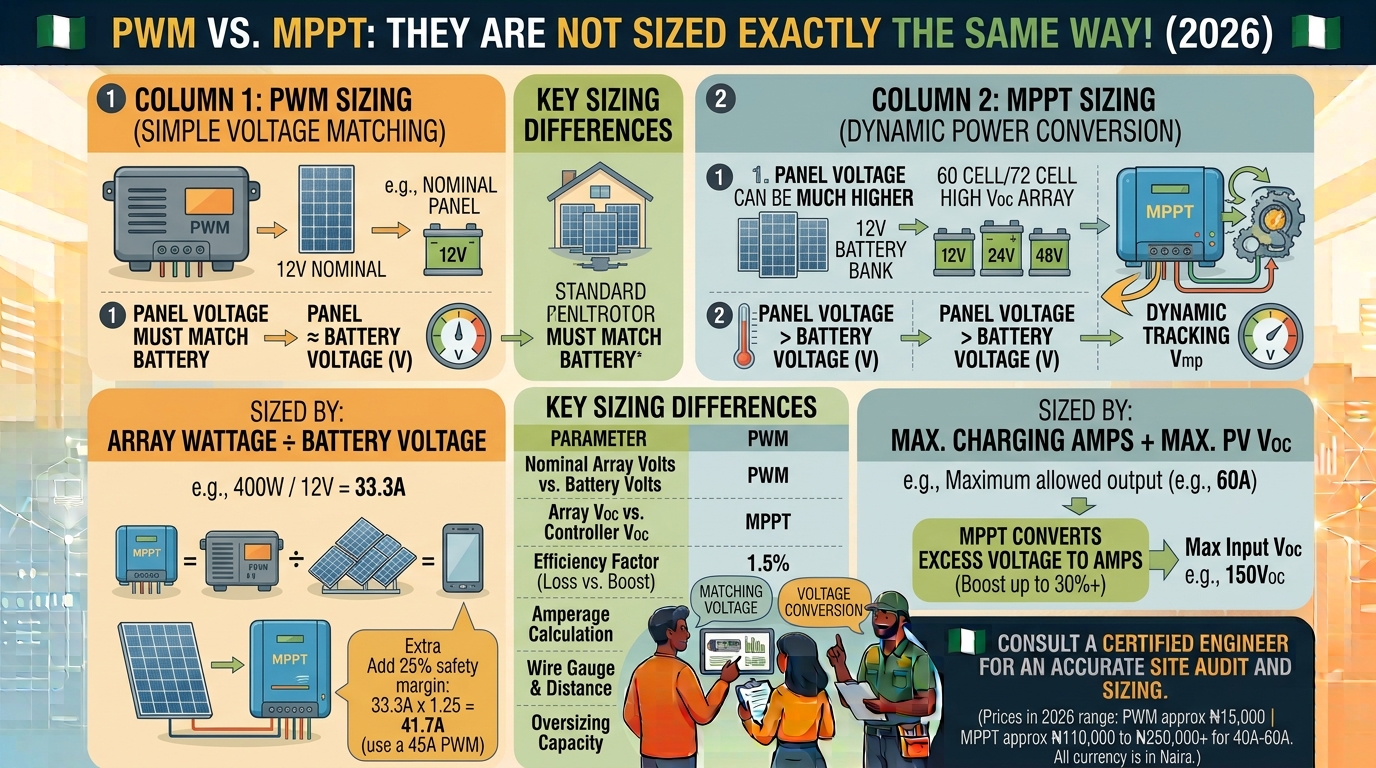
MPPT and PWM Controllers Are Not Sized Exactly the Same Way
This is important.
There are two main types of charge controllers:
PWM
and
MPPT
The calculation method is not exactly the same.
How Do I Size an MPPT Charge Controller?
For MPPT, a useful starting formula is:
Solar panel watts ÷ battery voltage × 1.25
For example:
800W solar + 24V battery
800 ÷ 24 = 33.3A
33.3 × 1.25 = 41.7A
You would therefore look at a controller around 45A or 50A, depending on the available models and their specifications.
MPPT controllers also require you to check the maximum PV voltage. The panel string voltage must remain within the controller’s allowed input range.
How Do I Size a PWM Charge Controller?
PWM controllers need a little more care because they work differently from MPPT.
For PWM, the controller current is generally based on the solar array’s short-circuit current (Isc) rather than simply dividing total panel watts by battery voltage. A safety margin is then applied.
You can find the panel’s Isc on its specification label or datasheet.
For example, if your panels have a combined Isc of 25A:
25A × 1.25 = 31.25A
You would normally look at a controller above that calculated requirement, such as a 40A model.
Can I Use Any Solar Panel With a PWM Controller?
No.
PWM works best when the solar panel voltage is properly matched to the battery system.
For example, a panel designed for a 12V battery system is different from a high-voltage panel commonly used in larger solar installations.
If you have higher-voltage panels or want to connect panels in series, MPPT is usually the better option.
This is one of the reasons MPPT controllers are commonly used in larger systems.
What Happens If My Charge Controller Is Too Small?
If your controller is too small for the solar array, it may not be able to properly handle the available charging current.
Depending on the controller, you may experience:
- power being limited
- controller overheating
- overload protection
- reduced solar production
- possible damage if its limits are exceeded
The exact behaviour depends on the controller.
Do not assume that a controller can safely accept any amount of extra solar power just because it has protection features.
Always check its maximum rated PV power and current.
What Happens If My Charge Controller Is Too Large?
A controller that is larger than necessary is generally less of a problem than one that is too small, but it can cost much more.
For example, if your system only needs around 30A, buying a 100A controller may not make financial sense.
You should choose a controller that gives you enough capacity for your current system and, if needed, reasonable room for future expansion.
Don’t Look at Amps Alone
This is another common mistake.
Someone may see:
60A MPPT
and assume it can handle any 60A solar system.
That’s not correct.
You should also check:
- Maximum PV voltage
- Maximum PV power
- Battery voltage
- MPPT voltage range
- Maximum charging current
- Supported battery types
For an MPPT controller, the solar panels can be connected in series, which increases the voltage. The combined open-circuit voltage of the series string must stay below the controller’s maximum PV input voltage.
What Is Panel Voc and Why Does It Matter?
Voc means Open Circuit Voltage.
It is the voltage a solar panel can produce when it is not connected to a load.
This number is important when using an MPPT controller.
If you connect several panels in series, their voltages add together.
For example, if one panel has a Voc of 45V:
2 panels in series = about 90V
3 panels in series = about 135V
So you cannot connect three of them to an MPPT controller with a maximum PV input of only 100V.
You must check the panel and controller specifications before connecting them.
Should I Connect My Solar Panels in Series or Parallel?
It depends on your system.
Series connection
Connecting panels in series increases voltage.
Parallel connection
Connecting panels in parallel increases current.
For larger MPPT systems, series connections can be useful because they allow the solar array to operate at a higher voltage and lower current.
But you must stay within the controller’s maximum PV voltage.
What Size Charge Controller Do I Need for a 24V Battery?
Here are some simple examples:
| Solar Array | Approx. Controller Size |
|---|---|
| 200W | 10A–20A |
| 400W | 20A–30A |
| 500W | 30A |
| 600W | 30A–40A |
| 800W | 40A–50A |
| 1,000W | 60A |
| 1,500W | 80A |
| 2,000W | 100A+ |
These are general planning estimates for MPPT systems. The actual controller must still meet the panel voltage, PV power and battery requirements.
What Size Charge Controller Do I Need for a 48V Battery?
A 48V system requires less charging current than a 12V or 24V system for the same solar array.
For example:
| Solar Array | Approx. Controller Size |
|---|---|
| 500W | 20A |
| 1,000W | 30A |
| 1,500W | 40A |
| 2,000W | 60A |
| 3,000W | 80A |
Again, these are planning figures, not a substitute for checking the controller’s actual specifications.
Use Our Charge Controller Calculator
You don’t have to do all these calculations yourself.
We built the Solar Charge Controller Calculator specifically to make this easier.
You can enter:
- Charge controller type
- Battery system voltage
- Number of solar panels
- Panel wattage
The calculator then gives you an estimated charging current and recommended controller size.
This is especially useful if you are not comfortable doing the calculation manually.
Check Charge Controller Prices Before You Buy
Once you know the controller size you need, the next step is checking the available options and prices.
Visit our:
Solar Prices in Nigeria
You can compare estimated Nigerian market prices for different charge controller sizes, including:
- PWM
- MPPT
- 20A
- 30A
- 40A
- 50A
- 60A
- 80A
- 100A+
We also cover other solar equipment on the page, including solar panels, inverters and batteries.
What If I Am Building the Complete Solar System?
Choosing the charge controller is only one part of the process.
You also need to know:
What inverter size do I need?
Use our Inverter Calculator.
How much battery capacity do I need?
Use our Battery Calculator.
How many solar panels do I need?
Use our Solar Panel Calculator.
How much will the complete installation cost?
Use our Solar Installation Cost Calculator.
This allows you to calculate the different parts of your solar system instead of guessing.
Simple Rule to Remember
If you only remember one thing from this article, remember this:
The right charge controller depends on your solar panel capacity and battery voltage.
Don’t buy a controller simply because someone told you:
“Buy a 60A controller.”
First find out:
- How many watts of solar panels do you have?
- Are you using 12V, 24V or 48V batteries?
- Are you using PWM or MPPT?
- What is the panel voltage?
- What is the maximum PV input of the controller?
Then choose the correct controller.
Final Advice
For small solar systems, a PWM controller may be enough.
For larger systems, especially where higher-voltage solar panels are being used, MPPT is often the better choice.
But the most important thing is proper sizing.
A 1,000W solar array on a 12V battery system does not require the same controller size as a 1,000W array on a 48V system.
So before buying, calculate first.
Start with our Solar Charge Controller Calculator.
Then check the current estimated equipment prices on our Solar Prices in Nigeria page.
You can also use:
And if you are still deciding what type of solar system is right for your home, read How to Choose the Right Solar System for Your Home in Nigeria.