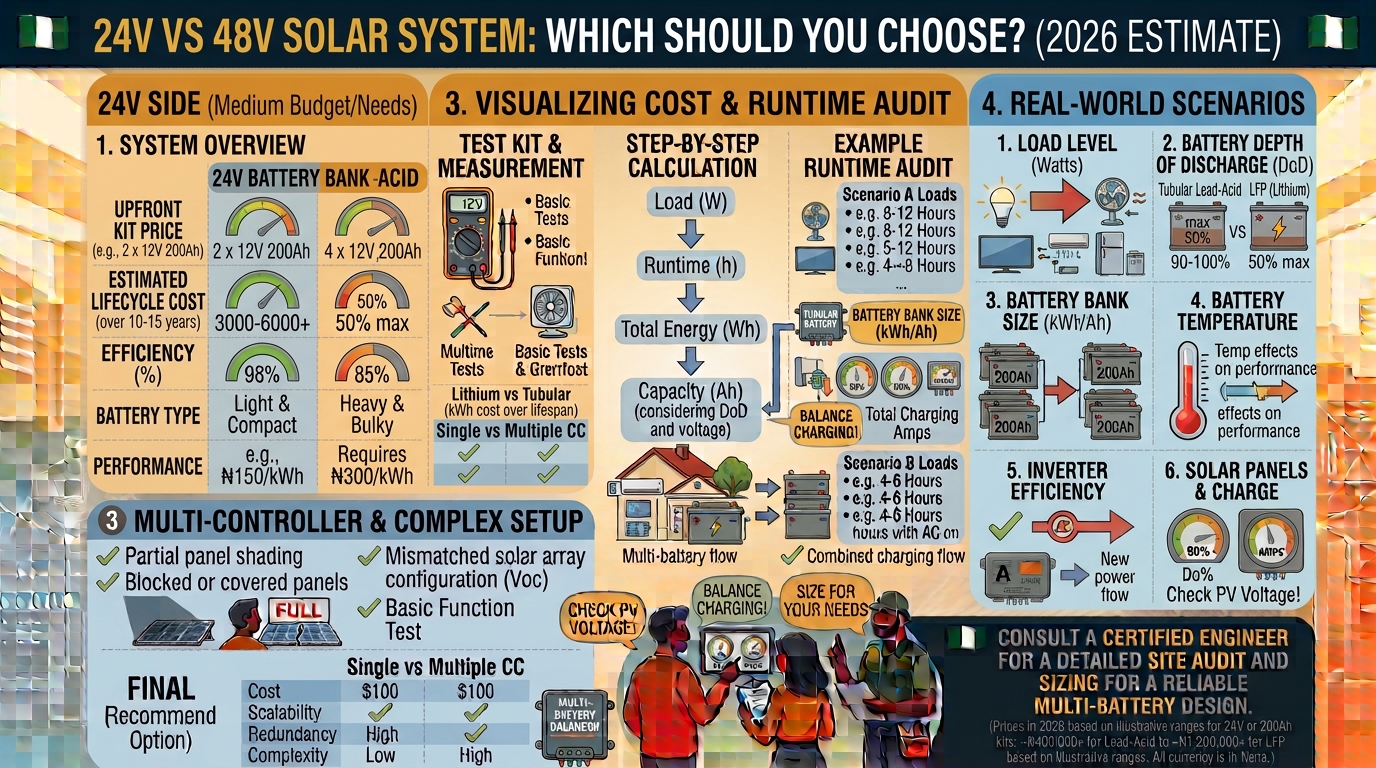
If you are planning a solar system, you may have noticed that some systems use 24V batteries while others use 48V batteries.
This can be confusing, especially when you see two systems with similar inverter sizes but different battery voltages.
So which one is better?
For most medium and larger solar systems, 48V is usually the better choice.
But that does not mean 24V is bad.
A 24V system can be a good choice for smaller solar installations, especially when the inverter and battery capacity are within a reasonable range.
The right choice depends on the size of your system, the appliances you want to run, the inverter you choose and how much battery and solar capacity you need.
Let’s compare them.
24V vs 48V Solar System at a Glance
| Feature | 24V System | 48V System |
|---|---|---|
| System voltage | 24V | 48V |
| Current for same power | Higher | Lower |
| Cable requirements | Can require thicker cables | Usually easier for larger loads |
| Suitable for | Small to medium systems | Medium to large systems |
| Battery bank size | Smaller systems | Larger systems |
| Efficiency at higher loads | Good | Generally better suited |
| Expansion | Suitable for smaller systems | Better for larger systems |
| Common use | Small homes and backup systems | Larger homes and solar systems |
| Initial battery arrangement | Usually fewer 12V batteries | Usually more 12V batteries if using series |
| Best choice for large loads | Not usually | Usually |
These are general differences. The exact design depends on the inverter, batteries, solar panels, cables and other equipment.
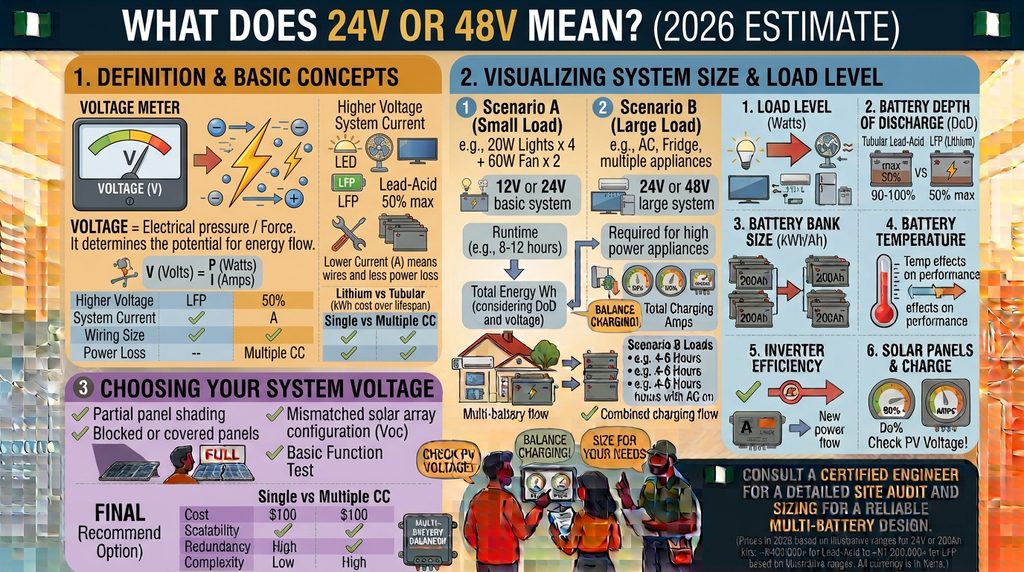
What Does 24V or 48V Mean?
The voltage refers to the battery bank voltage used by the inverter.
For example, a 24V inverter may require a 24V battery bank.
A 48V inverter requires a 48V battery bank.
If you are using 12V batteries, you can connect batteries in series to increase the voltage.
For example:
2 × 12V batteries = 24V
And:
4 × 12V batteries = 48V
This is a simple example. The actual battery arrangement must follow the inverter and battery manufacturer’s specifications.
Why Does Higher Voltage Matter?
The biggest reason is current.
The basic formula is:
Current = Power ÷ Voltage
So if you have a 2,400W load:
At 24V
2,400W ÷ 24V = 100A
At 48V
2,400W ÷ 48V = 50A
The 48V system needs about half the current for the same power.
This is one of the biggest advantages of using a higher-voltage battery system.
Lower current can make it easier to manage cables, connections and power losses, especially as the system becomes larger.
Your Solar Panel Calculator also allows you to work with 24V and 48V system configurations.
24V vs 48V: Which Is More Efficient?
48V generally has an advantage for larger systems.
The reason is that a higher voltage allows the same amount of power to move at a lower current.
Higher current can result in greater losses in cables and connections if the system is not designed properly.
For example:
A 2,400W load at 24V requires about:
100A
The same load at 48V requires:
50A
Because the current is lower at 48V, cable and connection losses can be easier to control.
This does not mean a 48V system is automatically more efficient in every situation.
The quality of the inverter, cables, connections and installation also matters.
Which System Needs Thicker Cables?
24V systems can require thicker cables for the same power.
Remember:
Power = Voltage × Current
If the voltage is lower, the current must increase to deliver the same amount of power.
For example:
A 2,400W load:
24V → 100A
48V → 50A
That difference can become significant as the system gets larger.
A poorly sized cable can cause:
- Voltage drop
- Heat
- Power loss
- Reduced system performance
- Safety problems
This is why cable sizing should be done based on the actual current, cable length, installation method and manufacturer’s requirements.
Is 24V Better for a Small Solar System?
It can be.
A 24V system can make sense when the total power requirement is moderate.
For example, someone may want to power:
- Lights
- TV
- Fans
- Router
- Laptop
- Refrigerator
- Other small appliances
A properly designed 24V system can handle this type of load depending on the inverter and battery capacity.
However, you should not choose 24V simply because your home is small.
The actual appliance load is more important.
If you are not sure what inverter size you need, use our Inverter Calculator before choosing your system voltage.
Is 48V Better for a Large Solar System?
Usually, yes.
48V becomes more attractive as the power requirement increases.
For example, larger homes may want to run:
- Several refrigerators
- Freezers
- Multiple fans
- Water pumps
- Washing machines
- Computers
- Air conditioners
- Other heavy appliances
At these power levels, the lower current of a 48V system becomes a major advantage.
This is one reason many larger modern solar systems use 48V battery banks.
What About a 3kVA Inverter?
A 3kVA inverter can be designed for different battery voltages.
You may find:
24V 3kVA
and:
48V 3kVA
models.
So don’t assume that every 3kVA inverter uses the same battery voltage.
The exact inverter model matters.
Before buying the battery, check the inverter’s:
- Battery voltage
- Maximum charging current
- Maximum discharge requirement
- Solar input
- Battery compatibility
- Manufacturer specifications
You can also read our guide:
How Many kVA Inverters Do I Need for My Home in Nigeria?
That article explains why inverter size should be based on your actual appliance load rather than simply the size of your house.
What About a 5kVA Inverter?
48V is commonly a better fit.
Many 5kVA solar inverters use 48V battery systems.
For example:
A 5kVA load at 48V would require much less current than the same power at 24V.
However, this does not mean every 5kVA inverter must use 48V.
Always check the exact model.
You can also read:
How Many Batteries Do I Need for a Solar System in Nigeria?
This explains how inverter voltage affects the number and arrangement of batteries.
How Many 12V Batteries Do I Need?
If you are using traditional 12V batteries, the basic series arrangement is:
24V system
2 × 12V batteries
2 × 12V = 24V
48V system
4 × 12V batteries
4 × 12V = 48V
But remember:
Creating the correct voltage does not automatically give you enough backup time.
For example:
2 × 12V 200Ah batteries in series gives:
24V 200Ah
Nominal energy:
24 × 200 = 4.8kWh
Four 12V 200Ah batteries in series gives:
48V 200Ah
Nominal energy:
48 × 200 = 9.6kWh
So the 48V bank in this example contains twice the nominal energy because it contains twice as many 12V batteries.
For a proper battery requirement, use our Battery Calculator.
What If I Use Lithium Batteries?
Lithium batteries make the comparison a little different.
You don’t always have to build a 24V or 48V bank using multiple 12V batteries.
You can find lithium batteries such as:
- 12V
- 24V
- 48V
- 51.2V
- 5kWh
- 10kWh
- Larger battery systems
For example, our current Lithium Battery Prices in Nigeria database includes 24V and 48V-class lithium batteries.
You can find examples such as:
24V 200Ah ≈ 5kWh
and:
48V 100Ah ≈ 5kWh
These two batteries can have a similar nominal energy capacity even though their voltage and Ah ratings are different.
This is another reason you should not compare batteries using Ah alone.
24V 200Ah vs 48V 100Ah
This is a good example.
24V 200Ah
24 × 200 = 4,800Wh
or:
4.8kWh
48V 100Ah
48 × 100 = 4,800Wh
or:
4.8kWh
Both have approximately the same nominal energy.
But they operate at different voltages.
The 48V battery uses half the current for the same power output.
So when comparing batteries, look at:
Voltage + Ah + kWh + usable capacity
not just the Ah number.
Which System Is Cheaper?
This depends on the equipment.
You cannot simply say:
“24V is cheaper.”
or:
“48V is cheaper.”
A 48V system may require more batteries if you are building the bank from 12V batteries.
For example:
24V:
2 × 12V batteries
48V:
4 × 12V batteries
But the total cost also depends on:
- Battery capacity
- Battery chemistry
- Inverter brand
- Inverter capacity
- Solar panel capacity
- Charge controller
- Cables
- Protection equipment
- Installation
You can compare current equipment prices on our Solar Prices in Nigeria page.
Which One Is Better for Future Expansion?
48V usually gives you more room for larger systems.
If you expect your solar system to grow later, starting with a suitable 48V platform can make sense.
For example, you may start with:
5kWh battery storage
and later expand to:
10kWh
or more, if the inverter and battery system support expansion.
But don’t buy a 48V system simply because you think you will expand someday.
Check the actual inverter and battery expansion options before buying.
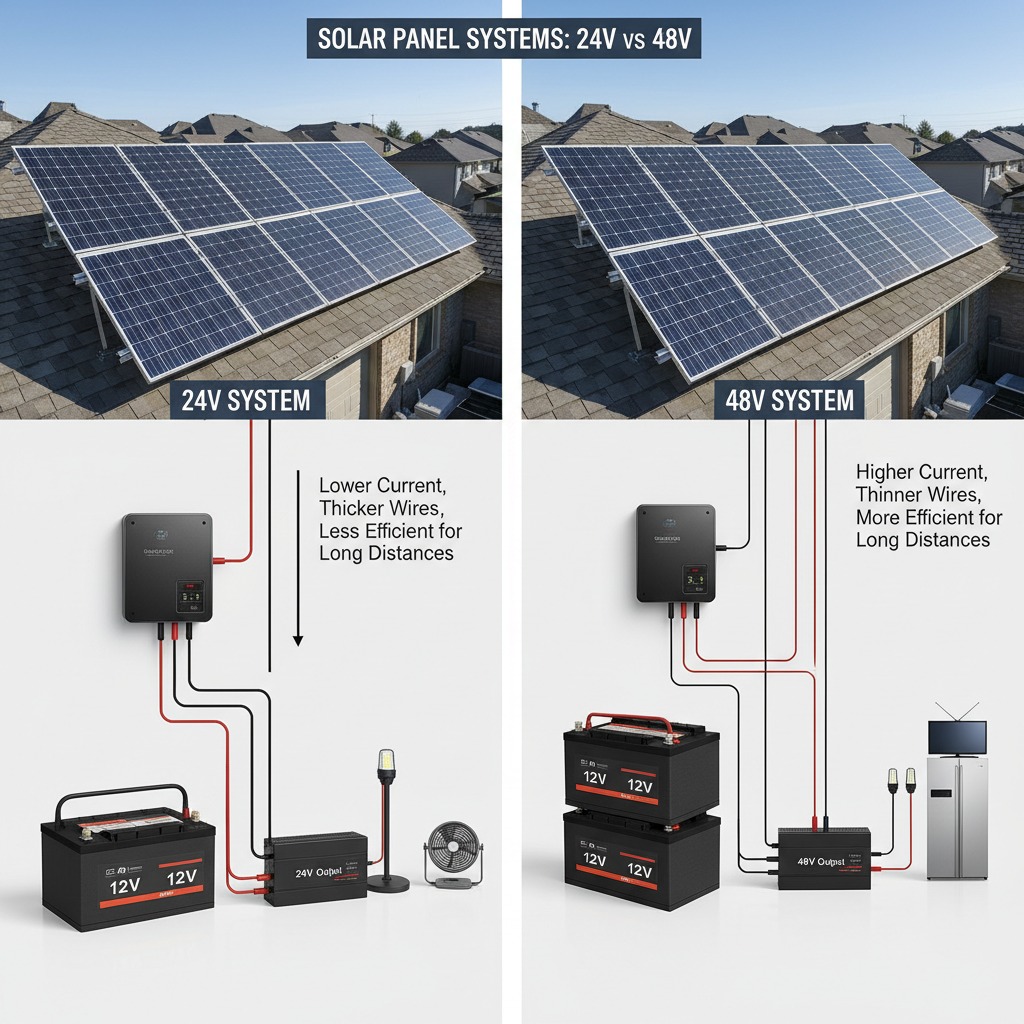
24V vs 48V for Solar Panels
Your battery voltage is also important when designing the solar charging side of the system.
However, you should not assume:
“I have a 48V battery, so I need 48V solar panels.”
Solar panels are normally connected in series and/or parallel according to the charge controller or inverter’s PV voltage range.
The inverter or charge controller determines what solar panel voltage arrangement is suitable.
Check:
- Maximum PV voltage
- MPPT voltage range
- Maximum PV current
- Maximum PV power
- Number of MPPT inputs
Our Solar Panel Calculator can help estimate your solar array requirement, but the final panel arrangement must still be checked against the exact inverter or charge controller specifications.
What About the Charge Controller?
If you are using a separate solar charge controller, you also need to make sure it supports your battery voltage.
For example, a controller may support:
12V / 24V / 48V
while another may support only:
12V / 24V
This is important when buying equipment.
You can see current controller options and prices on our Solar Prices in Nigeria page, where charge controllers are listed separately.
Also check our guide:
How Much Is a Solar Charge Controller in Nigeria? 2026 Prices
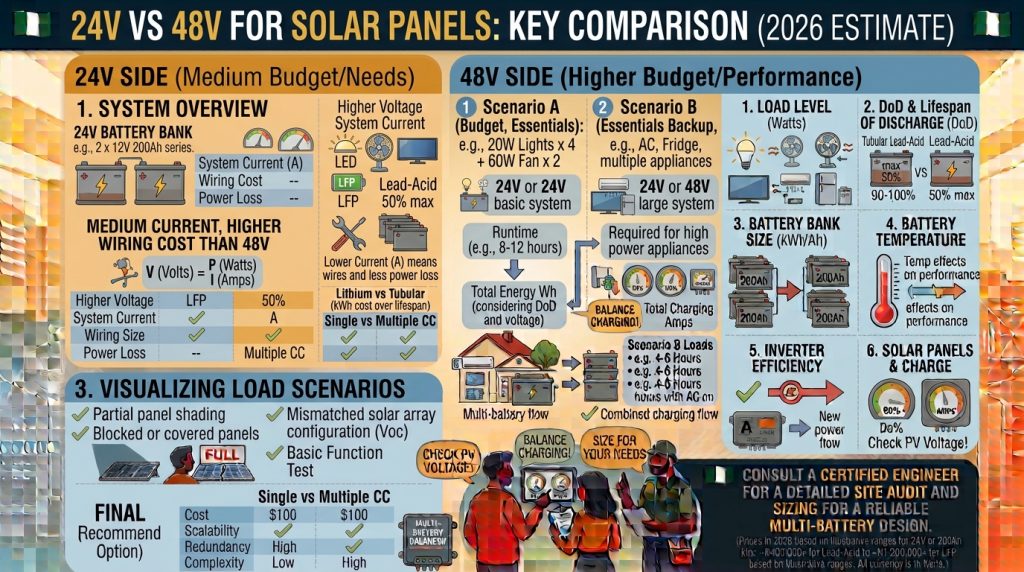
24V vs 48V: Which Is Better for Nigerian Homes?
For a small system with moderate loads:
24V can be a good choice.
For a medium or large system with higher loads:
48V is usually the better choice.
For example:
| System type | Possible voltage |
|---|---|
| Small backup system | 12V or 24V |
| Small/medium solar system | 24V |
| Medium residential system | 24V or 48V |
| Large residential system | 48V |
| Large home with several heavy loads | 48V |
| Commercial/high-load system | 48V or higher system architecture |
These are only general starting points.
The actual voltage should be selected based on the inverter and complete system design.
Advantages of a 24V System
A 24V system can be a good choice because:
- It is suitable for many small and medium systems
- It is easier to build than a large high-voltage system
- Some 24V inverters are affordable
- It can work well for moderate loads
- It can be suitable for smaller homes and backup systems
The disadvantage
As the power requirement increases, the current also increases.
That can mean:
- Larger cables
- More attention to voltage drop
- Greater current through connections
- More difficulty scaling to very large loads
Advantages of a 48V System
A 48V system offers several advantages:
- Lower current for the same power
- Better suited to larger loads
- Easier cable management for high-power systems
- Good platform for larger battery banks
- Common in many modern larger solar inverters
- Better suited for future expansion in many cases
The disadvantage
The equipment can cost more depending on the inverter and battery type.
If you are using 12V batteries, you may also need four batteries in series just to create the 48V bank.
24V vs 48V: Which One Should You Choose?
Choose 24V if:
- Your system is relatively small
- Your power requirement is moderate
- Your inverter is designed for 24V
- Your battery capacity is not very large
- You want a suitable system without moving into a larger 48V setup
Choose 48V if:
- You are building a medium or large system
- You have higher power requirements
- You plan to use a 5kVA or larger system
- You want lower battery-side current
- You want easier expansion
- You are running several heavy appliances
Don’t Choose the Voltage Before Choosing the Inverter
This is important.
You should not decide:
“I want 48V.”
and then buy any 48V battery.
Start with your power requirement.
Then select an appropriate inverter.
Then choose batteries that match the inverter.
Then size the solar panels and other equipment around the complete system.
The basic order is:
Appliances → Inverter → Battery → Solar Panels → Protection & Installation
Our Inverter Calculator can help you estimate the inverter size based on the appliances you want to run.
Then use the Battery Calculator to estimate your storage requirement.
Finally, use the Solar Panel Calculator to estimate your solar array.
What About Installation Cost?
The voltage you choose can also affect the rest of the system.
You may need different:
- Battery arrangements
- Cables
- Protection devices
- Inverter models
- Installation requirements
This means you should compare the complete system cost, not only the inverter or batteries.
You can use our Solar Installation Cost Calculator to estimate the likely installation cost of your system.
Final Verdict: 24V or 48V?
If you are building a small solar system, 24V can be perfectly suitable when the inverter, battery and loads are properly matched.
But if you are building a medium or large solar system, especially one with high loads, 48V is generally the better choice.
The main reason is simple:
Higher voltage = lower current for the same power.
That can make a big difference when the system becomes larger.
But don’t choose 48V simply because it sounds better.
Choose the voltage that matches your:
- Inverter
- Battery
- Appliance load
- Solar panels
- Charge controller
- Future expansion plans
The goal is not to have the highest voltage.
The goal is to build a properly matched solar system.
Frequently Asked Questions
Is 48V better than 24V for solar?
For medium and large solar systems, 48V is generally better because it requires less current for the same amount of power. However, 24V can be a good choice for smaller systems.
Can I use 24V batteries with a 48V inverter?
No, not as a direct match. A 48V inverter requires a battery bank with the voltage specified by the manufacturer. If you are using 12V batteries, four can potentially be connected in series to create 48V, provided the batteries and inverter support that configuration.
How many 12V batteries do I need for 24V?
A basic 24V series bank made from 12V batteries requires two 12V batteries. The batteries should be compatible and connected according to the manufacturer’s instructions.
How many 12V batteries do I need for 48V?
A basic 48V series bank made from 12V batteries requires four 12V batteries. This creates the voltage, but it does not automatically tell you how much backup energy the system will provide.
Is 48V better for a 5kVA inverter?
Many 5kVA inverters use 48V battery systems, and 48V is generally well suited to this power level because it reduces the battery-side current. However, always check the exact inverter model.
Does 48V mean I will get longer backup?
Not by itself.
Backup time depends mainly on the total battery energy available and the load.
For example, a 24V 200Ah battery bank and a 48V 100Ah battery bank both have approximately 4.8kWh nominal energy.
The voltage alone does not determine backup time.
Is 24V cheaper than 48V?
Not always.
The total cost depends on the inverter, battery capacity, battery chemistry, solar panels and other equipment.
A 48V system may cost more initially but can be more suitable for a larger system.
Can I change my 24V system to 48V later?
Sometimes, but it depends on the inverter and the rest of the equipment.
If your current inverter is designed only for 24V, you cannot simply connect a 48V battery to it.
You may need to replace the inverter and possibly change other parts of the system.
This is why future expansion should be considered before buying your first equipment.
Plan Your Solar System
Before buying equipment, use our free tools to estimate what your system may need:
Inverter Calculator — Estimate the inverter capacity based on your appliances.
Battery Calculator — Estimate your battery storage requirement.
Solar Panel Calculator — Estimate your solar panel capacity and panel count.
Solar Installation Cost Calculator — Estimate the likely installation cost.
You can also check Solar Prices in Nigeria to compare current estimated prices for batteries, inverters, panels, charge controllers and other solar equipment.
Prices and specifications can change. Always confirm the exact specifications, compatibility and final price with the manufacturer, seller or qualified installer before purchasing.