
Last updated: August 2026
Choosing the right inverter size is one of the most important parts of building a solar system.
Buy an inverter that is too small and it may overload or shut down when you turn on several appliances.
Buy one that is much larger than you need and you may spend extra money on capacity you don’t actually use.
So, how many kVA inverter do you need for your home?
The answer depends mainly on the appliances you want to run at the same time, their power consumption and their starting or surge power.
A 5kVA inverter is a popular choice for Nigerian homes, but it is not automatically the right size for every home. Current Nigerian guides also recommend sizing from the actual appliance load rather than choosing an inverter based only on house size or number of bedrooms.
Quick Guide to Inverter Sizes
Here is a simple starting point:
| Inverter Size | May Suit |
|---|---|
| 1kVA | Lights, TV, router, small fans and small electronics |
| 1.5kVA | Basic home backup and small loads |
| 2kVA | Lights, fans, TV, router, refrigerator and small appliances |
| 3kVA | Larger essential loads and some small appliances |
| 5kVA | Medium homes with several appliances |
| 6kVA | Larger homes and higher loads |
| 8kVA | Large homes and heavier appliance loads |
| 10kVA | Large homes, offices and higher loads |
| 12kVA+ | Large homes and commercial applications |
| 15–30kVA+ | Larger commercial or high-load systems |
These are only general examples.
Your actual requirement should be calculated from your appliances.
What Does kVA Mean?
kVA means kilovolt-ampere.
It is a measure of the inverter’s apparent power capacity.
You will often see inverters labelled:
- 1kVA
- 1.5kVA
- 2kVA
- 3kVA
- 5kVA
- 6kVA
- 8kVA
- 10kVA
- 12kVA
- 15kVA
- 20kVA
- 30kVA
However, don’t assume that a 5kVA inverter always supplies exactly 5,000W.
You should check the inverter’s power factor and rated output in watts.
For example, a 5kVA inverter with a power factor of 0.8 may have a rated real power of around:
5,000VA × 0.8 = 4,000W
A model with a power factor of 1.0 could provide approximately:
5,000W
This is why the actual model specifications matter.
How Do I Calculate the Inverter Size I Need?
The basic process is simple.
Step 1: List the appliances you want to run
For example:
- TV
- refrigerator
- fans
- lights
- router
- decoder
- laptop
Step 2: Find their wattage
For example:
| Appliance | Approx. Running Power |
|---|---|
| LED bulb | 10W |
| TV | 100W |
| Decoder | 25W |
| Standing fan | 75W |
| Refrigerator | 150W |
| Router | 15W |
| Laptop | 65W |
These are only examples. Your actual appliances may use more or less.
Step 3: Add the appliances you expect to run together
Suppose you want:
- 4 bulbs = 40W
- TV = 100W
- 2 fans = 150W
- refrigerator = 150W
- router = 15W
Total:
455W
You now know that the inverter needs to handle at least this running load.
But you still need to consider starting surge and some allowance for additional loads.
Don’t Choose an Inverter Based on Your Number of Bedrooms
This is a common mistake.
Someone may say:
“I have a three-bedroom house, so I need a 5kVA inverter.”
But another three-bedroom house may have:
- 3 air conditioners
- 2 refrigerators
- freezer
- water pump
- washing machine
- electric cooker
while another may only use:
- fans
- lights
- TV
- refrigerator
- router
These two houses have completely different energy needs.
House size does not determine inverter size.
Your appliance load does.
How Much Can a 1kVA Inverter Power?
A 1kVA inverter is generally suitable for smaller loads.
Depending on its actual watt rating, it may be used for things such as:
- LED bulbs
- TV
- decoder
- router
- phone charging
- small fans
- laptop
It is not normally the right choice for several heavy appliances running together.
Before connecting anything, check the inverter’s actual watt rating and surge rating.
How Much Can a 2kVA Inverter Power?
A 2kVA inverter can provide more capacity for essential household appliances.
A possible load could include:
- LED lights
- TV
- decoder
- router
- fans
- refrigerator
- laptop
But you should not assume all these appliances can run simultaneously on every 2kVA inverter.
The actual watt capacity and surge rating must be checked.
How Much Can a 3kVA Inverter Power?
A 3kVA inverter can be suitable for a small-to-medium home with a controlled load.
For example:
- lights
- TV
- fans
- router
- refrigerator
- freezer
- laptop
- some other small appliances
You need to be careful with high-starting-current appliances such as pumps and some refrigerators or freezers.
How Much Can a 5kVA Inverter Power?
This is one of the most important questions because 5kVA is a popular size in the Nigerian residential market. Nigerian solar guides currently describe 5kVA as a common residential size, while current marketplace listings show many 5kVA models from brands such as Felicity, MUST, Luminous, Blue Power and others.
A 5kVA inverter may be suitable for a home running a combination of:
- refrigerator
- freezer
- TVs
- fans
- lights
- router
- computers
- water pump
- one or more efficient air conditioners
But not necessarily all at once.
For example, one current Nigerian guide lists 1.5HP inverter ACs around 1,200–1,500W and a 1HP pump around 750W, with higher startup demand for motor loads.
So a 5kVA inverter may handle these appliances, but your exact combination matters.
Can a 5kVA Inverter Run an Air Conditioner?
It can, depending on the air conditioner and the rest of the load.
For example, an inverter AC may consume less power once it reaches its target temperature, while a non-inverter AC may behave differently.
You also need to consider:
AC + refrigerator + freezer + pump + lights + fans + TV
rather than looking at the AC alone.
If the combined load is too high, the inverter may overload.
Can a 5kVA Inverter Run a Water Pump?
It may, but water pumps can have a significant starting surge.
A pump rated at:
750W
does not necessarily require only 750W from the inverter when starting.
The motor may briefly demand much more power.
This is why surge capacity matters.
Don’t choose an inverter based only on the normal running wattage of motor-driven appliances.
What Is Starting Surge?
Some appliances need extra power when they start.
This is common with:
- refrigerators
- freezers
- water pumps
- air conditioners
- some washing machines
- other motor-driven equipment
For example, a pump may normally use 750W but require significantly more for a short period when starting.
If your inverter cannot handle that surge, it may:
- shut down
- show an overload warning
- fail to start the appliance
This is one reason an inverter should not be sized by simply adding the normal running watts.
Running Watts vs Starting Watts
There are two numbers you should think about:
Running power
How much electricity the appliance normally uses while operating.
Starting power
The temporary extra power needed when the appliance starts.
For example:
Refrigerator
Running: perhaps 100–200W depending on the model and operating condition.
Starting: potentially much higher for a short period.
This does not mean every refrigerator has the same surge.
Always check the appliance specifications where possible.
How Much Inverter Capacity Do I Need for a 3-Bedroom House?
There is no automatic answer.
However, you can start by listing the appliances.
For example:
| Appliance | Quantity | Example Total |
|---|---|---|
| LED bulbs | 6 | 60W |
| Fans | 3 | 225W |
| TV | 1 | 100W |
| Refrigerator | 1 | 150W |
| Decoder | 1 | 25W |
| Router | 1 | 15W |
| Laptop | 2 | 130W |
Running total:
705W
If you also want to run:
- freezer
- pump
- air conditioner
- washing machine
the required inverter size can increase significantly.
This is why a three-bedroom house might need a 3kVA inverter while another might need 5kVA, 8kVA or even 10kVA.
How Much Inverter Do I Need for a 4-Bedroom or Duplex House?
The same rule applies.
Don’t size the system based on the building.
Instead, calculate the loads.
A duplex with:
- 4 ACs
- freezer
- refrigerator
- water pump
- washing machine
- TVs
- computers
- fans
- lights
can have a much higher peak load than a smaller home with basic appliances.
In a large home, it may make more sense to divide appliances into:
Essential loads
and
Heavy/non-essential loads.
This can reduce the size and cost of the backup system.
What Is an Essential Load?
Essential loads are appliances you want to keep running when grid power fails.
For example:
- lights
- refrigerator
- freezer
- fans
- Wi-Fi
- TV
- security system
- selected sockets
You may decide not to put these on backup:
- electric cooker
- water heater
- pressing iron
- large oven
- some air conditioners
This can greatly reduce the inverter and battery size you need.
Do I Need a 5kVA or 10kVA Inverter?
It depends on your load.
A 10kVA inverter is not automatically better.
If your maximum expected load is around 3kW, buying a 10kVA unit may simply mean spending more money than necessary.
But if your home regularly needs:
7–8kW
then a 5kVA inverter would probably be too small.
This is where the [Inverter Calculator] becomes useful.
What Size Inverter Do I Need for a Refrigerator and Freezer?
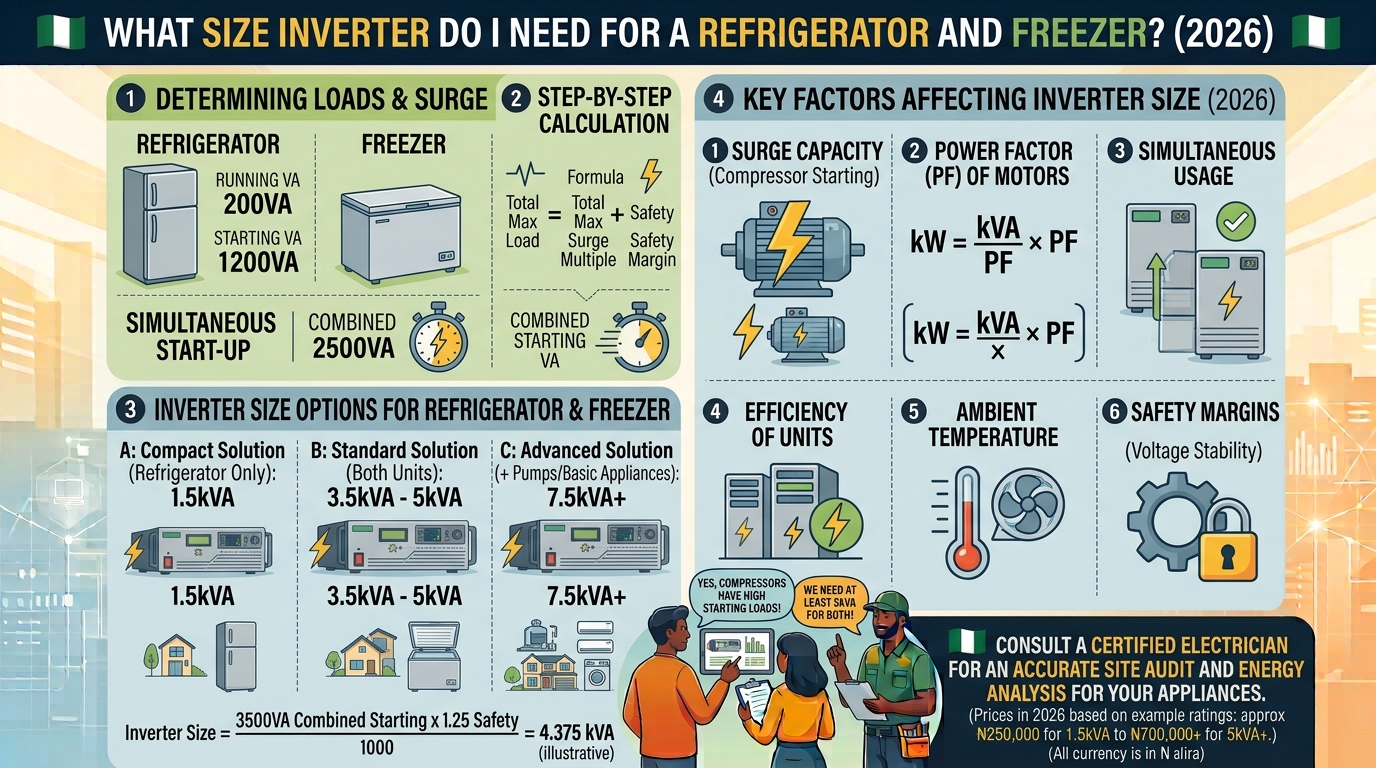
You need to consider:
- refrigerator running power
- freezer running power
- starting surge
- other appliances running at the same time
A refrigerator and freezer by themselves may not require a large inverter, but when you add fans, lights, TV, pump or AC, the total load can rise quickly.
What Size Inverter Do I Need for an Air Conditioner?
This depends on the AC.
A 1HP inverter AC can have a very different power profile from a 1.5HP or 2HP unit.
As a rough example, some Nigerian solar guides use approximately 750–900W for a 1HP AC, while actual consumption varies by model and operating conditions.
For a 1.5HP AC, consumption can be higher.
If you want to run multiple ACs, inverter sizing becomes much more important.
For homes with several ACs, it may be better to perform a proper load assessment rather than relying on a simple online estimate.
What Size Inverter Do I Need for a Pump?
Check the pump’s:
- running wattage
- starting current
- voltage
- phase
A pump can have a much higher starting requirement than its normal running power.
This is why a small inverter that appears to have enough wattage on paper may still struggle to start a pump.
What About Solar Panels?
Choosing the inverter is only one part of the system.
You also need enough solar panel capacity.
For example, a 5kVA inverter could potentially be paired with different amounts of solar depending on the exact model.
One 5kVA model may have a different maximum PV input from another.
Current Nigerian listings show 5kVA models with very different specifications and prices, including models with substantial built-in MPPT capacity.
So check:
- Maximum PV power
- Maximum PV voltage
- MPPT voltage range
- Maximum PV current
Use our [Solar Panel Calculator] to estimate your panel requirement.
What About the Battery?
The inverter determines how much power you can use at one time.
The battery determines how long you can continue using that power when solar or grid power is unavailable.
For example, you could have:
5kVA inverter + 5kWh battery
or:
5kVA inverter + 10kWh battery
The inverter is the same size, but the second system can store much more energy.
Use our Battery Calculator to estimate the battery capacity you need.
You can also read:
How Many Batteries Do I Need for a Solar System in Nigeria?
Should I Buy a Bigger Inverter for Future Expansion?
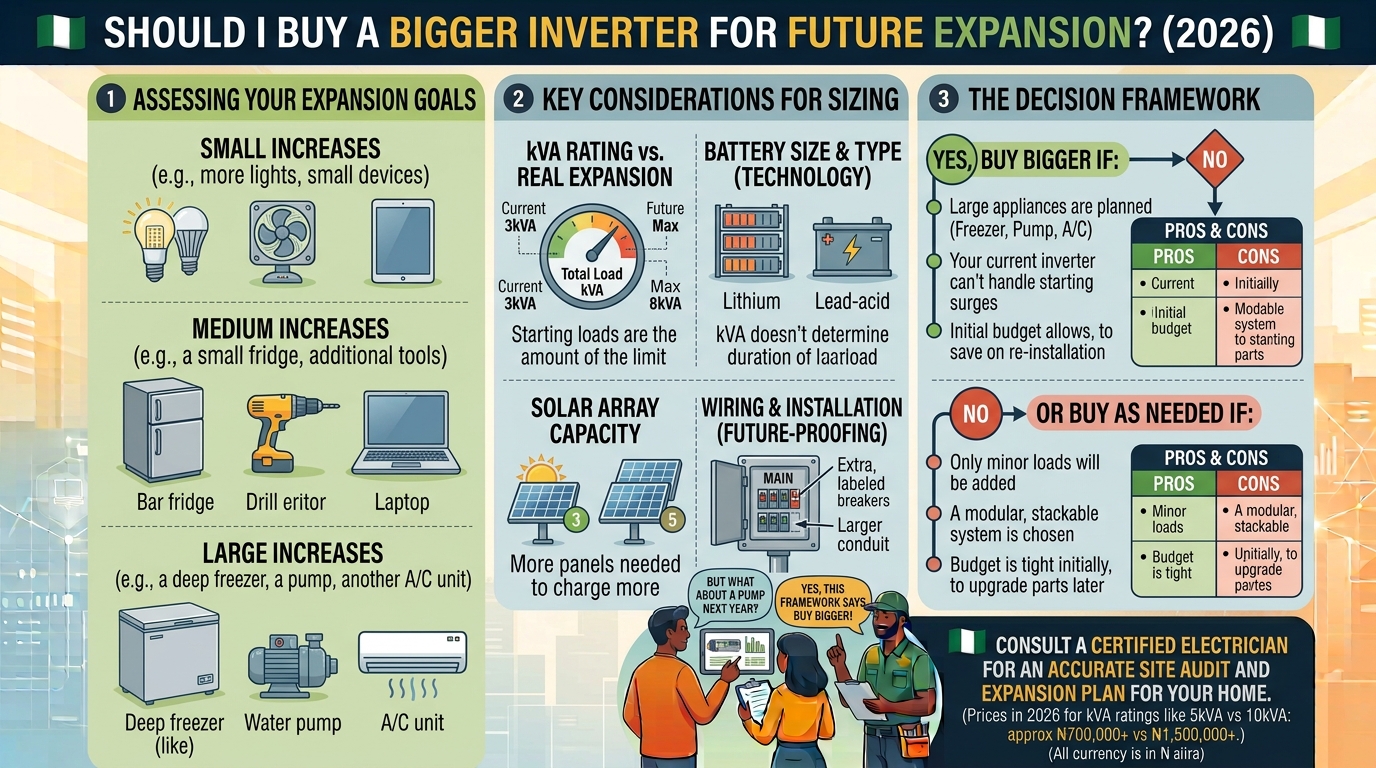
Sometimes this makes sense.
For example, if you currently need about 3kVA but plan to add an air conditioner, pump or other major appliances later, you might consider a larger inverter.
But don’t oversize blindly.
Check whether the inverter supports:
- your battery voltage
- your expected solar array
- future battery expansion
- parallel operation if needed
A larger inverter also costs more, so future expansion should be planned carefully.
5kVA vs 8kVA vs 10kVA
Here is a simple way to think about them:
| Inverter | General Use |
|---|---|
| 5kVA | Medium residential loads |
| 8kVA | Larger homes and heavier loads |
| 10kVA | Large homes, offices and higher loads |
These are not strict limits.
The actual usable wattage depends on the model.
Don’t Confuse Inverter Size With Battery Size
This is very important.
Inverter size = how much power you can use at once.
Battery size = how much energy you can store.
Solar panel size = how much solar energy you can harvest.
For example:
5kVA inverter + 10kWh battery + 5kW solar panels
is a completely different system from:
5kVA inverter + 5kWh battery + 2kW solar panels.
The inverter rating is the same, but the overall system performance can be very different.
How Much Does the Inverter Size Affect Cost?
Generally, larger inverters cost more, but the exact price depends heavily on the brand and features.
Current Nigerian listings show a wide spread even among 5kVA models. For example, recent Jumia listings include 5kVA units from roughly ₦285,000 to over ₦1.2 million, depending on brand, voltage, type and features.
This is why you should compare the exact model, not just the kVA number.
For current estimates, visit our: Solar Prices in Nigeria page.
You can also read:
How Much Is a Solar Inverter in Nigeria? Current Prices and Buying Guide
A Simple Way to Choose Your Inverter
Follow these steps:
1. List the appliances you want to power.
2. Find their running wattage.
3. Add the loads you expect to use at the same time.
4. Identify appliances with starting surges.
5. Check the inverter’s continuous watt rating.
6. Check its surge rating.
7. Add a reasonable margin for future needs.
8. Check battery voltage compatibility.
9. Check solar input capacity.
10. Compare the complete system cost.
This is much safer than simply saying:
“I have a three-bedroom house, so I need 5kVA.”
Use Our Inverter Calculator
If you don’t want to calculate everything manually, use our:
Add the appliances you want to run and their expected usage.
The calculator can help you estimate the inverter capacity required based on your selected loads.
Then use our:
to estimate your backup requirement.
And:
to estimate the solar panel capacity.
Finally, use our:
Solar Installation Cost Calculator
to estimate the cost of the complete installation.
Final Advice
There is no single inverter size that is right for every Nigerian home.
A small home with basic loads may work well with a 1kVA, 2kVA or 3kVA system.
A medium home may need 5kVA or 6kVA.
A large home with several air conditioners, pumps and other heavy appliances may need 8kVA, 10kVA or more.
The important thing is to calculate your actual load before buying.
Remember:
Don’t choose your inverter based on the number of bedrooms. Choose it based on the appliances you want to run.
Start with our Inverter Calculator, then use the Battery Calculator and Solar Panel Calculator to build the rest of the system.
For current Nigerian equipment prices, check our Solar Prices in Nigeria database.
You can also read:
- How to Choose the Right Solar System for Your Home in Nigeria
- How Much Is a Solar Inverter in Nigeria? Current Prices and Buying Guide
- How Many Batteries Do I Need for a Solar System in Nigeria?
- How Many Solar Panels Do I Need for My House in Nigeria?
- Solar Installation Cost in Nigeria: 2026 Complete Price Guide