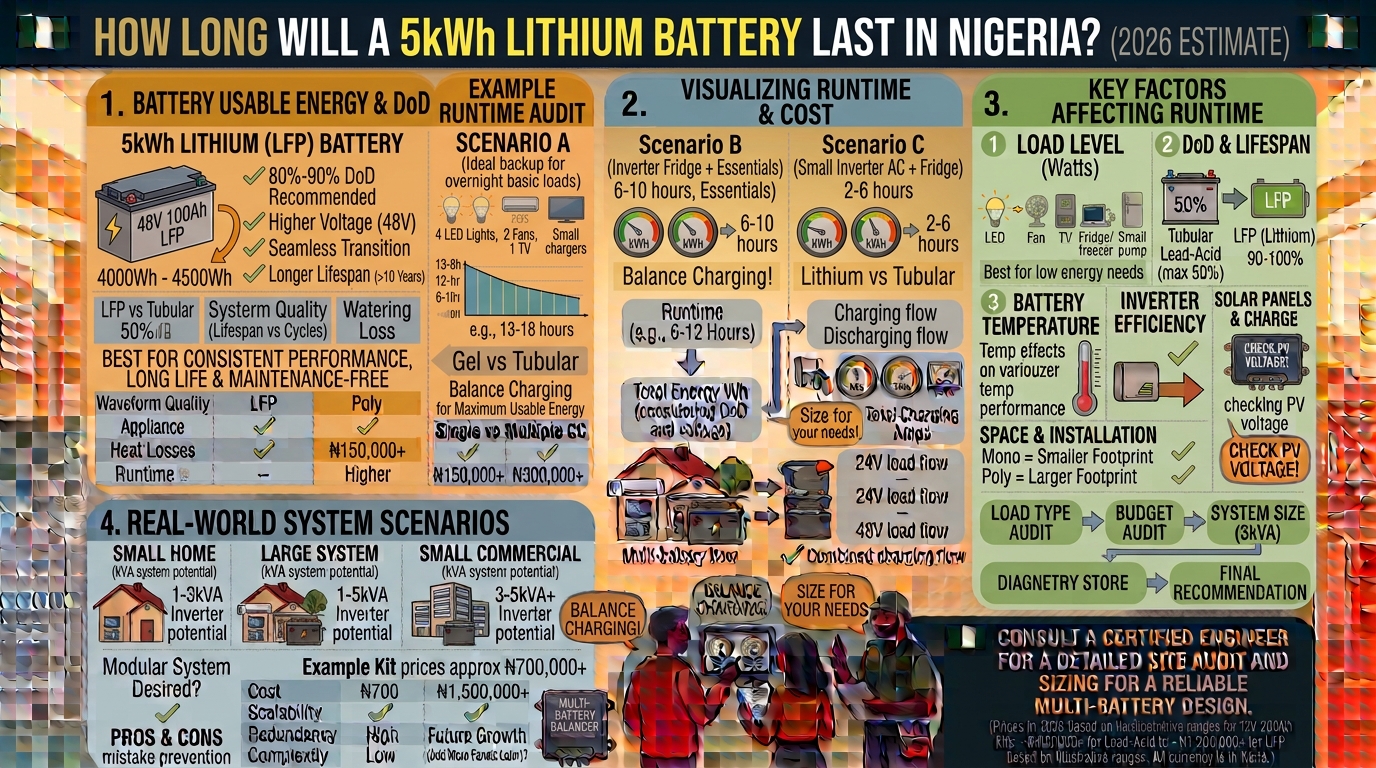
If you are thinking about buying a 5kWh lithium battery for your home or office, one of the first questions you may have is:
How many hours will a 5kWh lithium battery last?
The answer depends mainly on how much electricity your appliances use.
A 5kWh battery does not automatically mean that it will power a house for 5 hours, 10 hours or 20 hours.
For example, a home using an average of 500 watts will get much longer backup than a home using 1,500 watts.
Your actual backup time also depends on the battery’s usable capacity, inverter efficiency, battery condition and the way your appliances use power.
In this guide, we will show you how to estimate the backup time of a 5kWh lithium battery using simple examples.
What Does a 5kWh Battery Mean?
A 5kWh battery can store approximately:
5 kilowatt-hours of energy
or:
5,000 watt-hours (Wh)
This is the battery’s nominal energy capacity.
However, the amount of energy that reaches your appliances will not be exactly 5,000Wh.
There can be losses from:
- The inverter
- Cables
- Battery management system
- Battery temperature
- Battery operating conditions
The battery manufacturer may also specify a recommended depth of discharge.
So it is better to use usable energy rather than simply assuming that the entire 5kWh is available.
How Long Will a 5kWh Battery Last?
The basic calculation is:
Backup Time = Usable Battery Energy ÷ Average Load
For example, if you had exactly 5,000Wh available and your appliances were using:
500W
then:
5,000Wh ÷ 500W = 10 hours
But this is a simple theoretical calculation.
Real-world backup will normally be lower after allowing for inverter losses and the battery’s recommended usable capacity.
This is why a 5kWh battery should not be advertised as automatically providing 10 hours of backup.
5kWh Battery Backup Time at Different Loads
Here is a simple way to understand the difference.
| Average Load | Theoretical Runtime* |
|---|---|
| 200W | 25 hours |
| 300W | 16.7 hours |
| 500W | 10 hours |
| 750W | 6.7 hours |
| 1,000W | 5 hours |
| 1,500W | 3.3 hours |
| 2,000W | 2.5 hours |
| 2,500W | 2 hours |
*These are simple theoretical calculations using the full 5,000Wh. Actual runtime will be lower depending on usable battery capacity, inverter efficiency and other losses.
The table shows the most important point:
The battery does not determine your backup time by itself. Your load matters just as much.

What Can a 5kWh Lithium Battery Power?
A 5kWh battery can potentially power a combination of appliances such as:
- LED lights
- Fans
- Television
- Decoder
- Wi-Fi router
- Laptop
- Refrigerator
- Freezer
- CCTV
- Small office equipment
- Some inverter air conditioners
But there is no universal list of appliances that a 5kWh battery can run.
The question is not simply:
“How many appliances?”
It is:
“How much power are those appliances using and for how long?”
For example, ten small LED bulbs may consume less power than one large air conditioner.
Example 1: 300W Home Load
Suppose your evening load is approximately:
- LED lights — 40W
- TV — 100W
- Fans — 100W
- Wi-Fi router — 15W
- Laptop — 45W
Total:
300W
Using the simple 5,000Wh capacity:
5,000 ÷ 300 = 16.7 hours
After allowing for battery and inverter losses, the actual runtime will be lower.
This type of load is much easier for a 5kWh battery to handle for a long period.
Example 2: 500W Home Load
Suppose your average load is:
500W
The simple calculation is:
5,000 ÷ 500 = 10 hours
So a 5kWh battery can theoretically supply 500W for 10 hours if the full 5,000Wh were available.
In real use, expect less because of system losses and the battery’s usable capacity.
This is why a 5kWh battery can be a useful size for essential overnight loads in many homes.
Example 3: 1,000W Load
Now suppose your average load is:
1,000W
The theoretical calculation becomes:
5,000 ÷ 1,000 = 5 hours
So the battery has approximately five hours of theoretical runtime at a constant 1,000W load.
Again, actual runtime will depend on the system.
If you increase the load, the backup time drops.
Example 4: 1,500W Load
At:
1,500W
the simple calculation becomes:
5,000 ÷ 1,500 = 3.33 hours
So you might get around three hours and some minutes under a simple theoretical calculation.
Actual runtime will depend on the battery’s usable energy and inverter efficiency.
This is why running heavy appliances continuously can drain a 5kWh battery much faster than running only lights, fans and a TV.
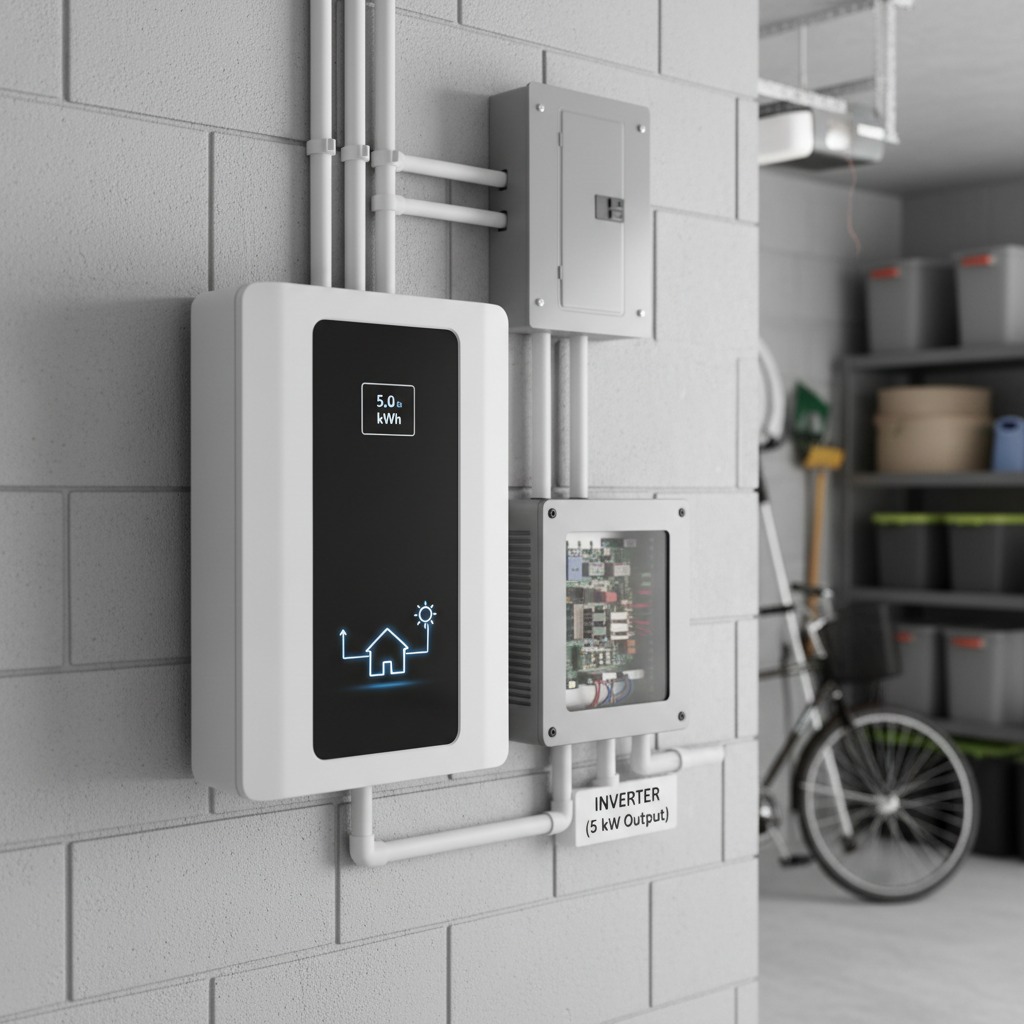
Can a 5kWh Battery Power a 3-Bedroom House?
It can, but it depends on what you mean by power a 3-bedroom house.
If you mean essential loads such as:
- Lights
- Fans
- TV
- Router
- Refrigerator
- Laptop
- Small electronics
then a 5kWh battery may provide useful overnight backup depending on the total load.
But if you want to run:
- Air conditioners
- Water heater
- Electric cooker
- Large freezer
- Water pump
- Multiple heavy appliances
the battery will drain much faster.
The number of bedrooms does not determine battery size.
Your electrical load determines battery size.
Can a 5kWh Battery Run an Air Conditioner?
It can, depending on the air conditioner’s power consumption and how long you want to run it.
For example, suppose an inverter air conditioner averages:
600W
A simple calculation using 5,000Wh gives:
5,000 ÷ 600 = 8.3 hours
But this is not a promise of 8.3 hours.
The air conditioner may not consume a constant 600W.
Its power use can change depending on:
- Temperature setting
- Room temperature
- Room insulation
- Outdoor temperature
- Compressor operation
- Air conditioner efficiency
And you still have inverter and battery losses.
If you add lights, fans, TV, refrigerator and other appliances, the total load becomes higher.
Can a 5kWh Battery Run a Refrigerator Overnight?
A refrigerator is different from a simple 500W heating element because its compressor cycles on and off.
It may not consume its maximum rated power continuously.
For example, a refrigerator might have a running power of around 100W to 200W at certain times, but its actual daily energy consumption depends on the model and conditions.
This means you should use the refrigerator’s actual energy rating where available rather than simply multiplying its maximum wattage by 24 hours.
A 5kWh battery can potentially support a refrigerator together with other essential loads, but the exact runtime depends on the total energy consumption.
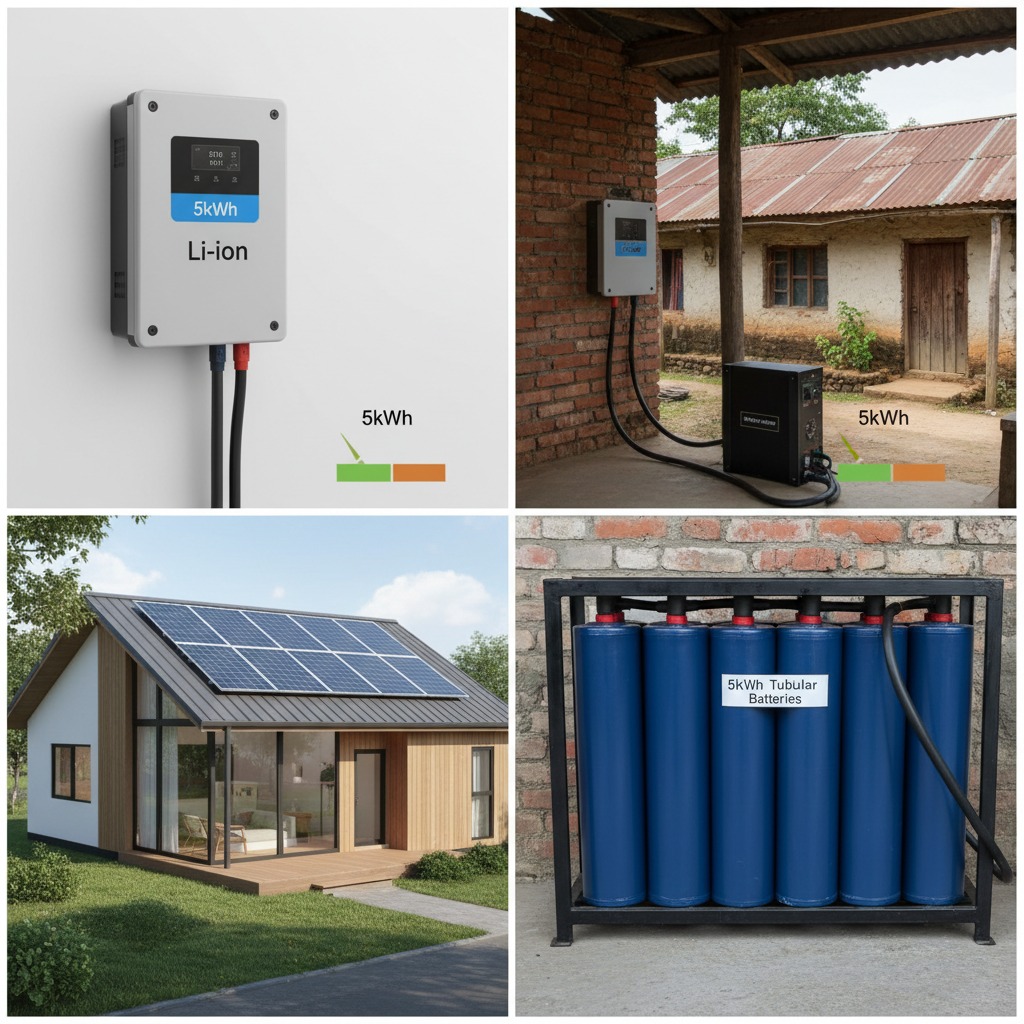
5kWh Lithium vs Tubular Batteries
A 5kWh lithium battery and a lead-acid battery bank can have very different practical performance.
Lithium batteries generally allow a deeper discharge and are often designed for frequent cycling.
Lead-acid batteries usually require more care around depth of discharge if you want to preserve their lifespan.
For example, if a system needs a certain amount of usable energy, you may need a larger nominal lead-acid battery bank than lithium to achieve the same practical usable energy.
The exact usable percentage should always come from the battery manufacturer’s specifications.
For a broader comparison, see:
Lithium vs Tubular Battery: Which Is Better for Solar in Nigeria?
How Much Solar Do I Need to Recharge a 5kWh Battery?
The battery is only one part of the system.
You also need enough solar panels to replace the energy you use.
The required solar capacity depends on:
- Daily energy consumption
- Battery capacity
- Peak sun hours
- Panel efficiency
- System losses
- Charge controller
- How quickly you want the battery recharged
- Whether appliances are also running during the day
For example, a person who uses only 2kWh per day has a very different solar requirement from someone who uses 5kWh or 10kWh.
You can use our:
to estimate the solar panel capacity required for your system.
What Size Inverter Do I Need for a 5kWh Battery?
The battery capacity does not automatically determine the inverter size.
A 5kWh battery can be connected to different inverter sizes, provided the battery voltage, discharge capability and other specifications are compatible.
Your inverter should be selected based on the maximum power you expect to use at one time.
For example:
If your appliances can reach:
2,000W
you need an inverter capable of handling that load and any applicable starting surge.
If your appliances can reach:
4,000W
you need a larger inverter.
Use our:
to estimate the inverter size for your appliances.
What Battery Voltage Is a 5kWh Lithium Battery?
There is no single voltage for every 5kWh lithium battery.
You may find batteries around this capacity in configurations such as:
- 24V
- 48V
- 51.2V
For example:
48V × 100Ah = 4.8kWh
A battery marketed as approximately 5kWh may therefore be based on a 48V/51.2V 100Ah-class configuration.
You should always check the actual battery specifications before buying.
Do not choose a battery based only on the words “5kWh lithium battery.”
Check:
- Nominal voltage
- Ah capacity
- Usable capacity
- Maximum charge current
- Maximum discharge current
- Recommended depth of discharge
- BMS rating
- Inverter compatibility
- Warranty
How Long Does a 5kWh Lithium Battery Take to Charge?
There is no fixed charging time.
It depends on the charging power.
For example, ignoring losses for a moment:
5kWh ÷ 1kW = 5 hours
5kWh ÷ 2kW = 2.5 hours
But real charging takes longer because charging is not 100% efficient and many lithium batteries reduce their charging current as they approach full charge.
The inverter, charge controller and battery’s maximum charging current also limit the charging speed.
Why Does My 5kWh Battery Finish Faster Than Expected?
If your battery is not lasting as long as you expected, check:
Your actual load
You may be using more watts than you thought.
Battery usable capacity
The full rated capacity may not be available as AC power.
Inverter efficiency
Some energy is lost while converting DC battery power to AC.
Battery condition
An older or damaged battery may have reduced capacity.
Temperature
Battery performance can change with temperature.
Appliance cycling
Fridges, freezers and air conditioners don’t always consume a constant amount of power.
Standby loads
Some appliances continue consuming power even when you are not actively using them.
How Can I Make a 5kWh Battery Last Longer?
The easiest way is to reduce unnecessary energy consumption.
You can:
- Turn off appliances you are not using.
- Use LED lighting.
- Use energy-efficient fans.
- Avoid running heavy appliances unnecessarily.
- Use efficient refrigerators.
- Avoid running an electric heater from the battery.
- Monitor your actual power consumption.
- Set the battery according to the manufacturer’s recommended settings.
Remember:
Reducing your load increases your backup time.
How Much Is a 5kWh Lithium Battery in Nigeria?
The price depends on the battery brand, chemistry, voltage, BMS, warranty, seller and current market conditions.
There is therefore no single price that applies to every 5kWh lithium battery.
For current Nigerian market estimates, check our:
You can also see our detailed guide:
How Much Is a Lithium Battery in Nigeria? 2026 Prices by Capacity
We recommend checking the specifications along with the price because two batteries with similar capacity can have very different features and warranties.
Use the SolarPriceNG Battery Calculator
You don’t have to guess whether a 5kWh battery is enough for your home.
Start by listing the appliances you want to use and how many hours you want them to run.
Our:
can help you estimate the battery capacity required for your load and backup period.
You can then use the other calculators:
to estimate the inverter size.
to estimate the solar panel requirement.
to estimate the charge controller size where a separate controller is required.
And our:
Solar Installation Cost Calculator
to estimate installation costs.
Final Answer: How Many Hours Will a 5kWh Battery Last?
A 5kWh lithium battery has approximately:
5,000Wh of nominal energy.
Theoretical runtime can be estimated by:
5,000Wh ÷ Load in watts
So:
- 300W load: about 16.7 hours theoretically
- 500W load: about 10 hours theoretically
- 750W load: about 6.7 hours theoretically
- 1,000W load: about 5 hours theoretically
- 1,500W load: about 3.3 hours theoretically
- 2,000W load: about 2.5 hours theoretically
These are not guaranteed real-world figures.
Your actual backup time will depend on the battery’s usable capacity, inverter efficiency, appliance behaviour, battery condition and other system losses.
The most important thing to remember is:
A 5kWh battery does not give every home the same number of hours.
A home using 300W can get much longer backup than a home using 1,500W.
Before buying a battery, calculate your actual load and desired backup time.
Use the SolarPriceNG Battery Calculator to estimate the battery capacity you need.
Then check estimated Nigerian market prices on our:
Solar Prices in Nigeria page.