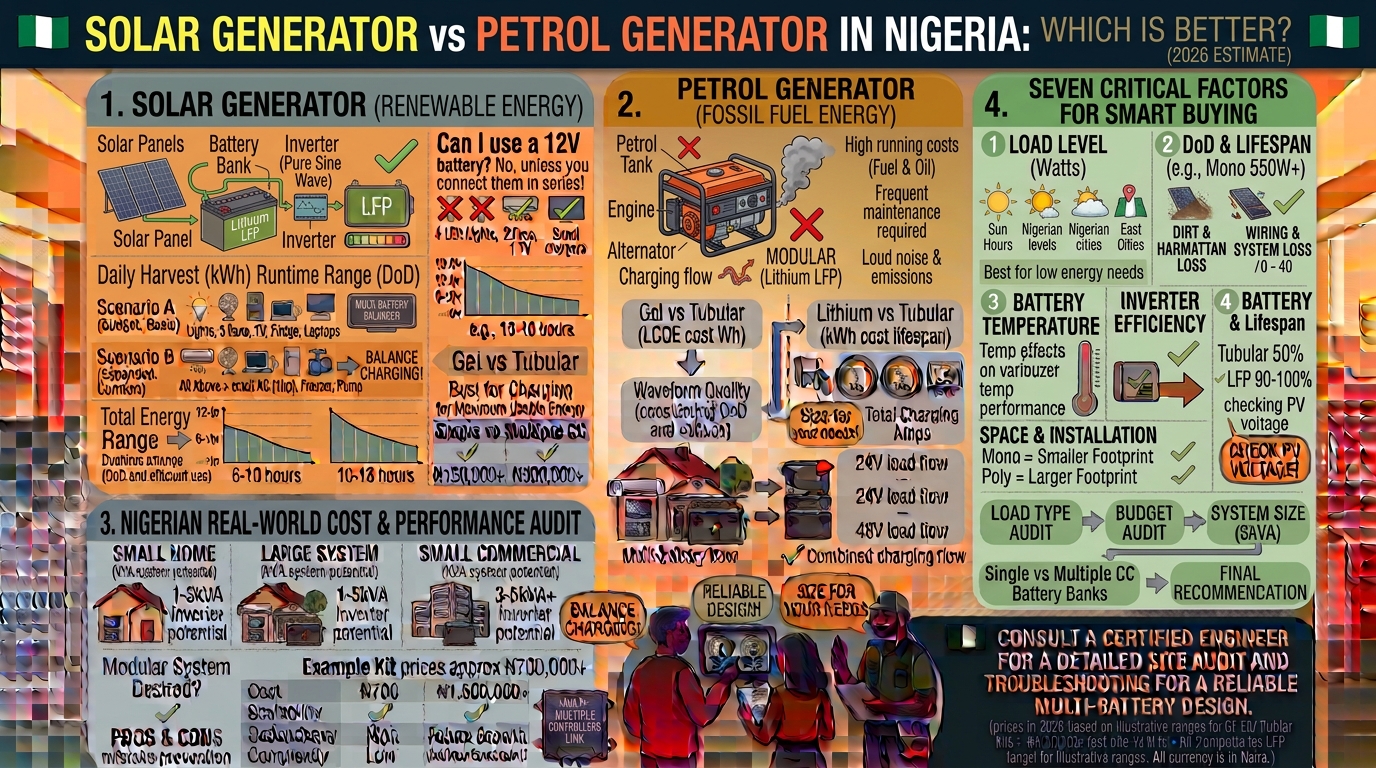
If you need backup electricity in Nigeria, you may be wondering whether you should buy a solar generator or continue using a petrol generator.
Both can provide electricity when public power is unavailable, but they work in very different ways.
A petrol generator uses an engine and petrol to produce electricity. A solar generator, also called a portable power station, stores electricity in a battery and uses an inverter to supply power to your appliances.
So, which one is better?
The honest answer is that it depends on what you want to power, how long you need backup, your budget and how often you use it.
For someone who mainly needs to charge phones, run a laptop, TV, router and lights, a solar generator can be very convenient.
For someone who needs to run heavy appliances for many hours, a petrol generator may still be more practical.
And for a home that wants quiet daily backup while reducing its dependence on fuel, a solar generator or a properly designed solar system can be a better long-term option.
Let’s compare them.
Solar Generator vs Petrol Generator at a Glance
| Feature | Solar Generator | Petrol Generator |
|---|---|---|
| Main energy source | Stored electricity | Petrol |
| Engine | No | Yes |
| Fuel required while running | No | Yes |
| Noise | Very low | High |
| Exhaust fumes | No | Yes |
| Mechanical maintenance | Low | Regular |
| Portability | Usually easy to move | Depends on size |
| Charging/refuelling | Electricity or solar | Petrol |
| Running cost | Low when using stored energy | Fuel is required during operation |
| Long continuous use | Limited by battery capacity | Can continue with fuel |
| Heavy appliances | Depends on inverter output | Depends on generator size |
| Solar charging | Available on compatible models | No |
| Indoor operation | Follow the manufacturer’s instructions | Never operate indoors |
Neither option is automatically better for everyone.
The right choice depends on your actual electricity needs.
What Is a Solar Generator?
A solar generator is a battery-based power system that normally combines battery storage, an inverter and charging electronics in one unit.
Depending on the model, it can be charged from:
- Solar panels
- Public electricity
- A vehicle
- Other supported charging sources
Many products sold as solar generators are also called portable power stations.
The main difference from a traditional generator is that a solar generator does not need to burn petrol while supplying power from its stored battery energy.
If you want to understand the technology itself, our guide on what a solar generator is and how it works explains the basic system in simple terms.
SolarPriceNG currently lists portable power stations from small units around 240Wh and 500Wh to models above 3,000Wh, with output power also varying widely between products. (Solar Generator & Portable Power Station Prices in Nigeria)
What Is a Petrol Generator?
A petrol generator uses an internal combustion engine to produce electricity.
The basic process is:
Petrol → Engine → Generator → Electricity
You put petrol into the tank, start the engine and the generator produces electricity while it is running.
This is one reason petrol generators remain popular in Nigeria.
You do not have to wait for a battery to charge before using one. As long as you have enough fuel and the generator is correctly sized for your appliances, it can continue supplying power.
The downside is that every hour of operation uses fuel.
You also have engine oil, servicing, spark plugs, air filters and other maintenance to consider.
Which One Is Cheaper to Buy?
It depends on the size and type of equipment.
A small petrol generator can be cheaper to buy than a large solar generator.
But portable power stations also come in many sizes.
For example, current SolarPriceNG listings include small units around 500Wh, while larger 2,000Wh and 4,000Wh-class units cost much more. (solarpriceng.com)
This is why you should not compare only the purchase price.
You should also consider how much it will cost to operate and maintain the equipment over time.
Which One Is Cheaper to Run?
This is where the difference becomes more important.
A petrol generator needs fuel whenever it is running.
If you use it regularly, fuel can become a major part of your electricity cost.
A solar generator does not need petrol while it is supplying electricity from its battery.
However, that does not mean solar electricity is completely free.
The battery needs to be charged.
You may charge it from public electricity, solar panels or another supported charging source.
If you buy solar panels with the power station, there is also an additional upfront cost.
So the better question is not:
“Is solar free?”
A better question is:
“How much will this backup system cost me to own and operate over time?”
Petrol Generator Fuel Cost in Nigeria
Fuel is one of the biggest ongoing costs of running a petrol generator.
Your actual cost depends on:
- Generator size
- Appliance load
- Number of hours used
- Generator efficiency
- Petrol price
- How often you experience power outages
A generator that runs for one hour occasionally is very different from one that runs for six or eight hours almost every day.
This is why someone who rarely uses a generator may not recover the higher purchase price of a solar generator quickly.
But someone who runs a petrol generator frequently can spend a significant amount on fuel over time.
Solar Generator vs Petrol Generator: Noise
This is one area where the solar generator has a clear advantage.
A petrol generator has an engine, and that engine produces noise whenever it is running.
A battery-based solar generator does not have a petrol engine running beside you.
This can make a big difference if you:
- Work from home
- Sleep during power outages
- Live close to neighbours
- Run a business where noise is a problem
- Simply want quieter backup power
A portable power station can run appliances such as a TV, router, laptop and lights without the engine noise associated with a petrol generator.
What About Fumes?
A petrol generator produces exhaust gases.
For this reason, a petrol generator should never be operated inside a house, room, garage or other enclosed space.
Exhaust gases can contain carbon monoxide, which is dangerous and can be fatal.
A battery power station does not have a petrol engine producing exhaust fumes.
However, you should still follow the manufacturer’s instructions for operating and charging the particular power station.
Do not assume every electrical product can be used anywhere simply because it does not burn petrol.
Which One Needs More Maintenance?
A petrol generator has an engine, so it requires regular mechanical maintenance.
Depending on the generator, this can include:
- Engine oil changes
- Spark plug replacement
- Air filter cleaning or replacement
- Fuel-system maintenance
- General engine servicing
A solar generator has no petrol engine.
That means there are fewer mechanical parts to maintain.
However, the battery and electronics still matter.
Battery performance can change with age, temperature, usage and charging conditions.
You should therefore follow the manufacturer’s instructions for charging, storage and operating conditions.
Which One Is Better for Long Power Outages?
This depends on the size of the solar generator.
A petrol generator can continue producing electricity as long as you keep supplying fuel.
A battery power station has a limited amount of stored energy.
For example, if a power station has a 2,048Wh battery, it does not have unlimited electricity.
Its actual runtime depends on:
- Battery capacity
- Appliance power
- Usable battery capacity
- Inverter losses
- Other conversion losses
- How much of the battery you use
This is why you should not choose a solar generator based only on the watt rating printed on the product.
You need to understand both Wh and W.
Wh vs W: Why Both Matter
This is one of the most important things to understand when buying a solar generator.
Wh tells you how much energy the battery stores.
W tells you how much power the inverter can supply at one time.
For example, a power station rated:
2,048Wh / 2,400W
has approximately 2,048Wh of battery storage and a 2,400W continuous output rating, subject to the manufacturer’s specifications.
The 2,048Wh figure does not mean the unit can power a 2,048W appliance.
Likewise, a 2,400W output rating does not mean the battery stores 2,400Wh.
You need both figures.
Our solar generator price guide for Nigeria explains the different battery capacities and price ranges currently available.
You can also compare individual models in the SolarPriceNG solar generator and portable power station price database.
Can a Solar Generator Run a Refrigerator?
Yes, some can.
But you should not assume that every solar generator can run a refrigerator simply because the refrigerator has a relatively low running wattage.
Refrigerators have compressors.
When the compressor starts, it can require more power than it uses during normal operation.
This is called startup or surge power.
When choosing a solar generator for a refrigerator, check:
- Continuous AC output
- Surge output
- Battery capacity
- Refrigerator running power
- Refrigerator starting requirement
The same applies to freezers, pumps, air conditioners and other appliances with motors or compressors.
If you are unsure about the difference between normal and starting power, the Inverter Calculator can help you understand how running and startup loads affect the required inverter size.
Can a Solar Generator Run an Air Conditioner?
Some large models can run certain air conditioners.
But this requires more careful planning.
An air conditioner can consume a lot of energy, and the battery can drain quickly even if the inverter is powerful enough to handle the load.
For example, a power station may be capable of supplying an air conditioner but still provide only a short runtime.
The bigger the load, the faster the stored energy is used.
For serious home air-conditioning loads, a properly designed solar inverter and battery system may make more sense than a portable power station.
Can a Petrol Generator Run Heavy Appliances?
Generally, petrol generators are well suited to high continuous loads when the generator is correctly sized.
But the generator must still be large enough.
You need to consider:
- Running watts
- Starting watts
- Total simultaneous load
- Generator rated output
- Generator surge capacity
A generator that is too small can struggle when heavy appliances start.
The same principle applies to an inverter-based solar system.
The SolarPriceNG Inverter Calculator can help you check your running and starting power requirements before choosing an inverter.
Solar Generator vs Petrol Generator for a Small Home
For a small home that mainly needs:
- Lights
- TV
- Wi-Fi router
- Phones
- Laptops
- Small fans
a solar generator can be very convenient.
You get quiet backup without carrying petrol around.
A small portable power station can also be moved from one room to another or taken to another location.
A petrol generator can still make sense if you need longer continuous operation and already own one.
Solar Generator vs Petrol Generator for a Large Home
For a large home with:
- Several refrigerators
- Freezers
- Multiple fans
- Water pumps
- Air conditioners
- Electric cookers
- Other high-power appliances
the decision becomes more complicated.
A small portable solar generator will probably not be enough.
You may need a much larger power station, a higher-output inverter or a complete solar installation.
At this point, it may be better to design a proper solar system rather than simply buying the biggest portable power station you can find.
The Solar Calculator can help estimate the inverter, battery, solar panels and charge controller needed based on the appliances you want to run.
Solar Generator vs Petrol Generator for a Business
For businesses, reliability and operating cost are especially important.
A small business may need:
- Lights
- Fans
- POS terminals
- Phones
- Routers
- Computers
- Refrigeration
- Small equipment
A solar generator can be attractive when quiet operation and low day-to-day operating costs are important.
However, a business using welding machines, large refrigeration equipment, compressors or other heavy loads may need a larger power system.
In such cases, a petrol generator may still be useful, or the business may use a combination of solar and generator backup.
What About Solar Charging?
One major advantage of a solar generator is that compatible models can be recharged using solar panels.
This can reduce dependence on public electricity and allow you to recharge the battery during the day.
But solar charging speed depends on the power station’s maximum solar input.
For example, having a 2,000Wh battery does not automatically mean you can connect any amount of solar panels to it.
You must check the manufacturer’s:
- Maximum solar input
- Maximum PV voltage
- Maximum PV current
- Recommended solar-panel configuration
The Solar Generator Calculator can help estimate the solar charging requirement based on the battery capacity, solar input and panel size.
What Happens During Cloudy Weather?
This is one area where petrol generators have an advantage.
A petrol generator does not depend on sunlight.
If the weather is cloudy or rainy, you can refuel the generator and continue using it.
A solar generator that depends heavily on solar charging may take longer to recharge when available sunlight is poor.
However, many portable power stations can also be charged from mains electricity.
So solar charging is not necessarily the only charging option.
Which One Is More Portable?
Small solar generators are usually easy to move.
A compact power station can often be carried by one person.
Large power stations become heavier, but many are still designed with handles or wheels to make movement easier.
Petrol generators vary greatly.
A small petrol generator may also be portable, while larger models may require wheels or more than one person to move safely.
Which One Is Better During Power Outages?
It depends on what you need.
Choose a solar generator if you value:
- Quiet operation
- No petrol refuelling
- Low mechanical maintenance
- Portable backup
- Solar charging
- Running small and medium electronics quietly
Choose a petrol generator if you value:
- Long continuous runtime
- Quick refuelling
- High-power loads
- Independence from battery capacity
- Lower upfront cost for some applications
Consider both if you need flexibility
You do not necessarily have to choose only one.
Some homes and businesses use solar as their main backup and keep a petrol generator for emergencies or very heavy loads.
For example:
Solar → everyday backup
Petrol generator → extended outage or unusually heavy loads
This can reduce generator fuel use while keeping another source available when necessary.
Which One Saves More Money in Nigeria?
There is no universal answer.
It depends on how often you use your backup system.
If you rarely experience outages or rarely run your generator, spending a large amount on a solar generator may take a long time to recover through fuel savings.
If you run a petrol generator almost every day, fuel and maintenance can become a much larger long-term expense.
The purchase price also matters.
A fair comparison should include:
Purchase cost + running cost + maintenance + expected lifespan + replacement cost
rather than simply comparing the prices of the two machines.
A Simple Example
Imagine two people.
Person A
They only need:
- TV
- Router
- Laptop
- Lights
- Phones
They experience short outages and want quiet backup.
A small or medium solar generator may be a very good fit.
They do not need to start an engine every time public power goes off.
Person B
They need:
- Water pump
- Freezer
- Refrigerator
- Several fans
- Air conditioner
- Other heavy appliances
and they sometimes experience long outages.
A small portable power station will probably not be enough.
They may need a larger solar system, a larger generator or a combination of both.
This is why choosing the system based on your appliances is more important than simply choosing “solar” or “petrol.”
How to Decide Which One You Need
Before buying either system, write down the appliances you want to run.
For each appliance, find:
- Running watts
- Starting watts if applicable
- Number of hours you want to use it
- Whether you need all appliances running at the same time
Then calculate your total power requirement.
For a solar generator, you also need to estimate the battery capacity required.
The SolarPriceNG Solar Generator Calculator lets you estimate the power station size, runtime and solar recharge requirement based on your appliances.
If you are planning a complete home solar system rather than a portable power station, use the Solar Calculator to estimate the wider system.
Solar Generator or Petrol Generator: Which Is Better?
There is no single answer for everyone.
A petrol generator is still a practical choice when you need high power, long continuous operation and quick refuelling without depending on battery capacity.
A solar generator is often better when you want quiet backup, easy operation, low mechanical maintenance and the ability to recharge from solar.
For small electronics and everyday backup, a solar generator can be extremely convenient.
For heavy loads and long outages, a petrol generator can still have an important role.
And for households that want to reduce fuel use without giving up emergency backup, using solar plus a petrol generator can be a sensible approach.
The best system is the one that matches your actual electricity needs rather than the one with the biggest number printed on the box.
Final Advice Before You Buy
Do not buy a solar generator simply because it has a large Wh number.
Do not buy a petrol generator simply because it has a high kVA rating.
First ask:
What appliances do I want to run?
How many watts do they need?
How long do I need them to run?
Do any of them have high starting power?
How often will I use the backup system?
Once you know these answers, the choice becomes much easier.
You can then compare the equipment and current market prices on the SolarPriceNG solar prices page instead of choosing based only on the advertised price.