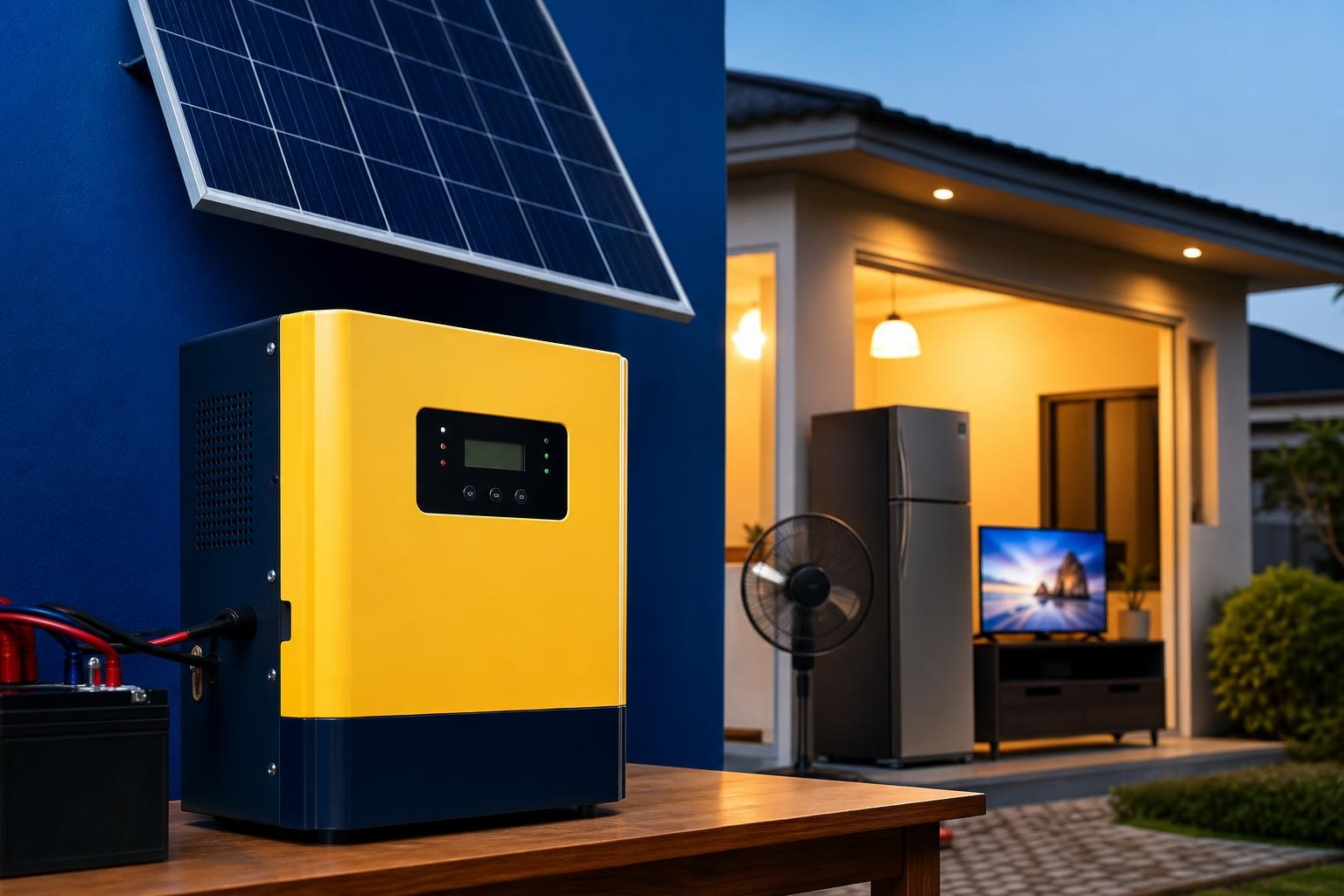
If you are considering a 2kVA inverter, the practical question is simple: which appliances can it run in your Nigerian home or small business?
A suitable 2kVA inverter can comfortably handle lights, fans, a TV, decoder, Wi-Fi router, laptops and other small electronics. It may also run a refrigerator, freezer, washing machine or small pump in the right setup, but you must check the appliance’s starting power and the inverter’s actual continuous and surge ratings.
It is not safe to assume that every appliance will work simply because the inverter is labelled 2kVA. This guide explains what a 2kVA inverter can realistically power, the combinations that make sense, what may overload it and how to estimate the battery and solar panels you need.
Quick answer: What can a 2kVA inverter power?
For many small homes, flats, shops and offices in Nigeria, a 2kVA inverter can be suitable for appliances such as:
- LED lights
- One or more TVs
- Decoder
- Wi-Fi router
- Standing or ceiling fans
- Laptops and phone chargers
- Small desktop computer setup
- Refrigerator or freezer, if the starting demand is compatible
- Some washing machines without a high-power heating function
- Some small water pumps, after checking motor starting power
The exact answer depends on the particular inverter. Check its continuous output in watts, surge capacity, battery voltage and manufacturer instructions before connecting a load.
A 2kVA inverter is not always a 2,000W inverter
kVA measures apparent power, while watts measure the real power used by your appliances. The relationship depends partly on power factor.
For example, if a 2kVA inverter has a rated power factor of 0.8, the simple conversion is:
2kVA × 0.8 = 1.6kW
That is approximately 1,600W of real power. Another 2kVA model may have a different continuous watt rating, so do not use 1,600W as a universal rule.
The value written in the manufacturer’s specification is the one you should use. Also avoid planning a system that must sit at its maximum output for long periods. Leave reasonable room for changes in appliance consumption and temporary starting surges.
A practical 2kVA inverter load for a Nigerian home
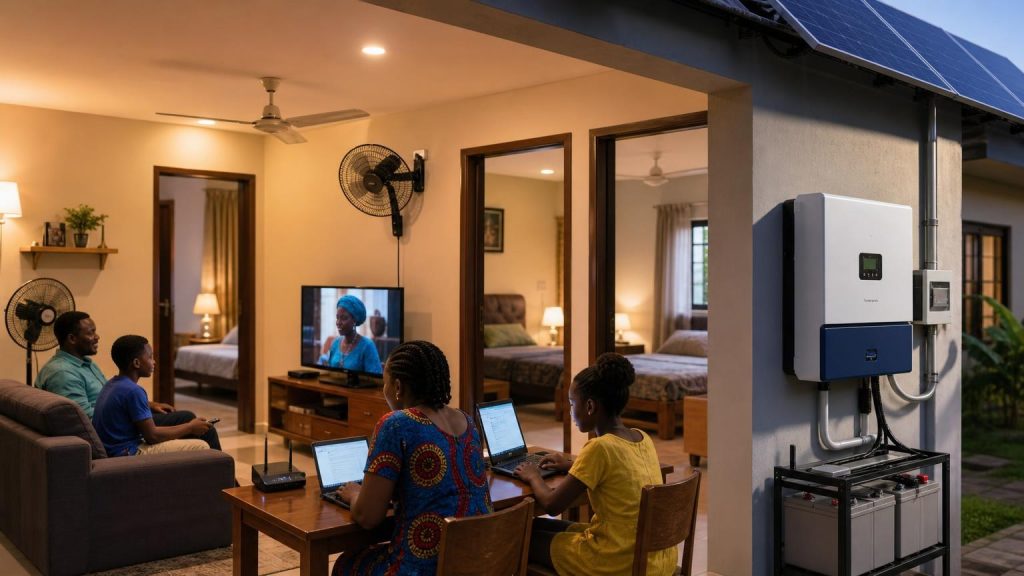
Consider a small two-bedroom flat using the inverter mainly during a power outage.
| Appliance | Quantity | Example watts each | Estimated total |
|---|---|---|---|
| LED bulbs | 6 | 10W | 60W |
| Standing fans | 3 | 60W | 180W |
| TV | 1 | 100W | 100W |
| Decoder | 1 | 15W | 15W |
| Wi-Fi router | 1 | 15W | 15W |
| Laptops | 2 | 65W | 130W |
| Phone chargers | 3 | 10W | 30W |
| Total running load | 530W |
A 530W running load is well below the continuous capacity of many 2kVA inverters. This is the type of situation where a 2kVA inverter can provide useful headroom without being unnecessarily large.
These figures are examples. Your fan, TV or laptop may use more or less power. Check the appliance label or use a suitable power meter where possible.
You can enter your actual appliances in the SolarPriceNG Inverter Calculator instead of copying an example setup.
Can a 2kVA inverter power a fridge or freezer?
It can in many cases, but you must check the compressor’s starting demand.
A refrigerator may have a modest running load after the compressor starts. The difficult moment is often the first few seconds, when the compressor can demand more power than its normal running level.
Suppose the 530W household load above is already running and you add a refrigerator using 150W during normal operation:
530W + 150W = 680W
The running total may look comfortable. However, the inverter must still handle the refrigerator’s temporary starting demand while the other appliances remain on.
Compare the appliance’s starting requirement with the inverter’s surge rating. Our guide to surge power in a solar inverter explains why this matters for refrigerators, freezers, pumps and other motor-driven appliances.
Can a 2kVA inverter power an electric iron?
Possibly, but an electric iron can use most of the available output of a small inverter.
Imagine an iron rated at 1,200W. If the basic home load is still 530W, the combined load becomes:
1,200W + 530W = 1,730W
That would exceed a 2kVA inverter whose actual continuous output is 1,600W. Even if your inverter is rated for more real power, operating close to its maximum leaves little room for other loads.
If you must use an iron, switch off unnecessary appliances and check the iron’s wattage first. Do not assume that “2kVA” guarantees enough power.
Can a 2kVA inverter power a microwave?
It depends on the microwave’s electrical input power. The cooking-output figure advertised on the front may not be the same as the power it draws from the inverter.
Check the label at the back of the microwave. If its input is close to the inverter’s continuous limit, use it only after reducing other loads. A high-power microwave combined with fans, a fridge, TV and lights can overload a small inverter.
Can a 2kVA inverter power a water pump?
A 2kVA inverter may run some small water pumps, but pump motors can draw a high current when starting. The pump’s horsepower alone is not enough information for a safe decision.
Check:
- Pump running watts
- Starting or locked-rotor demand where available
- Inverter continuous output
- Inverter surge output and how long it can maintain it
- Battery voltage and discharge capability
- Cable and protection-device requirements
If the pump is one of your main loads, ask a qualified installer to match the exact pump and inverter specifications. A motor that repeatedly causes overload shutdowns is not a suitable load simply because it starts occasionally.
Can a 2kVA inverter power an air conditioner?
Do not choose a 2kVA inverter for an air conditioner without checking the exact AC input and starting behaviour.
Some small inverter-type air conditioners may have manageable operating power under certain conditions, while conventional compressor units can place a much heavier starting demand on the inverter. Room size, thermostat setting, outdoor temperature and AC design also affect consumption.
If air conditioning is a major requirement, calculate it separately and leave room for the other appliances that will remain on. A larger inverter may be the more practical choice.
Can a 2kVA inverter power a washing machine?
Some washing machines can work with a suitable 2kVA inverter, especially simpler models without an electric water-heating function. However, the motor starting load and the power used during spinning still matter.
A model that heats water internally can use much more power than one that only runs a motor and water pump. Check the machine’s maximum input rating rather than judging by its physical size.
Appliances to be careful with on a 2kVA inverter
A 2kVA inverter is not automatically suitable for every appliance below:
- Air conditioners
- Large refrigerators or freezers
- Water pumps
- Electric irons
- Microwave ovens
- Electric kettles
- Electric cookers and hot plates
- Water heaters
- Washing machines with heaters
- Power tools and welding equipment
Heating appliances use a lot of continuous power. Motors and compressors can demand high surge power. In both cases, the appliance may leave little capacity for the rest of the house.
How much battery does a 2kVA inverter need?
The inverter size does not determine your backup time. The inverter controls how much power you can supply at once, while the battery determines how much stored energy is available.
For example, suppose your average load is 600W and you want five hours of backup:
600W × 5 hours = 3,000Wh
That is 3kWh of AC energy. The battery must provide more than 3kWh because the inverter and wiring are not perfectly efficient.
If we use 90% inverter efficiency as a planning assumption:
3kWh ÷ 0.90 = approximately 3.33kWh from the battery
A lithium battery should be planned primarily in kWh. Tubular, GEL and AGM batteries should be planned primarily in Ah, while also accounting for voltage and usable depth of discharge.
Do not buy a battery based only on the inverter’s 2kVA label. Check the inverter’s required battery voltage first. Different 2kVA models may use different battery-bank voltages.
Use the SolarPriceNG Battery Calculator to estimate the battery capacity for your load, battery type and desired backup time.
How many solar panels does a 2kVA inverter need?
A 2kVA inverter does not have one fixed solar-panel requirement. Panel sizing depends on how much energy you use each day, how quickly you want to recharge the battery, available sunlight and the inverter or charge controller’s solar-input limits.
For example, a home using 3kWh daily will need enough solar generation to replace that energy plus system losses. But you must also check:
- Maximum PV power
- MPPT operating-voltage range
- Maximum PV open-circuit voltage
- Maximum solar-charging current
- Panel series and parallel arrangement
Use the SolarPriceNG Solar Panel Calculator for an initial estimate, then confirm the final design with the inverter or charge-controller specification.
2kVA vs 1.5kVA: Is the larger inverter worth it?
A 2kVA inverter gives you more capacity than a 1.5kVA inverter, which can be useful if your normal load is close to the smaller inverter’s continuous limit or you need more surge headroom.
However, a larger inverter may also affect battery voltage, battery discharge requirements, cable size, protection devices and overall cost.
If your load is mainly lights, one TV, two fans, a router and a laptop, a smaller system may already be enough. Read what a 1.5kVA inverter can power before paying for capacity you may not need.
When should you move from 2kVA to 3kVA or higher?
Consider a larger inverter if:
- Your calculated running load is close to the 2kVA inverter’s actual continuous output.
- You regularly use several high-power appliances together.
- Your refrigerator, freezer, pump or AC has a starting demand the inverter cannot handle.
- You expect to add more appliances soon.
- The manufacturer recommends a larger inverter for your main appliance.
Do not jump to a larger size without calculating the load. A bigger inverter costs more and still needs a correctly sized battery, charging system, cables and protection.
Checklist before buying a 2kVA inverter
- List the appliances you want to run at the same time.
- Check their wattages from the appliance labels.
- Identify motors and compressors that need starting power.
- Check the inverter’s continuous watts, not only its kVA label.
- Check the surge rating and how long it is available.
- Confirm the battery voltage required by the exact model.
- Calculate backup time from the load and usable battery capacity.
- Confirm PV-input limits before choosing solar panels.
- Use suitable cables, breakers and protection specified for the system.
- Use a qualified solar installer for final design and electrical installation.
Use SolarPriceNG tools before you buy
If you are unsure whether 2kVA is enough, start with the Inverter Calculator. Enter the appliances you expect to run together and include appliances with a starting surge.
If you already have an inverter and want to test a particular appliance, use Can My Solar System Power It?
After choosing the inverter size, estimate storage with the Battery Calculator and estimate charging needs with the Solar Panel Calculator.
Finally, check current SolarPriceNG solar price information instead of relying on an old price quoted by a friend, installer or article.
Final answer
A 2kVA inverter can be a practical choice for a small Nigerian home, flat, shop or office using lights, fans, TV, router, decoder, laptops and other small appliances. It may also run a refrigerator, freezer, washing machine or small pump when the exact inverter has enough continuous and surge capacity.
Heavy heating appliances and motor-driven loads need more care. An electric iron, kettle, microwave, water pump or air conditioner can use a large part of the inverter’s output or overload it when combined with other appliances.
The correct decision is based on five things:
Continuous watts + starting watts + total appliance load + battery capacity + required battery voltage.
If the calculated load is close to the inverter’s limit, do not force the system. Reduce the load or choose the next suitable inverter size.
Frequently asked questions
Can a 2kVA inverter power a TV, fridge and fans together?
It may be able to run them together if their combined running load is within the inverter’s continuous watt rating and the refrigerator’s starting demand is within its surge rating.
Can a 2kVA inverter power an electric iron?
Possibly, but check the iron’s wattage and switch off unnecessary loads. A high-wattage iron can consume most of the usable output of some 2kVA inverters.
Can a 2kVA inverter power a freezer?
It can in some setups. Check both the freezer’s running power and compressor starting demand against the inverter’s continuous and surge specifications.
Can a 2kVA inverter power a 1HP water pump?
Do not decide from the 1HP label alone. Check the pump’s actual electrical input and starting current. Some pumps can exceed the inverter’s surge capability even when their normal running power appears acceptable.
Can a 2kVA inverter power an air conditioner?
It depends on the exact AC and inverter. Calculate the AC’s running and starting requirements and include every other appliance that will remain on. A larger inverter may be required.
How many batteries do I need for a 2kVA inverter?
There is no fixed number. It depends on the inverter’s required battery voltage, your desired backup time, the load and battery chemistry. Lithium should be sized mainly in kWh, while tubular, GEL and AGM batteries should be sized mainly in Ah.
Is a 2kVA inverter enough for a two-bedroom flat?
It can be enough for a two-bedroom flat using basic loads such as lights, fans, TV, router and laptops. The number of rooms does not determine inverter size; the appliances used at the same time do.