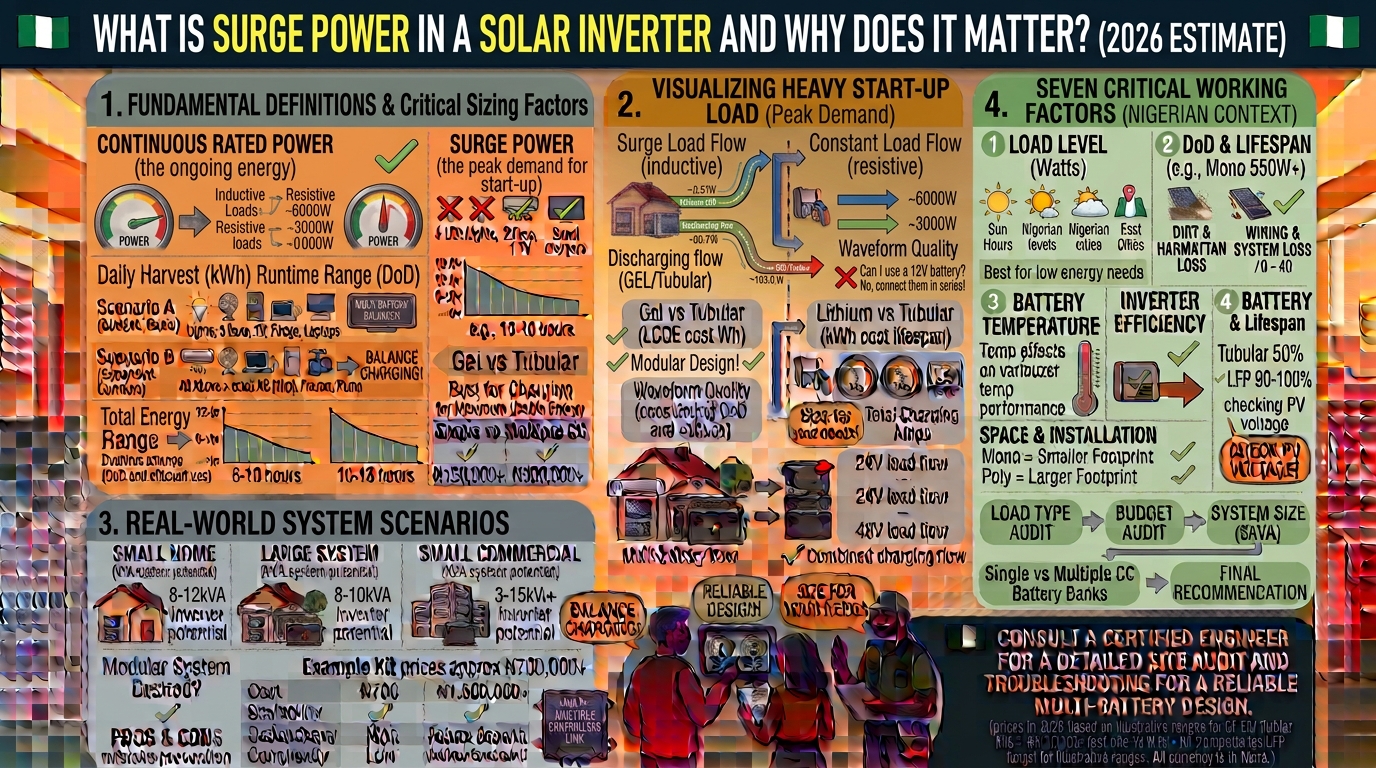
If you are buying a solar inverter, you will often see specifications such as:
5kVA continuous output
10kVA surge capacity
But what does the second number mean?
Why would an inverter need more power for a few seconds if your appliance normally uses much less?
This is where surge power comes in.
Surge power is the extra power an inverter can supply for a short period when an appliance starts.
It is especially important when you are powering appliances with motors or compressors, such as:
- Refrigerators
- Freezers
- Water pumps
- Air conditioners
- Washing machines
- Some power tools
An inverter may be able to handle an appliance while it is running but still struggle when that appliance starts if its surge capacity is not enough.
That is why looking only at the inverter’s kVA rating is not always enough.
What Is Surge Power?
Surge power is the short-term extra power an inverter can provide above its normal continuous output rating.
An appliance may have one power requirement when it is already running and another, higher requirement when it starts.
For example, imagine a motor normally uses:
800W
but briefly needs:
1,600W
when starting.
The inverter needs to handle that higher starting demand.
That extra requirement is the surge.
The exact amount and duration depend on the appliance and the inverter.
Some appliances may have a very short startup surge, while others may require more power for longer.
Running Power vs Starting Power
This is the easiest way to understand surge power.
Running power
This is the power an appliance normally uses while operating.
For example:
Refrigerator: 150W running
Starting power
This is the extra power the appliance may require when its motor or compressor starts.
For example:
Refrigerator: 600W starting
These figures are only examples. Your actual appliance can be different.
The safest approach is to check the appliance label or manufacturer’s specification.
This is also why our Inverter Calculator asks for both running watts and startup watts when available.
Why Do Some Appliances Need Surge Power?
Many appliances contain motors.
Motors can require a higher amount of electrical power when they start turning.
Common examples include:
- Refrigerator compressors
- Freezer compressors
- Water pumps
- Air-conditioner compressors
- Washing-machine motors
- Some workshop equipment
Once the motor is running normally, the power requirement can drop.
This creates two different situations:
Starting → higher power requirement
Running → normal power requirement
The inverter needs to cope with both.
A Simple Example
Imagine you have a water pump rated at:
750W running power
When the pump starts, it may temporarily require much more than 750W.
Suppose the starting requirement is 1,500W.
Your inverter therefore needs to handle:
750W continuously
and approximately:
1,500W during startup
If your inverter can continuously supply 2,000W but has very limited surge capability, the pump may still have trouble starting.
This is why continuous output and surge output are two separate specifications.
Does a 5kVA Inverter Automatically Handle Any Surge?
No.
This is a very common misunderstanding.
People sometimes think:
“It is a 5kVA inverter, so it can start anything.”
That is not correct.
The 5kVA figure tells you about the inverter’s rated capacity, but you also need to check the manufacturer’s actual specifications for:
- Continuous output power
- Surge/peak power
- Surge duration
- Power factor
- Battery voltage
- Maximum current
- Appliance compatibility
Two different 5kVA inverters can have different surge capabilities.
So you should compare the actual model specifications rather than comparing only the kVA number.
Our 3kVA vs 5kVA inverter comparison explains why a bigger inverter is not automatically the right choice and why actual appliance loads matter.
What Is Continuous Power?
Continuous power is the amount of power an inverter is designed to supply normally.
For example, an inverter may have a rated continuous output of:
5,000W
That means it is designed to supply around that level continuously, subject to the manufacturer’s specifications and operating conditions.
You should not assume that an inverter can operate indefinitely at its maximum rating in every situation.
Always check the manufacturer’s datasheet.
What Is Peak or Surge Power?
Peak or surge power is the higher amount of power the inverter can supply for a limited period.
For example, a manufacturer might specify:
Continuous output: 5,000W
Peak output: 10,000W
This does not mean the inverter is a 10,000W inverter.
It means the inverter may be capable of supplying a higher load temporarily under the conditions and duration specified by the manufacturer.
The exact surge time matters.
An inverter that can supply 10,000W for a few milliseconds is not the same as one that can supply it for several seconds.
Surge Power Is Not the Same as Extra Continuous Capacity
This is important.
Suppose you have:
5,000W continuous
10,000W surge
You cannot use 10,000W continuously.
The 10,000W figure is only for the short-term surge capability.
You should think about it like this:
Continuous rating = what the inverter can normally carry
Surge rating = what it can briefly handle when needed
The two figures serve different purposes.
Which Appliances Usually Have High Starting Surge?
The appliances most likely to cause problems are those with motors and compressors.
Refrigerators
A refrigerator may use relatively little power once running, but the compressor can require extra power when it starts.
Freezers
Freezers work in a similar way because they also use compressors.
Water pumps
Water pumps can have a significant starting demand.
The exact requirement depends on the pump motor.
Air conditioners
Air conditioners can have high startup requirements, especially models without inverter technology.
Washing machines
Some washing machines use motors that can require additional power when starting or changing operating modes.
Power tools
Certain drills, grinders, saws and other motor-driven equipment can also produce starting surges.
This is why an appliance’s normal wattage alone does not always tell you whether an inverter can run it.
What About Inverter Air Conditioners?
An inverter air conditioner can behave differently from a traditional fixed-speed air conditioner.
Instead of simply switching the compressor fully on and off, the compressor speed can be adjusted.
This can reduce sudden starting demand in some systems.
However, you should still check the actual manufacturer’s specifications.
Do not assume that every inverter AC has the same starting requirement.
What About Refrigerators?
Refrigerators are another reason surge power matters.
You may see a refrigerator rated around 100W–200W and think:
“That is a very small load.”
But the compressor does not necessarily start at exactly the same power level.
If you are designing a solar system, consider both:
Normal running load
and
Possible startup demand
This becomes even more important when several motor-driven appliances may start around the same time.
What Happens If the Inverter Cannot Handle the Surge?
If an appliance requires more startup power than the inverter can provide, several things can happen.
The inverter may:
- Fail to start the appliance
- Shut down temporarily
- Display an overload warning
- Trigger protection
- Make an alarm sound
- Restart
- Drop the output temporarily
The exact behaviour depends on the inverter.
Repeated overloads are not something you should simply ignore.
If an appliance repeatedly causes the inverter to shut down, the system needs to be checked.
Can Surge Power Drain the Battery Faster?
Yes, but the important point is that surge power is usually short-lived.
A battery may have to supply a higher current during startup.
For example, an appliance may normally consume:
500W
but briefly require:
1,500W
when starting.
The battery and inverter must provide the additional power during that period.
If the surge lasts only a short time, it may have a relatively small effect on total energy consumption compared with running the appliance for several hours.
But repeated or long surges can still matter.
Does a Bigger Battery Increase Surge Capacity?
Not automatically.
This is another common misunderstanding.
A larger battery gives you more stored energy, but surge capability also depends on:
- Inverter design
- Inverter output stage
- Battery voltage
- Battery discharge capability
- Battery BMS limits
- Battery cables
- Connections
- Protection settings
For example, a large battery connected to an inverter with limited surge capability does not automatically turn that inverter into a high-surge inverter.
The inverter must be designed to handle the required load.
Does Battery Type Affect Surge Performance?
It can.
Lithium batteries can often deliver high current, depending on the battery’s design and BMS rating.
Lead-acid batteries can also supply high starting currents, but their performance depends on the battery size, condition, temperature and discharge characteristics.
This is one reason battery selection should not be based only on Ah.
A battery’s:
- Voltage
- Ah
- kWh
- Maximum discharge current
- BMS rating
- Manufacturer specifications
can all matter.
Our Battery Calculator can help with battery capacity planning, but the actual battery’s discharge specification should always be checked for high-power loads.
Can a 3kVA Inverter Run a Refrigerator?
It can, provided the refrigerator’s running and starting requirements are within the inverter’s capabilities.
A refrigerator may use relatively little power while running, so its normal load can be quite manageable.
The question is what happens when the compressor starts.
If the inverter has enough surge capacity, the refrigerator should be able to start normally.
If the starting demand is too high, the inverter may trip or fail to start the compressor.
Can a 3kVA Inverter Run a Water Pump?
It depends on the pump.
A small water pump may work well with a suitable 3kVA inverter.
A larger pump with a high starting requirement may need more capacity.
You should check the pump’s:
- Running wattage
- Motor size
- Starting current
- Manufacturer’s recommended generator/inverter size
Do not choose the inverter based only on the pump’s running wattage.
Can a 5kVA Inverter Run a Water Pump?
A 5kVA inverter generally gives you more room than a 3kVA inverter, but the same principle applies.
The exact pump and inverter specifications still matter.
If the pump has a very high starting requirement, you need to check the inverter’s surge rating rather than assuming that 5kVA is enough.
How Do I Calculate Surge Power?
There is no single formula that can accurately predict the starting power of every appliance.
The best source is the appliance manufacturer’s specification.
Look for terms such as:
- Starting watts
- Starting current
- Locked-rotor current
- Peak power
- Surge power
- Maximum input power
If the appliance only gives you running watts, you should not simply multiply it by an arbitrary number and assume that is its exact startup requirement.
For planning, an estimate can be useful.
For final system design, use the actual manufacturer’s specifications whenever possible.
Why You Should Not Use a Fixed “3× Rule”
You may hear people say:
“Just multiply the appliance watts by three.”
This can be useful as a rough estimate in some situations, but it is not a universal rule.
Different appliances have different starting characteristics.
For example:
- One refrigerator may have a relatively small startup surge.
- Another refrigerator may have a different compressor.
- A water pump may have a much larger starting requirement.
- An inverter AC may behave differently from a conventional AC.
So:
Running watts × 3 = exact surge power
is not a reliable engineering rule.
Use the manufacturer’s data when available.
What Happens When Several Appliances Start Together?
This is where things become more complicated.
Imagine your home has:
- Refrigerator
- Freezer
- Water pump
- Air conditioner
Each appliance may have a startup surge.
If several of them start at nearly the same time, the inverter may temporarily face a much larger combined demand.
For example:
Refrigerator running: 150W
Freezer running: 150W
Pump running: 500W
AC running: 800W
The normal combined load is:
1,600W
But the starting demand could be considerably higher if multiple motors or compressors start at the same time.
This is why system design should consider the appliances that are likely to operate together.
Does Surge Power Affect Solar Panel Size?
Indirectly.
Solar panels produce energy and power for the system, but the inverter and battery must still be capable of handling the appliance load.
A large surge does not automatically mean you need more solar panels.
The solar array is mainly sized according to:
- Daily energy consumption
- Battery charging needs
- Peak sun hours
- System losses
- Inverter PV limits
- Required charging speed
However, the inverter still needs to handle the appliance’s startup demand.
This is why you should treat solar array sizing and inverter surge sizing as related but separate parts of system design.
Our Solar Panel Calculator focuses on the solar energy side, while the Inverter Calculator focuses on the inverter load requirement.
Does Surge Power Matter for Solar Generators?
Yes.
Portable power stations also use inverters.
So you should check both:
Continuous AC output
and
Surge/peak output
For example, a portable power station might have:
2,000W continuous output
and
4,000W surge output
That does not mean you can run a 4,000W appliance continuously.
It means the inverter may be able to handle a short higher demand.
This is especially important when using a portable power station with refrigerators, freezers, pumps or other motor-driven appliances.
If you are comparing portable power stations, check both their battery capacity in Wh and their inverter output in W.
You can compare available models on the SolarPriceNG solar generator and portable power station price page.
How to Read an Inverter Specification Sheet
When comparing inverters, don’t stop at the headline:
5kVA
Look for the following:
1. Rated output power
This tells you the normal output capacity.
2. Maximum or peak output
This tells you the short-term surge capability.
3. Surge duration
Find out how long the inverter can maintain the higher output.
4. Power factor
Power factor affects the relationship between kVA and actual usable kW.
5. Battery voltage
A 24V and 48V inverter can have very different battery requirements.
6. Maximum PV input
This tells you how much solar power the inverter can accept.
7. Maximum PV voltage and current
These are important when designing the solar panel arrangement.
8. Manufacturer’s appliance recommendations
Some manufacturers provide specific guidance for motor loads.
The actual manufacturer’s datasheet should always take priority over a general online estimate.
Surge Power and kVA Are Not the Same Thing
This is worth repeating.
kVA is a capacity rating.
Surge power is a temporary higher output capability.
For example, an inverter may be:
5kVA rated
with:
10kVA peak
The 5kVA rating is not the same thing as the 10kVA peak.
And you should not treat the 10kVA figure as if the inverter can continuously supply that amount.
Always check the manufacturer’s exact units and specifications.
Why Power Factor Matters
You may see:
5kVA
on an inverter and assume:
5kW
But kVA and kW are not always equal.
A simplified relationship is:
kW = kVA × power factor
For example, if an inverter has a 5kVA rating and a power factor of 0.8:
5 × 0.8 = 4kW
However, modern inverter specifications vary, and some manufacturers specify their units differently.
Always check the actual rated output in watts or kilowatts in the datasheet.
This is one reason our existing guide on choosing the right inverter size for a Nigerian home recommends checking actual appliance loads rather than choosing an inverter based only on the kVA label.
Example: 5kVA Inverter With a Refrigerator and Pump
Imagine a home has:
- Refrigerator: 150W running
- Freezer: 150W running
- Water pump: 600W running
- Lights: 150W
- Fans: 300W
- TV: 100W
Normal load:
1,450W
At first glance, this looks easy for a 5kVA inverter.
But now consider starting demand.
The refrigerator compressor may need additional power.
The freezer compressor may also need additional power.
The water pump motor may have a much higher starting requirement.
If these loads start close together, the inverter may experience a temporary peak much higher than the 1,450W running load.
This is why surge capability matters even when the normal running load looks comfortably below the inverter rating.
How Much Surge Capacity Do You Need?
There is no universal number such as:
“Every 5kVA inverter must have 10kVA surge.”
The required surge capacity depends on your appliances.
If your home contains mostly:
- Lights
- TVs
- Routers
- Laptops
- Chargers
your startup demand may be relatively small.
If your home contains:
- Pumps
- Refrigerators
- Freezers
- Air conditioners
- Washing machines
- Other motors
you should pay much more attention to surge capability.
The more motor-driven equipment you have, the more important this specification becomes.
Can You Increase an Inverter’s Surge Capacity?
Normally, you should not try to modify an inverter to increase its surge capacity.
The inverter’s surge capability is determined by its design and components.
If your system cannot handle the startup load, the correct solution may be to:
- Use a larger inverter
- Reduce simultaneous loads
- Use appliances with lower startup demand
- Stagger motor loads
- Check battery discharge capability
- Improve system design
Do not attempt unsafe modifications to force an inverter beyond its manufacturer’s specifications.
How to Reduce Startup Problems
If your inverter struggles when appliances start, there are several things you can check.
Avoid starting several heavy appliances at once
For example, you may not need to start the water pump at the same time an air conditioner and freezer compressor start.
Check the inverter’s surge rating
Make sure the inverter is suitable for your appliances.
Check the battery
A weak battery or battery with a low discharge limit can affect inverter performance.
Check cables and connections
Poor connections or undersized cables can cause voltage drop and other problems.
Check the actual appliance specifications
Do not rely entirely on generic wattage estimates.
Consider a larger inverter if necessary
If the actual load is too close to the inverter’s limits, additional capacity may be needed.
Does a Larger Inverter Always Mean Better Surge Performance?
No.
A larger inverter usually provides more output capacity, but you still need to check the actual surge specification.
For example, two 5kVA models may have different peak ratings and different surge durations.
Likewise, a well-designed 3kVA inverter may handle a particular appliance better than a poorly matched larger inverter.
The model specification matters.
Common Mistakes People Make With Surge Power
1. Looking only at kVA
A 5kVA label does not tell you everything.
2. Ignoring starting power
A refrigerator may use little power while running but still need more when starting.
3. Assuming every motor needs exactly three times its running watts
There is no universal multiplier.
4. Ignoring battery discharge limits
The inverter may be capable of handling the surge, but the battery may have its own limits.
5. Running several motor loads together
Several startup events can happen at the same time.
6. Confusing peak power with continuous power
Peak power is temporary.
7. Ignoring the manufacturer’s datasheet
The manufacturer’s specification should be the final reference for the equipment you are buying.
How to Check Your Own Solar System
If you already have a solar system and want to know whether a new appliance will work with it, start with the appliance’s running and starting requirements.
Then check your inverter’s:
- Rated output
- Surge output
- Surge duration
- Battery voltage
- Manufacturer specifications
Our Can My Solar System Power It? calculator can also help you compare an appliance with your existing inverter and other loads.
It estimates the combined running load and peak demand, but the actual inverter and appliance specifications should always be used for final confirmation.
Final Advice
Surge power is easy to ignore when buying a solar inverter because the main number you see is usually something like:
3kVA
5kVA
10kVA
But that number alone does not tell the whole story.
If your home only runs lights, TVs, routers, laptops and other simple loads, surge power may not be a major concern.
But once you introduce refrigerators, freezers, pumps, air conditioners and other motor-driven appliances, it becomes much more important.
Before buying an inverter, check:
1. Total running load
2. Starting or surge demand
3. Inverter continuous output
4. Inverter surge capacity
5. Surge duration
6. Battery discharge capability
7. Manufacturer specifications
The goal is not to buy the inverter with the biggest surge number.
The goal is to buy an inverter whose continuous and surge capabilities properly match the appliances you actually want to run.
Calculate first. Check the manufacturer’s specifications. Then buy.
Related Articles
- How Many kVA Inverters Do I Need for My Home in Nigeria?
- 3kVA vs 5kVA Inverter: Which One Is Better for Your Home in Nigeria?
- How Much Is a Solar Inverter in Nigeria? Current Prices and Buying Guide
- Pure Sine Wave vs Modified Sine Wave Inverter: Which Is Better in Nigeria?
- How Many Batteries Do I Need for a 5kVA Inverter in Nigeria?
- How Many Solar Panels Do I Need for a 5kVA Inverter in Nigeria?