
Short answer: The number of watts you need in a solar generator depends on the appliances you want to run at the same time. Add their running watts, check the highest starting surge from appliances such as refrigerators or pumps, and choose a power station whose continuous and surge output are comfortably above those requirements.
Do not choose a solar generator by battery capacity alone. A unit may have a large 1,000Wh or 2,000Wh battery but still have an inverter that cannot start your refrigerator, freezer, pump or other high-power appliance.
Also remember that watts and watt-hours are different. Watts tell you how much power the inverter can supply at one moment. Watt-hours tell you how much energy the battery stores. You need enough watts to run the appliances and enough watt-hours to run them for the required time.
What Do Watts Mean on a Solar Generator?
The watt rating on a solar generator normally describes the inverter’s output power. For example, a product may be described as having:
1,000Wh battery capacity and 1,800W output
In that example:
- 1,000Wh describes the approximate stored energy in the battery.
- 1,800W describes the inverter’s stated continuous output, subject to the manufacturer’s conditions.
The 1,800W figure does not mean the battery will run an 1,800W appliance for one hour. It only describes the power the inverter may be able to supply at one time. Runtime depends on the battery capacity and the actual load.
In simple terms, W answers “how much can it power at once?” while Wh answers “how much energy is available?”
How to Calculate the Watts You Need
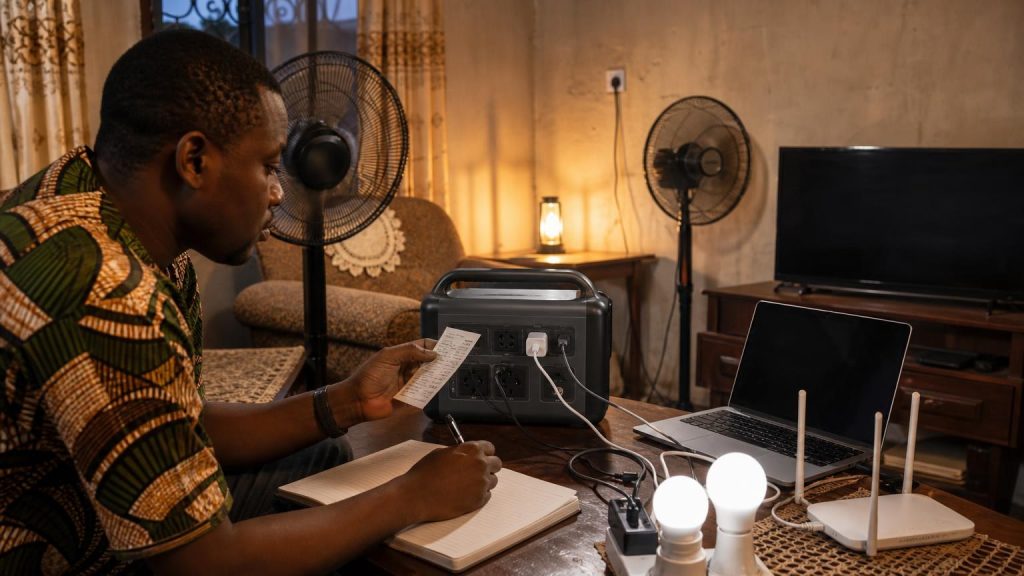
Use this process:
- List the appliances you want to use during an outage.
- Find the running watts of each appliance from its label, manual or a power meter.
- Add the running watts of appliances that may operate at the same time.
- Check the starting surge of appliances with motors or compressors.
- Choose a solar generator with enough continuous output and surge output, plus practical headroom.
The basic formula is:
Total running watts = Appliance 1 watts + Appliance 2 watts + Appliance 3 watts
Calculate the appliances you expect to use together, not every appliance in the house if they will not run at the same time.
Illustrative Appliance Wattage Example
Imagine a Nigerian home wants backup for:
| Appliance | Illustrative running watts |
|---|---|
| Television | 100W |
| Two standing fans | 120W |
| Wi-Fi router | 15W |
| LED lights | 60W |
| Laptop charger | 65W |
| Decoder | 20W |
| Total | 380W |
The actual wattage will vary by appliance model, but this example gives a running load of about 380W.
A 300W solar generator would be too small for this combination. A 500W unit may still be close to its limit, especially if the appliance labels are lower than their brief starting or charging demands. A unit with a higher continuous output gives you more practical room.
For a personalised estimate, use the Solar Generator Calculator and then confirm the result against the actual appliance labels.
How Many Watts Do I Need for Small Electronics?
If you mainly want to charge phones, power a router, run a laptop and use a few LED lights, your total load may be relatively small.
A small solar generator may be suitable for phones, tablets, a Wi-Fi router, a laptop, LED lights and other small rechargeable devices.
For this type of use, the number of outlets and USB charging ports may matter almost as much as the AC watt rating. A 300W to 500W-class unit may be enough for some small-electronics setups, but calculate your actual combined load before buying.
How Many Watts Do I Need for a TV, Fan and Lights?
A TV, fan and lights are common essential loads during a Nigerian power outage. An illustrative combination might look like this:
| Load | Illustrative watts |
|---|---|
| TV | 100W |
| Two fans | 120W |
| Six LED bulbs | 60W |
| Router and decoder | 35W |
| Total | 315W |
A power station with only 300W of continuous output would be too close to the limit for this illustrative load. A higher-rated unit may be more practical, especially if you plan to add a laptop, phone chargers or another fan.
Do not assume that a fan always uses the same number of watts. Speed settings, motor type and the specific model can change the actual demand.
How Many Watts Do I Need for a Fridge, TV and Fan?
This combination needs extra care because a refrigerator compressor can require a short starting surge that is much higher than its normal running watts.
Suppose the illustrative running load is:
- Refrigerator: 120W running
- TV: 100W
- Fan: 60W
- Total running load: 280W
A 300W unit may be unable to start the fridge even though the running total appears close to 300W. You need to check the refrigerator’s startup demand and the power station’s surge rating, not only the running total.
For this type of load, a 1kWh-class power station with a suitably higher continuous and surge output may be a more realistic starting point, but the refrigerator specification must still be confirmed. A larger battery does not fix an inverter that cannot handle the compressor.
What About Pumps, Freezers and Pressing Irons?
Some appliances are difficult to size because they either have motors or use a large amount of heat-producing power.
| Appliance type | Why it needs care |
|---|---|
| Refrigerator or freezer | Compressor starting surge |
| Water pump | Motor starting surge and high running load |
| Pressing iron | High heating load while switched on |
| Kettle | High heating load and rapid battery drain |
| Microwave | High running power and possible startup demand |
| Air conditioner | High running demand and compressor surge |
A solar generator that works well for lights and fans may be unsuitable for a pressing iron, kettle, pump or air conditioner. Never add these loads simply because the unit has unused battery capacity. The inverter’s output must also be able to handle them.
For a larger home load, use the Inverter Calculator as a planning aid and check the appliance manuals before purchasing.
Continuous Watts vs Surge Watts
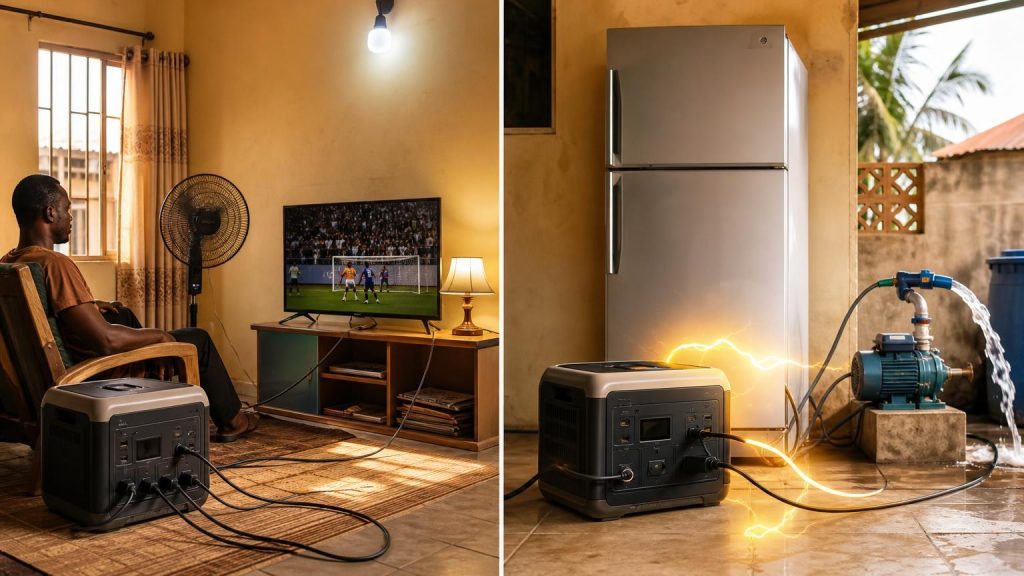
Solar generators normally have two relevant output figures:
- Continuous output: the power the inverter can supply during normal operation.
- Surge output: the higher short-term power it may supply when a motor or compressor starts.
Surge output is not a second continuous rating. A power station advertised with a higher surge figure cannot run appliances at that surge level indefinitely.
For example, a unit might have enough continuous output for a TV, fan and router but still shut down when a refrigerator compressor starts. The starting event is what exposes the weakness.
Our guide on surge power in a solar inverter explains why motor-driven appliances need this extra check.
How Much Headroom Should You Leave?
It is better not to choose a unit that will operate at its stated maximum every time you switch on your normal appliances. Practical headroom helps accommodate small differences between label wattage and real use, brief changes in load, charging electronics and appliance startup.
There is no single headroom percentage that applies to every solar generator. The manufacturer may state its operating limits, surge duration and overload behaviour. Use those limits, then avoid designing a system that is constantly at the edge.
As a simple planning approach, if your measured simultaneous running load is about 400W, do not automatically buy the smallest 400W unit you can find. Look for a unit with a higher continuous output and confirm that its surge specification matches any motor-driven appliance.
Watts Are Not the Same as Runtime
A higher-watt inverter does not automatically give longer backup. Runtime mainly depends on the battery’s Wh capacity and the load.
For example, imagine two solar generators:
| Power station | Battery | Inverter output |
|---|---|---|
| A | 1,000Wh | 500W |
| B | 1,000Wh | 1,800W |
Both have the same advertised battery capacity, so they may store a similar amount of energy. But Power Station B can supply a larger load at one time. Power Station A may still provide similar runtime for a 200W load if both systems have similar efficiency and battery condition.
This is why you must make two separate checks:
- Can the inverter handle the appliances?
- Can the battery run them for long enough?
A Simple Nigerian Power-Outage Example
Imagine you want backup for a small apartment during a six-hour outage. Your essential loads are a router, laptop, TV for part of the evening, two fans and several LED lights.
Your simultaneous load may be around 300W to 450W depending on the appliances and how many are switched on. A 500W unit could be close to its limit, while a higher-output model may give you more flexibility.
But to last six hours, the battery also needs enough usable energy:
400W × 6 hours = 2,400Wh before system losses
That does not mean you automatically need a 2.4kWh power station because your load will not stay at 400W continuously. The TV may be switched off, the fans may run at different speeds and the lights may not all be used for six hours. It does show why a watt rating alone cannot answer the full sizing question.
Estimate both the maximum simultaneous load and the total energy you expect to use.
Common Wattage Mistakes
- Confusing W and Wh: watts describe output power, while Wh describes stored energy.
- Adding every appliance in the house: calculate the appliances that can run together.
- Ignoring chargers and standby loads: routers, decoders and adapters still consume power.
- Ignoring motor startup: fridges, freezers and pumps may need much more power briefly.
- Using the surge rating as the normal rating: surge power is short-term.
- Buying the biggest number: extra watts are not useful if the battery, warranty or support is poor.
- Forgetting the solar input: if you plan to recharge from panels, check the maximum solar charging power and voltage.
What Wattage Should You Buy?
Use your measured or estimated simultaneous load as the starting point:
| Typical use | Possible starting output class | Important limitation |
|---|---|---|
| Phones, router, laptop and lights | 300W–500W class | Check ports and actual combined load |
| TV, fans, lights and electronics | 500W–1,000W class | Leave room for extra devices and startup demands |
| Fridge, TV and fan | Often 1,000W-class or higher output may be more practical | Confirm refrigerator surge before buying |
| Fridge, freezer, pump or several heavy appliances | Higher output or a fixed solar system may be needed | Calculate each motor load and battery requirement |
These are planning ranges, not universal product recommendations. A 500W unit from one manufacturer may have different surge behaviour, battery chemistry and protection from another 500W unit.
For current estimated models and Nigerian prices, compare the Solar Generator and Portable Power Station Prices in Nigeria category. Check the product’s continuous watts, surge watts, Wh capacity, battery type, solar input and warranty before deciding.
Final Answer
The right wattage for a solar generator is the wattage needed to run your appliances at the same time, plus enough surge capacity to start any motor or compressor.
As a rough starting point:
- Small electronics may fit a 300W–500W class unit.
- TVs, fans, lights and electronics may need a 500W–1,000W class unit, depending on the actual load.
- A fridge, TV and fan often need a higher-output unit with suitable compressor surge capacity.
- Pumps, freezers, pressing irons, kettles and air conditioners require more careful sizing.
Calculate the running watts, check the surge watts, then choose enough Wh capacity for the number of hours you need.