Last reviewed: September 23, 2026
If a cloudy or rainy day leaves your solar battery partly empty, the extra solar you need depends on the energy missing from the battery, the electricity your home will use while the battery is recovering, the sunlight available, and the losses in the panels, inverter, wiring and charging process.
Do not size the extra panels from the battery label alone. First calculate the energy you need to replace, then subtract the solar energy your existing array can reliably provide on a recovery day.
A practical planning formula is:
Extra solar array (kW) ≈ extra PV energy required (kWh) ÷ [useful sunlight hours × realistic system factor]
This is an estimate, not a promise of output. Nigerian cloud cover, rain, Harmattan dust, heat, shading, roof direction and daytime appliance use can change the result. Use your inverter or charge-controller readings whenever possible.
What “recover the battery” means
Recovery means bringing the battery back to the target state of charge you need for the next outage or night. It does not always mean forcing every battery to display 100% immediately.
For example, after a poor-weather day you may want to:
- replace the energy used overnight;
- restore a lithium battery from 55% to its normal evening target;
- bring a lead-acid battery back to the charging level recommended by its manufacturer; or
- recover enough energy to keep critical loads running through the next evening.
The right target depends on the battery chemistry, the manufacturer’s instructions, your expected load and whether grid or generator charging is available. A battery that is deliberately kept below full charge for a particular operating strategy should not be treated the same way as a battery that is failing to charge.
The four numbers you need before adding panels
1. Energy missing from the battery
For a lithium battery, use the verified energy capacity in kWh and the state-of-charge readings. If a 5 kWh battery is at 60% and you want to return it to 100%, the simple energy gap is:
5 kWh × (100% − 60%) = 2 kWh
This is an illustrative calculation. The usable capacity shown by the battery, the state-of-charge accuracy, the permitted charge limit and the inverter’s charging behaviour all matter.
For tubular, GEL and AGM batteries, use Ah together with voltage. A 24 V, 200 Ah bank has a nominal energy value of:
24 V × 200 Ah = 4,800 Wh, or 4.8 kWh nominal
That does not mean 4.8 kWh is available to your appliances or that you should routinely remove all of it. Apply the battery manufacturer’s recommended discharge limit, the battery’s age and condition, the discharge rate and inverter losses. Never compare a lithium battery and a lead-acid battery by Ah alone.
2. Charging and conversion losses
The panels must usually produce more energy than the battery appears to be missing. Some energy is lost in the charge controller, wiring, inverter and battery charging process.
As a planning illustration, if you need to put 2 kWh back into a battery and the overall recovery path is assumed to be 90% efficient:
2 kWh ÷ 0.90 = about 2.22 kWh of PV energy
The 90% figure is only an example, not a universal value. Battery type, temperature, load, charging stage, cable condition and equipment settings affect the actual result. Battery monitors also account for charge efficiency because more energy may have to be supplied during charging than can later be recovered.
3. Energy your appliances will use during recovery
If your home continues using energy while the battery is charging, the panels must cover that daytime load as well as restore the battery.
Suppose your selected daytime loads use 1.2 kWh while the battery is recovering. Using the previous illustration:
2.22 kWh for battery recovery + 1.2 kWh for daytime loads = 3.42 kWh of PV energy required
Heavy loads such as air conditioners, electric irons, kettles, cookers, pumps and large freezers can change this calculation quickly. If possible, run flexible loads when solar production is strong, but remember that running an appliance directly from solar does not make its energy free: it still reduces what is available for charging.
4. Solar energy your existing array can actually provide
Do not multiply panel wattage by the number of daylight hours and assume the result is guaranteed. A panel’s nameplate rating is measured under test conditions. Real production varies with sunlight intensity, cloud, panel temperature, dust, shading, orientation, wiring and inverter or controller limits.
The most useful number is the PV energy shown by your system over a similar recovery day. Record the daily PV kWh, not only the midday watt reading. If your inverter does not store history, record the morning and evening readings for several days.
If you do not have monitoring data, use a cautious planning estimate:
Daily PV energy ≈ array size (kW) × equivalent useful sunlight hours × realistic system factor
For example, a 2.2 kW array, four equivalent useful sunlight hours and a 0.75 planning factor would be estimated as:
2.2 kW × 4 hours × 0.75 = about 6.6 kWh per day
This is not a promise that a Nigerian system will produce 6.6 kWh on every day. A thick rainy day may produce much less, while a clear day with good orientation and clean panels may produce more. The purpose of the factor is to avoid treating rated panel watts as constant energy production.
A worked example: calculating the extra solar needed
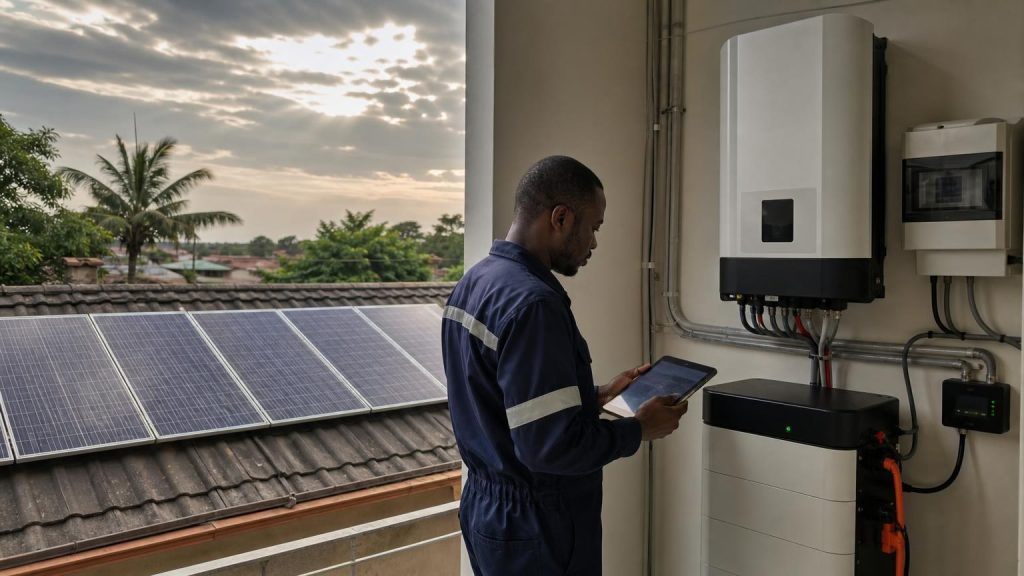
Imagine a home with:
- a 5 kWh lithium battery;
- the battery at 60% state of charge after a cloudy day;
- 1.2 kWh of daytime critical loads during recovery;
- an assumed 90% overall recovery efficiency; and
- an existing array that reliably provides about 2.4 kWh available for recovery on the observed type of day.
Step 1: Calculate the battery energy gap
5 kWh × 40% = 2 kWh missing from the battery.
Step 2: Allow for recovery losses
2 kWh ÷ 0.90 = about 2.22 kWh of PV energy.
Step 3: Add the daytime load
2.22 kWh + 1.2 kWh = about 3.42 kWh required from the PV system.
Step 4: Find the shortfall
3.42 kWh − 2.4 kWh from the existing array = 1.02 kWh extra PV energy needed on that recovery day.
Step 5: Convert the shortfall into extra panel capacity
Using four useful sunlight hours and a 0.75 planning factor:
1.02 kWh ÷ (4 × 0.75) = about 0.34 kW
The mathematical result is about 340 W of additional array capacity. In practice, you would not install exactly 340 W. You would choose a compatible panel arrangement, perhaps around 400–500 W or more depending on the available panel sizes and the inverter/controller limits. A qualified installer must confirm the final string voltage, current, protection and mounting design.
If the next day is also heavily overcast, that extra 400 W may not restore the battery fully. If you need reliable recovery during several poor-weather days, use measured worst-case production, reduce the load, use grid or generator charging where safe, or design more storage and generation together.
How to calculate the “extra” part correctly
The formula above gives the total PV energy required for the recovery day. To find the extra panels, use this sequence:
- Calculate the energy removed from the battery.
- Divide by a realistic charging and conversion efficiency.
- Add the energy your appliances will use during the recovery period.
- Subtract the energy your existing array can reliably provide during that type of day.
- Divide the remaining energy by useful sunlight hours and a realistic system factor.
- Round up to a compatible real-world panel arrangement.
If the result after step 4 is zero or negative, you may not need extra panels for that particular recovery target. The problem may instead be the battery size, the night-time load or the way the energy is being used.
Do not confuse a charging problem with a panel shortage
Before buying more panels, check whether the existing system is working normally. A low battery after cloudy weather may be expected, but a sudden change under similar sunlight may indicate a fault.
Check the inverter or charge-controller display for:
- PV voltage and PV power;
- battery voltage or state of charge;
- charging current and charging stage;
- daytime load power;
- error messages or protection events; and
- daily PV energy, if the system records it.
Also inspect for visible shade, heavy dust, loose or overheated connectors, a tripped protection device and incorrect battery settings. Do not open the inverter, disconnect live PV wiring or change battery charging values unless the work is being done safely by a qualified professional.
If the battery is not gaining energy at all, read Why Is My Solar Battery Not Charging? If panel output is unusually low in good sunlight, see Why Are My Solar Panels Producing Low Power?
When more panels are not the best first solution
Extra solar is most useful when the battery is not recovering because the system does not have enough generation. It is not always the right purchase.
Consider a different solution when:
- the battery reaches full charge early on normal sunny days but still runs out at night;
- your night-time appliances use more energy than the battery can safely store;
- the battery shows a high state of charge but its voltage collapses quickly under a modest load;
- the inverter or charge controller is already at its maximum PV input;
- the proposed panels would exceed maximum PV voltage, current or power limits; or
- the main problem is an unplanned daytime load such as a pump, freezer or air conditioner.
SolarPriceNG’s guide on whether to add more solar panels or a bigger battery first explains how to separate a generation problem from a storage problem. For rainy-season planning, also see how many cloudy or rainy days a solar battery can survive in Nigeria.
Check equipment limits before adding panels
More panels are not automatically safer or better. Before expanding the array, confirm the exact specifications of your hybrid inverter or MPPT controller:
- maximum PV power;
- maximum PV voltage, including the string’s open-circuit voltage;
- MPPT operating-voltage range;
- maximum PV and charging current;
- number of MPPT inputs;
- permitted panel configuration; and
- cable, isolator, fuse, breaker, earthing and surge-protection requirements.
Panels in series increase array voltage, while panels in parallel increase current. Both must remain within the equipment limits, including conditions that can raise or lower voltage. Do not mix panels with unsuitable electrical characteristics simply because their wattage looks similar.
Use the SolarPriceNG Solar Panel Calculator to organise the energy calculation, then confirm the actual design against the inverter, controller and panel manuals. The calculator is a planning aid, not a substitute for electrical design or installation.
Use a recovery test instead of guessing

For the next three comparable recovery days, record:
- the battery state of charge or voltage in the morning;
- the target state of charge for the evening;
- daily PV energy produced;
- daytime energy used or the appliances operated;
- the battery charging current and charging stage;
- weather, shade and panel cleanliness; and
- whether grid or generator charging was available.
Then compare the energy gap with the actual PV energy. If the panels are producing normally but the battery still does not last, use the SolarPriceNG Battery Calculator to review the load and usable battery energy. If the panels are not producing normally, diagnose the charging path before expanding the array.
Safety matters during an upgrade
Solar panels can produce dangerous DC voltage whenever light reaches them, and batteries can deliver very high fault current. Use a qualified installer for panel-string changes, battery-bank changes, roof work, protection devices, earthing and house wiring.
- Do not exceed the inverter or controller’s PV voltage, current or power limits.
- Do not bypass a fuse, breaker, isolator or battery-management system.
- Do not connect batteries of different chemistry, voltage, model or age without manufacturer approval.
- Do not run extra panels through an improvised connection or unsafe cable.
- Do not work on live PV or battery connections because the system appears small.
Bottom line
To estimate how much extra solar you need after a cloudy day:
Calculate the battery energy gap, allow for charging losses, add daytime appliance use, subtract the energy your existing array can provide, then convert the remaining energy into panel capacity.
In formula form:
Extra solar (kW) ≈ [battery energy gap ÷ recovery efficiency + daytime recovery load − existing recovery-day PV energy] ÷ [useful sunlight hours × system factor]
Use real readings from your Nigerian installation where possible. A cloudy day in Lagos, Enugu, Abuja or Kano will not produce the same result, and Harmattan dust, shading, heat and rain can change the recovery time. If the system is not charging normally, repair or test it before buying more panels. If the panels already fill the battery but night-time backup is too short, a bigger battery or lower load may be the better answer.