
Last reviewed: September 24, 2026
A solar inverter and battery system does not need the same service every month, but it should not be ignored until it stops working. In a Nigerian home or small business, a sensible plan is to monitor the system regularly, carry out safe external checks monthly, arrange a professional inspection periodically, and service it sooner after a fault, storm, flooding, major upgrade or unusual change in performance.
Quick answer: Check the inverter and battery display whenever you use the system, inspect the accessible installation about once a month, and arrange professional service at least periodically or whenever you notice alarms, overheating, short backup time, low solar production, loose-looking connections or repeated shutdowns. The exact interval depends on the equipment, installation environment, battery chemistry and manufacturer’s instructions.
“Servicing” does not mean opening a live inverter or tightening battery terminals casually. Solar panels can produce dangerous DC voltage in daylight, and batteries can deliver very high fault current. Leave electrical testing, internal repairs, rooftop work and high-current connections to a qualified solar professional.
Service is different from a quick home check
Many people use the word maintenance to describe several different activities. Separating them makes it easier to know what you should do yourself and what requires an installer.
| Activity | What it means | Who should do it? |
|---|---|---|
| Routine monitoring | Reading battery state of charge, solar input, load, alarms and energy history | Homeowner or trained operator |
| Safe visual check | Looking for heat, water, dust, damaged cables, blocked ventilation or visible battery damage without opening equipment | Homeowner from a safe position |
| Cleaning | Removing dust from accessible equipment or arranging safe panel cleaning | Homeowner only when safe; otherwise a professional |
| Professional service | Testing charging, battery behaviour, PV input, protection, connections, settings and system performance | Qualified solar technician |
| Repair or upgrade | Changing wiring, batteries, panels, breakers, firmware, settings or equipment | Qualified installer following the manuals |
A service visit should produce useful evidence, not only a statement that “everything is fine”. The technician should explain what was checked, identify any limitation, record important readings and list work that still needs attention.
A practical solar service schedule for Nigeria

There is no single calendar that fits every system. A clean, lightly used home system in a dry indoor equipment area may need less attention than a busy shop near a dusty road, a coastal property exposed to salt air, or a system that changes frequently between solar, DisCo supply and a generator.
| When | Useful checks |
|---|---|
| Whenever the system is used | Look for alarms, unusual noise, unexpected low battery, overheating or a sudden change in backup time. |
| Weekly | Confirm that the inverter and battery area remains dry, shaded, ventilated and free from stored items or dust buildup. |
| Monthly | Review solar energy, battery charging, load history, low-battery events and visible cable or enclosure condition. |
| After Harmattan, heavy rain or a storm | Check panel soiling, shading, water entry, loose mounting, damaged cables and changes in PV production. |
| Periodically | Arrange a professional inspection based on the manufacturer’s requirements, system age, environment and operating history. |
| Immediately when a serious symptom appears | Stop unsafe troubleshooting and call a qualified technician for smoke, burning smell, hot cables, repeated trips, damaged batteries or persistent fault codes. |
For a new installation, the first professional service should also confirm that the system is operating as designed after it has experienced normal loads and a few changes between available power sources. Keep the commissioning and handover records so later service visits have a baseline for comparison.
What you can safely check at home
You can collect useful information without opening the inverter or touching live electrical connections.
- Check whether the inverter display or app shows an active warning or fault.
- Record the battery state of charge, battery voltage or other normal readings shown by the system.
- Compare solar input on similar clear days rather than judging it from one cloudy afternoon.
- Look for water, insects, heavy dust, blocked vents or objects stored against the inverter and battery.
- From a safe position, look for cracked panels, new shade, loose-looking mounting or damaged exposed cable insulation.
- Notice whether the system now shuts down earlier, charges more slowly or runs fewer appliances than before.
- Write down the time, load and warning message whenever a fault occurs.
Do not remove covers, open battery cabinets, disconnect PV connectors, change charging values or tighten battery terminals as part of a routine home check. If your system shows a warning, record the exact message before resetting anything. SolarPriceNG’s guide on checking whether the battery or inverter is the problem explains why the same symptom can come from several different parts of the system.
What should a professional service include?
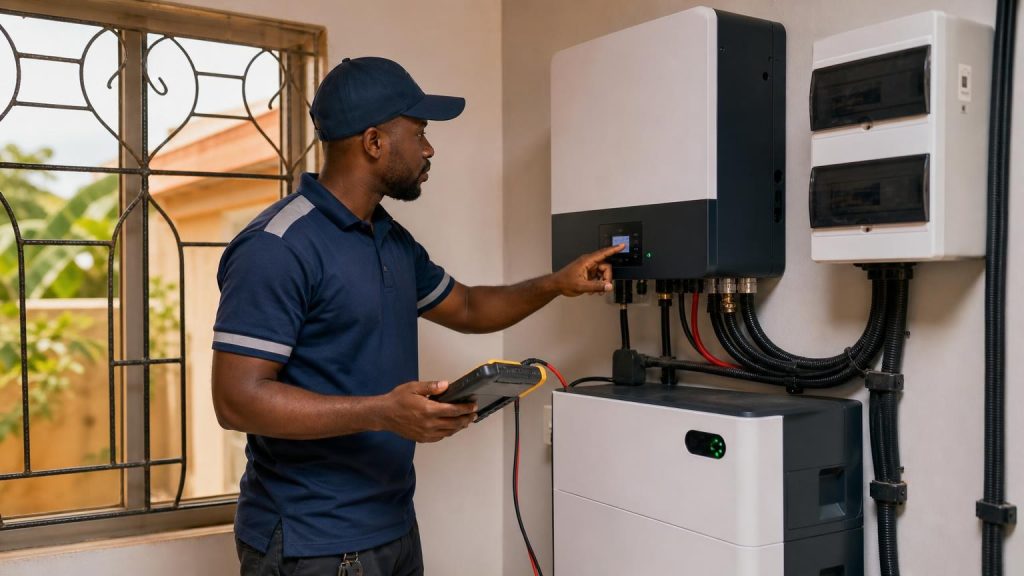
The exact tests depend on the equipment and installation, but a competent technician should review the complete system instead of looking only at the inverter screen.
- Inverter operation: operating mode, fault history, ventilation, fans, displays, charging behaviour and output under an appropriate load.
- Battery condition: battery chemistry, state-of-charge behaviour, charging and discharge readings, temperature, BMS warnings and the condition of the bank or battery cabinet.
- Solar input: PV voltage, current or power, panel-string arrangement, shading, connectors, cable routes and whether the array remains within inverter or controller limits.
- Protection: battery fuses or breakers, DC and AC isolators, surge protection where included, labels, earthing and accessible emergency isolation.
- Connections: signs of heat, corrosion, loose lugs, damaged insulation, water entry or voltage drop under an appropriate controlled test.
- Loads and changeover: backed-up circuits, grid or generator input, changeover behaviour, overload events and appliances with high starting demand.
- Monitoring: whether the app or display records useful data, whether the battery and inverter communicate correctly, and whether alarms are reaching the operator.
A service visit should end with a written record of important findings. If a technician cannot test something because the battery is full, there is no sunlight, the grid is unavailable or a load is not present, that limitation should be recorded rather than treated as a successful test.
Battery service depends on the chemistry
Lithium and lead-acid batteries should not be serviced or assessed in exactly the same way.
Lithium batteries
For lithium batteries, the technician should pay attention to the battery-management system, communication with the inverter, state-of-charge accuracy, temperature, charging current, discharge current and repeated protection events. Lithium capacity is primarily discussed in kWh, but the permitted current and BMS limits are also important.
A lithium battery is not maintenance-free simply because you do not add water. Keep it cool, dry and ventilated where required, use the correct charging profile, and investigate repeated BMS shutdowns or unusual heat. See how to maintain a lithium solar battery in Nigeria for the routine checks that are specific to lithium systems.
Tubular, GEL and AGM batteries
For tubular, GEL and AGM batteries, service should consider the battery voltage, Ah capacity, number of batteries, charging behaviour, discharge level, temperature, terminal condition and the condition of individual units in a bank. Ah should be interpreted together with voltage; Ah alone does not tell you the bank’s total nominal energy.
Flooded batteries may have additional manufacturer-specific checks, including electrolyte or ventilation requirements. GEL and AGM batteries should not be treated as if they were flooded batteries. Follow the exact battery manual rather than using one charging or maintenance rule for every lead-acid product.
Nigerian conditions that can shorten the service interval
The environment around the system matters as much as the calendar.
- Harmattan dust: soiling can reduce PV production and may enter ventilation openings or equipment areas.
- Heat: a battery or inverter in a hot, enclosed room may run under more stressful conditions than equipment in a shaded, ventilated space.
- Rain and flooding: water entry, damp walls, leaking roofs and standing water require immediate attention.
- Coastal air: salt and moisture can accelerate corrosion around frames, fasteners, terminals and enclosures.
- Dusty roads or construction: panels and ventilation openings may need more frequent inspection.
- Generators: frequent generator use makes input quality, changeover and charging settings important service checks.
- Storms and wind: panels, mounting rails and exposed cable routes should be checked after severe weather.
- Changing loads: a new freezer, pump, air conditioner, office or shop load can make an old system appear to have developed a fault.
For panel-specific cleaning and inspection, see How to Maintain Solar Panels in Nigeria. A panel service visit and an inverter-battery service visit are related, but they are not always the same job.
Signs that your system needs service now
Do not wait for the next scheduled visit when you notice a serious change. Arrange professional help promptly if you see or hear:
- Repeated inverter alarms, shutdowns or unexplained low-battery warnings
- Backup time that has become much shorter with the same measured load
- Solar production that is much lower than comparable clear days
- A battery that will not charge, reaches full unusually quickly or drops rapidly under a modest load
- Hot cables, terminals, breakers, fuses or battery surfaces
- Burning smell, smoke, sparking, buzzing or crackling
- Swollen, cracked, leaking or physically damaged batteries
- Water inside or around the inverter, battery cabinet or electrical enclosure
- Repeated breaker or fuse trips
- New corrosion, loose-looking panels or damaged cables after rain or wind
Stop unsafe use if there is smoke, arcing, severe heat, a damaged battery or a burning smell. Do not keep resetting the system or cover the equipment to hide the noise. Keep people away and contact a qualified professional.
How to tell whether service solved the problem
After a service visit, compare the system with its earlier behaviour. Useful evidence may include:
- PV energy on similar clear days before and after the work
- Battery charging current and the time needed to reach the normal target
- Backup time with a similar, measured appliance load
- The number and type of alarms or shutdowns
- Battery temperature and BMS status where available
- Whether the inverter can carry the agreed loads without overload or low-voltage warnings
- Whether grid, solar and generator changeover now behaves as expected
For example, if a system previously produced about 7kWh on comparable clear days and now produces about 4kWh, the difference deserves investigation. That comparison does not prove that the service caused or solved the problem; weather, dust, shade, battery state and daytime appliance use must also be considered. Use several comparable days rather than one reading.
Keep a simple service record
A service log helps you see gradual changes and gives the next technician useful context.
| Record | What to write down |
|---|---|
| Date and weather | Service date, recent rain, Harmattan dust, heat or storm conditions |
| System identity | Inverter, battery, panel and controller models and serial numbers |
| Readings | PV power or energy, battery SOC/voltage, load and charging status where available |
| Fault history | Alarm codes, shutdown times and what appliances were running |
| Work completed | Cleaning, testing, repaired connection, setting review or replaced part |
| Outstanding work | Unresolved issue, responsible person and agreed follow-up date |
Keep the service record with the quotation, invoice, manuals, warranties and handover documents. If the problem later becomes a warranty issue, a clear history is more useful than a general statement that the system “has not been working well”.
Do not service by changing settings at random
A common mistake is to treat a service visit as an opportunity to increase charging voltage, disable low-battery protection or change the operating mode until the system appears to run longer. That may hide the symptom while creating a battery, inverter or safety problem.
- Use the exact inverter and battery manuals.
- Record the original settings before making an approved change.
- Confirm battery chemistry, voltage and BMS communication.
- Do not bypass fuses, breakers, isolators or battery-management protection.
- Do not connect additional batteries or panels without checking equipment limits.
- Do not copy settings from a different brand or model.
If the battery is draining quickly or not charging, diagnose the load, solar input, charging path and battery condition together. The existing guides on why a solar battery drains quickly and what to check when a solar battery is not charging provide a useful starting sequence.
How to choose a service provider
Choose someone who can identify the actual models and explain the test results, not only someone who offers to reset the inverter or sell a replacement battery.
- Ask whether the technician is familiar with your inverter, battery and controller models.
- Ask what tests are included and what will be recorded.
- Ask whether the service covers the solar array, battery, inverter, protection and changeover or only one component.
- Request a written report with defects, readings and recommended actions.
- Confirm that the technician will not bypass safety devices or use unapproved settings.
- Ask for evidence of the parts and work supplied if a repair or replacement is recommended.
- Get a second technical opinion before replacing an expensive battery or inverter when the cause has not been demonstrated.
Final checklist
- Do I monitor the inverter and battery for alarms and unusual changes?
- Is the equipment area dry, shaded, ventilated and reasonably clean?
- Have I checked the system after Harmattan, heavy rain, flooding or a storm?
- Do I know whether my battery is lithium, tubular, GEL or AGM and what maintenance it requires?
- Have I recorded the exact inverter and battery models?
- Do I have a written service history?
- Has a qualified technician checked the system when performance changed suddenly?
- Am I avoiding random changes to charging settings and protection devices?
- Do I have a clear plan for smoke, hot cables, battery damage or repeated fault codes?
Bottom line
Service your solar inverter and battery system according to its actual condition, environment and manufacturer’s requirements—not only according to a fixed calendar. Monitor it regularly, carry out safe external checks about once a month, and arrange professional inspection periodically or whenever alarms, heat, water, low production, short backup or battery problems appear.
In Nigeria, Harmattan dust, heat, rain, coastal moisture, generators and changing appliance loads can all affect service needs. A written service record and measurements from comparable days will help you decide whether the problem is the battery, inverter, panels, wiring, protection, settings or the load itself.
Good maintenance is not about making the system run beyond its safe limits. It is about finding changes early, correcting faults properly and keeping the equipment within the limits written in the manuals.