
Last reviewed: September 24, 2026
If rainwater, roof leakage or floodwater reaches your solar inverter, battery, changeover box or other electrical equipment, treat the system as unsafe until it has been inspected. Do not touch wet equipment, walk through water to reach a switch, open the inverter, reconnect the battery or turn the system on “just to test it”. Move people away, isolate the area if you can do so from a dry and safe position, and call a qualified solar or electrical technician.
Quick answer: A little rain on correctly installed outdoor panels is not the same as floodwater entering an inverter or battery cabinet. If water has reached the inverter, battery, breakers, cables, changeover equipment or electrical enclosures, stop using the affected system and arrange a professional inspection before re-energising it. Do not assume that drying the outside makes the inside safe.
This guide is for Nigerian homes, shops and small offices using solar panels, an inverter and battery storage. It does not replace emergency electrical advice, the equipment manuals or an inspection by a qualified professional.
First protect people, not the equipment
Water and electricity can create a serious shock, fire and equipment-damage risk. The safest first response depends on where the water is and whether you can isolate the system without entering the wet area.
- Keep children, visitors and animals away from the wet equipment and surrounding floor.
- Do not touch the inverter, battery, metal cabinet, cables, sockets or breakers while standing in water or on a wet surface.
- Do not step over water to reach a wall switch or distribution board.
- If a normal isolation switch is in a completely dry, accessible and safe location, follow the installed shutdown procedure. If reaching it would expose you to water or damaged equipment, wait for a professional.
- If you see smoke, sparks, arcing, a burning smell or a hot battery, move away and contact emergency help and a qualified technician.
- Do not start a petrol or diesel generator indoors or in a poorly ventilated space while dealing with the solar fault.
Do not assume that switching off the inverter display makes every part of the system dead. Solar panels can produce DC voltage in daylight, and batteries can retain dangerous energy even when the inverter screen is blank.
How serious is the water exposure?
Tell the technician exactly what happened. The difference between a damp wall, a splash, standing water and full submersion affects the inspection, but none of these situations should be treated casually when electrical equipment is involved.
| Situation | What it may mean | Safe response |
|---|---|---|
| Rain near an intact outdoor panel array | Normal outdoor weather may not indicate a fault if the array, connectors and enclosures are undamaged. | Do not touch wet connectors. Monitor from a safe position and investigate any alarm, crack or water entry. |
| Roof leak above the inverter or battery | Water may enter through the top, vents, cable glands or wall and remain inside after the outside looks dry. | Stop using the affected equipment and arrange an inspection. |
| Splashing or dampness around cables and breakers | Moisture may reduce insulation or create corrosion and tracking paths. | Keep clear and do not reset tripped protection repeatedly. |
| Standing water on the equipment-room floor | The battery cabinet, inverter base, sockets or distribution equipment may have been exposed. | Do not enter the water to isolate the system. Call a qualified professional. |
| Floodwater reaches or submerges equipment | Contamination, corrosion and hidden internal damage may remain after drying. | Treat the equipment as unsafe until professionally assessed. Do not reconnect or reuse it based on appearance. |
Take photographs from a safe, dry position if doing so does not bring you near the equipment. Record how high the water reached, when it happened, whether the system was operating, which alarms appeared and whether grid or generator power was connected.
What to do if the inverter or battery was flooded
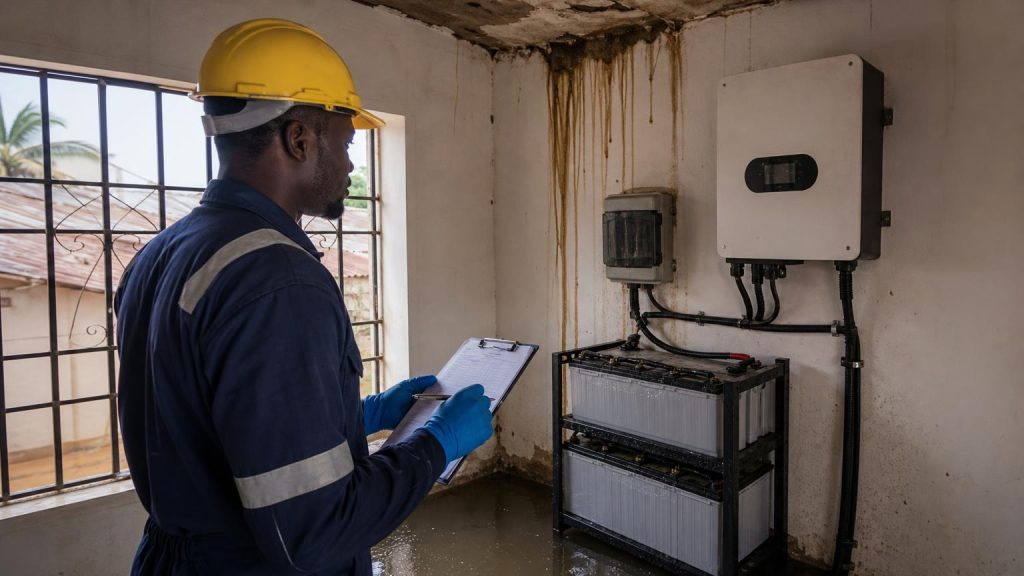
If water reached the inverter, battery, changeover, distribution board or protection equipment, the correct next step is professional isolation and inspection. Do not remove the covers yourself and do not place a fan beside live or partially wet equipment.
- Keep the affected area isolated from people.
- Do not wipe terminals, operate breakers or pull connectors while the system may still be energised.
- Do not charge a wet or damaged battery.
- Do not reconnect grid, generator or battery supply to “see if it works”.
- Tell the technician whether the battery is lithium, tubular, GEL or AGM and provide the model if known.
- Keep the equipment manuals, installation records and warranty details available for the inspection.
Drying the cabinet is not the same as proving that the equipment is safe. Water can remain behind covers, inside cable glands, around terminals, in fans, on circuit boards or inside protective devices. Floodwater may also leave dirt, salts and other contamination that later causes corrosion or leakage current.
What a professional should inspect before switching it back on
The technician should inspect the complete affected path, not only the part that looks wet.
- Inverter: signs of water entry, corrosion, contamination, damaged fans, fault history and internal condition.
- Battery: casing, terminals, BMS or protection status, electrolyte or contamination where relevant, temperature and evidence of swelling, leakage or damage.
- Solar cables and connectors: wet connectors, damaged seals, exposed insulation, water in cable routes and connector condition.
- Panels and junction boxes: cracked glass, damaged frames, loose mounting, damaged junction boxes and cable entries.
- Protection equipment: fuses, breakers, DC and AC isolators, surge protection, changeover equipment and distribution boards.
- Earthing and bonding: whether the protective path remains intact and suitable after water exposure or corrosion.
- Building conditions: roof leakage, drainage, rising damp, low mounting position and the route by which water reached the equipment.
The technician may need to carry out tests on insulation, continuity, polarity, battery condition, protective devices and equipment operation. The exact tests depend on the equipment and the type of exposure. Ask for the findings in writing, including any part that must be repaired or replaced.
Can you use solar panels during rain?
Rain on a properly installed outdoor solar panel is not automatically the same as flood damage. Solar panels are designed for outdoor service when the modules, mounting, connectors, cable entries and enclosures are intact and installed according to their requirements.
However, do not use rain as proof that every part of the system is safe. Problems can arise when:
- A panel is cracked or its junction box is damaged.
- A connector is loose, incorrectly joined or exposed to water.
- Cables are lying in water or have damaged insulation.
- Water is entering the inverter, combiner box or battery area.
- A roof leak has reached indoor equipment.
- The inverter shows a fault, unusual noise, smoke or repeated shutdown.
- Floodwater or dirty water has covered part of the array or electrical route.
If the panels are simply wet from normal rain and the system is intact, let the equipment operate according to the manufacturer’s instructions. If there is any damage, water entry or abnormal behaviour, stop relying on assumptions and arrange an inspection. For regular panel checks, see How to Maintain Solar Panels in Nigeria.
What about a lithium or lead-acid battery that got wet?
Battery chemistry changes the inspection, but water exposure is not safe for either type of battery.
Lithium batteries
A lithium battery may have a sealed casing and a battery-management system, but that does not mean floodwater cannot damage it. Water can affect the casing, terminals, communication ports, protection devices or connected cables. Do not bypass the BMS, force-charge the battery or open the casing. A swollen, hot, cracked, leaking or repeatedly faulting lithium battery should be left alone and assessed by a qualified professional.
For normal, dry-condition care, read How to Maintain a Lithium Solar Battery in Nigeria. Water exposure requires a separate safety assessment rather than routine cleaning.
Tubular, GEL and AGM batteries
Water around a tubular, GEL or AGM battery can create corrosion, short-circuit and contamination risks. Floodwater can also damage the battery tray, terminals, cables and nearby protection equipment. Do not assume that a battery is safe because its label or casing looks normal. A technician should identify the battery type, inspect the bank and confirm whether individual units and connections remain usable.
Do not add water to a battery unless the exact battery manual requires it and the work is being done under safe conditions. GEL and AGM batteries should not be treated as flooded batteries.
When can the system be switched back on?
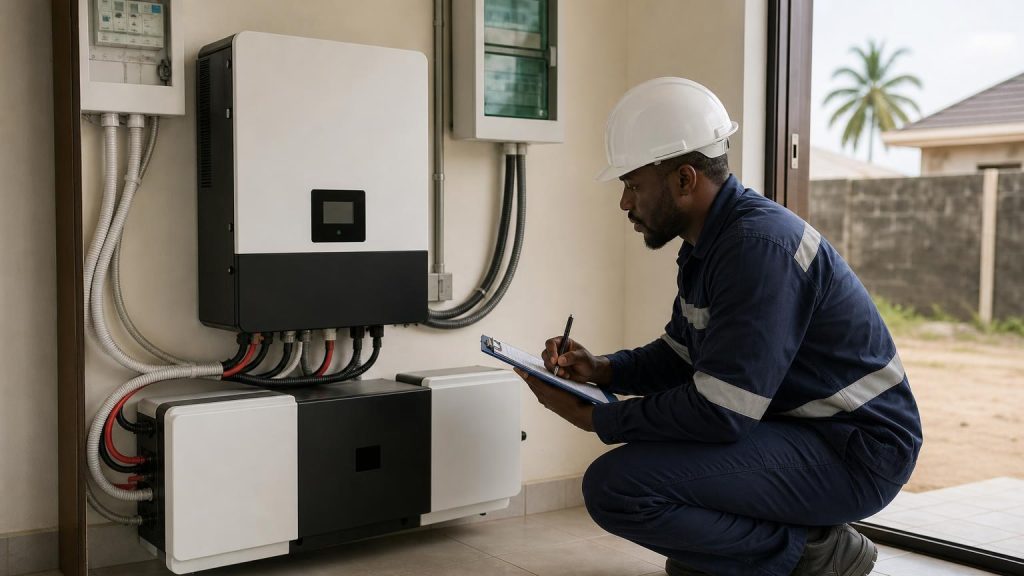
Only after the affected equipment has been safely isolated, dried or replaced as appropriate, inspected and tested by a qualified professional. “The outside is dry” is not enough.
Before re-energisation, ask the technician to explain:
- Which equipment was exposed and which parts were isolated or replaced
- What tests were completed and what the results mean
- Whether the battery is safe to charge and discharge
- Whether the inverter, panels, cables and protection devices remain within their operating limits
- Whether the source changeover and backed-up circuits are safe
- What repairs are still outstanding
- What warning signs should cause you to shut the system down again
If the technician recommends replacing a battery, inverter, breaker or cable, ask for the water-related evidence and the exact reason. Do not approve an expensive replacement only because the system is not working after a flood; the affected component may be repairable, but it may also be unsafe to reuse. The decision should follow inspection and testing.
Common mistakes after rain or flooding
- Turning the inverter on repeatedly to see whether it has dried
- Using a hair dryer, heater or fan close to wet electrical equipment
- Opening a battery cabinet or inverter without isolation and training
- Resetting a breaker that trips again
- Charging a wet, swollen or damaged battery
- Assuming solar panels are safe because the inverter screen is off
- Connecting a generator while the changeover or distribution board may be wet
- Covering ventilation openings with plastic in a way that traps heat and moisture
- Cleaning corrosion without finding and correcting the water source
- Replacing only the visible part while leaving wet cables, connectors or protection equipment in service
If the inverter is beeping after the event, record the exact code and stop guessing. Different models use different warnings. SolarPriceNG’s guide on why a solar inverter may be beeping explains why the sound alone is not enough to identify the fault.
How to reduce future water damage
Once the system is safe, correct the route by which water reached it. Replacing equipment without fixing the roof or drainage problem leaves the same risk in place.
- Repair leaking roofs, walls and windows above the equipment.
- Keep inverter and battery cabinets away from floor-level flood paths where the installation design permits.
- Improve drainage and avoid placing equipment where water can pool.
- Protect cable entries and use proper weatherproof glands and routing according to the equipment requirements.
- Keep outdoor connectors supported, protected and out of standing water.
- Do not install equipment in a sealed hot cupboard just to keep it away from rain.
- Keep ventilation openings clear and use only manufacturer-approved covers or enclosures.
- Inspect the system after severe rain, storms, construction or changes to the roof.
- Record the equipment location and isolation points so a technician can respond quickly.
Regular monitoring and periodic professional service can help you notice water entry early. Keep a service record with the installation documents, equipment manuals and warranty details.
A safe post-flood checklist
- Has everyone been kept away from the wet equipment?
- Was the system isolated without anyone entering water or touching damaged equipment?
- Were grid and generator connections considered as well as the solar battery?
- Was the water source corrected?
- Were the inverter, battery, cables, connectors, panels and protection devices inspected?
- Was the battery chemistry and model provided to the technician?
- Were tests completed before re-energisation?
- Were damaged or contaminated parts repaired or replaced appropriately?
- Were the findings recorded in writing?
- Do you know what warning signs require immediate shutdown and professional help?
If the system is not charging after the inspection, do not immediately buy a new battery. The water event may have affected the charger, PV wiring, protection device, battery connection or inverter. You can use Solar Inverter Not Charging the Battery as a troubleshooting reference after the equipment has been declared safe to operate.
Bottom line
If rainwater or floodwater reaches your solar inverter, battery or electrical equipment, stop and treat the system as unsafe until it has been professionally inspected. Protect people first, avoid wet floors and exposed equipment, do not force a restart, and do not assume that visible drying proves internal safety.
Normal rain on an intact outdoor panel array is different from water entering an inverter, battery cabinet, changeover or cable route. After a flood or roof leak, the technician should inspect the entire affected path, test the equipment and explain whether each part can be safely reused.
In Nigeria, correcting the roof leak, drainage problem, equipment position and cable-entry route is just as important as repairing the damaged component. A safe system is one that has been inspected, tested and protected against the next water event.