Last reviewed: September 25, 2026
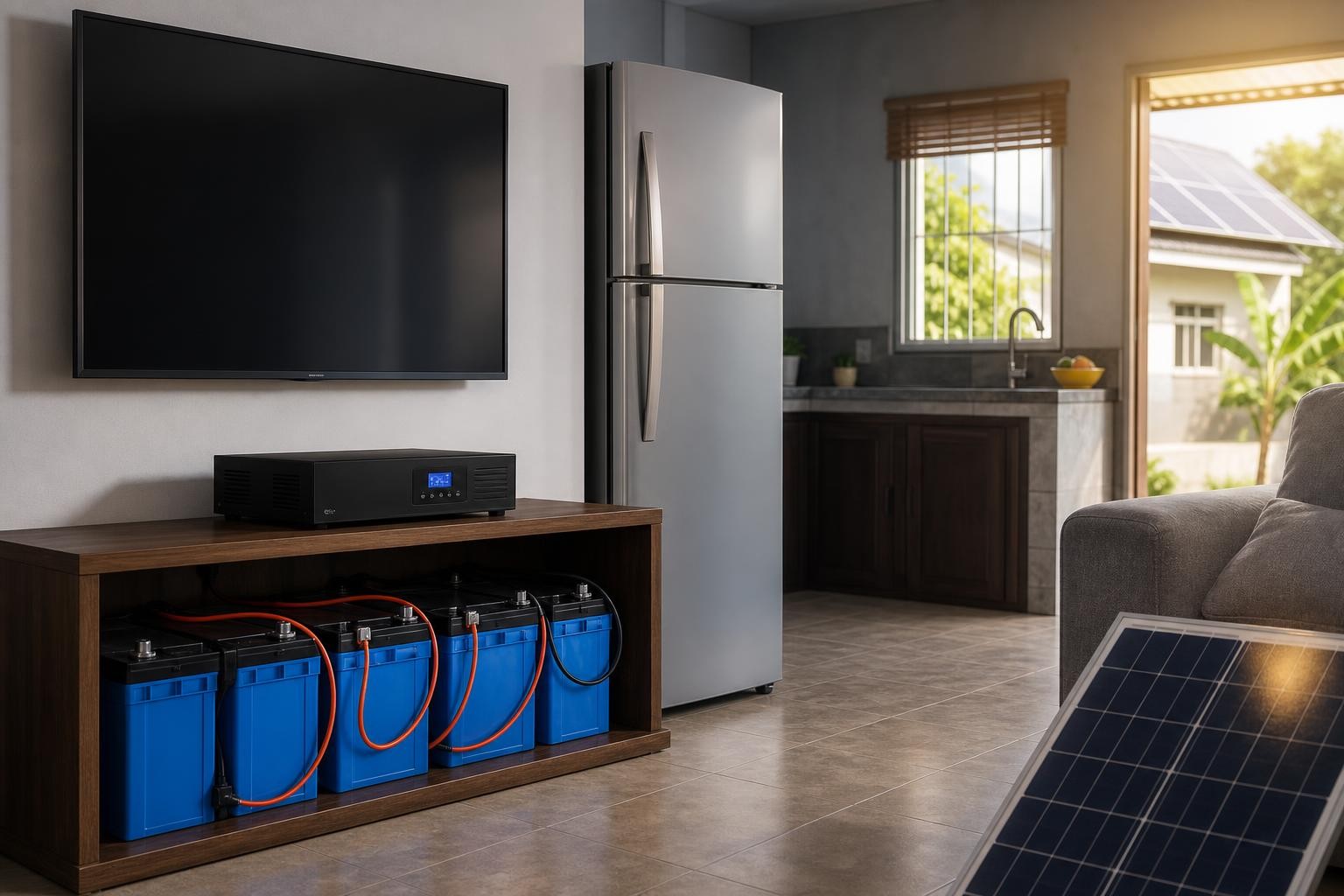
If you want to run a fridge and TV from a 48V battery bank, the battery may last anywhere from several hours to more than a day. The answer depends on the bank’s total energy in kWh, the actual average load, the battery chemistry, the inverter’s efficiency and whether the fridge is cycling normally.
A 48V label alone is not enough to predict runtime. For example, a 48V 100Ah lithium bank and a 48V 200Ah tubular bank do not contain the same amount of stored energy. You need voltage and Ah together for lead-acid batteries, or the verified kWh rating for lithium batteries.
Quick answer
For a planning example, suppose your fridge, TV, decoder and router average about 220W while the system is running:
- A 48V 100Ah lithium bank may provide roughly 16 to 17 hours.
- A 48V 100Ah lead-acid bank may provide roughly 9 hours.
- A 48V 200Ah lead-acid bank may provide roughly 18 to 19 hours.
- If the combined average load is closer to 400W, those estimates become roughly 9 hours, 5 hours and 10 hours.
These are planning examples, not a promise of runtime. Your fridge model, TV usage, battery age, inverter settings, wiring and battery manufacturer’s limits can change the result.
First, understand what “48V battery bank” means
A battery bank’s energy is calculated from:
Nominal energy (Wh) = Voltage (V) × Capacity (Ah)
So a 48V 100Ah bank has 48V × 100Ah = 4,800Wh = 4.8kWh nominal energy. A 48V 200Ah bank has 48V × 200Ah = 9,600Wh = 9.6kWh.
Nominal energy is not the same as the AC energy that reaches your appliances. You must allow for the usable discharge limit, inverter losses and sometimes battery-cable losses.
How batteries are arranged to make 48V
Many 48V banks are built from 12V batteries. In a series connection, the voltage increases but the Ah rating stays the same:
- Four 12V 100Ah batteries in series = 48V 100Ah.
- Four 12V 200Ah batteries in series = 48V 200Ah.
- Eight 12V 100Ah batteries arranged as two parallel strings of four = 48V 200Ah.
Do not add the Ah values of batteries connected in series. Do not mix batteries of different ages, chemistry, models or condition unless the manufacturer specifically allows it. Series and parallel battery work should be checked by a qualified installer because a mistake can damage equipment or create a serious electrical hazard.
The fridge and TV load is not one fixed number
Your fridge may show a running wattage on its nameplate, but its compressor normally switches on and off. Heat, door opening, thermostat setting, poor ventilation and the condition of the fridge can change its daily energy use.
A TV is easier to estimate, but its power still depends on screen size, picture settings and whether a decoder, sound system or streaming device is connected.
For a useful estimate, record the fridge’s actual or measured wattage, TV hours, decoder/router load, inverter standby consumption and any lights, fans or chargers sharing the inverter.
A worked Nigerian home example
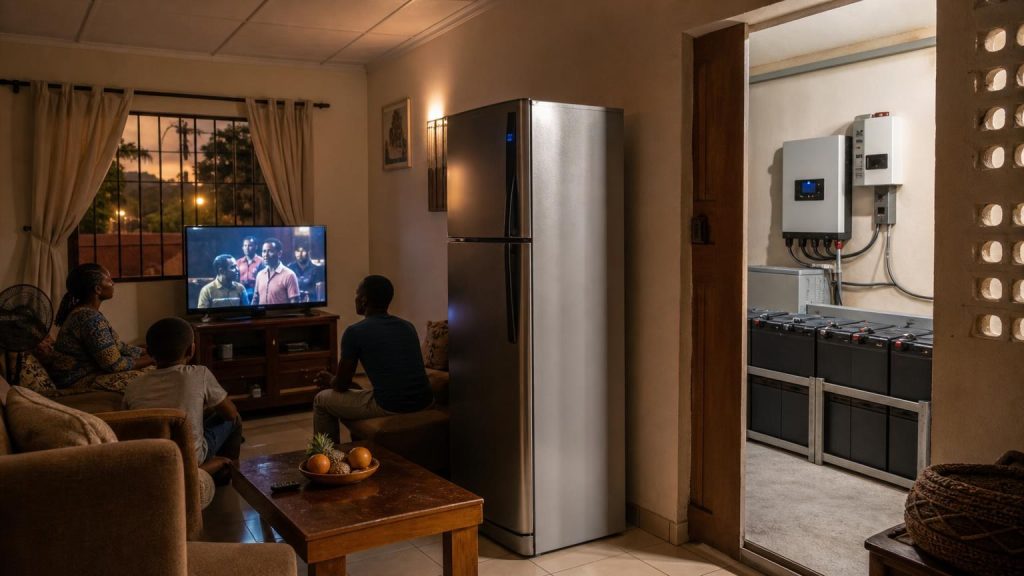
Imagine a home in Nigeria wants to keep a refrigerator cold during an overnight outage, watch television for five hours and keep a router connected. The planning assumptions are:
| Load | Planning assumption | Planned use | Energy |
|---|---|---|---|
| Fridge | 100W average | 8 hours | 800Wh |
| TV | 80W | 5 hours | 400Wh |
| Router/decoder | 20W | 8 hours | 160Wh |
| Total | 1,360Wh |
This example needs about 1.36kWh at the appliance side, before allowing for inverter losses and additional appliances. If the fridge is older, the room is very hot or the TV stays on longer, the real requirement will be higher.
How long can a 48V 100Ah lithium bank last?
The nominal energy is 4.8kWh. For a simple planning example, use an 85% usable-energy allowance and 90% inverter efficiency:
4.8kWh × 0.85 × 0.90 = about 3.67kWh of planning AC energy
At a steady 220W average load, 3.67kWh ÷ 0.22kW = about 16.7 hours. At 400W, it is about 9.2 hours.
The manufacturer’s usable energy, battery-management-system limits, low-voltage cutoff and inverter operating mode take priority over a general planning allowance.
How long can a 48V 100Ah lead-acid bank last?
A 48V 100Ah lead-acid bank also has 4.8kWh nominal energy, but it should not automatically be treated like a 4.8kWh lithium battery. A planning calculation might allow about 50% usable energy and 85% inverter efficiency, depending on the battery type, manufacturer’s guidance and discharge rate:
4.8kWh × 0.50 × 0.85 = about 2.04kWh of planning AC energy
At 220W, that is about 9.3 hours. At 400W, it is about 5.1 hours. Lead-acid runtime can fall when the battery is old, undercharged, hot or discharged at a higher rate than the rating assumes.
Tubular, GEL and AGM batteries are not interchangeable in their charging requirements, so use the exact manufacturer’s limits.
What about a 48V 200Ah bank?
A 48V 200Ah bank has 9.6kWh nominal energy—twice the nominal energy of a 48V 100Ah bank. If the same 50% usable-energy and 85% inverter-efficiency planning assumptions are used for lead-acid:
9.6kWh × 0.50 × 0.85 = about 4.08kWh of planning AC energy
At 220W, that is about 18.5 hours. At 400W, it is about 10.2 hours. A 48V 200Ah lithium bank would provide a different result because its usable-energy allowance and manufacturer’s limits may be different.
Why your real runtime may be shorter
- The fridge is using more energy than expected. A hot kitchen, poor ventilation, damaged door seals or frequent opening can increase compressor operation.
- The TV load is not the only TV load. Decoders, sound systems, routers and streaming devices also consume energy.
- The inverter has its own consumption. This matters more when the appliance load is small.
- The battery is not fully charged. A cloudy day, shading, dirty panels, a weak charging source or incorrect settings can reduce the starting energy.
- The battery is aged or damaged. A bank can show a normal voltage and still fail to deliver the runtime you need.
- The battery bank is poorly matched. Old and new batteries, or batteries with different capacities, may not share charge and discharge properly.
- The inverter or cables are limiting the system. Loose terminals, undersized cables, voltage drop or an inverter low-voltage cutoff can make the system stop early.
How to check your own runtime safely
- Write down the battery voltage, Ah or kWh rating, chemistry and number of batteries.
- Confirm that the bank is configured as 48V and that the inverter supports it.
- Record the inverter’s load reading while the fridge and TV are operating.
- Note the battery state of charge before the outage and when the inverter shuts down or reaches its low-battery warning.
- Repeat the comparison on a normal day with similar appliance use. Do not add an air conditioner, pump or freezer during the test unless it is part of the planned load.
Do not open a battery case, bridge terminals, bypass a fuse or change charging voltages just to test runtime. Battery measurements and cable checks can involve dangerous current even in a household system. Ask a qualified installer to test the bank, inverter and protection equipment.
Use the SolarPriceNG Battery Calculator
The SolarPriceNG Battery Calculator can help you compare battery capacity with the appliances you want to run. Enter voltage and Ah for a lead-acid bank, or use the verified kWh capacity for lithium where the product provides it. Add the fridge, TV and other loads separately, then adjust their wattage and expected usage.
If you are unsure whether the inverter can run the appliances together, use Can My Solar System Power It? as the next check. The inverter must handle the normal combined load and the fridge compressor’s starting demand.
You may also find these guides useful:
- 24V vs 48V Solar System: Which Should You Choose?
- How Long Will a 5kWh Lithium Battery Last in Nigeria?
- How Many Batteries Do I Need for a 5kVA Inverter in Nigeria?
Final answer
A 48V battery bank can run a fridge and TV for several hours or much longer, but the answer comes from usable energy and actual load—not from the 48V label alone. A 48V 100Ah bank contains 4.8kWh nominal energy, while a 48V 200Ah bank contains 9.6kWh. The battery chemistry, usable discharge limit, inverter efficiency, fridge cycling and battery condition then determine how much of that energy reaches your appliances.
For a safer buying decision, record the real appliance load, calculate the energy needed for the hours you want, check the inverter’s surge capability and confirm the battery manufacturer’s limits. If you only know the battery voltage but not the Ah or kWh capacity, you do not yet have enough information to estimate backup time reliably.