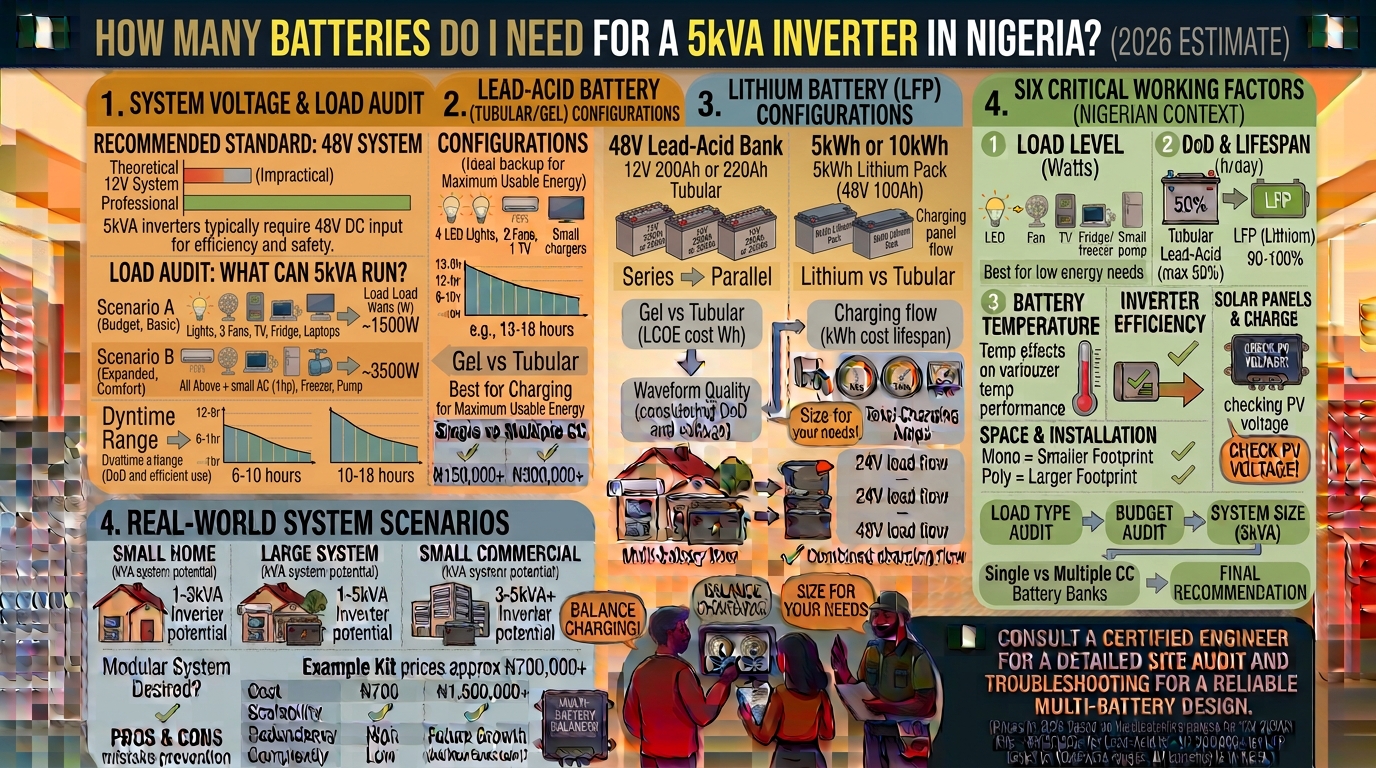
If you are planning to buy a 5kVA inverter, one of the first questions you may ask is:
How many batteries do I need for a 5kVA inverter?
You may hear someone say:
“A 5kVA inverter needs four batteries.”
That can be correct for some systems, but it is not a rule for every 5kVA inverter.
The number of batteries you need depends on:
- The battery voltage required by the inverter
- The battery capacity
- Your appliance load
- How many hours of backup you want
- The type of battery
- The battery’s maximum discharge capability
- The inverter manufacturer’s specifications
Many 5kVA solar inverters use a 48V battery system, but you should always check the exact inverter model before buying batteries.
In this guide, we will explain how to calculate the battery requirement for a 5kVA inverter in Nigeria, including examples using 12V batteries and modern lithium batteries.
Quick Answer: How Many Batteries Does a 5kVA Inverter Need?
There is no single number that works for every 5kVA inverter.
If your 5kVA inverter requires a 48V battery bank and you are using traditional 12V batteries, you would normally need:
4 × 12V batteries = 48V
For example:
4 × 12V 200Ah batteries
would give you:
48V 200Ah
The nominal battery storage would be:
48V × 200Ah = 9,600Wh
or:
9.6kWh
But this does not mean every 5kVA inverter needs four 200Ah batteries.
A modern inverter may instead use one or more 48V or 51.2V lithium battery modules.
The correct setup depends on the inverter and how much battery storage you need.
If you are still trying to determine whether 5kVA is the right inverter size for your appliances, you can first use the SolarPriceNG Inverter Calculator.
What Does a 5kVA Inverter Tell You?
A 5kVA inverter mainly tells you about the amount of electrical power the inverter can handle.
It does not tell you how much energy your batteries need to store.
Think of it this way:
Inverter = how much power you can use at once
Battery = how long you can keep using that power
For example, you could have:
5kVA inverter + 5kWh battery
or:
5kVA inverter + 10kWh battery
The inverter is the same size, but the second system has approximately twice the nominal battery storage.
This is why choosing batteries simply because you have a 5kVA inverter can give you much less backup than expected.
Your actual appliances and their running time should determine the battery capacity.
First Check the Battery Voltage of Your 5kVA Inverter
Before buying any battery, check the inverter specification.
The inverter may require a particular battery voltage, such as:
- 24V
- 48V
- 51.2V-class lithium battery systems
Many larger solar systems use 48V battery banks because higher voltage means lower current for the same power. We explain this in more detail in our guide to 24V vs 48V solar systems.
If your inverter requires 48V, you cannot simply connect one 12V battery and expect the system to work correctly.
With traditional 12V batteries:
12V + 12V + 12V + 12V = 48V
So four 12V batteries are normally needed to create the required voltage.
But remember:
Four batteries only solves the voltage requirement.
It does not automatically solve your backup-time requirement.
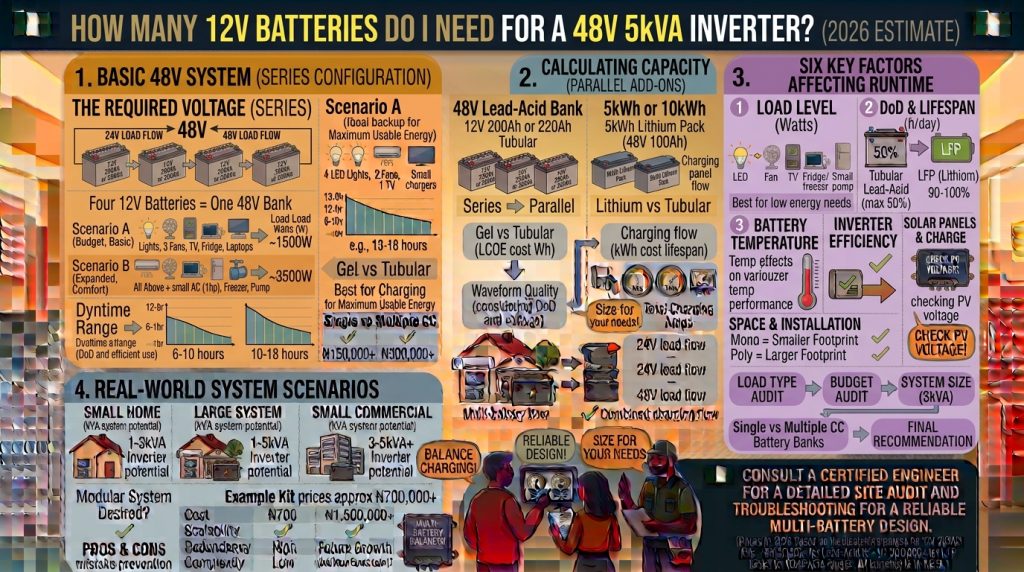
How Many 12V Batteries Do I Need for a 48V 5kVA Inverter?
If your inverter requires 48V and you are using 12V batteries, the basic series arrangement is:
4 × 12V batteries = 48V
Now the Ah rating determines the amount of energy stored in the battery bank.
Example: Four 12V 100Ah Batteries
Four 12V 100Ah batteries connected in series give:
48V 100Ah
Nominal energy:
48V × 100Ah = 4,800Wh
or:
4.8kWh
Example: Four 12V 200Ah Batteries
Four 12V 200Ah batteries connected in series give:
48V 200Ah
Nominal energy:
48V × 200Ah = 9,600Wh
or:
9.6kWh
So increasing the battery capacity from 100Ah to 200Ah doubles the nominal energy storage.
This is why you should not ask only:
“How many batteries?”
You also need to ask:
“What voltage and capacity is each battery?”
Why Four Batteries Does Not Always Mean Enough Backup
This is where many people get confused.
Someone may tell you:
“Buy four 200Ah batteries for your 5kVA inverter.”
But what if you only want to run lights, fans, a TV and a router?
You may not need the same amount of battery storage as someone who wants to run:
- Refrigerator
- Freezer
- Several fans
- TV
- Lights
- Router
- Water pump
- Air conditioner
The inverter size does not tell you how long the batteries will last.
Your actual load and desired backup time determine the energy requirement.
For a more detailed explanation of battery sizing, see our guide to how many batteries you need for a solar system in Nigeria.
How Much Battery Do I Need for 5 Hours of Backup?
Let’s use a simple example.
Suppose your essential appliances use an average of:
1,000W
and you want:
5 hours of backup
Your basic energy requirement is:
1,000W × 5 hours = 5,000Wh
or:
5kWh
This means your appliances need about 5kWh of energy during those five hours.
However, you should not simply buy a battery labelled 5kWh and assume exactly 5kWh will reach your appliances.
You need to allow for:
- Battery usable capacity
- Inverter losses
- Battery discharge limits
- Cable losses
- Battery condition
- Temperature
- Manufacturer recommendations
This is why installed battery capacity normally needs to be higher than the simple energy requirement.
How Much Battery Do I Need for 8 Hours of Backup?
Suppose your average load is:
1,000W
and you want:
8 hours
The basic calculation is:
1,000W × 8 hours = 8,000Wh
or:
8kWh
This is the basic energy requirement before accounting for battery and system losses.
For example, if you were planning around 90% usable energy as a simple illustration:
8kWh ÷ 0.90 = 8.9kWh
So you would be looking at roughly a 9kWh-class installed battery capacity before considering other system limits.
The final battery size should be based on the actual battery specifications and inverter requirements.
What If My Load Is Only 500W?
A 5kVA inverter does not mean you have to use 5,000W continuously.
Suppose your essential appliances average:
500W
and you want:
8 hours
The basic calculation is:
500W × 8 hours = 4,000Wh
or:
4kWh
This is much smaller than the 8kWh requirement for a 1,000W load running for the same amount of time.
This is why two people with the same 5kVA inverter can need very different battery capacities.
One person may want to run only essential appliances.
Another may want several heavy appliances during a power outage.
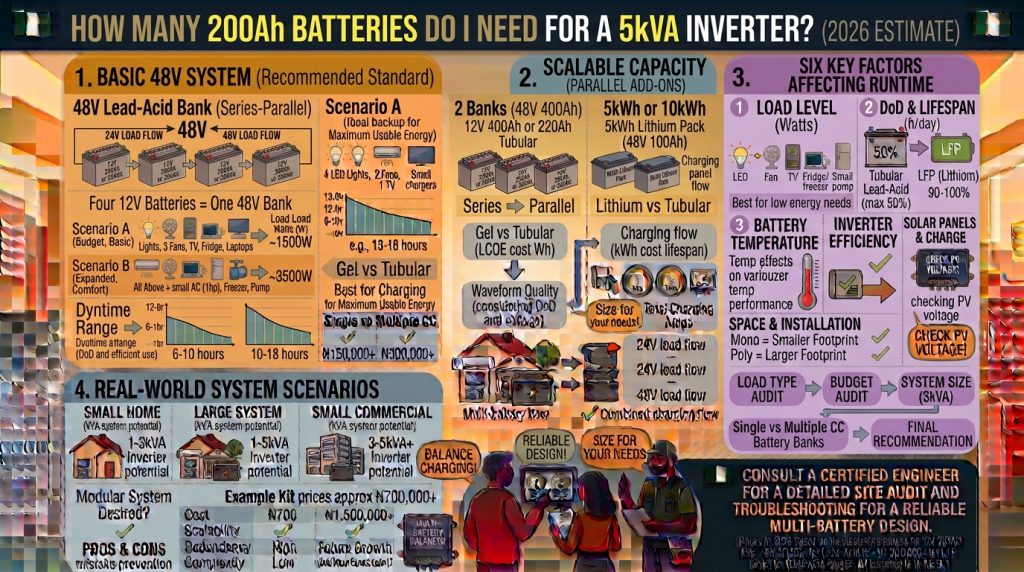
How Many 200Ah Batteries Do I Need for a 5kVA Inverter?
If you are using 12V 200Ah batteries with a 48V inverter:
4 × 12V 200Ah
gives:
48V 200Ah
Nominal energy:
48V × 200Ah = 9.6kWh
So four 12V 200Ah batteries provide approximately 9.6kWh of nominal storage.
However, this does not mean you will receive 9.6kWh of usable AC energy.
The usable amount depends on:
- Battery chemistry
- Depth of discharge
- Inverter efficiency
- Battery condition
- Wiring losses
- Manufacturer specifications
The same basic principle applies to other battery capacities.
| Battery Setup | Nominal Storage |
|---|---|
| 4 × 12V 100Ah | 4.8kWh |
| 4 × 12V 150Ah | 7.2kWh |
| 4 × 12V 200Ah | 9.6kWh |
| 4 × 12V 220Ah | 10.56kWh |
| 4 × 12V 250Ah | 12kWh |
These are nominal energy calculations.
They should not be treated as guaranteed usable AC energy.
What About Lithium Batteries?
Lithium batteries are often easier to configure because many modern solar batteries are already available as high-capacity modules.
You may see batteries such as:
- 48V 100Ah
- 51.2V 100Ah
- 48V 200Ah
- 5kWh
- 10kWh
- 15kWh
For example:
48V × 100Ah = 4,800Wh
or:
4.8kWh
A 51.2V 100Ah battery gives:
51.2V × 100Ah = 5,120Wh
or:
5.12kWh
This is why some batteries are marketed as approximately 5kWh batteries.
Always check the actual manufacturer’s specification rather than relying only on the product name.
Can One 5kWh Lithium Battery Work With a 5kVA Inverter?
It can, if the battery voltage, discharge capability and inverter requirements are compatible.
A 5kVA inverter can potentially be paired with a 5kWh-class lithium battery.
But there is another important question:
Can the battery supply enough power to the inverter?
A battery can have enough energy storage but still have a maximum discharge rating that is too low for the load you want to run.
For example, you should check:
- Battery voltage
- Battery capacity
- Usable capacity
- Maximum continuous discharge current
- Maximum discharge power
- BMS rating
- Recommended inverter size
- Inverter compatibility
- Communication requirements
- Battery expansion limits
Do not choose a lithium battery based on kWh alone.
Why Battery Discharge Current Matters
A 5kVA inverter can demand a large amount of power from the battery when it is supplying a heavy load.
A simple way to understand the relationship is:
Current = Power ÷ Voltage
For example, ignoring losses:
At 48V:
5,000W ÷ 48V ≈ 104A
At 24V:
5,000W ÷ 24V ≈ 208A
The real current will be affected by inverter efficiency and the actual output power.
This is one reason higher-voltage battery systems are commonly used for larger solar installations.
It also shows why the battery’s maximum discharge rating matters.
A battery should not be selected only because its kWh capacity looks large.
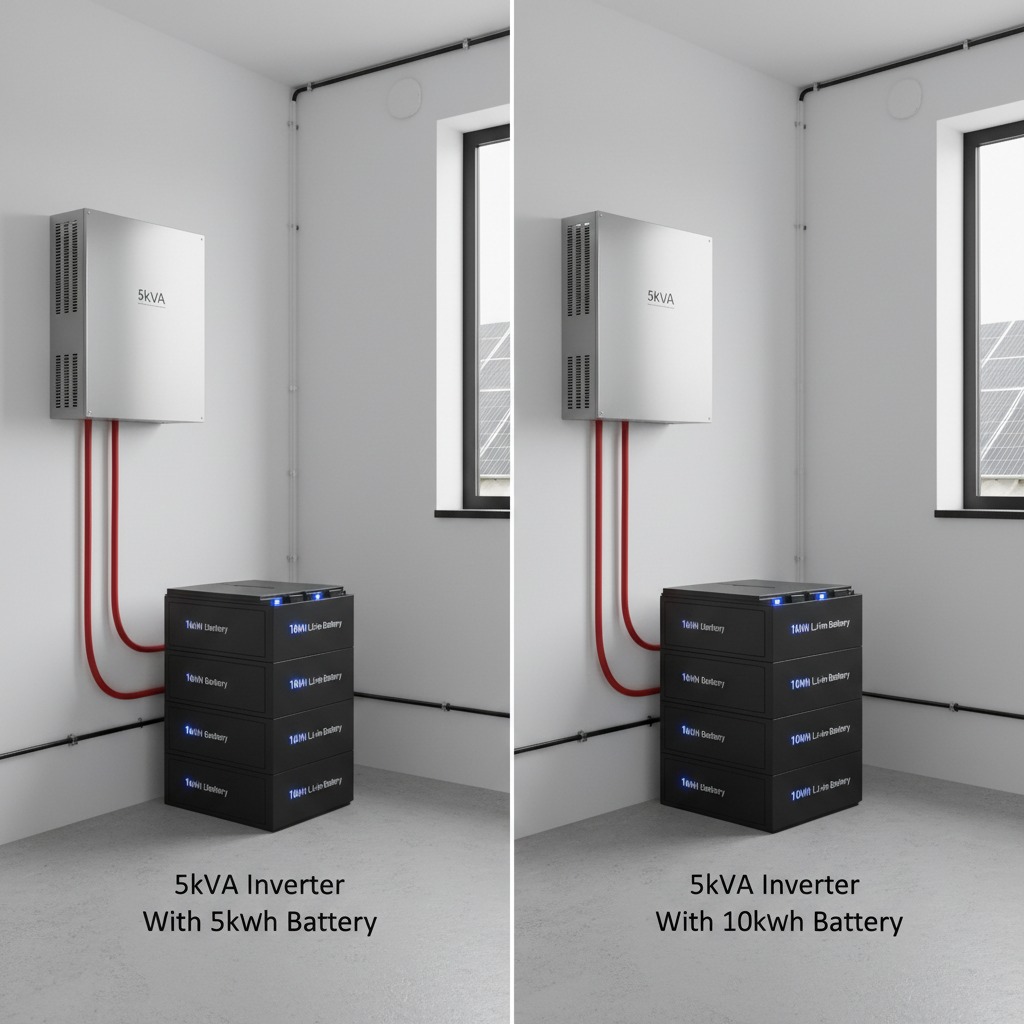
5kVA Inverter With 5kWh vs 10kWh Battery
Consider two systems:
System A
5kVA inverter + 5kWh battery
System B
5kVA inverter + 10kWh battery
Both have the same inverter power rating.
But System B has approximately twice the nominal battery storage.
If both systems are powering the same load, the larger battery will generally provide longer backup.
For example, at a constant 1,000W load:
5,000Wh ÷ 1,000W = 5 hours
while:
10,000Wh ÷ 1,000W = 10 hours
These are theoretical figures.
Actual backup will be different because of usable battery capacity, inverter losses, load changes and other system conditions.
Our guide on how long a 5kWh lithium battery lasts in Nigeria explains this difference in more detail.
5kVA Inverter With 10kWh vs 15kWh Battery
The same principle applies.
A 5kVA inverter can work with different battery storage sizes when the system is properly designed.
For example:
5kVA + 10kWh
or:
5kVA + 15kWh
The 15kWh system stores more energy.
But a larger battery does not make the inverter capable of supplying more power.
A 5kVA inverter is still a 5kVA inverter whether it has:
- 5kWh battery storage
- 10kWh battery storage
- 15kWh battery storage
If you want to run more appliances at the same time, you may need a larger inverter.
If you want the same appliances to run for longer, you may need more battery storage.
What Battery Size Is Best for a 5kVA Inverter?
There is no single best battery size.
As a simple planning guide:
| Battery Storage | Possible Use |
|---|---|
| 5kWh | Essential loads and shorter backup |
| 10kWh | Longer backup for moderate loads |
| 15kWh | Longer backup or heavier energy use |
| 20kWh+ | Larger loads or extended backup |
These are not fixed rules.
A 5kWh battery can last a long time with a small load.
A 15kWh battery can also drain quickly if you run heavy appliances continuously.
Your actual appliance usage should always come first.
Should I Use Tubular, GEL or Lithium?
The right battery type depends on your budget, usage pattern, required backup and the specifications of your system.
Lithium
Lithium batteries are often attractive when you want:
- Higher usable capacity
- Frequent cycling
- Faster charging
- Low routine maintenance
- A compact battery system
Tubular
Tubular batteries can be attractive when:
- Initial cost is important
- You want a traditional lead-acid option
- The battery will be properly maintained
- You understand its recommended discharge limits
GEL
GEL batteries can be useful when:
- You want a sealed lead-acid battery
- Low routine maintenance is important
- The battery is suitable for your inverter system
Do not choose the battery type based only on price.
Check the battery specifications, warranty, expected use and inverter compatibility.
You can also compare current battery options in our Solar Batteries Prices in Nigeria section.
For a wider comparison of lithium, tubular and GEL batteries, see our guide to inverter battery prices in Nigeria.
Can I Add More Batteries Later?
Sometimes yes.
But you should plan for expansion before buying the first battery.
Check whether:
- The inverter supports additional battery capacity
- The battery supports parallel expansion
- The battery manufacturer allows the planned configuration
- The inverter supports the total battery current
- The cables and protection are correctly sized
- The batteries are compatible
- The batteries are the same model or an approved combination
Avoid mixing batteries that are very different in age, capacity, chemistry or condition unless the manufacturer specifically allows it.
What If I Already Have Four 12V Batteries?
Do not connect them automatically just because you have a 5kVA inverter.
First check the inverter’s required battery voltage.
If it requires 48V, four 12V batteries connected in series can create:
48V
But you still need to check:
- Battery Ah rating
- Battery condition
- Battery chemistry
- Maximum discharge current
- Maximum charging current
- Inverter charging settings
- Battery manufacturer’s requirements
If the inverter requires a different voltage, the same four-battery arrangement may not be suitable.
What If My Installer Says “5kVA Needs Four Batteries”?
Ask one more question:
“What battery voltage and capacity are those four batteries?”
For example:
4 × 12V 100Ah
is:
4.8kWh nominal
while:
4 × 12V 200Ah
is:
9.6kWh nominal
They both contain four batteries.
But they do not provide the same amount of stored energy.
This is why you should always ask for:
Battery voltage + Ah/kWh + battery type
rather than simply asking for the number of batteries.
How Do I Calculate the Batteries I Need?
Use this simple process.
Step 1: List the appliances
Write down everything you want to run during a power outage.
For example:
- TV
- Fans
- Lights
- Refrigerator
- Freezer
- Router
- Laptop
- Water pump
- Air conditioner
Step 2: Find their actual power consumption
Use the appliance label or manufacturer’s specification where possible.
Do not rely only on general internet estimates.
Step 3: Decide how long you need them to run
For example:
- 3 hours
- 5 hours
- 8 hours
- 10 hours
Step 4: Calculate your energy requirement
The simple calculation is:
Load × Hours = Energy Needed
For example:
800W × 6 hours = 4,800Wh
or:
4.8kWh
Step 5: Allow for usable capacity and losses
Your battery’s full rated capacity is not necessarily the same as the energy that reaches your appliances.
Consider:
- Battery usable capacity
- Depth of discharge
- Inverter efficiency
- Battery condition
- Wiring losses
Step 6: Check the inverter voltage
Make sure the final battery bank matches the inverter.
Step 7: Check the battery’s discharge rating
The battery must be capable of supplying the power your inverter and appliances require.
Step 8: Choose the battery configuration
Only after the above steps should you decide how many batteries or battery modules you need.
Use the SolarPriceNG Battery Calculator
You do not have to do all of these calculations manually.
Use the SolarPriceNG Battery Calculator to enter your appliances, expected load and backup requirement.
The calculator can help you estimate the battery capacity needed for your system.
You can then use the other SolarPriceNG tools to continue planning.
Inverter Calculator
Use the SolarPriceNG Inverter Calculator to estimate the inverter capacity required for your appliances.
Solar Panel Calculator
After choosing your battery capacity, you also need enough solar generation to recharge it.
The SolarPriceNG Solar Panel Calculator can help estimate the solar array required based on your energy use and battery recharge requirement.
Charge Controller Calculator
If your system uses a separate charge controller, the SolarPriceNG Charge Controller Calculator can help with controller sizing.
The exact controller voltage, current and solar input limits should still be checked against the manufacturer’s specifications.
Installation Cost Calculator
After working out your equipment requirements, you can use the SolarPriceNG Solar Installation Cost Calculator to estimate installation costs.
Solar Prices in Nigeria
You can also check Solar Prices in Nigeria to see current estimated prices for batteries, inverters, panels, charge controllers and other solar equipment.
How Many Batteries Do I Need for a 5kVA Inverter? Examples
Here is the simple way to remember it:
| Battery Setup | Nominal Storage |
|---|---|
| 4 × 12V 100Ah | 4.8kWh |
| 4 × 12V 150Ah | 7.2kWh |
| 4 × 12V 200Ah | 9.6kWh |
| 4 × 12V 220Ah | 10.56kWh |
| 4 × 12V 250Ah | 12kWh |
| 48V 100Ah lithium | 4.8kWh |
| 51.2V 100Ah lithium | 5.12kWh |
| 48V 200Ah lithium | 9.6kWh |
These are nominal energy calculations.
They should not be treated as guaranteed usable AC energy.
The actual usable energy depends on the battery technology, manufacturer’s specifications, inverter losses and operating conditions.
Common Mistakes to Avoid
Buying four batteries without checking the inverter voltage
Four 12V batteries create 48V when connected in series, but that does not mean every 5kVA inverter requires 48V.
Looking only at Ah
A 12V 200Ah battery and a 48V 100Ah battery have different voltage and energy characteristics.
Compare batteries using Wh or kWh, not Ah alone.
Assuming 5kVA means 5kWh
They are different measurements.
kVA = inverter power rating
kWh = battery energy storage
Ignoring battery discharge limits
A battery may have enough kWh capacity but still be unable to safely supply the power required by the inverter.
Ignoring the manufacturer’s specifications
The battery and inverter manufacturer’s specifications should always take priority over a general rule found online.
Assuming a larger battery fixes an undersized inverter
A bigger battery gives you more stored energy.
It does not increase the inverter’s maximum output power.
Final Answer: How Many Batteries Do You Need for a 5kVA Inverter?
A 5kVA inverter does not have one fixed battery requirement.
If your inverter requires a 48V battery bank and you are using traditional 12V batteries, you would normally need:
4 × 12V batteries
to create:
48V
But the capacity of those batteries depends on how much backup you need.
For example:
4 × 12V 100Ah = 4.8kWh nominal
4 × 12V 200Ah = 9.6kWh nominal
A modern lithium system may instead use one or more 48V/51.2V battery modules, depending on the inverter and battery specifications.
So don’t ask only:
“How many batteries does a 5kVA inverter need?”
Ask:
“What battery voltage does my inverter require, how much energy do I need, and can the battery safely supply the required power?”
That is the better way to size your battery bank.
Before buying, check the exact inverter model, battery voltage, battery capacity, usable capacity, maximum discharge current and manufacturer requirements.
Then use the SolarPriceNG Battery Calculator to estimate the battery capacity needed for your actual appliances and backup time.
For current Nigerian battery prices, you can also check the SolarPriceNG Solar Batteries price section.
Prices and specifications can change. Always confirm the exact specifications, compatibility, warranty and final price with the manufacturer, seller or qualified installer before purchasing.
Frequently Asked Questions
Can a 5kVA inverter use four 12V batteries?
Yes, if the inverter is designed for a 48V battery bank and the batteries are suitable for the required configuration.
Four 12V batteries connected in series give 48V.
How many 200Ah batteries do I need for a 5kVA inverter?
If the inverter requires 48V and you are using 12V 200Ah batteries, four batteries connected in series give a 48V 200Ah bank with approximately 9.6kWh of nominal storage.
Whether 9.6kWh is enough depends on your load and desired backup time.
Can I use one 5kWh lithium battery with a 5kVA inverter?
It can be possible if the battery voltage, discharge capability and inverter specifications are compatible.
Check the battery’s maximum continuous discharge power/current and the inverter manufacturer’s requirements before connecting them.
Does a bigger battery make my 5kVA inverter more powerful?
No.
A larger battery gives you more stored energy and potentially longer backup.
It does not turn a 5kVA inverter into a 7kVA or 10kVA inverter.
Is four batteries always better than one lithium battery?
Not necessarily.
Four 12V lead-acid batteries and one 48V lithium battery can have very different capacities, usable energy, discharge limits, lifespan and prices.
Compare the complete specifications rather than simply counting the batteries.
How long will a 5kWh battery last with a 5kVA inverter?
The inverter size does not determine the runtime.
Runtime depends mainly on the battery’s usable energy and the load being powered.
For example, a 5kWh battery running a 500W load has a simple theoretical runtime of about 10 hours before accounting for losses and usable-capacity limits.
Read our full guide on how long a 5kWh lithium battery lasts for more examples.
Related SolarPriceNG Guides
You may also find these guides useful: