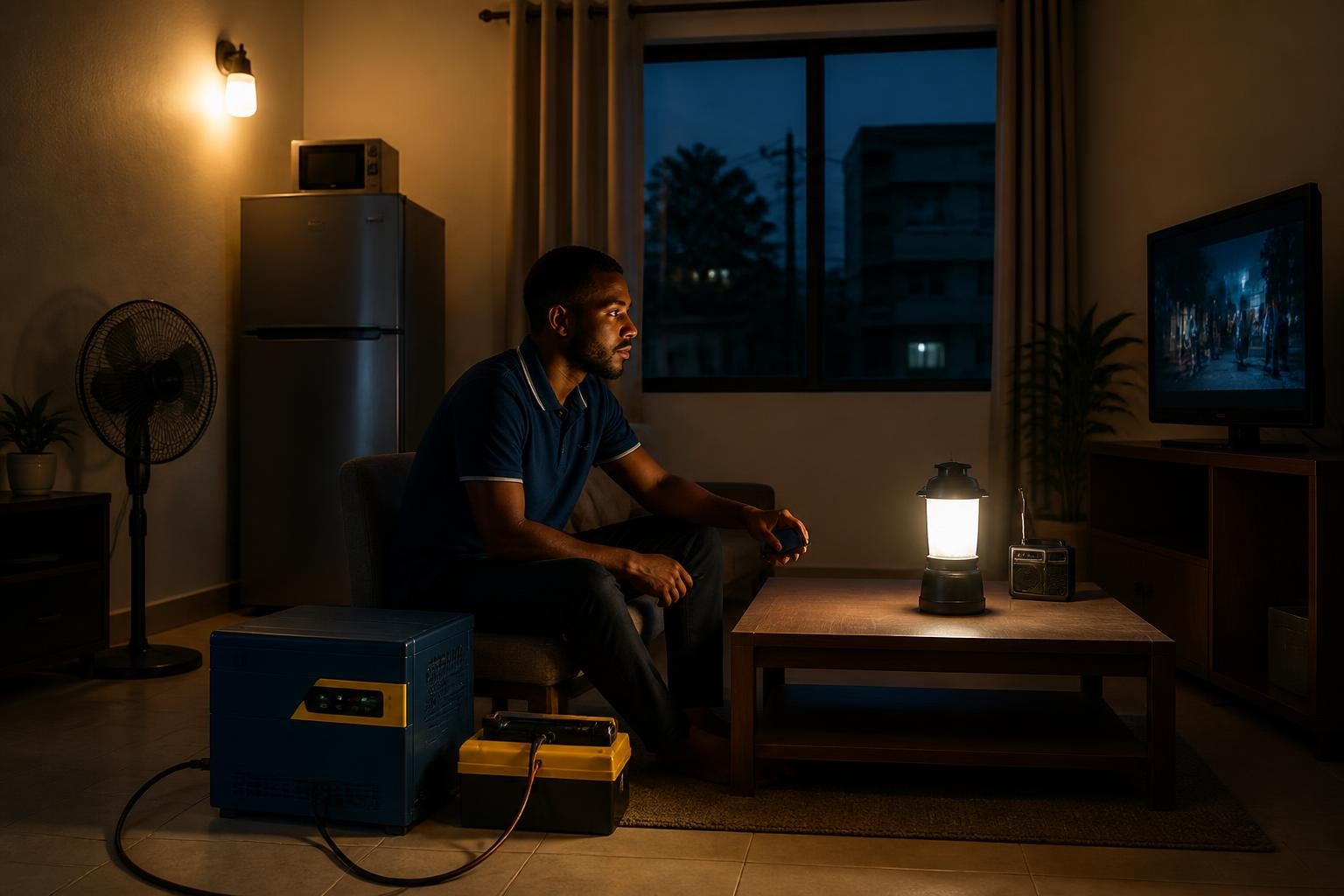
Short answer: the cheapest safe approach is usually to reduce and separate your load before buying a larger inverter, battery or solar system. Decide which appliances must stay on, calculate their running and starting demand, and connect only those circuits to the backup system through proper protection and changeover equipment.
For many Nigerian homes, the critical list may be a few lights, a fan, Wi-Fi router, phone chargers, television, laptop and perhaps a refrigerator. Water heaters, pressing irons, electric cookers, kettles, pumps and other heavy appliances should normally stay off the backup circuit unless the system was deliberately designed for them.
Start with a critical-load list
Do not begin with “What size inverter should I buy?” Begin with “What do I actually need during a blackout?” A smaller, well-prioritised load can reduce the size and cost of the inverter, battery, panels and wiring.
| Load group | Typical priority | Why |
|---|---|---|
| Router, phones and laptop | Usually critical | Communication, work and payments |
| One or two lights | Usually critical | Safety and basic movement at night |
| Fan | Often important | Comfort, especially in hot weather |
| Television | Optional | Can be added if the battery has enough energy |
| Refrigerator or freezer | Case-by-case | Motor starting surge may be high |
| Iron, kettle, cooker or heater | Usually exclude | High power demand drains a small system quickly |
| Water pump | Separate assessment | Starting demand and operating time can be significant |
“Critical” is personal. A small POS shop may prioritise a router, phone chargers, lights and a computer. A home may prioritise a refrigerator, security equipment, lights and a fan. Write the list down before asking an installer for a quotation.
The cheapest saving usually comes from reducing the load
If your backup system is struggling, adding a bigger battery is not always the first answer. A bigger battery cannot solve an inverter that is overloaded, an appliance with a large starting surge, poor wiring or unnecessary loads running at the same time.
Try these lower-cost changes first:
- Remove electric heating appliances from the backup circuit.
- Use fewer lights and switch off rooms that are empty.
- Use LED bulbs and efficient fans where practical.
- Turn off television, decoder, speakers and chargers when nobody is using them.
- Schedule charging and other flexible loads during strong sunshine or when grid power is available.
- Run a freezer or refrigerator only if its starting demand is compatible with the inverter.
- Separate essential loads from convenience loads instead of backing up the entire house.
This approach can reduce both the inverter’s required power rating and the battery energy needed through the night.
Check running watts and starting watts
There are two different questions:
- How much power do the appliances use while running?
- How much extra power do they need when starting?
The first question affects the inverter’s continuous output. The second affects its surge or starting capability.
Lights, routers, televisions and phone chargers normally have relatively predictable running demand. Refrigerators, freezers, water pumps and some pressing irons or power tools can behave differently. A system may appear large enough based on running watts but still shut down when a motor starts.
Check the appliance nameplate or manual where possible. If the information is unclear, use a plug-in power meter for suitable appliances or ask a qualified installer to measure the load. Do not assume that the wattage printed in a generic online table is the exact demand of your appliance.
A simple example of a smaller backup load
Assume a household wants to run the following during an evening outage:
| Appliance | Illustrative running power | Use in the example | Approximate energy |
|---|---|---|---|
| Router | 12 W | 10 hours | 120 Wh |
| Four LED bulbs | 36 W total | 5 hours | 180 Wh |
| Television | 80 W | 4 hours | 320 Wh |
| Fan | 60 W | 6 hours | 360 Wh |
| Phone charging | 20 W | 2 hours | 40 Wh |
The illustrative total is about 1,020 Wh, or 1.02 kWh, before allowing for inverter losses and other system limits. The figures are examples, not a quotation or a guarantee. Actual appliance demand and usage time will change the result.
The running load in this example is about 208 W if all listed appliances operate together. That does not mean a 208 W inverter is automatically suitable. The inverter must have enough continuous capacity, enough surge capacity for any motor load added later, and a battery with enough usable energy for the required backup time.
For a more complete sizing decision, see what a 1kVA inverter can realistically handle in a Nigerian home.
Use energy, not only inverter size, to choose the battery
The inverter determines how much power can run at one time. The battery determines how long the selected loads can continue running.
A rough planning calculation is:
Required battery energy ≈ load energy ÷ overall system efficiency
In practice, the result is also affected by battery chemistry, permitted depth of discharge, battery age, temperature, inverter limits and whether the load is continuous or intermittent.
For lithium batteries, capacity is commonly discussed in kWh. For tubular, GEL and AGM batteries, capacity is commonly stated in Ah together with voltage. Do not compare a lithium battery and a lead-acid battery by Ah alone.
If your current battery empties too quickly, first check the actual load and usage hours. You may need a larger battery, but you may instead need to remove one high-energy appliance or repair a battery, inverter, cable or charging problem. Read how to tell whether the battery or inverter is causing the problem.
The safest wiring arrangement is a separate essential-load circuit
A proper installation should not depend on moving plugs around the house or improvising connections whenever NEPA or the DisCo supply goes off. Ask the installer about a dedicated essential-load circuit or a correctly installed changeover arrangement.
The installation should include, as appropriate:
- Correctly sized cables, breakers, fuses and isolators.
- Proper earthing and protection against faults.
- A safe changeover arrangement between grid, inverter and generator where applicable.
- Clear labelling of the backed-up and non-backed-up circuits.
- Protection against back-feeding electricity into the public supply.
- Enough ventilation and a suitable location for the inverter and batteries.
Never connect an inverter or generator into a wall socket to energise house wiring. Do not bypass breakers, remove protective devices or allow an unqualified person to work on dangerous electrical sections. A qualified electrician or solar installer should handle the changeover, distribution-board work and high-voltage parts.
When should you add battery, panels or inverter capacity?
| Symptom | Likely direction to investigate |
|---|---|
| The inverter shuts down when several appliances start together | Reduce simultaneous load or check inverter continuous and surge ratings |
| The battery reaches low voltage early every night | Reduce energy use, test the battery and check usable capacity |
| The battery is not full by evening after normal sunshine | Check solar input, shading, dust, charging settings and panel capacity |
| The system has enough power but not enough runtime | Investigate battery energy and the hours each appliance runs |
| The system works until a freezer or pump starts | Check motor starting surge and inverter surge capability |
Do not automatically buy more panels or a bigger battery. First identify whether the limitation is power, energy, charging or an appliance fault. This guide on adding solar panels versus adding battery capacity explains that decision in more detail.
A practical low-cost plan for a Nigerian home
- List every appliance you want during a blackout.
- Label each one critical, useful or unnecessary.
- Remove heaters and other high-power loads from the first design.
- Record running watts and identify appliances with starting surge.
- Estimate how many hours each critical appliance will run.
- Choose a safe essential-load circuit rather than backing up the whole house by default.
- Size the inverter for simultaneous running and starting demand.
- Size the battery for usable energy and required runtime.
- Confirm the charging source, protection and changeover arrangement.
- Review the setup after a real outage and adjust the load list.
Bottom line
The cheapest safe blackout plan is usually not “buy the biggest inverter.” It is to keep only the loads that genuinely matter, remove high-power appliances, account for starting surge, and install a properly protected essential-load circuit.
Once the critical load is clear, you can make a better decision about whether you need a small inverter system, more battery capacity, more solar panels or a hybrid arrangement that reduces generator use. See how to plan a system that reduces generator use in Nigeria.