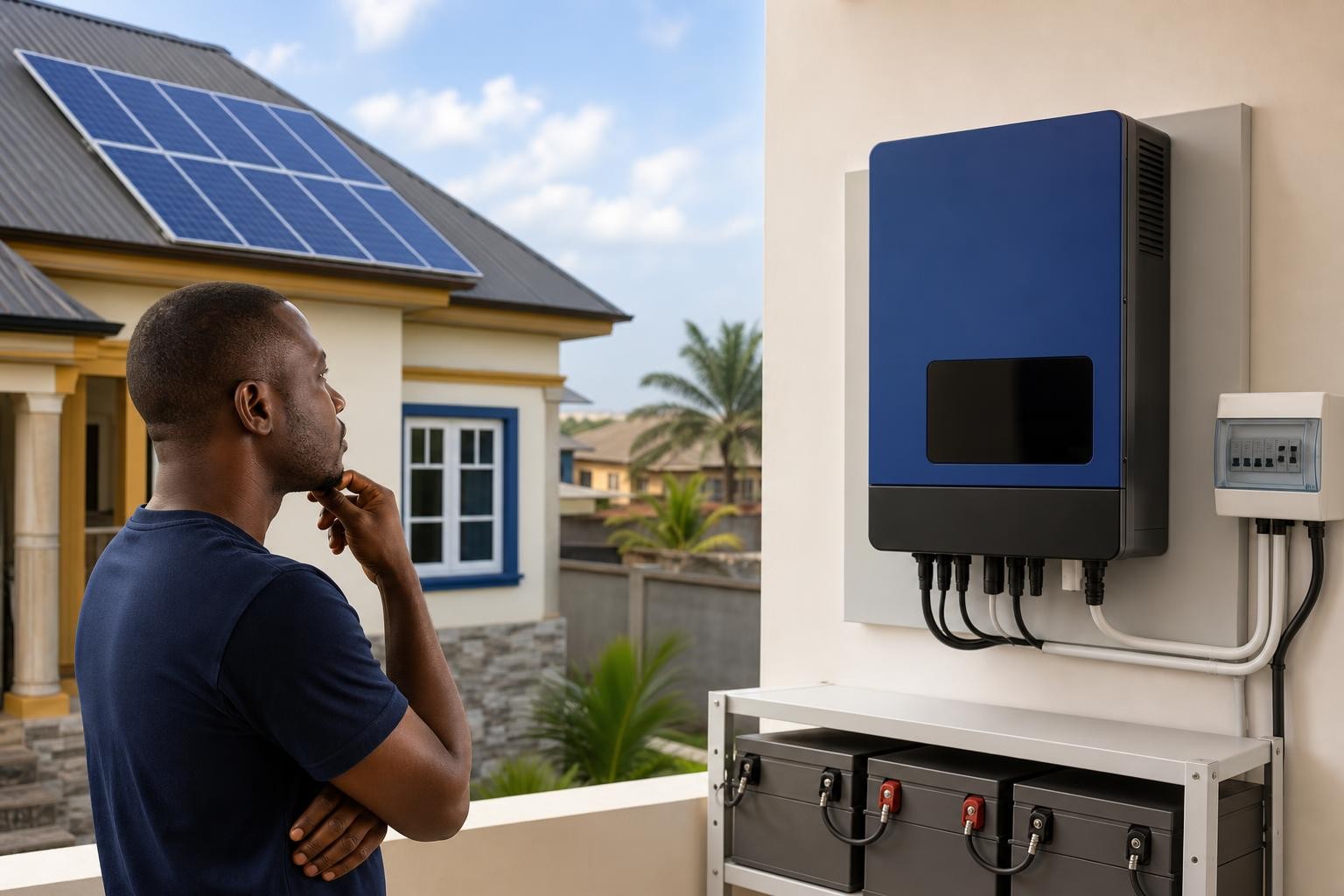
Last reviewed: September 25, 2026
A 1kVA inverter can be suitable for a Nigerian home that wants to keep a carefully chosen group of essential appliances running during a blackout. It is usually not a whole-house solution. The correct size depends on the inverter’s actual continuous watt rating, the appliances you will run at the same time, the starting surge of fridges or pumps, and the battery energy required for the number of hours you want.
For many homes, a sensible 1kVA system is built around lights, fans, a television, a decoder, a router, laptops and phone charging. Adding a refrigerator may still be possible, but you must check its starting demand and leave room below the inverter’s verified output. Kettles, pressing irons, cookers, water heaters, microwaves, pumps and air conditioners normally make a 1kVA system unsuitable unless they are excluded or carefully managed.
The short answer: start with your simultaneous load
Do not choose a 1kVA inverter because the number sounds close to the wattage printed on your appliances. First list what you genuinely need during an outage, add the power of the appliances that may run together, and then check the exact inverter’s continuous watt rating and surge rating.
- Likely suitable: lights, fans, TV, decoder, router, laptops, phone chargers and other small electronics used together.
- Possible but needs checking: one refrigerator or freezer, provided its running and starting requirements fit the inverter and the battery can support it.
- Usually unsuitable for the same time: electric iron, kettle, microwave, cooker, water heater, pressing machine, pump or air conditioner.
These are planning categories, not guarantees. Appliance labels, actual measurements and the inverter manual should decide the final answer.
Why “1kVA” does not always mean 1,000W
Inverter capacity may be shown in VA or kVA, while appliance consumption is normally discussed in watts. The two numbers are related but are not always identical because of power factor. An appliance can require more apparent power in VA than its real power in watts.
That is why you should look for both of these figures on the product label or datasheet:
- Continuous output in W: the real power the inverter can supply continuously under the stated conditions.
- Continuous or apparent rating in VA: the current-handling capacity expressed as volt-amperes.
- Surge or peak rating: the short-duration output available for starting some motors, compressors and other loads.
As a manufacturer example, Victron publishes inverter specifications with separate VA, W and peak-power figures. Its guidance also explains that motors, compressors and some electronic power supplies can create higher starting or apparent-power demands. Treat this as a reminder to read the exact datasheet, not as a specification for every 1kVA inverter.
Victron’s inverter sizing guidance explains the relationship between VA, watts, power factor and starting surge.
A practical load example for a Nigerian home
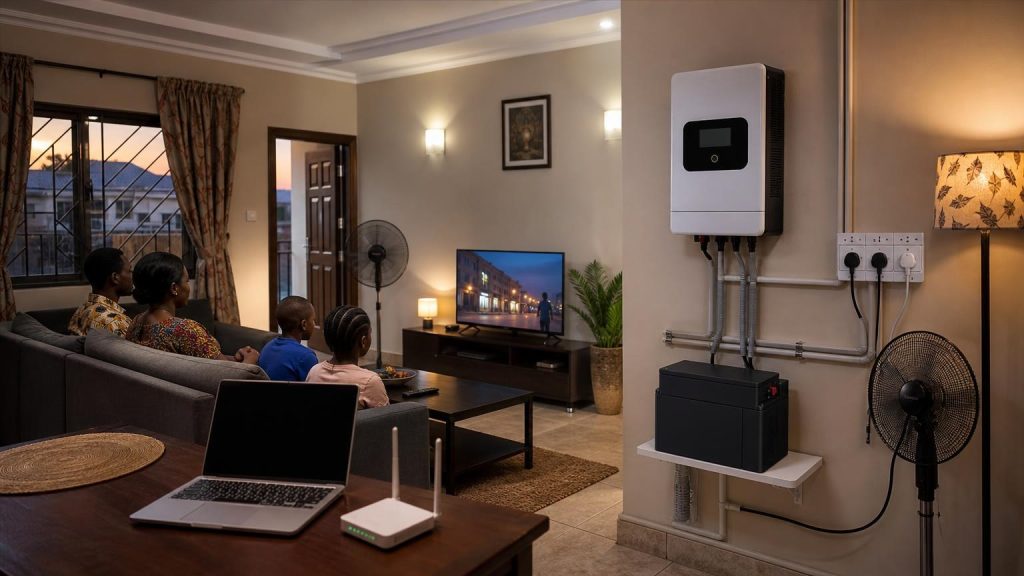
Imagine a flat or small home that wants to keep only essential appliances on during a DisCo outage. The following figures are illustrative planning values. Your appliances may use more or less, so check nameplates or measure them where possible.
| Appliance | Illustrative running load | Quantity | Subtotal |
|---|---|---|---|
| LED lights | 10W | 4 | 40W |
| Standing or ceiling fans | 60W | 2 | 120W |
| LED television | 100W | 1 | 100W |
| Decoder and Wi-Fi router | 35W | 1 set | 35W |
| Laptop | 65W | 1 | 65W |
| Estimated total | 360W |
A 360W running load gives a 1kVA system much more breathing room than a 900W load. If you add a refrigerator with an illustrative running demand of 150–250W, the normal running total may become roughly 510–610W. The refrigerator can still draw a short starting surge that is much higher than its running figure, so the inverter’s surge capability and the battery’s ability to deliver current must also be checked.
Do not copy the refrigerator range into a quotation as if it were a guaranteed specification. Check the refrigerator’s nameplate, manufacturer information or a reliable meter. Old fridges, freezers and pumps can behave very differently from newer efficient models.
A 1kVA inverter may be too small when these appliances are included
High-power heating appliances are the common reason a small inverter overloads. A single electric kettle, iron, microwave or water heater can consume a large part of the available output before you add lights or electronics.
- Electric iron or pressing iron
- Electric kettle
- Microwave oven
- Hot plate, cooker or water heater
- Washing machine during its motor cycle
- Water pump or borehole pump
- Air conditioner
- Large freezer or refrigerator with a difficult compressor start
You may be able to use one of these appliances occasionally when other loads are switched off, but that is a load-management decision, not proof that the 1kVA inverter can run the whole home. Never defeat an overload alarm or replace a protective device with a larger one to force the system to carry more load.
How to calculate whether your appliances fit
Use this simple process before buying or upgrading:
- Write down every appliance you want during an outage. Separate critical loads from convenience loads.
- Record the running watts. Use the nameplate, manual or a meter rather than a guess.
- Add only appliances that may run at the same time. A fan used in the afternoon may not overlap with a television used later.
- Identify motor and compressor loads. Fridges, freezers, pumps and some air conditioners need starting surge.
- Compare the result with the exact inverter’s continuous W rating. Do not rely on “1kVA” alone.
- Check the surge rating and duration. The inverter must tolerate the starting event without tripping.
- Leave practical headroom. A system operating close to its limit is less forgiving of heat, low battery voltage, appliance variation and additional loads.
If you are unsure about the appliance combination, use the SolarPriceNG “Can My Solar System Power It?” tool as a planning aid. Then compare the result with the exact inverter and appliance specifications.
The battery determines how long the 1kVA inverter will run
The inverter rating answers, “Can the system supply this load now?” The battery answers, “How long can it supply the load?” A 1kVA inverter with a small battery may run a 300W load safely but stop after a short time. A larger battery cannot make an undersized inverter safely run a heavy appliance.
Start with the energy calculation:
Energy used by the appliances = average load in watts × operating time in hours
For example, a 400W average load used for 4 hours needs about 1,600Wh, or 1.6kWh, at the AC output. The battery must be larger than that because some energy is lost in the inverter and because the full nominal battery capacity may not be safely usable.
Illustrative battery calculation
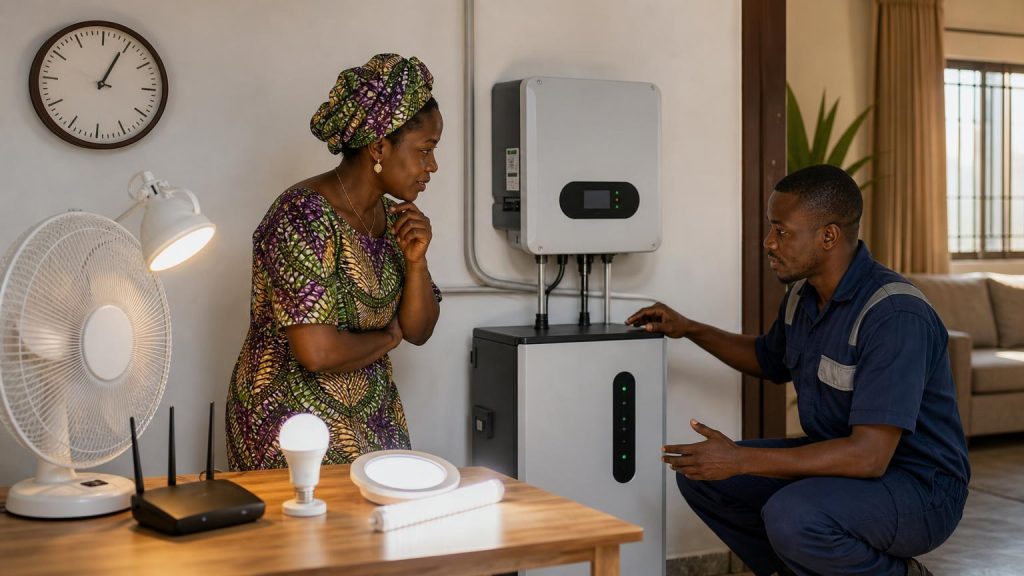
Suppose the target is 400W for 4 hours:
- AC energy required: 400W × 4h = 1.6kWh.
- If you allow an illustrative 90% inverter efficiency and 80% usable fraction for a lithium battery, nominal battery energy is approximately 1.6 ÷ (0.90 × 0.80) = 2.22kWh.
- For a lead-acid example using an illustrative 85% inverter efficiency and 50% usable fraction, nominal battery energy is approximately 1.6 ÷ (0.85 × 0.50) = 3.76kWh.
These are calculation examples, not a universal battery recommendation. Lithium batteries should primarily be compared in kWh when that is the verified rating. Tubular, GEL and AGM batteries should be considered in Ah together with voltage. For example, 3.76kWh at 24V is about 157Ah before allowing for system-specific limits, while the same energy at 12V would be about 313Ah. The installer must confirm the battery voltage, chemistry, maximum discharge current, cable size, fuse and inverter compatibility.
You can use the SolarPriceNG Battery Calculator to test different loads and backup times. If the expected runtime is much shorter than the result, investigate actual appliance consumption, battery condition, charging level, settings and cable voltage drop before buying another component.
What changes the answer in Nigerian conditions?
A 1kVA system designed only for evening essentials may work well in one home and disappoint in another because the operating conditions are different.
- Heat: inverter output can be affected by high temperature or poor ventilation. Do not hide the unit in a closed cupboard.
- Low battery voltage: a long or undersized DC cable can cause voltage drop and an early low-battery shutdown.
- Cloudy weather and Harmattan dust: reduced solar charging can mean the battery starts the night only partly charged.
- Generator or DisCo charging: a hybrid inverter may have different charging settings and input limits. Use the manufacturer’s instructions and a stable source.
- Unplanned loads: a pressing iron, freezer, pump or small shop appliance connected later can overload a system sized for lights and fans.
- Appliance surge: running watts are not enough for equipment with motors or compressors.
If your 1kVA inverter powers a small load but shuts down when a fridge, pump or other motor starts, read the exact alarm and test the appliance separately. Do not immediately assume that the battery or inverter is defective.
When a 1.5kVA or 2kVA inverter is more sensible
Consider a larger inverter when your measured simultaneous load is already close to the verified 1kVA inverter limit, when you need to start a fridge or pump reliably, or when you expect to add appliances soon. The larger inverter will still need a correctly sized battery, cables, protection and charging system; increasing the inverter label alone does not create more stored energy.
For comparison, see:
Safety checks before installing a 1kVA system
- Confirm whether the inverter is 12V, 24V or another battery voltage before selecting the battery bank.
- Use the manufacturer’s battery type, charging and low-voltage settings.
- Size the DC cables, fuse, breaker and isolator for the actual current and installation method.
- Keep batteries and inverter in a dry, ventilated location away from heat, water and flammable materials.
- Do not mix different battery chemistries, ages or capacities without a design that specifically allows it.
- Do not open the inverter, work on exposed DC terminals or alter protection devices unless you are qualified to do so.
- Have a qualified installer check polarity, earthing, protection, battery connections and the final load test.
A 1kVA inverter can deliver high fault current from a battery even though the number looks small. Treat the battery cables and protection devices as serious electrical equipment.
Bottom line
A 1kVA inverter is usually best for a defined essential-load circuit, not every appliance in a Nigerian home. It can often support lights, fans, a TV, a router, a decoder, laptops and charging, and it may support one refrigerator if the exact running and starting requirements fit. The final decision must be based on the inverter’s continuous watt rating, surge rating, measured simultaneous load, battery voltage and required backup time.
If your load list contains a kettle, iron, pump, microwave, water heater or air conditioner, either exclude those appliances during an outage or assess a larger system. Calculate the load first, check the battery energy separately, and have the final wiring and protection verified by a qualified installer.