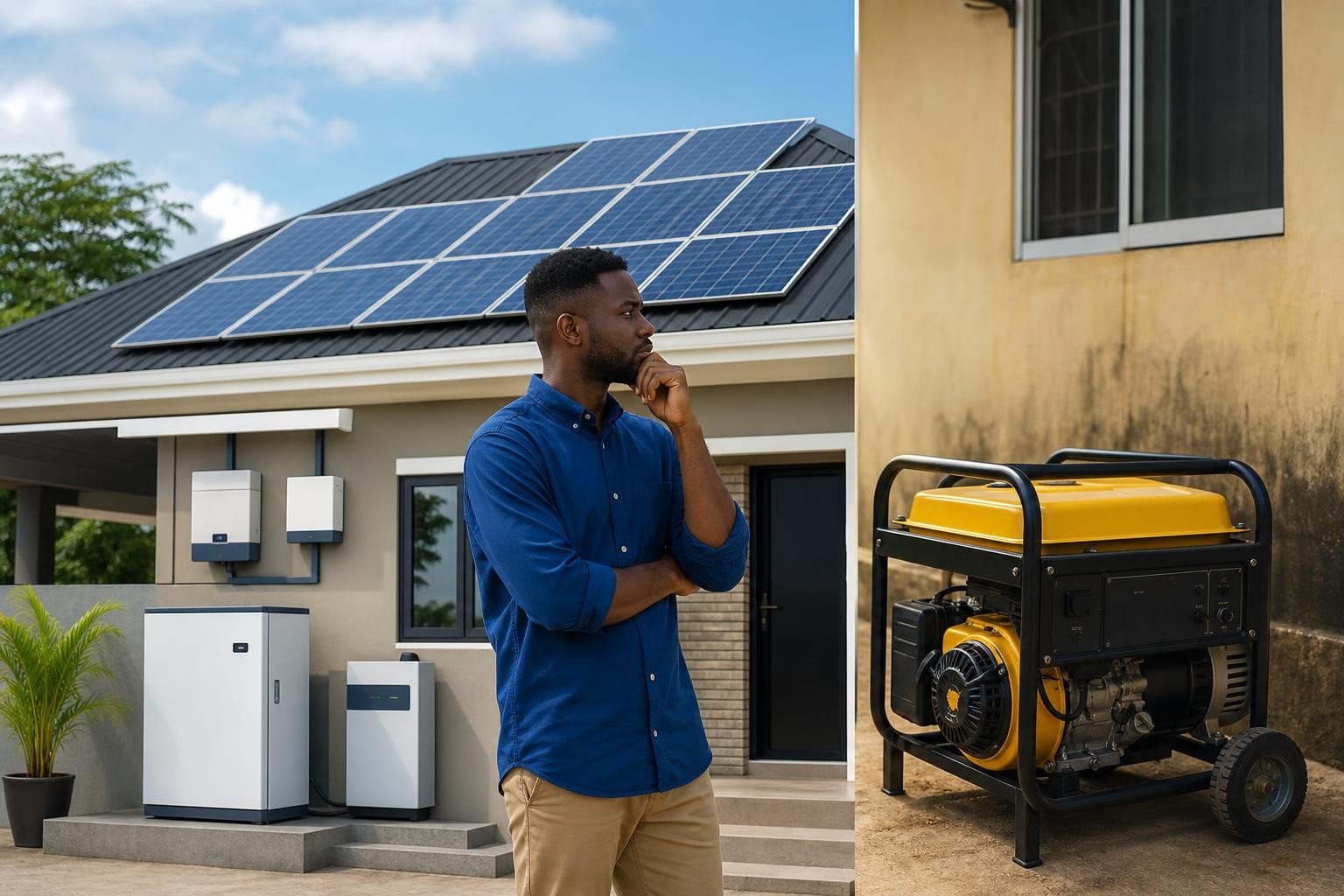
You do not have to choose between running your generator all day and going completely off-grid. For many Nigerian homes and small businesses, the practical goal is to use solar and batteries for the predictable, essential part of an outage, then keep the generator for long cloudy periods, heavy loads or emergency charging.
How much generator use you can remove depends on three things: the energy your critical loads need, how much solar energy your system can reliably replace each day, and the peak power your inverter and battery can deliver when appliances start. A larger battery can reduce generator starts, but it cannot create energy that the solar array does not replace. More panels may reduce generator hours, but they will not solve an inverter that cannot start a pump or air conditioner.
Short answer: aim to remove the generator hours your system can measure and support
A sensible target is not “zero generator use” from the beginning. First separate your loads and measure your present generator pattern for at least several outage days. Then decide which generator hours are caused by:
- Small essential loads such as lights, fans, a television, router, phone charging, CCTV or a small fridge. These are often the easiest hours for solar and battery backup to replace.
- Battery recharge after a long night or cloudy day. More usable solar, lower daytime consumption or controlled grid/generator charging may reduce these hours.
- High-power or starting loads such as pumping machines, pressing irons, kettles, freezers, air conditioners and workshop equipment. These may still need the generator unless the inverter, battery and wiring are designed for them.
- Long periods with little usable solar. A battery can cover one evening, but repeated rainy or heavily shaded days may still require a generator or another charging source.
The right question is therefore: which generator hours can my solar-battery system replace safely and repeatedly? Solar and battery systems can provide backup during an outage, while a generator can remain part of a hybrid system for longer interruptions or higher demand. The exact result depends on the equipment and the way it is controlled.
Why generator hours continue even after installing solar
People often expect a solar system to eliminate the generator immediately, then become disappointed when the generator still starts. Usually the generator is filling one of these gaps:
| What is happening? | What it usually means | First improvement to investigate |
|---|---|---|
| The battery reaches low state of charge before morning | Night-time energy demand is higher than the usable battery energy | Reduce critical-load energy, add usable battery capacity or change the night load plan |
| The battery does not recover during the day | Solar energy is being used by daytime loads, or PV production is limited | Measure PV energy, check shade/dust and compare solar production with daytime demand |
| The inverter trips when a motor starts | Starting surge, battery discharge limit, cable voltage drop or inverter output limit | Test the appliance start and the complete DC path; do not judge by running watts alone |
| The generator runs to charge the battery | The system cannot collect enough energy from solar before the next outage | Check panel size, charging settings, available sunlight and generator charge-current limits |
| The generator runs during several rainy days | The system has an energy deficit over several days | Use a realistic rainy-period plan instead of assuming a bigger inverter will solve it |
If your main problem is that the system does not last long enough, compare the options before buying anything. SolarPriceNG’s guide on adding a battery, adding solar panels or reducing your load explains why the cheapest fix depends on the actual failure point.
Step 1: Record your current generator use
Before changing the system, keep a simple seven-day or fourteen-day record. Write down:
- When the grid failed or became unusable
- When the generator started and stopped
- Which appliances were running
- The inverter battery state of charge or voltage before and after the generator ran
- Whether the generator was powering loads, charging the battery, or doing both
- Whether the event happened at night, during rain, after heavy daytime use or when a motor started
Do not record only the total generator hours. Two systems can both run a generator for four hours but have different problems: one may need four hours because a freezer and pump are too large for the inverter, while the other may need four hours because its battery never receives enough daytime charge.
Step 2: Choose the loads you are actually trying to protect
Start with a critical-load list instead of trying to back up the whole house. In a typical Nigerian home or small office, the first group may include lights, fans, router, phone charging, television, CCTV and a refrigerator. A borehole pump, electric iron, kettle, water heater or air conditioner may need a separate decision because its starting or continuous demand can change the system size sharply.
- Write down each appliance.
- Estimate or measure its running watts.
- Record how many hours it is needed during an outage.
- Mark appliances with motors, compressors or heating elements.
- Decide which loads can be delayed until the grid or generator is available.
For example, a home may choose to keep lights, fans, router, TV and a fridge on backup, while moving ironing, pumping and water heating to generator or grid periods. That does not mean the home is fully off-grid; it means the generator is reserved for the loads that the solar-battery system cannot yet support economically.
Step 3: Calculate the energy the critical loads need
Use this basic estimate:
Daily energy needed = appliance power in watts × hours used ÷ 1,000
Suppose the selected critical loads average 650W while they are running and are needed for six hours during an evening outage:
650W × 6 hours = 3,900Wh, or 3.9kWh of AC load energy
The battery does not deliver all of its nominal energy to the appliances. Allow for inverter losses, battery operating limits, wiring losses and the fact that some appliances cycle rather than run continuously. A planning estimate might therefore require more than 3.9kWh of nominal storage, but the exact usable figure must come from the battery chemistry, model and system settings.
Use kWh as the primary capacity measure for a verified lithium battery. For tubular, GEL or AGM batteries, use Ah together with voltage; do not compare a lithium battery and a lead-acid battery by Ah alone. SolarPriceNG’s Battery Calculator can help with a first estimate, but the final design should be checked against the exact battery and inverter manuals.
Step 4: Check whether solar can refill the battery
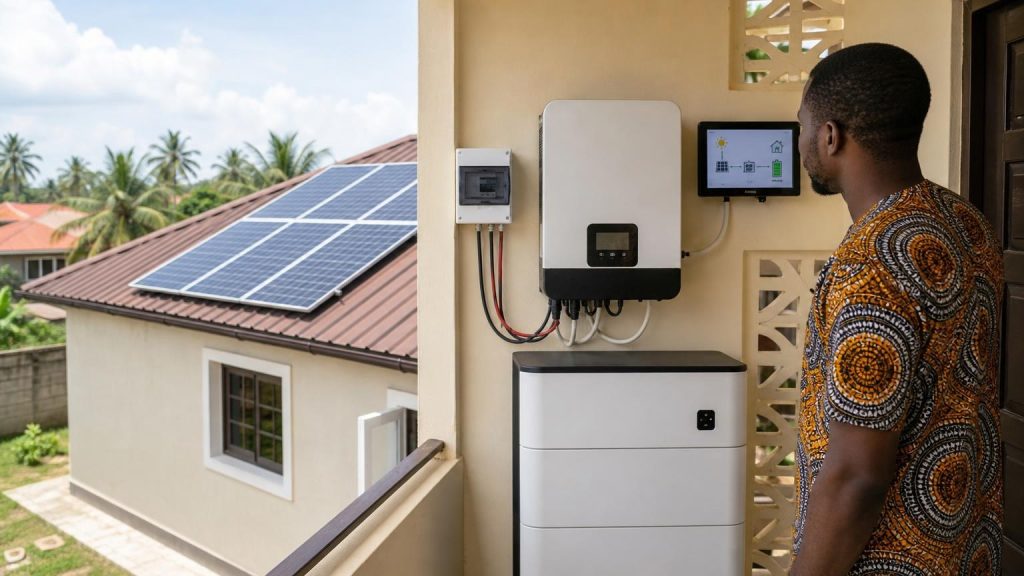
Removing generator use is not only a battery-size problem. The energy used tonight must be replaced by solar, grid or generator charging before the next demanding outage. If daytime appliances consume nearly all the available PV energy, the battery may finish the day partly charged even when the panels are producing.
- Record daily PV energy or a comparable solar-power reading where your inverter provides it.
- Compare PV production with daytime loads and battery charging energy.
- Check for new shade, heavy dust, damaged wiring, poor connections or an inverter/controller input limit.
- Look at several clear and cloudy days instead of judging the system from one afternoon.
- Confirm that the battery settings and BMS communication match the battery manufacturer’s requirements.
Solar output changes with clouds, rain, dust, heat, shading, orientation and the time of day. A panel’s nameplate wattage is not the same as the energy it will deliver to the battery over a full Nigerian day. If the battery is repeatedly empty before the next outage, adding solar input or reducing daytime consumption may be more useful than buying a bigger battery alone.
The three main ways to reduce generator hours
1. Reduce the load before increasing equipment
Load reduction is often the fastest and safest way to remove generator hours. Move ironing, pumping, water heating and other high-demand appliances to periods when the grid or generator is already available. Replace unnecessary always-on loads, check old fridges or freezers, and avoid running several high-power appliances together on the backup circuit.
If your goal is only to keep essential lights, fans, internet and refrigeration available, a smaller critical-load circuit may achieve more than trying to run every socket in the building. Read SolarPriceNG’s guide to keeping only critical appliances running during a blackout.
2. Add solar when the battery is not recovering
Add or improve PV when the battery is large enough for the desired night load but does not return to a healthy charge during normal sunlight. The installer must check the inverter’s maximum PV voltage, current and power, the panel arrangement, roof space, shading and the controller’s operating limits. More panels are not automatically safe if the string voltage or current exceeds the equipment rating.
3. Add usable battery energy when solar already refills it
Add battery capacity when the solar array regularly produces enough energy to recharge the existing battery, but the stored energy still runs out before the required backup period ends. Check the battery’s usable energy, discharge limits, age, temperature, warranty and compatibility with the inverter. For lead-acid banks, also check whether one weak battery is limiting the whole bank.
When keeping the generator is the sensible choice
Keeping some generator use is not a design failure. It may be the sensible choice when:
- you need to run a borehole pump, air conditioner, large freezer or workshop equipment;
- the outage can last several days with limited solar production;
- the roof cannot hold enough PV for the required energy;
- the cost of making the battery large enough is higher than occasional generator use;
- the business must keep operating even when the battery is low; or
- the inverter is not designed to accept generator input or its generator settings are not configured safely.
A hybrid system can use solar first, the battery for short or predictable gaps, and the generator as a controlled backup. Some inverter-chargers can limit the AC current they draw from a generator so that the generator powers the loads and charges the battery without being overloaded, but the setting and compatibility are model-specific. Never assume that any generator can be connected to any inverter.
A worked planning example
Imagine a small Nigerian office that currently runs a generator for four hours during a typical outage. The owner wants solar to cover lights, fans, internet equipment, CCTV and a small fridge, but is willing to keep the generator for printing, pumping and other high loads.
- Record the critical loads and their actual operating times.
- Calculate the evening energy requirement in kWh.
- Check whether the battery can deliver that usable energy without exceeding its discharge limit.
- Measure whether the solar array replaces that energy before the next outage.
- Test the inverter with the critical loads and separately test the larger appliances.
- Keep the generator as a fallback for long outages, low-solar days and the excluded high-power loads.
If the critical loads need 2.4kWh and the system can safely supply and recharge that energy, the office may remove most generator hours associated with those loads. It may still need the generator when printing, pumping or charging after several poor-solar days. This is a planning example, not a promise of a particular percentage reduction; the real result must be measured after installation.
What your installer should verify before promising fewer generator hours
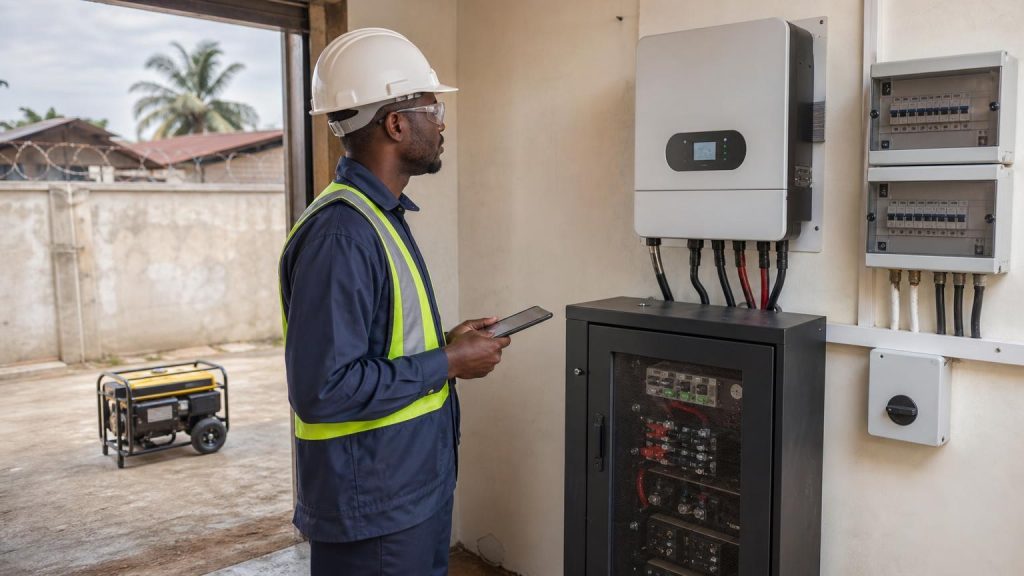
- The exact inverter model, continuous output and surge capability
- Battery chemistry, nominal capacity, usable energy and maximum permitted charge/discharge current
- PV voltage, current and power limits, including the proposed string arrangement
- Critical-load circuits and which appliances are deliberately excluded
- Generator voltage, frequency, phase arrangement, neutral/earthing arrangement and acceptable input range
- AC charging current and any generator input limit on the inverter
- Changeover or automatic-start equipment, protection devices and safe isolation
- What happens when the battery reaches its minimum state of charge
- How the system will behave during rain, low solar production, overload and a generator start
- How performance will be measured after handover
Do not allow a technician to connect a generator to the inverter output, bypass protection, mix incompatible batteries or change charging values without checking the exact manuals. Generator, battery and solar work involves hazardous voltages and high fault current; use a qualified installer for wiring, testing and configuration.
How to measure whether the upgrade worked
After the system is changed, compare similar outage days rather than one unusually sunny or rainy day. Track:
- generator hours;
- generator starts;
- fuel use if you already record it;
- critical-load backup hours;
- PV energy produced;
- battery state of charge at sunset and before morning;
- overload, low-battery or temperature alarms; and
- which loads still require the generator.
The upgrade is doing its job when the agreed critical loads remain available for the agreed period, the battery regularly recovers from normal use, the inverter does not trip under the tested load, and generator use falls for the reasons the design was meant to address. If generator hours do not change, the record should show whether the problem is energy, power, charging, load selection or system control.
Bottom line
You can often eliminate a meaningful part of generator use without going fully off-grid, but the amount cannot be predicted from inverter kVA or battery Ah alone. Start with a measured generator log, choose critical loads, calculate their energy requirement, check the inverter’s peak-power limits and confirm that the solar array can refill the battery.
Reduce loads first when possible. Add panels when the battery is not recovering. Add usable battery energy when solar already refills the existing battery but the stored energy runs out too soon. Keep the generator for long low-solar periods and appliances whose power or starting demand would make a solar-only design unnecessarily expensive.
Related SolarPriceNG guides
- Which Is Cheaper: Adding a Battery, Adding Solar Panels, or Reducing Your Load in Nigeria?
- What Is the Cheapest Safe Way to Keep Only My Critical Appliances Running During a Blackout in Nigeria?
- How to Choose the Right Solar System for Your Home in Nigeria
- SolarPriceNG Battery Calculator
- How Do I Know If My Solar Battery Is Bad or the Inverter Is the Problem?