Last updated: August 2026
One of the most common questions people ask when planning a solar system is:
How many solar panels do I need for my house?
There is no single answer.
A house may need 4 panels, 6 panels, 8 panels, 10 panels or even more depending on the amount of electricity the household uses.
The number of panels you need depends mainly on:
- Your daily electricity usage
- The wattage of each solar panel
- Available sunlight
- Solar panel efficiency
- Inverter capacity
- Battery size
- System losses
- How quickly you want to recharge your battery
In this guide, we will explain how to estimate the number of solar panels you need and give simple examples for common Nigerian homes.
Important: The examples in this article are estimates. A proper solar system should be designed using the actual appliance loads, inverter specifications and battery requirements.
Quick Guide: Number of Solar Panels
The number of panels depends on the total solar capacity you need.
For example:
| Required Solar Capacity | 250W Panels | 400W Panels | 500W Panels | 550W Panels |
|---|---|---|---|---|
| 1kW | 4 | 3 | 2 | 2 |
| 2kW | 8 | 5 | 4 | 4 |
| 3kW | 12 | 8 | 6 | 6 |
| 4kW | 16 | 10 | 8 | 8 |
| 5kW | 20 | 13 | 10 | 10 |
| 6kW | 24 | 15 | 12 | 11 |
| 8kW | 32 | 20 | 16 | 15 |
| 10kW | 40 | 25 | 20 | 19 |
The table uses simple rounding because you cannot install a fraction of a panel.
For example, if you need about 5kW and are using 400W panels:
5,000 ÷ 400 = 12.5
You would therefore need at least:
13 × 400W panels = 5,200W
But there is an important point:
The number of panels is not determined by the inverter size alone.
You also need to check the inverter’s maximum PV input and MPPT voltage range.
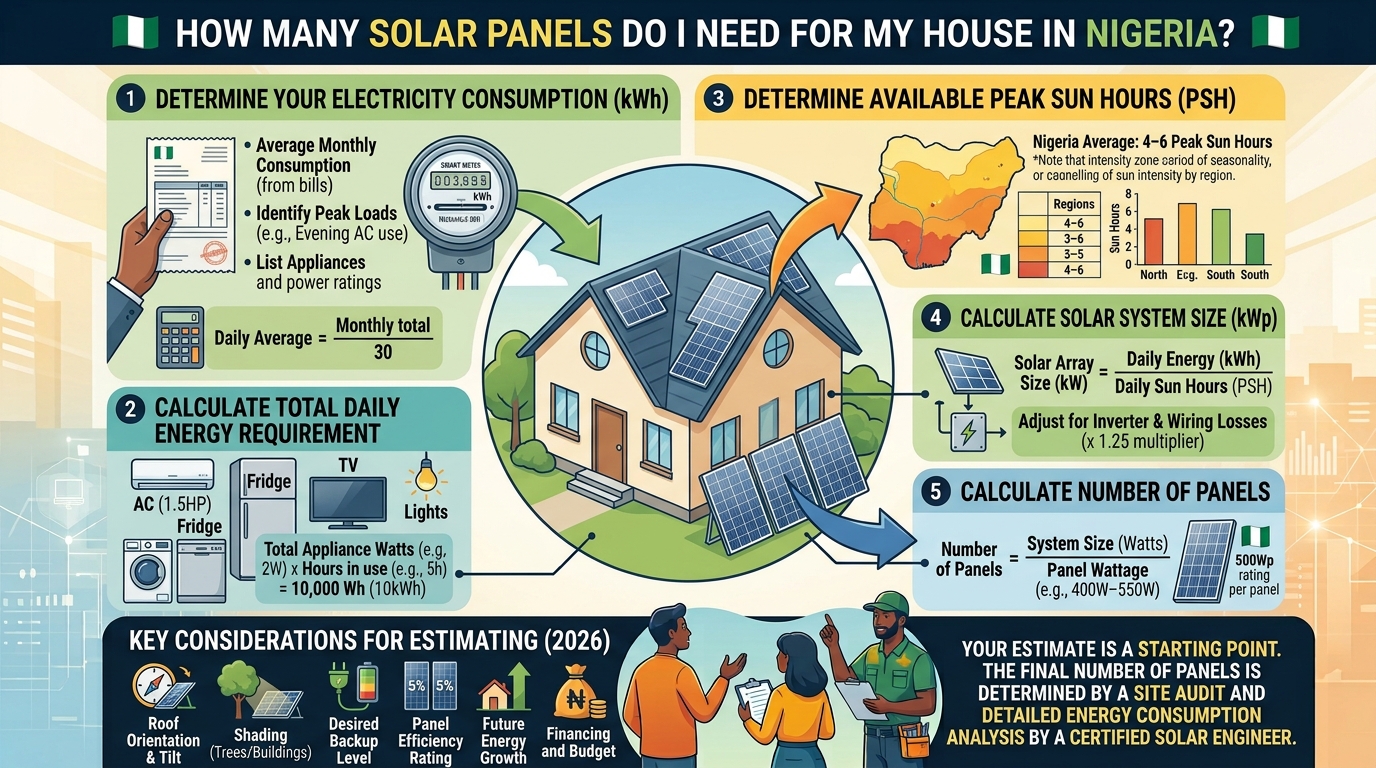
How Do I Calculate How Many Solar Panels I Need?
The simple formula is:
Number of panels = Required solar power ÷ Panel wattage
For example, if your required solar array is:
3,000W
and you want to use:
500W panels
Then:
3,000 ÷ 500 = 6
So you would need:
6 × 500W panels
giving you:
3,000W or 3kW of solar panels.
However, this is only the basic calculation.
Real solar systems need to account for sunlight and system losses.
Why Can’t I Simply Divide My Inverter Size by Panel Wattage?
Because inverter size and solar panel capacity are two different things.
For example:
A 5kVA inverter does not automatically mean you need exactly 5,000W of solar panels.
Depending on the inverter model, it may accept:
- 3kW of solar
- 4kW
- 5kW
- 6kW
- or more
You must check the manufacturer’s specifications.
Look for:
- Maximum PV power
- Maximum PV voltage
- MPPT voltage range
- Maximum PV current
- Number of MPPT inputs
This is especially important when using large 500W, 550W, 600W or 650W panels.
How Many Solar Panels Do I Need for a 1kVA Inverter?
A small 1kVA system might use around:
2–4 × 250W panels
or:
2 × 500W panels
depending on the inverter and battery system.
But don’t automatically buy two 500W panels just because you have a 1kVA inverter.
Check the inverter’s PV specifications first.
A small system may be designed mainly for:
- lights
- TV
- router
- fans
- phone charging
- small appliances
How Many Solar Panels Do I Need for a 3kVA Inverter?
A 3kVA system might use approximately:
3kW of solar panels
For example:
6 × 500W = 3,000W
or:
8 × 400W = 3,200W
or:
12 × 250W = 3,000W
But the final number depends on the inverter’s maximum PV input.
This is why two people with the same 3kVA inverter size may have different solar panel arrangements.
How Many Solar Panels Do I Need for a 5kVA Inverter?
A 5kVA solar system may use around:
4kW–6kW+ of solar panels
depending on the inverter and the system design.
For example:
Using 500W panels
10 × 500W = 5,000W
Using 550W panels
10 × 550W = 5,500W
Using 400W panels
13 × 400W = 5,200W
But again, you must confirm that the inverter can accept the selected solar array.
How Many Solar Panels Do I Need for a 10kVA Inverter?
A 10kVA inverter can potentially be paired with a much larger solar array, but the exact amount depends on the model.
For example, a system might use:
8kW–12kW of solar panels
depending on the inverter’s PV input specifications and the home’s energy requirements.
Using 500W panels:
20 × 500W = 10,000W
Using 550W panels:
19 × 550W = 10,450W
But don’t use these numbers as a final installation design.
The inverter’s specifications must come first.
How Many Solar Panels Does a 3-Bedroom House Need?
The number of bedrooms does not determine the number of solar panels.
A 3-bedroom house could have:
- 1 refrigerator
- 1 TV
- 4 fans
- a few lights
while another 3-bedroom house could have:
- 2 refrigerators
- freezer
- 3 air conditioners
- water pump
- washing machine
- electric cooker
- several TVs
The second house will need a much larger system.
So instead of saying:
“I have a 3-bedroom house.”
Start by listing the appliances you want to power.
Example: Small Nigerian Home
Let’s assume a home uses:
| Appliance | Quantity | Approx. Power |
|---|---|---|
| LED bulbs | 6 | 60W |
| TV | 1 | 100W |
| Fans | 2 | 150W |
| Refrigerator | 1 | 150W |
| Router | 1 | 15W |
| Decoder | 1 | 25W |
| Laptop | 1 | 65W |
The total running load is approximately:
565W
This does not mean you only need a 565W inverter.
You need to consider starting loads, future loads and how the appliances will be used.
You also need enough solar generation to replace the energy consumed during the day.
Use our Solar Panel Calculator to work through your actual appliances.
What If I Want to Run an Air Conditioner?
Air conditioners can significantly increase your solar requirements.
A 1HP inverter air conditioner may use around 600W under some operating conditions, but actual consumption varies.
A non-inverter AC may behave differently and can have a higher starting demand.
If you add an air conditioner to your system, you may need:
- a larger inverter
- more battery capacity
- more solar panels
This is why adding one major appliance can change the entire system design.
You can start with our Inverter Calculator to see how your appliance load affects the inverter size.
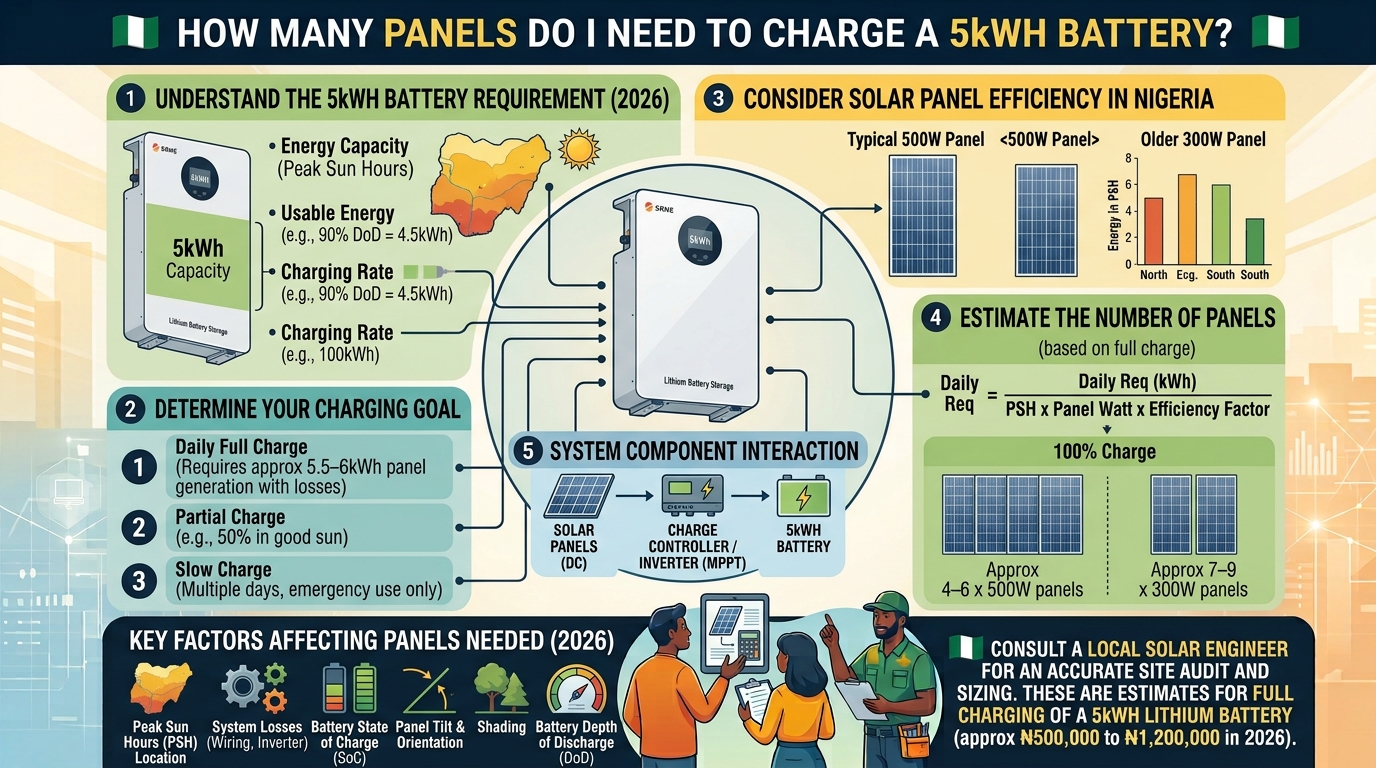
How Many Panels Do I Need to Charge a 5kWh Battery?
This depends on how quickly you want to recharge the battery and how much energy your home uses.
Suppose you have a: 5kWh lithium battery and want to replace roughly 5kWh of energy.
A simple calculation might suggest that a 2kW solar array could produce enough energy over several good sunlight hours.
But real systems have losses.
You also need to consider:
- sunlight hours
- panel temperature
- dust
- shading
- inverter efficiency
- battery charging losses
- wiring losses
- weather
So a larger solar array may be needed to reliably replace the energy used.
This is why you shouldn’t size your panels using battery capacity alone.
How Many Solar Panels Do I Need in Nigeria?
Nigeria receives useful sunlight across much of the country, but the actual solar resource varies by location and season.
For a simple planning estimate, many residential solar calculations use roughly 4–5 peak sun hours per day, but actual production can be higher or lower.
This is one reason our Solar Panel Calculator uses a peak sun hours setting rather than assuming that a panel produces its full rated wattage throughout the day.
Does a 500W Solar Panel Produce 500W All Day?
No.
This is a very common misunderstanding.
A 500W panel is rated to produce up to about 500W under its standard test conditions.
It will not normally produce 500W continuously from morning until evening.
Its output changes according to:
- sunlight intensity
- time of day
- weather
- temperature
- panel angle
- shading
- dust
- system losses
For example, a 500W panel may produce much less power early in the morning than around midday.
250W vs 500W Solar Panels
Both can be useful.
250W panels
You need more panels to reach the same total capacity.
For example:
8 × 250W = 2,000W
Advantages can include:
- easier handling
- useful for smaller systems
- may be easier to fit into certain spaces
500W panels
You need fewer panels.
For example:
4 × 500W = 2,000W
Advantages can include:
- fewer panels
- potentially less mounting hardware
- less wiring between individual panels
But larger panels can also be physically bigger and heavier.
So the best option depends on your available space and system design.
Can I Add More Solar Panels Later?
Sometimes, yes.
But you should plan for expansion before buying the inverter.
Check whether the inverter can accept additional:
- PV power
- voltage
- current
If the inverter has already reached its maximum PV input, you cannot simply keep adding panels.
The same applies to batteries.
If you expect your energy needs to increase later, choose equipment that supports expansion.
What Happens If I Install Too Many Solar Panels?
Installing more panels than the inverter can safely handle can be a problem.
The inverter has limits for:
- maximum PV voltage
- maximum PV current
- maximum PV power
Exceeding these limits can damage equipment or create unsafe conditions.
Never assume:
“More panels are always better.”
The solar array must be designed within the inverter’s specifications.
What Happens If I Install Too Few Panels?
If your solar array is too small, the system may struggle to produce enough energy to:
- power your daytime loads
- recharge your battery
- recover the energy used overnight
For example, if you use a lot of energy every day but install only a small solar array, your battery may remain partially charged.
This can lead to poor backup performance.
How Much Do the Solar Panels Cost?
The number of panels you need will obviously affect the total cost.
For example, if you need:
10 × 500W panels
and each panel costs approximately:
₦150,000
the panel cost alone would be:
₦1.5 million
But remember that the total installation will also include the inverter, battery, mounting, cables, protection and labour.
For current panel price ranges, read:
How Much Is a Solar Panel in Nigeria? 2026 Prices by Wattage
You can also check our Solar Prices in Nigeria database.
How Many Panels Do I Need for a Complete Solar System?
The correct process is:
Step 1: List your appliances
Write down everything you want to power.
Step 2: Calculate the load
Find the approximate wattage of each appliance.
Step 3: Calculate daily energy use
Consider how many hours each appliance runs.
Step 4: Size the inverter
The inverter must handle the expected load and starting surge.
Use our Inverter Calculator.
Step 5: Size the battery
Decide how many hours of backup you want.
Use our Battery Calculator.
Step 6: Size the solar array
Calculate enough panel capacity to power your daytime loads and recharge the battery.
Use our Solar Panel Calculator.
Step 7: Calculate the complete cost
Use our Solar Installation Cost Calculator.
This approach is much better than simply asking for a certain number of panels.
Common Mistakes When Buying Solar Panels
Buying panels before choosing the inverter
The inverter determines the PV voltage and current limits you must work within.
Looking only at wattage
Two panels with the same wattage can have different efficiency, dimensions and electrical characteristics.
Ignoring shading
A shaded panel can produce much less power.
Forgetting battery charging
Your panels need to produce enough energy for your daily use and battery recharge.
Buying based only on price
A very cheap panel may not offer the same quality or warranty as a better product.
Installing too many panels
More panels are not useful if you exceed the inverter’s PV limits.
Final Advice
There is no universal number of solar panels for a Nigerian home.
The right number depends on your energy usage, panel wattage, inverter, battery, sunlight and system design.
For example:
4 × 500W = 2kW
while:
8 × 250W = 2kW
Both have the same rated solar capacity, but the actual system design can be different.
If you want to know exactly how many panels you may need, start with our Solar Panel Calculator.
Then use our:
You can also check our Solar Prices in Nigeria page for current estimated prices by panel wattage.
For more information, read:
How Much Is a Solar Panel in Nigeria? 2026 Prices by Wattage
How Much Is a Lithium Battery in Nigeria? 2026 Prices by Capacity
How Much Is a Solar Inverter in Nigeria? Current Prices and Buying Guide
And if you are starting from the beginning, see:
How to Choose the Right Solar System for Your Home in Nigeria