Last reviewed: September 26, 2026
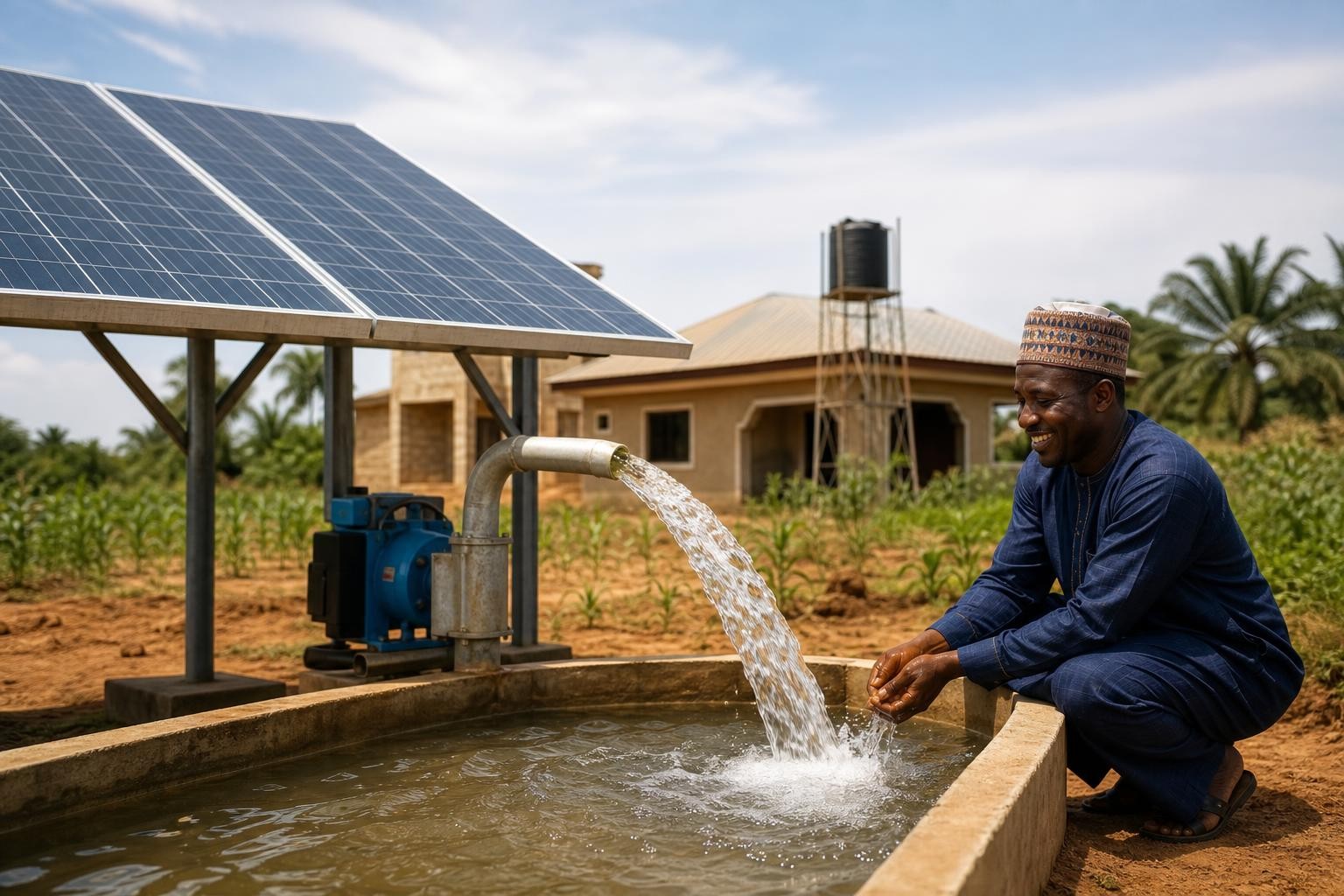
Yes, a solar water pump can run without batteries. The usual arrangement is a solar panel array, a pump controller or solar pump inverter, a pump designed for variable solar input, and a storage tank. The pump works when there is enough sunlight; the tank stores the water for use later. In this design, you store the useful result—water—instead of first storing electricity in batteries.
That does not mean every pump can be connected directly to solar panels. A normal AC borehole pump or ordinary domestic pump may need a correctly sized inverter, generator or battery-backed inverter. A battery-free system works when the pump, controller, panels, borehole and water-storage plan are designed as one system.
For many Nigerian homes, farms, livestock points and small businesses, battery-free pumping is practical when water can be pumped during daylight into an overhead or ground-level tank. It is less suitable when you need guaranteed pumping at night, constant water pressure, or the pump must keep running through long periods of weak sunlight.
How a solar pump works without a battery
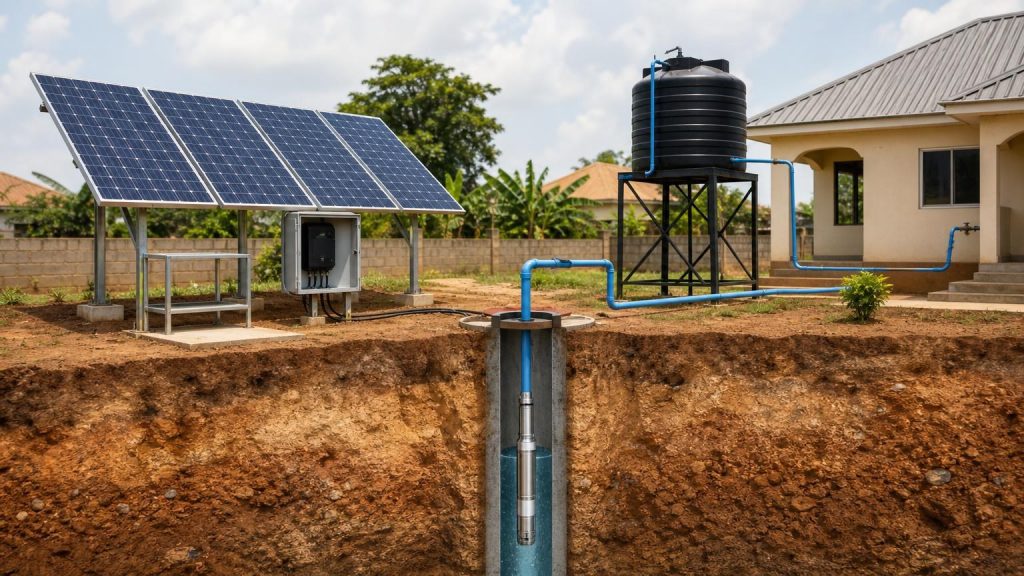
A battery-free solar pumping system normally follows this path:
- Solar panels convert sunlight into DC electricity.
- A solar pump controller manages the changing panel voltage and current, often using maximum power point tracking (MPPT).
- The pump motor uses the available power to lift and move water.
- A tank, reservoir or elevated storage system holds the water until it is needed.
- Float switches or level controls stop the pump when the source is too low or the tank is full.
At strong midday sun, the pump may run faster or deliver more water. In the morning, late afternoon or under cloud, output may reduce. A suitable solar pump controller should manage this change rather than allowing the motor to stall, overheat or repeatedly restart.
Manufacturers such as LORENTZ and Grundfos describe solar pumping systems that can operate directly from solar energy without a battery bank. The exact arrangement varies: some pumps use a dedicated solar controller, some have integrated electronics, and some systems can also accept grid or generator backup. Always follow the pump manufacturer’s wiring and input-voltage requirements.
The water tank becomes your practical energy storage
With a normal inverter system, panels charge a battery and the battery later powers appliances. With a direct solar pump, the panels power the pump and the pump fills a tank. When you open a tap later, gravity or a separate pressure pump supplies the water.
This is especially useful for a Nigerian borehole that supplies an overhead tank. The pump does not have to run every time somebody flushes a toilet, washes clothes or opens a tap. It can do most of the lifting during available daylight, while the tank handles the timing difference between pumping and using the water.
Water storage is not a free pass. The tank must be large enough for the daily demand and any planned cloudy-day reserve. It must also be installed safely, supported properly and protected from overflow, contamination and leaks. If the tank is too small, the pump may stop early even though there is still useful sunlight.
When a battery-free solar pump makes sense in Nigeria
- Household boreholes: pump water into a tank during the day for use in the evening and at night.
- Livestock watering: fill a trough or storage tank while the sun is available, provided the animals do not require the pump to run after dark.
- Daytime irrigation: use the water directly or pump to a reservoir for later irrigation.
- Small farms: separate the water-delivery problem from the electricity-storage problem.
- Remote locations: avoid the maintenance and replacement burden of a large battery bank when a tank can meet the need.
- Hybrid sites: use solar as the main source and a generator or grid connection only when weather or demand requires it.
The strongest case is a site with a clear daytime pumping window and a place to store water. If the pump only needs to fill a tank once or twice each day, you may not need to build a battery system simply to move water from the borehole to the tank.
When you may still need batteries
A battery can be useful, or necessary, when:
- water must be pumped at night rather than stored in advance;
- the pump must maintain pressure at a time when sunlight is weak;
- the site has very limited tank space;
- the pump is also part of a home or business backup system;
- the water demand is time-critical and cannot wait for the next good solar period;
- the solar pump controller or pump model specifically requires a battery-backed supply;
- a hybrid design needs a short-term buffer for clouds, motor starting or control equipment.
Do not add a battery just because the sky becomes cloudy for a few minutes. First check whether the pump controller can reduce output safely and whether the tank has enough reserve. On the other hand, do not remove a battery from a design that promises night pumping without replacing its function with adequate water storage or another reliable power source.
Direct solar pump vs battery-backed pump
| Question | Direct solar, no battery | Battery-backed system |
|---|---|---|
| When does the pump run? | Mostly when enough solar power is available | When solar or stored battery power is available |
| What stores energy? | Water in a tank or reservoir | Battery energy, sometimes with a tank |
| Night pumping | Not normally, unless another source is added | Possible if the battery and inverter are large enough |
| Cloud response | Flow may reduce or the controller may stop the pump | Battery can smooth short interruptions, depending on design |
| Main design risk | Under-sized panels, controller or tank | Under-sized battery, inverter or charging system |
| Best fit | Daytime pumping to stored water | Time-flexible pumping is not enough or the pump must run with other loads |
Neither option is automatically better. The right choice depends on when water is needed, how much water is required each day, the borehole depth, the tank height, the local weather pattern and whether grid or generator backup is available.
How much solar does a battery-free pump need?
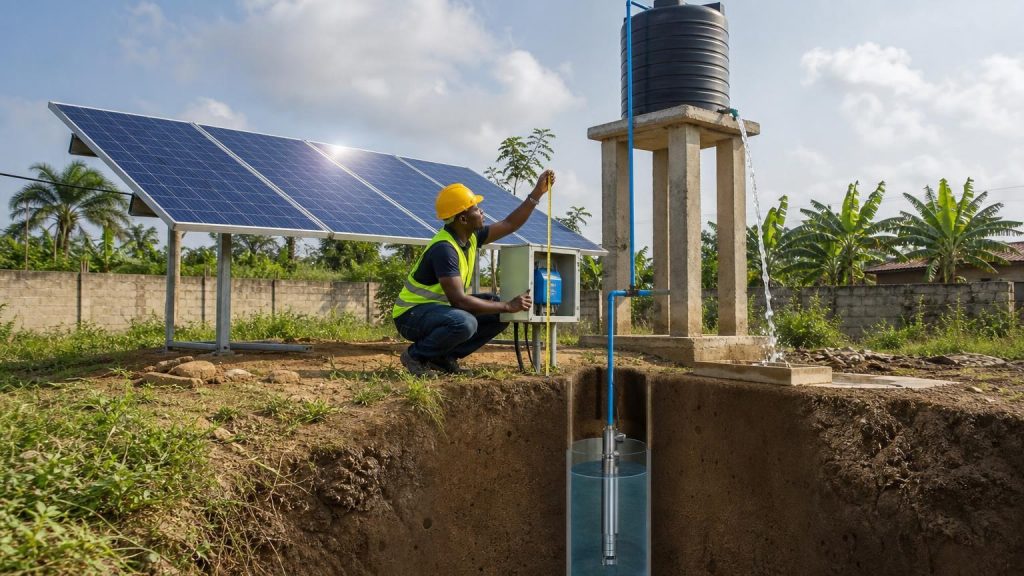
Do not choose the solar array from the pump’s horsepower alone. You need the daily water volume and the total dynamic head—the total height and pressure the pump must overcome, including pipe losses.
A useful first engineering estimate is:
Hydraulic energy (kWh/day) ≈ 0.002725 × water volume (m³/day) × total dynamic head (m)
This is the energy delivered to the water. The panels must supply more because the pump, motor, controller, cables and other parts have losses:
Electrical energy ≈ hydraulic energy ÷ overall wire-to-water efficiency
Illustrative Nigerian household example
Assume a home needs 8,000 litres of water each day, equal to 8m³. The pumping arrangement has a 35m total dynamic head, including the rise to the tank and estimated pipe resistance. For an early illustration only, use 50% overall wire-to-water efficiency.
- Hydraulic energy = 0.002725 × 8 × 35 = about 0.76kWh/day.
- Electrical energy at the assumed 50% efficiency = 0.76 ÷ 0.50 = about 1.53kWh/day.
- If the preliminary design uses 4.5 equivalent full-sun hours and a 0.75 allowance for PV, temperature, dust, wiring and controller losses, the basic array estimate is 1.53 ÷ (4.5 × 0.75) = about 0.45kWp.
This is not a final panel shopping list. The actual pump may need a larger array to start reliably, operate at the required duty point and keep filling the tank during less favourable weather. The controller’s minimum voltage, maximum current and motor-starting method must also be checked.
For a fuller borehole design, start with SolarPriceNG’s guide to sizing solar for a borehole from water needed, not just pump watts. It explains static water level, drawdown, total dynamic head, pump curves and pipe losses.
Why the pump may slow down or stop when clouds arrive
A battery-free pump has no stored electrical energy to cover every change in sunlight. Its output may fall when clouds, rain, Harmattan dust, shade, heat or poor panel orientation reduce the available power. Some controllers reduce pump speed; others stop the pump until the input recovers.
This behaviour is not automatically a fault. The important question is whether the system still delivers the required daily water volume. A tank with enough reserve may make short interruptions irrelevant. A farm that needs a precise irrigation schedule may need a larger array, a larger reservoir, a hybrid input or battery support.
Keep panels clean and free from shade, especially where dust accumulates. If the pump produces less water than expected, measure the solar input and compare the actual flow and head with the quotation. Do not assume that replacing the pump will solve a problem caused by dirty panels, a long undersized cable, a full tank, a low borehole water level or an incorrect controller setting. For a related panel diagnostic process, see How to test whether your solar panels are underperforming in Nigeria.
What a safe battery-free solar pump system should include
- A pump intended for the application: confirm the flow, head, water quality and duty cycle.
- A matched controller or solar pump inverter: check the panel voltage range, current limit, power range, motor type and protection functions.
- A correctly sized solar array: panel voltage and current must remain inside the controller’s limits in the actual site conditions.
- Water-level protection: use dry-run protection or a suitable sensor so the pump does not operate when the borehole or source is too low.
- Tank-level control: stop the pump before the tank overflows and restart it when the level falls.
- Electrical protection: include suitable isolation, fuses or breakers where required, earthing, surge/lightning protection and correctly sized cables.
- A realistic water plan: allow for cloudy periods, demand changes, leaks, seasonal irrigation needs and maintenance.
Water and electricity are a dangerous combination. A qualified installer should handle the array wiring, controller settings, earthing, protection, borehole pump installation and commissioning. Do not connect a high-power pump directly to panels unless the pump manufacturer explicitly provides a suitable direct-solar design and the electrical limits have been checked.
Questions to ask before accepting a quotation
- How many litres per day will the system deliver?
- What total dynamic head was used, and how were the water level and pipe losses measured?
- What is the pump model and its flow at the quoted head?
- Is the design direct solar, battery-backed or hybrid?
- What happens when the tank is full or the borehole water level falls?
- What daily water output is expected during cloudy or rainy conditions?
- What panel voltage and current reach the controller?
- Are the tank, stand, pipes, cables, protection devices, installation and civil works included?
- What backup source will be used if the water demand cannot wait for sunlight?
A quotation that says only “2HP solar pump and panels” is not enough to prove that the design will supply your home, farm or business. If the quote includes other solar equipment, compare the listed equipment and exclusions carefully with SolarPriceNG’s solar quote checklist.
Frequently asked questions
Can a solar pump run at night without batteries?
Not from solar panels alone. A battery-free pump normally stops when there is not enough solar power. Night water use is possible if water was stored in a tank, or if the pump has grid, generator or battery backup.
Can I connect an ordinary water pump directly to solar panels?
Do not assume that you can. Ordinary pumps may need a stable AC or DC supply, while solar panels produce variable voltage and current. Use a pump and controller designed to work together, or use a properly sized inverter approved for the pump.
Is a battery-free solar pump cheaper?
It can be simpler because it avoids a battery bank, but the total project cost still depends on the pump, panels, controller, tank, stand, pipes, borehole depth, protection and installation. A tank may be essential, so compare complete system costs rather than removing the battery line without replacing its storage function.
Bottom line
A solar pump can run without batteries when it is designed for direct solar operation and the water is stored in a tank or reservoir. This is often a sensible arrangement for Nigerian homes, farms and livestock systems that can pump during the day and use the water later.
The correct decision is not simply “battery or no battery”. First define the daily water volume, pumping water level, total dynamic head, tank size and timing of demand. Then match the pump, controller and solar array, and decide whether tank storage, battery storage, generator support or a hybrid system gives the safest and most reliable result.
Technical references
- LORENTZ: solar water pumps that operate directly from sunlight without batteries
- Grundfos: how to size and select a solar water pumping system
- Grundfos SQFlex: solar pumping for off-grid water supply
- Nigerian Journal of Renewable Energy Research: design and sizing procedures for stand-alone solar water pumping