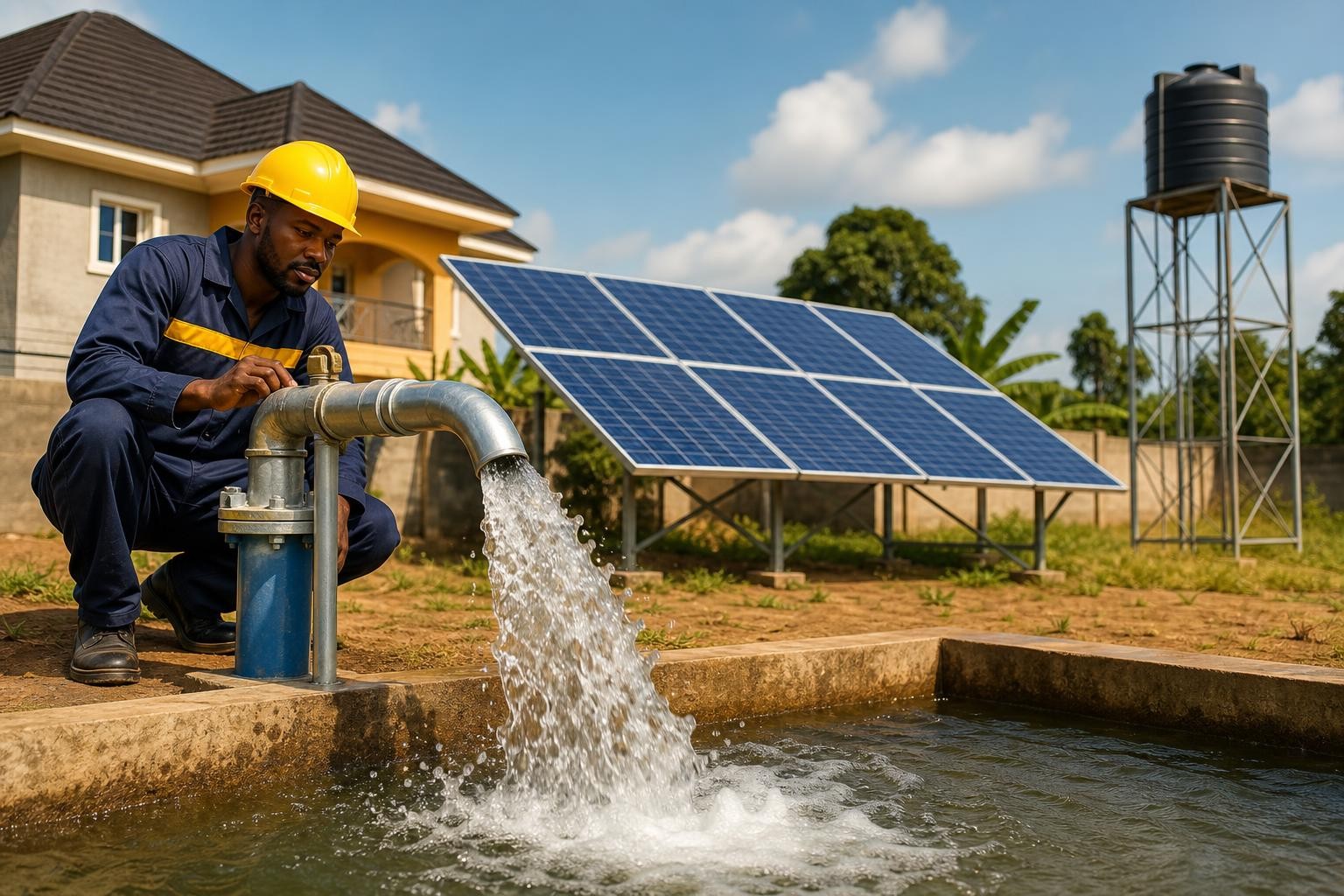
Last reviewed: September 25, 2026
If you want to power a borehole with solar, do not size the system from the pump’s horsepower or wattage alone. The safer method starts with the amount of water you need each day, then checks the total height and pipe resistance the pump must overcome. Only after that should you choose the pump, solar array, controller or inverter.
A small household borehole that fills a storage tank may need a very different solar system from a farm that must deliver many thousands of litres for irrigation. Two pumps with the same motor rating can also produce different water volumes when one is lifting water much higher or pushing it through a longer, narrower pipe.
The short answer: collect your daily water requirement, total dynamic head, pipe details and pump curve. Then calculate the daily hydraulic energy and match the solar array to the pump’s real operating point. In Nigeria, a storage tank is usually more useful than trying to make the pump run only when someone opens a tap: solar can pump water during good daylight, and the tank supplies the building later.
Why pump watts alone give the wrong answer
A pump nameplate may show 750W, 1.5kW or 2.2kW, but that figure does not tell you how much water the pump will deliver at your borehole. The actual result depends on the combination of:
- Flow: how much water the system must deliver, usually in litres per minute or cubic metres per day.
- Head: the height and pressure the pump must overcome, measured in metres or another pressure unit.
- Pipe losses: resistance from pipe length, pipe diameter, bends, valves, filters and fittings.
- Pump curve: the flow the particular pump can produce at the required head.
- Operating conditions: water level, drawdown, voltage, temperature, dust, shading and available solar energy.
For example, a pump that produces 5,000 litres per hour at a low head may deliver far less at a deep borehole and an elevated tank. This is why “the pump is 1.5kW, so use 1.5kW of panels” is not a complete design.
The four figures to collect before buying anything
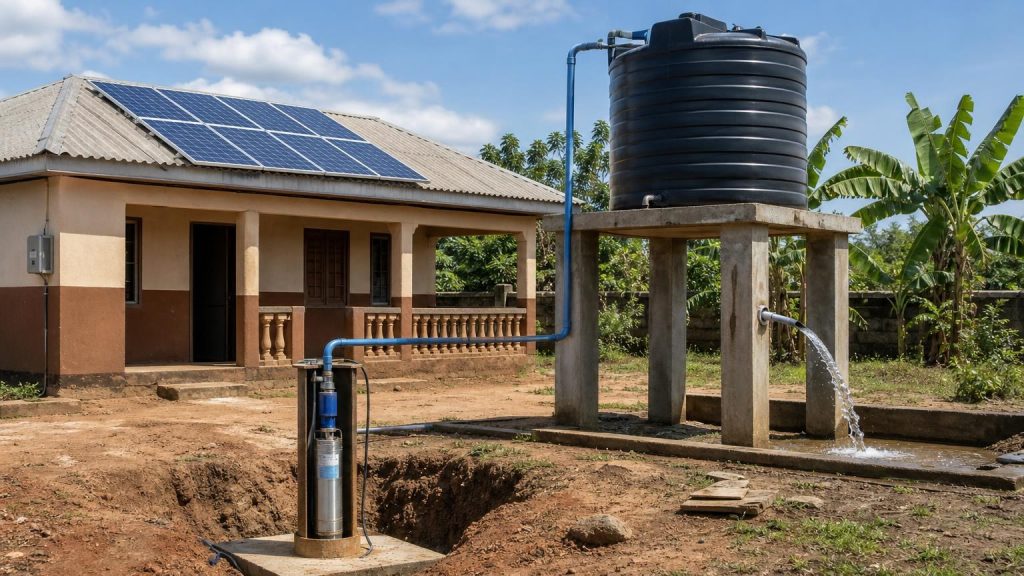
1. Daily water requirement
Estimate the water you actually need in one day. Separate uses where possible:
- household use;
- toilet flushing and cleaning;
- small business or office use;
- livestock watering;
- irrigation;
- water losses from leaks, overflow and poor fittings.
Write the target as litres per day or cubic metres per day. 1 cubic metre equals 1,000 litres. If you need 10,000 litres per day, your target is 10m³/day. If the borehole fills a 2,000-litre tank twice daily, the minimum delivered volume is 4,000 litres per day, before allowing for losses or extra demand.
Do not automatically size from the borehole’s maximum yield. The fact that a borehole can produce a large volume does not mean your solar system should pump continuously at that rate. The sustainable daily water target should be agreed with the driller, user and installer.
2. Dynamic water level, not only borehole depth
The pump must lift water from the water level while pumping, not simply from the bottom of the borehole. When pumping starts, the water level can fall; this is called drawdown. Ask for the static water level and the expected pumping or dynamic water level from the borehole report.
A borehole that is drilled to 80 metres may have a pumping water level much higher than 80 metres. Conversely, the pump may not be installed at the bottom. Your installer needs the actual water level and pump setting to calculate the lift.
3. Delivery height and pressure
Add the height from the pumping water level to the discharge point, such as an overhead tank. If the system must deliver water under pressure to a building, livestock trough or irrigation line, convert that pressure requirement into an equivalent head and include it.
4. Pipe length, diameter and fittings
Water loses pressure as it travels through a pipe. Long pipe runs, small pipe diameters, many elbows, non-return valves, filters and partially blocked sections all increase resistance. These losses are part of the total dynamic head, not optional details.
Grundfos describes solar water-pump sizing around the project’s location, daily water production and total dynamic head. Its pump-sizing guidance also separates the static lift, dynamic water level, outlet pressure and pipe friction losses. The same principle applies whether the system is in a Nigerian home, farm, school or business.
How to calculate the solar energy the water actually needs
The useful starting point is the hydraulic energy: the energy needed to move a known volume of water through a known head.
Hydraulic energy (kWh/day) ≈ 0.002725 × water volume (m³/day) × total dynamic head (m)
This is the energy delivered to the water. The electrical energy drawn from the solar system will be higher because the pump, motor, controller, wiring and other components are not 100% efficient.
Electrical energy required ≈ hydraulic energy ÷ overall wire-to-water efficiency
Use the efficiency supplied by the pump manufacturer or designer when available. For an early illustration only, assume 50% overall efficiency; do not treat that assumption as a universal value.
Worked example: 10,000 litres per day
Assume a household or small farm needs:
- 10,000 litres per day = 10m³/day;
- dynamic water level and delivery arrangement that produce a 40m total dynamic head;
- an illustrative overall wire-to-water efficiency of 50%.
First calculate the hydraulic energy:
0.002725 × 10 × 40 = 1.09kWh/day delivered to the water.
Then allow for the illustrative 50% system efficiency:
1.09kWh ÷ 0.50 = 2.18kWh/day of electrical energy.
If a preliminary design uses 4.5 equivalent full-sun hours and a 0.75 allowance for PV, controller, wiring, temperature and operating losses, the basic array estimate is:
2.18kWh ÷ (4.5 × 0.75) = about 0.65kWp.
That 0.65kWp is not a final shopping list. The installer must still check the pump curve, controller input range, motor starting method, minimum operating power, local solar conditions, cloudy-day target, battery or generator support and the need for design margin. A practical design may use a larger array or a different pump so the target is met reliably rather than only on a clear day.
A pump’s daily water target is different from its running power
Running power answers: “How much electrical power does the pump need while it is operating at this point?” Daily water target answers: “How much water must the system deliver in 24 hours?” You need both.
A 1.5kW pump running for one hour does not deliver the same water as the same pump running for four hours. But simply multiplying 1.5kW by four can also be misleading if the pump is not operating at its rated flow and head, or if solar power changes during the day.
Ask the installer to show the duty point on the pump curve:
- required flow rate;
- total dynamic head;
- expected flow at that head;
- hours of operation or daily solar pumping window;
- electrical input at the duty point.
Should the borehole use batteries?
Not always. For many boreholes, the cheapest and simpler form of storage is water in a properly sized tank. The pump runs when solar energy is available, and the tank supplies water later. This avoids using a battery to store energy and then using that energy to pump water.
A battery may still be useful when you need pumping at night, when the water demand is time-sensitive, when the system must operate during poor daylight, or when the pump is part of a wider inverter system. But adding a battery increases design complexity, cost, maintenance and the amount of energy lost through charging and discharging.
If you already have solar backup, compare the pump’s starting surge and running load with the inverter’s continuous and surge ratings. A pump that fits the daily energy calculation can still trip the inverter when its motor starts.
What changes the solar size in Nigeria?
- Location and weather: a design should use solar data for the actual site and a sensible reference period, not a national one-size-fits-all number.
- Cloud, rain and Harmattan dust: the array may produce less energy than its nameplate rating, especially when panels are dirty or shaded.
- Water demand: irrigation demand can be much higher than household demand and may change by crop and season.
- Borehole drawdown: the pumping water level can be lower than the static level.
- Pipe route: a long run to a distant tank or field can add substantial friction loss.
- Tank height and pressure: raising water to an overhead tank or supplying pressurised irrigation requires more head.
- Grid or generator support: hybrid input can reduce the solar and storage needed for guaranteed pumping.
- Pump and controller matching: the pump must operate inside the controller’s voltage, current and power range.
SolarPriceNG’s guide on recovering a battery after a cloudy day explains why a panel’s nameplate watts should not be treated as all-day energy production. The same caution matters for solar pumping.
A safe borehole solar design checklist
- Confirm the borehole report, static water level, pumping water level and recommended yield.
- Write down the required litres per day and whether the demand is household, business, livestock or irrigation demand.
- Measure the height to the tank or outlet and include any required pressure.
- Record pipe length, diameter, bends, valves, filters and other fittings.
- Obtain the actual pump curve and select the duty point at the required head and flow.
- Choose a compatible solar pump controller or inverter, checking voltage, current, power and starting behaviour.
- Decide whether water-tank storage is enough or whether battery storage is genuinely needed.
- Include dry-run protection, overload protection, appropriate isolation, earthing, surge/lightning protection and safe cable sizing.
- Provide a way to stop the pump when the tank is full and prevent overflow.
- Test the delivered flow and energy use after installation instead of accepting the motor rating as proof that the system is correctly sized.
Borehole pumps combine water, electricity and often deep underground equipment. A qualified installer should handle the electrical connections, pump installation, protection settings and commissioning. Do not improvise high-current DC wiring, bypass dry-run protection or enter a borehole chamber to inspect equipment yourself.
How to tell whether a quotation is realistic
A credible quotation should show more than “2HP pump + panels”. Ask for:
- daily water target in litres or cubic metres;
- total dynamic head and the measurements used to calculate it;
- pump model and duty-point flow;
- panel wattage, quantity and array voltage;
- controller or inverter model and input limits;
- tank size, mounting, pipework, cable lengths and protection devices;
- assumptions about cloudy weather, backup source and operating hours;
- what labour, drilling work, civil work and future maintenance are excluded.
For more buying checks, see How Do I Check Whether a Solar Quote Is Overpriced or Missing Important Parts in Nigeria? If the quotation includes an inverter and battery for the pump, also compare the promised load and battery energy rather than accepting a vague “complete solar package”.
Bottom line
To size solar for a borehole, start with water needed per day and total dynamic head. Convert those figures into hydraulic energy, allow for pump and system losses, then match the array and controller to the pump’s real duty point. Do not size the whole system from pump watts alone.
For many Nigerian homes and small farms, a solar pump filling a storage tank during daylight can be simpler than using batteries to pump water at night. But the final design still depends on the borehole water level, pipework, tank height, daily demand, weather, pump curve and safe electrical protection.
Related SolarPriceNG guides
- How Much Extra Solar Do I Need to Recover My Battery After a Cloudy Day?
- How to Test Whether Your Solar Panels Are Underperforming in Nigeria
- Can I Add Different-Wattage Solar Panels to My Existing System in Nigeria?
- How Much Generator Use Can I Eliminate Without Going Fully Off-Grid in Nigeria?
- How Do I Check Whether a Solar Quote Is Overpriced or Missing Important Parts in Nigeria?