Last reviewed: September 24, 2026
Yes, you can sometimes add a different-wattage solar panel to an existing system, but panel wattage alone does not tell you whether the combination is safe or productive. The important numbers are the panel’s operating voltage (Vmp), open-circuit voltage (Voc), operating current (Imp), short-circuit current (Isc), the way the panels will be wired, and the limits of the inverter or charge controller.
For a Nigerian home or small business, the safest practical rule is this: use matching panels where possible; if you must mix panels, keep panels with similar electrical characteristics on the same string or MPPT input, and let a qualified installer verify the design before connecting a live array. A separate MPPT input or charge controller is often cleaner than forcing very different panels to work as one array.
Why different wattage is not the real issue
A 550 W panel is not automatically incompatible with a 450 W panel, and two panels with the same wattage are not automatically compatible. Wattage is calculated from voltage multiplied by current:
Power (W) = voltage (V) × current (A)
Two panels can both be rated at 450 W but have different Vmp and Imp values because they use different cell layouts, technologies or product designs. Conversely, a 450 W panel and a 550 W panel may have fairly close operating voltages but different currents.
Before buying the new panel, obtain the data sheets for both the existing and proposed panels. Do not rely only on the number printed on the front of the panel or on a seller’s description.
What the main panel specifications mean
| Specification | What it tells you | Why it matters when adding panels |
|---|---|---|
| Vmp | Voltage at the panel’s maximum power point | Important for matching panels in parallel and for the MPPT’s operating range |
| Voc | Open-circuit voltage when the panel is not supplying a load | Critical for checking the maximum PV voltage, especially for panels in series |
| Imp | Current at the maximum power point | Important when panels are connected in series |
| Isc | Short-circuit current | Used when checking controller, inverter, cable and protection-device limits |
| Rated power | The panel’s nameplate output under test conditions | Useful for estimating total array size, but not enough to confirm compatibility |
Also check whether the panels are the same voltage class. A panel sold as a “12 V panel” may have a Vmp around the high teens so that it can charge a 12 V battery through a suitable controller. A larger grid-style panel may have a Vmp around the 30s or 40s. Those panels should not be treated as interchangeable simply because they both have positive and negative MC4 connectors.
What happens in series?
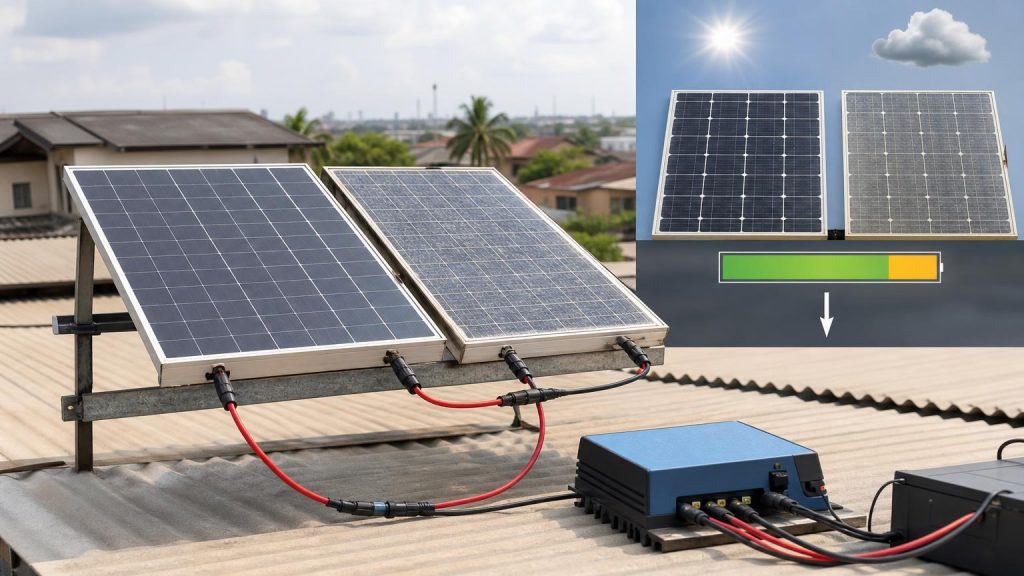
In a series string, the panel voltages add while the same current flows through each panel. In simplified form:
- Total Vmp is approximately the sum of the panels’ Vmp values.
- Total Voc is approximately the sum of the panels’ Voc values.
- String current is limited by the panel with the lower usable current at the operating point.
This means a panel with a much lower Imp can hold back a higher-current panel in the same string. You may still see some power from the combination, but it can be less than the sum of the nameplate ratings.
The more serious check is voltage. The total Voc of the string must remain below the inverter or MPPT controller’s maximum PV voltage, with a suitable safety margin and allowance for the fact that panel voltage rises in colder conditions. A string that appears acceptable on a hot afternoon can have a higher Voc in cooler conditions.
Never size a series string by adding the panel wattages alone. Add the Voc values and compare the result with the equipment manual. Exceeding the controller’s PV-voltage limit can damage the equipment and invalidate its warranty.
What happens in parallel?
In a parallel connection, the array voltage stays close to the operating voltage of the panels while the currents add:
- Array voltage is governed by the panels’ operating-voltage range.
- Total current is approximately the sum of the panel currents.
- Panels with significantly different Vmp values may not operate at their own best points when forced onto one MPPT input.
For parallel connection, panels or strings should have closely matched operating voltages. If one panel or string wants to operate at a much lower voltage than another, the shared MPPT operating point can reduce the useful output of one or both groups.
Parallel connection also increases current. The controller or inverter, cables, connectors, fuses and isolators must all be suitable for the higher Isc and operating current. A panel expansion can therefore be unsafe even when the total wattage looks comfortably below the controller’s advertised wattage.
Does an MPPT controller make mixed panels safe?
No. MPPT makes a system more flexible, but it does not cancel the need for matching and limit checks. An MPPT controller searches for a useful voltage-and-current operating point and converts the solar input to the battery-charging voltage. This is more capable than a basic PWM arrangement, but it still has a maximum PV voltage, a current limit, a usable operating-voltage range and often a recommended maximum PV power.
With an MPPT controller, a mixed array may work if the panels are electrically compatible and remain within the controller’s limits. However, the controller sees the combined array rather than giving every panel a completely independent operating point. Mismatch, shading and different panel temperature can reduce the energy harvested.
A separate MPPT input is usually better when:
- the old and new panels have different Vmp ranges;
- one group is wired in a different number of series panels;
- the panel groups face different directions or have different shading;
- the panels are from different voltage classes; or
- the existing inverter has independent MPPT inputs designed for separate arrays.
Read the equipment manual before assuming that two connectors mean two independent trackers. Some devices have multiple PV terminals that share one tracker, while others genuinely provide separate MPPT channels.
Why PWM systems need extra caution
Many small systems used for lights, fans, security equipment or a small shop use PWM charge controllers. A PWM controller generally operates the panel closer to the battery voltage rather than converting a much higher panel operating voltage down efficiently.
For that type of system, the panels must be in the correct nominal voltage class for the battery bank and controller. Mixing a low-voltage “12 V” panel with a higher-voltage panel, or placing panels in series when the controller is not designed for that voltage, can lead to poor charging or damage.
If you are expanding an older PWM installation, do not connect a new high-voltage panel through the existing wiring just because the plugs fit. It may be better to use a properly sized MPPT controller for the new array, or replace the controller and redesign the whole PV side.
A practical Nigerian example

Imagine a home in Nigeria with two existing 450 W panels connected in series. For illustration only, suppose each panel has a Vmp of about 41 V, a Voc of about 49 V and an Imp of about 11 A. The existing string would be roughly:
- Vmp: 41 V + 41 V = about 82 V
- Voc: 49 V + 49 V = about 98 V
- Current: about 11 A
Now suppose someone buys one 550 W panel with a Vmp of about 42 V and a Voc of about 50 V. That new panel cannot simply be placed in parallel with the 82 V existing string. The voltages are not the same. Putting it in series with the two existing panels would create a string with a different current and a much higher total Voc, so the controller’s limits and the mismatch would need careful checking.
A safer design might be to give the new panel its own suitable MPPT controller, use a separate compatible string, or replace/reconfigure the array so the panels are grouped by compatible electrical characteristics. Which option is correct depends on the actual data sheets and the inverter’s battery-charging arrangement.
This is why a Nigerian installer should inspect the exact panel labels, inverter model, controller model, cable route, roof orientation and protection devices rather than quoting a simple “add one more panel” answer.
What to check before buying the new panel
- Record the existing panel model and all electrical ratings. Take a clear photograph of the label if the data sheet is missing.
- Record the proposed panel’s Vmp, Voc, Imp and Isc. Compare the numbers, not only the wattage.
- Identify the wiring arrangement. Confirm whether the existing panels are in series, parallel or series-parallel.
- Identify the actual MPPT input. Find out how many independent trackers the inverter or controller has.
- Check maximum PV voltage. Add Voc for panels in series and allow for voltage rise in cooler conditions.
- Check maximum PV current. Add the relevant currents for parallel panels or strings and compare them with the equipment specification.
- Check maximum recommended PV wattage. A controller may accept some oversizing and limit output, but follow the manufacturer’s stated conditions rather than assuming every device behaves the same way.
- Check battery voltage and charging limits. More solar power must be accepted safely by the battery and inverter charger.
- Check physical conditions. Roof direction, shading from trees or nearby buildings, Harmattan dust, hot roof temperatures and different panel angles can create mismatch even when the electrical numbers look close.
- Check protection and installation hardware. Expansion may require different cable sizes, fuses, breakers, isolators, earthing or surge protection.
For a broader explanation of low output, see why solar panels produce low power and what to check. If dust or bird droppings are affecting the array, read how to maintain solar panels in Nigeria.
When you should not mix the panels on one input
Do not force panels into one string or one MPPT input when:
- the Vmp values are far apart for a parallel arrangement;
- the Imp values are far apart for a series arrangement;
- the panels have different voltage classes;
- the calculated series Voc can exceed the equipment limit;
- the combined Isc can exceed the controller, inverter, cable or protection ratings;
- the panels have different orientations or one group is shaded for part of the day; or
- you cannot verify the panel and controller specifications.
In these cases, the better choices may be a separate controller, a separate MPPT input, a redesigned array or a like-for-like replacement. A qualified installer should also confirm that the new charging source is compatible with the battery chemistry and inverter settings.
Do not confuse panel compatibility with system capacity
Even if the new panel is electrically compatible, the extra energy may not solve the problem you are trying to fix. If your battery is already full before evening but runs out overnight, storage may be the constraint. If the battery remains low all day, more PV may help, but only after checking for dust, shade, damaged cables, wrong settings or a failing panel.
Use the SolarPriceNG guide to choosing more panels or a bigger battery before spending money. If the system is not charging normally, check the common causes of a solar battery not charging first.
Safe installation checklist
Solar-panel wiring can produce dangerous DC voltage and current even when the public power supply is off. Do not unplug MC4 connectors, change series wiring or combine live strings as a trial-and-error exercise.
Before work begins, the installer should:
- shut down the system using the manufacturer’s sequence;
- isolate the PV array and battery as required;
- verify absence of dangerous voltage with suitable test equipment;
- use correctly rated connectors and protection devices;
- check polarity and cable termination;
- confirm the series Voc and parallel Isc calculations; and
- test PV production and battery charging after the expansion.
Never bypass a fuse, breaker, isolator or earth connection to make a mixed-panel arrangement work. If a proposed design requires bypassing protection, stop and obtain a proper redesign.
Bottom line
You can add a different-wattage solar panel to an existing system, but you should not connect it based on wattage alone. Match the electrical characteristics, understand whether the panels will be in series or parallel, check the inverter or MPPT limits, and account for Nigerian conditions such as heat, Harmattan dust, shading and different roof orientations.
The most reliable expansion is usually a like-for-like panel or a separately tracked new panel group. If the existing and new panels are substantially different, a separate MPPT input or controller may protect output better than forcing the panels to share one operating point. Have a qualified installer verify the design before making changes.
Technical references
- Victron Energy: Connecting different-sized PV modules in series or parallel — explains the effect of voltage and current mismatch.
- Victron Energy: Matching solar modules to MPPT charge controllers — explains maximum PV voltage, short-circuit current and temperature considerations.
- U.S. Department of Energy: PV system wiring overview — explains how series connections increase voltage and parallel connections increase current.