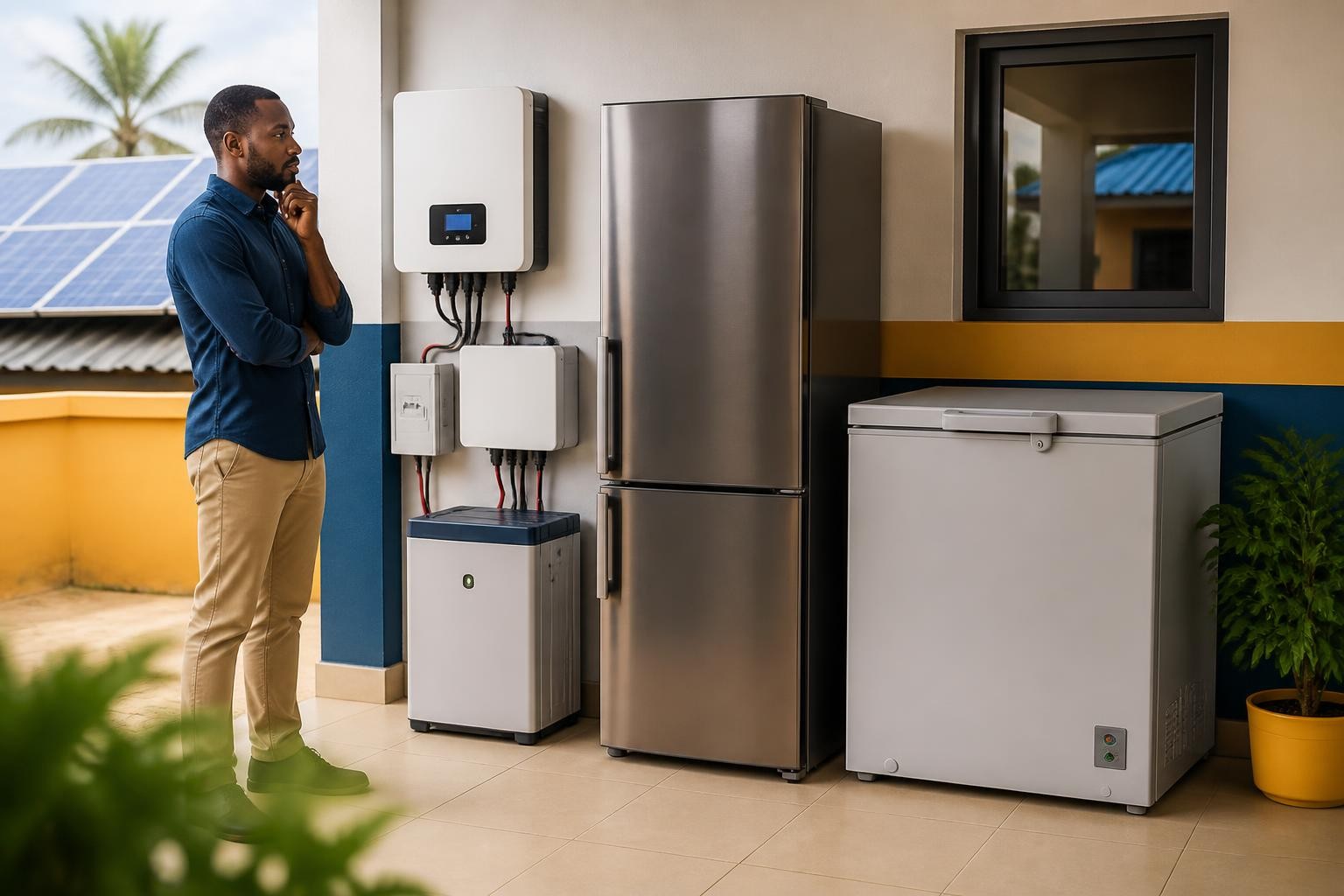
Short answer: Yes, you can often run a refrigerator and a freezer together on an inverter, but you should not choose the inverter from the appliances’ running watts alone. Both appliances usually have compressor motors, and each compressor can draw a short starting surge. The inverter must handle the combined running load, the possible start-up demand, and the battery must have enough usable energy for the hours you need.
For a Nigerian home or small shop, the safest way to decide is to check the nameplate or manual for both appliances, add the other loads you want to run at the same time, confirm the inverter’s continuous and peak ratings, and then test actual energy use where possible. A fridge and freezer may work well on a properly sized pure sine wave inverter, but the same pair can trip a small inverter when both compressors start together.
Last reviewed: September 27, 2026
What decides whether the pair will work?
Four things control the answer:
- Running power: how much power the refrigerator and freezer use while their compressors are operating.
- Starting power: the short surge when a compressor starts. This can be much higher than the running figure.
- Other simultaneous loads: lights, television, router, decoder, fan, POS terminal or other equipment sharing the inverter.
- Battery energy and DC current: the battery must supply the load for the required period without reaching low-voltage shutdown too early.
The appliance labels may show watts, amps or volts and amps. Do not assume that two appliances with similar running watts have the same starting behaviour. Compressor age, refrigerant condition, ambient heat, the appliance design and the inverter waveform can all affect starting.
Why refrigerator and freezer compressors cause inverter trips
A refrigerator and a freezer are not resistive loads like a simple bulb. Each has a compressor motor that starts and stops during the day. When a compressor starts, it can briefly demand more current than it uses after it is running.
That short demand is why an inverter can appear large enough on paper but still shut down when the fridge or freezer starts. Victron’s inverter guidance explains that motors and compressors can draw a significant start-up surge and that the inverter and battery must both be able to support it. The important lesson is not to use one universal “multiply by three” rule; check the actual appliance and inverter specifications where available.
Some inverter protections may show an overload alarm, reduce the output voltage or restart after a short delay. If the problem happens only when the compressor starts, suspect a surge or a weak DC supply before assuming that the refrigerator itself is damaged.
For a short explanation of continuous and surge ratings, see what surge power means in a solar inverter.
Step 1: Read both appliance labels
Before asking whether the inverter can run the pair, record the information on each appliance:
- Rated voltage and frequency.
- Running watts, if shown.
- Rated current in amps, if watts are not shown.
- Any starting, locked-rotor or maximum-current figure.
- Whether the appliance manual gives an inverter, generator or power-quality requirement.
If the label gives volts and amps but not watts, a simple estimate is:
Estimated watts = volts × amps
This is only a first estimate because the power factor and compressor operating cycle also matter. It is better to use the watt figure from the manual or measure the appliance with a suitable power meter.
Do not use the energy label as if it were the compressor’s starting wattage. A daily or annual kWh figure tells you about energy use over time; it does not tell you the short surge required at the moment the compressor starts.
Step 2: Add the other loads you will use during an outage
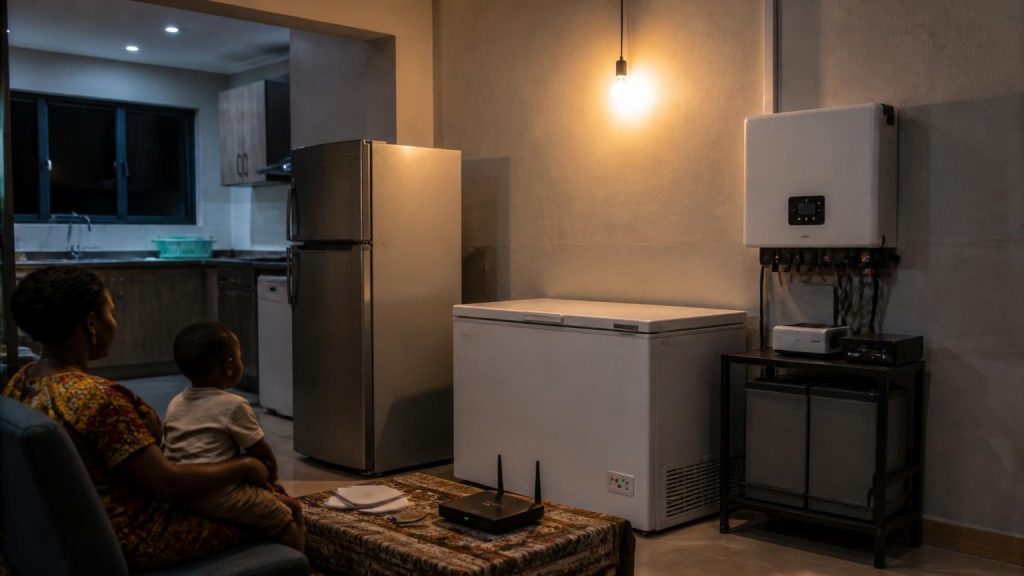
Many Nigerian homes do not want the inverter to power only the refrigerator and freezer. They also want lights, a Wi-Fi router, television, decoder, CCTV, a fan or phone chargers. Add the loads that may operate at the same time.
Here is an illustrative calculation, not a specification for every appliance:
| Load | Illustrative running power |
|---|---|
| Refrigerator | 120 W |
| Freezer | 180 W |
| Router and decoder | 25 W |
| Four LED lights | 40 W |
| Television | 80 W |
| Illustrative running total | 445 W |
The 445 W total is not enough to choose the inverter by itself. You still need to check the compressors’ start-up demand, the inverter’s continuous watt rating, the inverter’s peak rating, and whether the battery can deliver the required current. If the fridge and freezer start at nearly the same time, their combined surge may be much higher than 445 W.
Also remember that a freezer or refrigerator does not necessarily draw its rated running power continuously. The compressor cycles on and off. That reduces average energy use, but it does not remove the start-up requirement.
Step 3: Compare the result with the inverter’s real ratings
Check the inverter data sheet for these items:
- Continuous output: the power the inverter can deliver continuously.
- Peak or surge output: the power it can provide for the manufacturer’s stated time.
- Waveform: a pure sine wave output is the safer choice for compressor appliances and other sensitive equipment.
- Low-battery shutdown: the voltage at which the inverter stops to protect the battery.
- Battery voltage: the inverter must match the battery-bank voltage.
- DC input current limit: the battery cables, fuses and battery must support the current at the expected load.
As a practical screening rule, the inverter’s continuous rating should be comfortably above the combined running load, not exactly equal to it. Its surge rating must cover the compressor starting demand. Do not treat a 1kVA label as a guarantee that any fridge and freezer combination will start; kVA, watts, surge capability and the battery’s ability to hold voltage are separate checks.
Why the battery can still be the problem
An inverter may have enough AC output but still fail when a compressor starts because the battery voltage falls sharply. This is more likely when:
- The battery is nearly empty.
- A lead-acid battery is old, sulphated or undersized.
- The battery bank has a loose, undersized or damaged cable.
- The battery voltage is too low for the inverter’s demand.
- The battery management system on a lithium battery limits discharge current.
- The DC fuse, breaker or connection has a fault.
The approximate battery-side current is:
Battery current ≈ AC load ÷ (battery voltage × inverter efficiency)
For example, a 600 W AC load through an inverter operating at an assumed 90% efficiency would draw about 13.9 A from a 48 V battery bank, or about 27.8 A from a 24 V bank. The actual surge current can be much higher. This is one reason larger systems often use higher battery voltage, but the battery voltage must match the inverter and the whole system must be designed safely.
How much battery energy do you need?
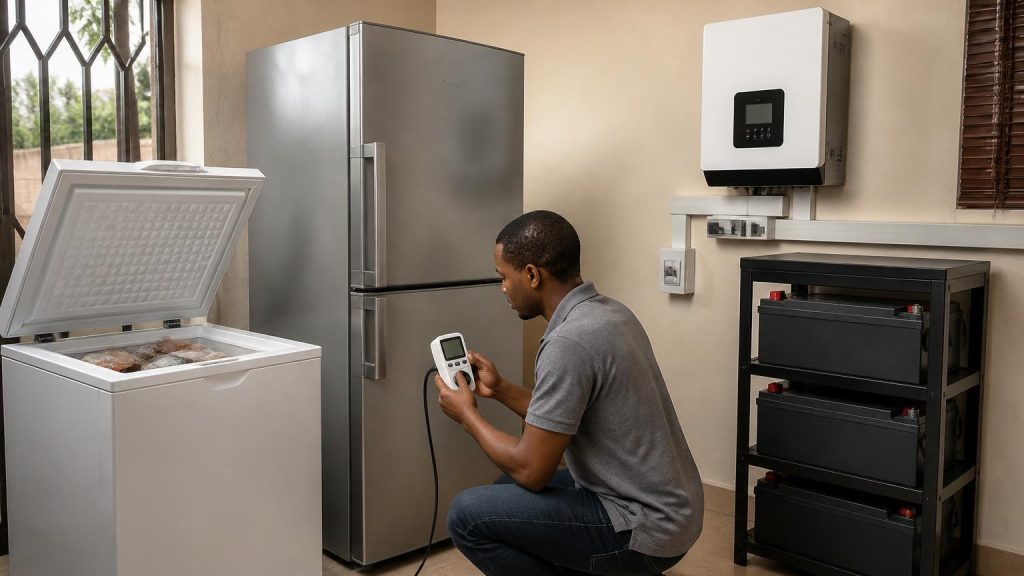
Do not size the battery from the refrigerator and freezer labels alone. Their compressors cycle, and the real energy used depends on room temperature, door opening, thermostat settings, ventilation, the condition of the door seals and how full the appliances are.
The best method is to measure the pair with a suitable energy meter for at least 24 hours while they are used normally. Then apply:
Battery energy needed from the inverter = appliance energy ÷ inverter efficiency
For example, suppose a 24-hour test shows that the refrigerator and freezer together use 1.2 kWh. At an assumed 90% inverter efficiency:
- 1.2 kWh ÷ 0.90 = about 1.33 kWh from the battery output.
- Add a practical reserve for conversion variation, battery ageing and other small loads. A planning figure around 1.6 kWh usable would be more realistic than treating 1.2 kWh as the exact battery requirement.
For a lithium battery, compare that requirement with the battery’s usable kWh, not only the advertised nominal capacity. For a tubular, GEL or AGM battery, use the battery voltage and Ah, then allow for the depth of discharge that the installer or manufacturer permits. A lead-acid battery bank may need substantially more nominal energy than the load’s usable requirement because repeatedly using the full nameplate capacity can shorten its life.
If you are comparing battery banks for a fridge or freezer, the guide on matching 48V battery banks to a fridge and TV explains why there is no fixed battery count for every home.
What if the inverter works with one appliance but not both?
That result is useful. It usually means the system has passed one load test but not the combined power, surge or battery test. Work through this sequence:
- Run the refrigerator alone and note whether it starts reliably.
- Run the freezer alone and note whether it starts reliably.
- Run both, with other non-essential loads switched off.
- Watch the inverter display for overload, low-battery or temperature alarms.
- Repeat the test when the battery is well charged and when it is partly discharged, without opening covers or touching live wiring.
- Check whether the failure occurs exactly when one compressor starts.
If each appliance works alone but the pair trips the inverter, the likely issue is combined surge or insufficient inverter headroom. If one appliance fails even when alone, check its plug, supply cable and manual, then have the appliance and inverter tested. If the inverter shuts down because the battery voltage collapses, a larger AC inverter alone may not solve the problem; the battery bank, cables, protection and connections may need attention.
How Nigerian conditions can change the result
A refrigerator or freezer in a hot kitchen, shop or outdoor enclosure may run for longer than one in a cool, well-ventilated room. Dust on condenser coils, poor ventilation behind the appliance, damaged door seals and frequent door opening can all increase energy use. During a long blackout, the battery may also be powering fans, lights, routers and televisions, leaving less energy for refrigeration.
In a Nigerian shop, the freezer may be opened repeatedly during business hours. In a home, a refrigerator may be the priority load while the freezer is switched on only during the day when solar power is available. That can be cheaper than buying a much larger battery for both appliances overnight.
If your real goal is to reduce generator use rather than run every appliance through every outage, compare the cost of adding battery capacity, adding solar panels or reducing the load first. The battery-versus-panels decision guide is useful for that upgrade question.
Safe installation checks
- Use a properly rated pure sine wave inverter for compressor appliances.
- Use the correct battery voltage, cable size, fuse or breaker and isolation equipment specified for the system.
- Do not connect a refrigerator or freezer to both inverter output and generator/grid supply at the same time. A correctly wired changeover or transfer arrangement is required.
- Do not bypass overload, low-battery or over-temperature protection.
- Keep the refrigerator and freezer dry, ventilated and away from direct heat where possible.
- Ask a qualified installer or electrician to make changes inside the distribution board, changeover system or high-current DC wiring.
Bottom line
You can run a refrigerator and freezer together on an inverter when the system is sized for their combined running load, compressor starting surge, other simultaneous appliances and required backup energy. The reliable answer comes from the appliance labels, the inverter data sheet and—ideally—a 24-hour energy measurement, not from the words “fridge and freezer” alone.
If the pair trips the inverter, test each appliance separately, reduce other loads and observe whether the battery voltage collapses at start-up. That evidence will tell you whether you need a larger inverter, a healthier battery bank, better cables and protection, or simply a different load schedule. For a broader hybrid plan that keeps essential appliances running while reducing generator use, see how to size a solar system to reduce generator use in Nigeria.
Technical references
This guide uses the general principle that compressor and motor loads can require short start-up surges above their running demand. For further technical reading, see Victron’s inverter sizing guidance and the ENERGY STAR refrigerator guidance. Appliance energy use varies by model and operating conditions, so use the manufacturer’s manual or measured data for a final system decision.