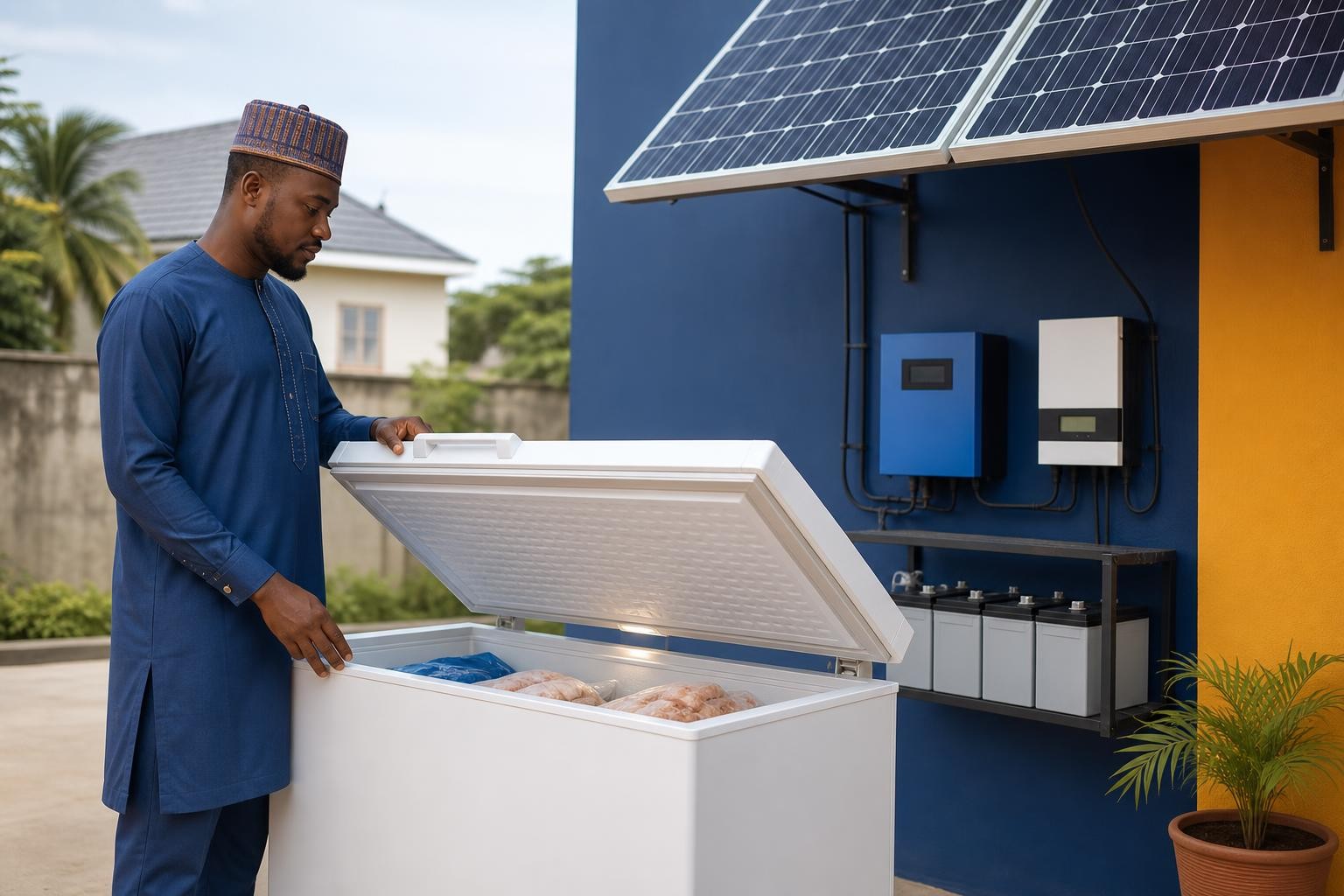
Last reviewed: September 26, 2026
If you want to run a deep freezer for six hours during a Nigerian power outage, do not choose the panel count from the words “deep freezer” alone. The reliable answer depends on the freezer’s measured energy use, whether the six hours are during the day or at night, the battery’s usable energy, the inverter’s starting capability and the solar inverter’s PV limits.
Short answer: measure or estimate the freezer’s energy use for six hours, allow for real system losses, divide by the solar energy available at your site, and round up to whole panels. Then check the battery, compressor-starting surge, panel voltage, current and inverter limits. A freezer that uses 600Wh in six hours might calculate to roughly 230W of PV for a night-time backup example, but that does not automatically mean one panel is a complete or reliable installation.
First decide what “six hours” means
This question normally describes one of two different designs:
- Six hours of backup: the freezer remains connected to the inverter for six clock hours while its compressor cycles on and off.
- Six hours of continuous compressor operation: the compressor runs almost continuously for six hours. This is a much larger energy requirement and should not be assumed without measurement.
Most homes and shops mean the first case. A freezer normally switches its compressor on and off. The wattage printed on the nameplate is therefore not necessarily the energy it uses every minute. The freezer may use more in a hot room, with frequent door opening or with a damaged door seal.
For buying decisions, an energy label or a plug-in energy meter is more useful than multiplying the nameplate wattage by six. ENERGY STAR’s freezer guidance also recommends using the appliance energy label to compare energy use and points out that size, ventilation, door seals and extreme temperatures affect freezer operation. That guidance is useful for the method, but overseas label values should not be treated as a guaranteed Nigerian result for your own freezer.
Why freezer wattage alone is not enough
Solar sizing has two separate parts:
- Power: can the inverter start and run the freezer, including the compressor’s brief starting demand?
- Energy: can the battery and solar array supply the electricity used over the six-hour period?
A freezer compressor is a motor load. Motors and compressors can draw substantially more power for a short time when starting than they use while running. Victron’s inverter guidance describes this as start-up surge and advises checking both the inverter’s peak capability and whether the battery can deliver the required DC current.
This is why one 450W panel cannot “fix” an inverter that trips whenever the freezer starts. Panel capacity mainly affects how much energy can be harvested and how quickly the battery can be recharged. It does not replace the need for a suitable inverter, battery, wiring and protection.
Find the freezer’s real energy use
Use the strongest evidence available, in this order:
- Check the freezer’s model number, energy label and manufacturer documentation.
- Measure the freezer with a suitable plug-in energy meter for at least 24 hours. More than one normal day is better.
- Use inverter or power-station monitoring if it can isolate the freezer’s AC energy use.
- If you have no measurement, use the nameplate wattage only as a cautious temporary estimate and label the result as uncertain.
Measure the freezer in the conditions in which it will actually operate. A freezer in a hot Nigerian shop, under a hot roof, with customers opening the lid often, may use more energy than the same model in a cool test environment. Leave ventilation space around the unit, keep the door seal in good condition and avoid assuming that a low reading on one unusually cool day represents every outage.
The panel-sizing formula
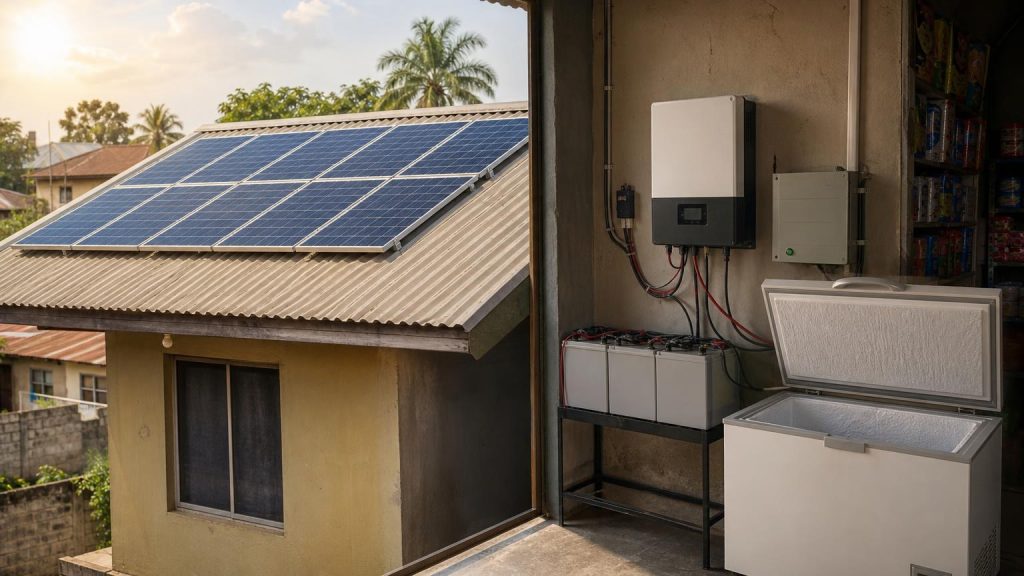
Once you know the freezer’s energy use for six hours, use this planning model:
Required solar capacity = freezer energy for six hours ÷ (effective sun hours × PV delivery factor × storage-delivery factor)
Use the storage-delivery factor only when the energy must pass through the battery. If the freezer is running in the daytime directly from the solar system, the battery path may be smaller. For a night-time outage, the battery and inverter losses matter.
For an illustration, assume:
- The freezer uses 600Wh in six hours.
- The design uses 4.5 effective sun hours as an example only. This is not a promise for every Nigerian location, month or weather condition.
- The PV delivery factor is 0.80 after practical effects such as heat, dust, wiring, orientation and other system losses.
- The storage-delivery factor is 0.72, representing an illustrative 90% inverter efficiency multiplied by an 80% usable battery fraction.
For a night-time six-hour backup:
600Wh ÷ (4.5 × 0.80 × 0.72) = about 232W of solar capacity
That is an energy calculation under stated assumptions, not a final shopping list. The actual design may need more capacity if the panels must also run daytime appliances, restore the battery quickly, compensate for poor weather or support other loads.
Worked examples using 450W panels
| Measured freezer energy in six hours | Night-backup PV under the example assumptions | 450W panels by energy arithmetic |
|---|---|---|
| 300Wh | About 116W | 1 panel |
| 600Wh | About 232W | 1 panel |
| 1,000Wh | About 386W | 1 panel, with little margin |
| 1,500Wh | About 579W | 2 panels |
| 2,000Wh | About 772W | 2 panels |
The table shows the method, not universal freezer sizes. If your calculated result is 740W and you are considering 550W panels, the arithmetic is 740 ÷ 550 = 1.35, so the energy calculation rounds up to two panels. The final series or parallel arrangement still has to match the inverter’s MPPT voltage and current limits.
Also, “one panel” can be misleading. A 450W panel may produce much less than 450W at a given moment because panel ratings are measured under standard test conditions. Heat, dust, shade, clouds, rain, orientation and system losses affect real energy yield. The U.S. Department of Energy describes these as important PV performance factors, which is why a design should use realistic site assumptions rather than the nameplate wattage alone.
If you only know the freezer’s running wattage
Suppose the nameplate says 200W. A deliberately cautious first check is:
200W × 6 hours = 1,200Wh
Using the same night-backup assumptions:
1,200Wh ÷ (4.5 × 0.80 × 0.72) = about 463W of solar capacity
That points to at least one 450W or 550W panel by arithmetic, but it does not prove that one panel will reliably recharge the battery. The freezer may not run continuously at 200W, or it may use more energy in a hot shop. Measurement is the better next step.
The battery must also be sized for six hours
If the outage happens after sunset, the panels cannot provide all of the energy at the moment the freezer needs it. The battery must carry the load, and the solar array must replace that energy later.
A rough battery-energy check is:
Nominal battery energy = freezer AC energy ÷ (inverter efficiency × usable battery fraction)
For 600Wh, using the illustrative 90% inverter efficiency and 80% usable fraction:
600Wh ÷ (0.90 × 0.80) = about 833Wh of nominal battery energy
This is before adding other appliances, battery age, temperature effects and the inverter’s own consumption. Lithium batteries should normally be compared primarily in kWh when that is the verified specification. Tubular, GEL and AGM batteries are normally specified in Ah together with voltage. Do not compare lithium and lead-acid batteries by Ah alone.
If the battery is too small, adding panels will not create six hours of night-time backup. If the panels are too small, a suitable battery may not recover fully before the next outage.
Check the inverter before buying panels
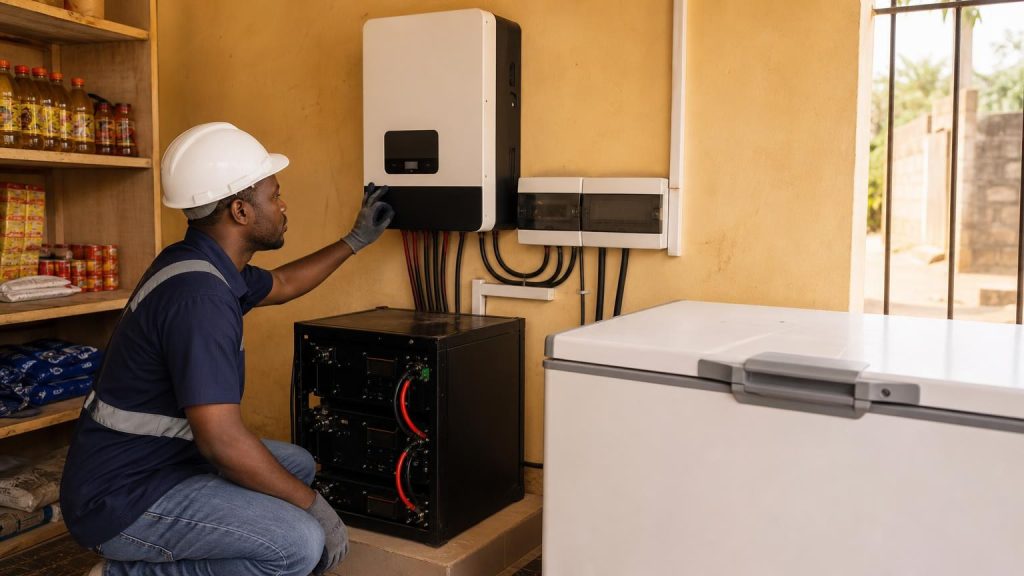
Read the inverter manual or datasheet and confirm:
- maximum PV power
- maximum PV open-circuit voltage
- MPPT operating-voltage range
- maximum PV input current
- limits for each MPPT if the inverter has more than one tracker
- continuous output, peak output and battery discharge capability
One panel may be below the inverter’s minimum MPPT voltage. Two panels in series may meet the voltage requirement, but the resulting open-circuit voltage must remain below the inverter limit. Parallel strings can increase current beyond the allowed input. These checks require the actual panel and inverter datasheets; do not guess from “450W” or “5kVA” alone.
If the freezer is connected to a house circuit, the installer should check the changeover arrangement, breakers, fuses, surge protection, earthing, cable sizes and back-feed risk. Never feed an inverter into a wall socket or bypass protection devices.
What can increase the panel count in Nigeria?
- Harmattan dust and dirt: soiling reduces the sunlight reaching the cells, especially where the array is not inspected and cleaned safely.
- Cloud and rain: the panel will not deliver its nameplate output continuously through changing weather.
- Heat: a hot freezer room can increase the appliance’s work, while hot panels can produce less than their laboratory rating.
- Frequent door opening or poor seals: the compressor may run more often.
- Shading: a nearby wall, tree, tank or roof structure can reduce array output.
- Other loads: lights, fans, POS equipment, routers or another freezer may share the battery and inverter.
These conditions do not justify adding an arbitrary number of panels. They justify measuring the freezer, using transparent assumptions and leaving a sensible design margin.
A practical buying process for a Nigerian home or shop
- Write down the freezer model, voltage, nameplate information and normal operating location.
- Measure energy use for at least one normal day if possible.
- Decide whether the six hours are daytime, night-time or a mixture.
- List every other appliance that may run at the same time.
- Size the inverter for running load and compressor starting surge.
- Size the battery using usable energy and the correct chemistry and voltage.
- Size the solar array to run daytime loads and restore the battery.
- Check PV voltage, current and power limits before finalising the panel count.
- Ask for a written calculation and a clear list of panels, mounting, cables, breakers, surge protection, changeover, labour and commissioning.
Useful SolarPriceNG next steps
Once you know the freezer’s measured energy, continue with the tool and guides that match your decision:
- Use the Solar Panel Calculator with the freezer’s measured energy and your chosen panel wattage.
- Read How Many Solar Panels Do I Need for My House in Nigeria? if the freezer will share the system with household loads.
- Use What Battery Size Matches a 1kVA Inverter for a Nigerian Home? when you are choosing a small inverter and battery system.
- Read How to Test Whether Your Solar Panels Are Underperforming in Nigeria if the installed array produces less energy than expected.
- Use How Many Cloudy or Rainy Days Can My Solar Battery Survive in Nigeria? when the six-hour target must survive poor-weather periods.
Final answer
There is no universal panel count for running every deep freezer for six hours. If your freezer uses 600Wh during the target period, a night-backup calculation using the example assumptions in this article gives about 232W of PV capacity. That may round to one 300W, 450W or 550W panel by energy arithmetic, but the right installation could require more panels once the inverter’s MPPT voltage, battery recovery time, other loads, weather and site conditions are checked.
Do not pay for a panel count based only on the words “deep freezer” and “six hours”. Ask the installer to show the freezer-energy calculation, the battery calculation and the inverter datasheet check together.
Technical references
The approach in this guide separates appliance energy from compressor starting power. For freezer energy-label and operating guidance, see ENERGY STAR’s freezer guidance. For compressor start-up surge and inverter/battery capability, see Victron Energy’s inverter selection guidance. For PV yield factors such as heat, dirt and shade, see the U.S. Department of Energy’s PV design and energy-yield overview.