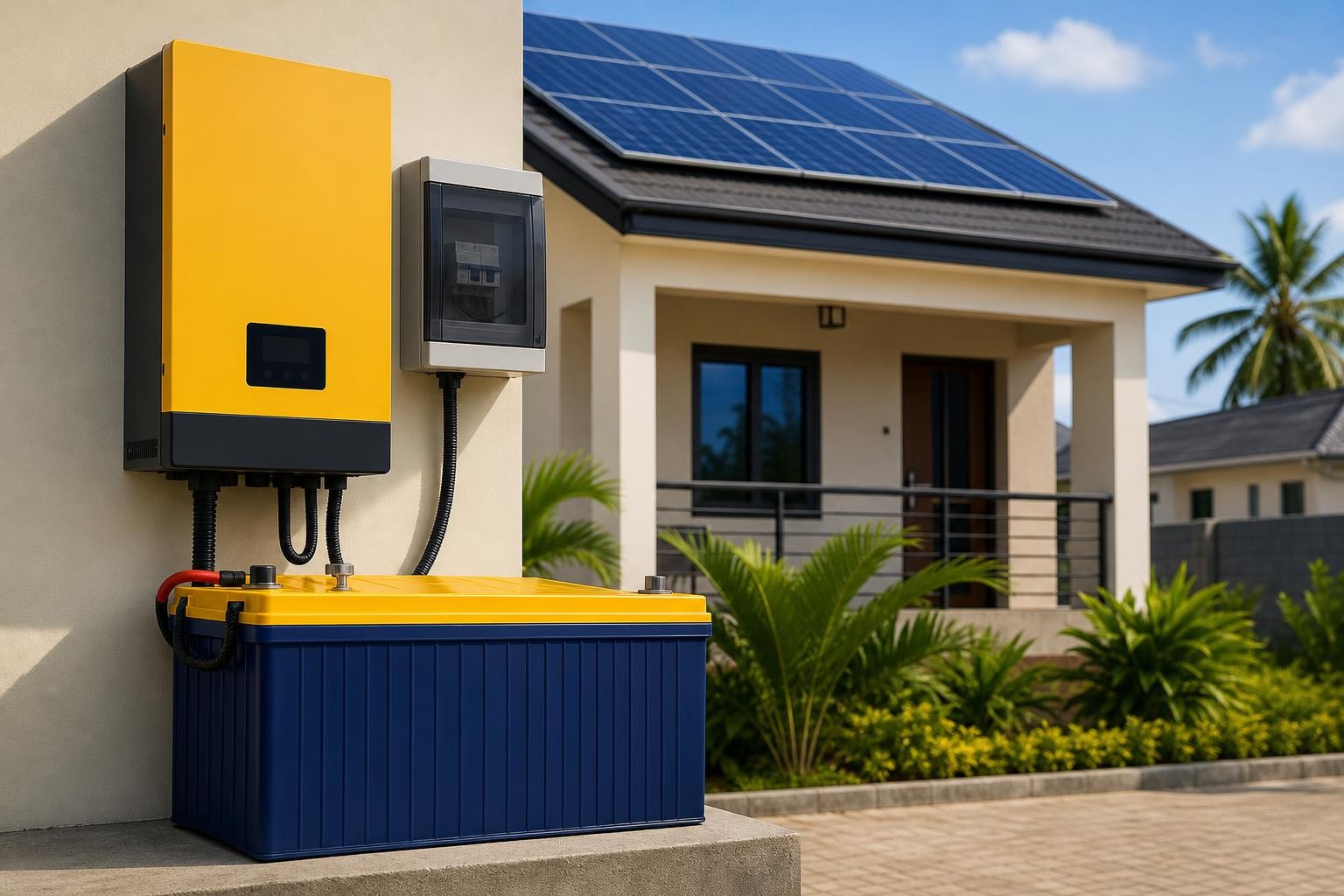
Last reviewed: September 25, 2026
There is no single battery size that matches every 1kVA inverter. A 1kVA label tells you roughly how much electrical power the inverter can deliver at one time; it does not tell you how many hours the battery will last. The correct battery depends on the appliances you want to run, their running and starting demand, the backup time you need, the inverter’s DC voltage, the battery chemistry and the manufacturer’s limits.
Short answer: for a small Nigerian backup system, a 1kVA inverter may use a 12V or 24V battery bank, but the required Ah or kWh must be calculated from the actual load and runtime. A light load such as lights, a router, television and one fan may need far less storage than a 700W load running for several hours. Do not buy “one 200Ah battery” just because the inverter is 1kVA.
This guide shows how to calculate the battery size, gives realistic examples, explains the difference between lead-acid and lithium batteries, and lists the checks to make before approving a quotation.
What does 1kVA mean?
Inverter capacity is normally shown in VA or kVA, while appliance consumption is usually discussed in watts. They are related, but they are not identical. The inverter’s datasheet should state its continuous watt rating, surge or peak rating, battery voltage and acceptable battery current.
For example, a 1kVA inverter may have a continuous real-power rating below 1,000W depending on its power factor specification. A refrigerator, freezer, pump or other motor can also need a short starting surge that is much higher than its normal running wattage. A battery with enough stored energy can still fail to run the appliance if the inverter or battery cannot supply the required starting current.
Think of the system as two separate questions:
- Power: can the inverter and battery deliver the appliances at the same time, including startup?
- Energy: can the battery store enough usable energy for the number of hours required?
The U.S. Department of Energy describes the same distinction for storage systems: power capacity is how much can be delivered at one time, while energy capacity is how much can be stored. The principle is useful for a small Nigerian home system too.
Step 1: List the actual backup appliances
Start with the appliances you genuinely want during an outage. A 1kVA inverter is usually better treated as a critical-load system than as a whole-house supply. A possible list could include:
| Appliance | Illustrative running power | Hours required | Estimated energy |
|---|---|---|---|
| LED lights | 40W total | 6 hours | 0.24kWh |
| Wi-Fi router | 12W | 8 hours | 0.096kWh |
| Television and decoder | 100W | 5 hours | 0.50kWh |
| One fan | 60W | 6 hours | 0.36kWh |
| Phone and laptop charging | 60W average | 3 hours | 0.18kWh |
The figures above are planning examples, not guaranteed appliance ratings. Check the label or use a plug-in meter where possible. A fan may draw less or more than the example, and a refrigerator’s compressor cycles rather than consuming its nameplate wattage continuously.
For each appliance, calculate:
Energy in kWh = watts × hours ÷ 1,000
Then add the appliance energy together. In the illustration above, the total is about 1.38kWh of AC energy. The battery must supply more than this because the inverter consumes some energy and no battery should normally be discharged to zero.
Step 2: Add inverter losses and the usable-energy limit
A useful planning formula is:
Required nominal battery energy ≈ AC load energy ÷ inverter efficiency ÷ usable battery fraction
For an illustration, assume:
- AC appliance energy: 1.38kWh
- Inverter efficiency: 90%
- Usable battery fraction: 50% for a regularly cycled lead-acid example
The calculation is:
1.38 ÷ 0.90 ÷ 0.50 = about 3.07kWh of nominal battery energy
That does not mean every 1kVA system needs exactly 3.07kWh. It is a worked example showing why a battery advertised by Ah alone is not enough information. The result changes with actual load, inverter efficiency, battery chemistry, discharge limit, age, temperature, cable losses and the time the inverter itself remains switched on.
Step 3: Convert the result into Ah or kWh correctly
For a lead-acid, tubular, GEL or AGM bank, capacity is normally expressed in Ah together with voltage:
Nominal battery energy in Wh = battery voltage × capacity in Ah
Examples:
- A 12V 100Ah battery has about 1.2kWh nominal energy.
- A 12V 200Ah battery has about 2.4kWh nominal energy.
- A 24V 200Ah bank has about 4.8kWh nominal energy.
Those are nominal figures, not the energy you should promise to your appliances. A lead-acid battery bank that is regularly used down to about half its nominal capacity would provide roughly half before inverter losses, subject to the exact battery and operating conditions. Deep or high-current discharge can also reduce practical performance and battery life.
For lithium batteries, use the verified kWh capacity and usable-energy specification as the primary comparison. If a lithium battery is described in Ah, you still need its nominal voltage before converting it to energy. Do not compare a lithium battery and a lead-acid battery using Ah alone.
What battery voltage should a 1kVA inverter use?
The inverter determines the required DC voltage. Some 1kVA models are designed for 12V battery input; others use 24V. A 12V battery bank connected to a 24V inverter is not a safe substitute, and a series or parallel arrangement must follow the inverter and battery manufacturer’s instructions.
Higher battery voltage reduces the current needed for the same AC power. Using a simplified 90% efficiency assumption:
- At a 500W AC load, a 12V system draws roughly 46A from the battery.
- At the same 500W AC load, a 24V system draws roughly 23A.
- At a 1,000W AC load, those approximate currents double to about 93A and 46A.
These currents explain why battery cables, fuses, breakers, lugs, terminals and voltage drop matter. They are not optional details. The inverter manual must be followed for minimum battery capacity, cable size, protection and maximum current. A manufacturer installation guide may also restrict the inverter’s use with a small battery even when the Ah calculation appears large enough.
Worked battery examples for common Nigerian backup loads

The following examples use simplified assumptions to show the method. They are not a substitute for the exact inverter and battery datasheets.
Example A: light critical load
Suppose you run 150W of lights, router, television and charging for six hours:
150W × 6 hours ÷ 1,000 = 0.9kWh AC energy
With a 90% inverter-efficiency assumption, the battery must supply about 1.0kWh before allowing for the usable-energy limit. A 24V 100Ah lead-acid bank has 2.4kWh nominal energy; at a 50% planning limit and after inverter losses, the usable AC energy may be around 1.08kWh in this simplified example. Actual performance may be lower or higher depending on the battery, discharge rate and condition.
Example B: moderate evening load
Suppose the load averages 300W for six hours:
300W × 6 hours ÷ 1,000 = 1.8kWh AC energy
At 90% inverter efficiency, that is about 2.0kWh from the battery before considering the usable-energy limit. A 24V 200Ah lead-acid bank has 4.8kWh nominal energy. Using a 50% planning limit and allowing for conversion losses gives roughly 2.16kWh of AC energy in a simplified calculation. This may be a reasonable starting point for the stated load, but only if the inverter is designed for the battery bank and the appliances stay within its power and surge limits.
Example C: high load close to the inverter limit
Suppose the appliances draw 700W for four hours:
700W × 4 hours ÷ 1,000 = 2.8kWh AC energy
At 90% efficiency, the battery must provide about 3.11kWh before the usable-energy allowance. This is no longer a small light-load application. The inverter may be close to its continuous rating, the battery current will be high, and a refrigerator or pump could add a starting surge. A quote that simply says “1kVA inverter with one 200Ah battery” is not enough to prove that this setup will work for four hours.
Lead-acid versus lithium for a 1kVA system
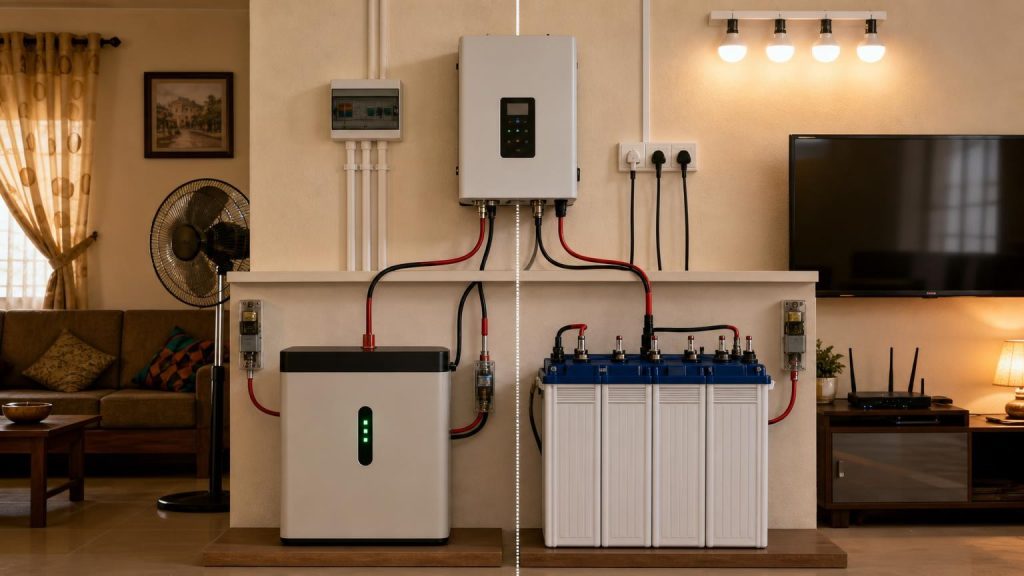
The chemistry changes how much of the advertised capacity is practical to use and how the battery should be installed.
| Battery type | How to state capacity | What to check |
|---|---|---|
| Tubular, GEL or AGM | Ah plus voltage | Recommended discharge limit, charging voltage, temperature, discharge rate, bank configuration and maintenance |
| Lithium | Verified kWh, preferably usable kWh | Battery management system, continuous and peak current, communication requirements, minimum state of charge and inverter compatibility |
Lithium is not automatically the right answer for every installation, and a large lithium label does not remove the need for correct protection and wiring. Lead-acid batteries may need more nominal capacity to deliver the same regularly usable energy. The choice should be based on the required backup, budget, expected cycling, installation conditions and the exact inverter-battery pairing.
Common mistakes when choosing a 1kVA inverter battery
- Choosing from the inverter label alone: 1kVA does not reveal your required runtime.
- Comparing Ah without voltage: 12V 200Ah and 24V 200Ah do not contain the same nominal energy.
- Ignoring the inverter’s own consumption: the system uses some energy even when the appliance load is small.
- Using nameplate watts as continuous consumption: refrigerators and pumps cycle, while starting current can be high.
- Assuming 100% of battery capacity is usable: chemistry, settings, age and discharge rate matter.
- Adding batteries without checking charging: a larger bank may take longer to recharge if solar or charger capacity is unchanged.
- Mixing old and new batteries casually: parallel or series banks need compatible batteries and correctly designed protection.
- Using undersized cables or missing DC protection: high battery current can cause dangerous heating and voltage drop.
What to ask for in a quotation
Before paying for a 1kVA system, ask the installer to write down:
- The inverter’s exact model, continuous watt rating, surge rating and DC voltage.
- The battery chemistry, brand and model, quantity, voltage, Ah or kWh capacity and recommended usable limit.
- The appliances included in the backup load and the assumed hours for each one.
- The calculated running watts and the highest expected starting surge.
- The estimated usable battery energy and expected runtime.
- The charging source, solar-panel capacity and how long recovery should take.
- The DC cable size, fuse or breaker rating, isolator, earthing and other protection included.
- What happens when the battery is low and whether generator or grid charging is supported by the equipment.
If the quotation only gives a battery count, ask the installer to express the same proposal in usable energy and runtime. SolarPriceNG’s Battery Calculator can help you make an initial estimate, while the guide How Many Batteries Do I Need for a Solar System in Nigeria? explains why the answer is not simply “two” or “four” batteries.
How to decide whether 1kVA is enough
Battery sizing cannot rescue an inverter that is too small for the simultaneous load. First add the running watts of the appliances you want to use together. Then identify motors, compressors and heating appliances that may need surge power. If the result is close to the inverter’s limit, reduce the simultaneous load, stagger the appliances or consider a different inverter size.
For a plain explanation of the appliance combinations a small inverter can handle, see What Can a 1kVA Inverter Power in Nigeria? If you are still choosing the inverter itself, compare your load with What Size 1kVA Inverter Do I Need for a Nigerian Home?
Safety checks before installation
A 1kVA system still involves high-current DC wiring. Do not connect a battery bank to an inverter using improvised cables, bypass a fuse or breaker, place batteries where the manufacturer prohibits them, or feed a generator into a wall socket. Battery voltage, cable cross-section, lugs, isolation and overcurrent protection must match the equipment and installation rules.
Have a qualified installer or electrician check the final battery arrangement, polarity, protection, earthing, ventilation and changeover connections. Follow the exact inverter and battery manuals. The equipment manufacturer, not a generic online table, is the final authority for compatible voltage, charging settings and maximum current.
Bottom line
A 1kVA inverter does not automatically require a particular battery size. Calculate the appliances and hours first, convert the AC energy into battery energy after inverter losses, then account for the usable limit of the chosen chemistry. For lead-acid batteries, use Ah together with voltage. For lithium, compare verified kWh and usable capacity.
As an illustration, a light 150W load for six hours may fit a much smaller bank than a 700W load for four hours. A 24V 200Ah lead-acid bank has about 4.8kWh nominal energy, but the usable AC energy is lower after the discharge limit and inverter losses. Whether it is enough depends on the actual load, battery condition, inverter model and required runtime.
The safest quotation is one that shows the calculation, exact equipment, usable energy, runtime assumption, surge check and protection—not one that only says “1kVA inverter plus one battery.”
Technical references
- U.S. Department of Energy: Solar Integration and Solar Energy Storage Basics — explains power capacity, energy capacity, storage losses and why solar output varies.
- Victron Energy Phoenix inverter manual — demonstrates calculating battery capacity from load energy, inverter losses and battery voltage.
- Victron Energy: Inverter Smart installation guidance — shows why battery capacity, cable size and external DC protection must be checked together.